• Radio
  • Interviews
    • Music Reviews
    • Live Reviews
  • Features
  • About Us/Contact
  • Search
Menu

Lonesome Highway

Street Address
City, State, Zip
Phone Number
Hardcore Country, Folk, Bluegrass, Roots & Americana

Your Custom Text Here

Lonesome Highway

  • Radio
  • Interviews
  • Reviews
    • Music Reviews
    • Live Reviews
  • Features
  • About Us/Contact
  • Search

Jim Murphy Interview

June 7, 2022 Stephen Averill

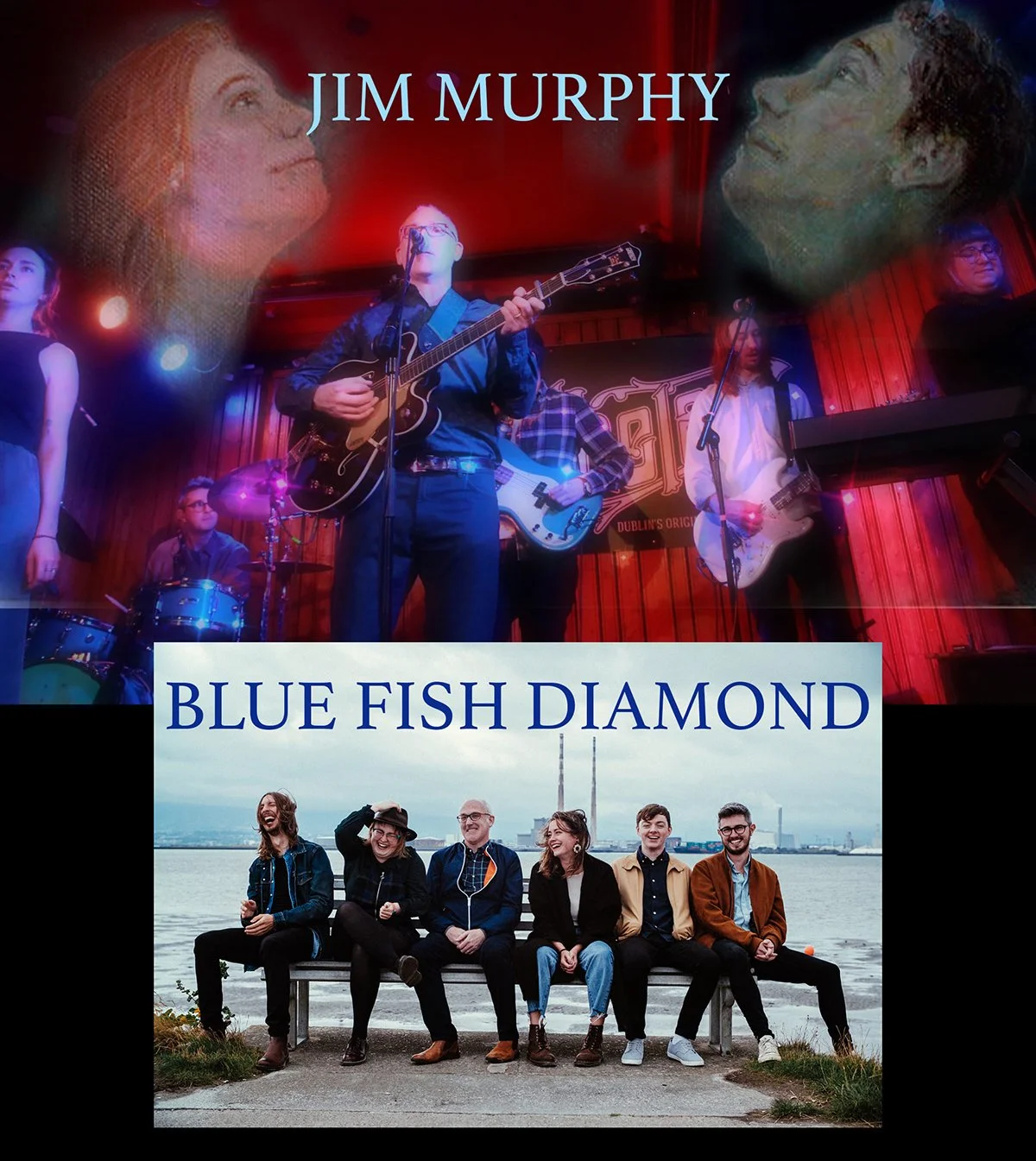
Band photograph by Jason Ennis

Jim Murphy is the creative centre behind the very talented Irish Roots/Rock band, Blue Fish Diamond. He decided to concentrate on a full-time career in music back in 2014 and his band have gone from strength to strength ever since. Jim describes the music as Inde/Folk but there are many other colours to discover in the songs and their excellent musicianship. Lonesome Highway wanted to get Jim’s thoughts following the release of their second album, written and recorded during Covid Lockdown.

When did you first start playing music?

I played traditional Irish music when I was young (the accordion and the tin whistle) but I gave it up in my ‘teens. When my eldest son was born, I found that I had more time on my hands as I wasn’t going out much anymore (!) so I bought a guitar and fell in love with it. That was 20 years ago.

Did you always want to make a career in music and who were your earliest influences growing up?

They say that there’s a link between maths and music. In my case, maths came first. When I left school, I studied to become an actuary and worked in the insurance sector for 25 years. In 2014, I made the decision to pursue music full time. I had been thinking about it for a few years but kept finding reasons not to do it but in the end I decided to take the plunge and I haven’t looked back since! I think that some of my musical influences can be heard in the music of Blue Fish Diamond – The Beatles, Tom Petty, R.E.M. and Paul Simon.

Can I ask about the band formation back in 2016?

When I finished work in 2014, I went to BIMM in Dublin where I did a four year degree in Commercial Modern Music. It was there that I met all of the band members – Shay, Laura, Axel, Matilda and Ronan. We played our first gig upstairs in Whelans in October 2016 and I still remember it vividly!

Your debut album, From Dark To Light, arrived in 2018. How long had the project taken before the launch date?

I started writing the material for the album in 2015 and in 2017, we went into Orphan Studios in Inchicore to record it (the studio has since moved to Wexford). The album was mixed and mastered by autumn 2017 and we released the first single from it in early 2018.

How did you find the media reaction to the album release?

We released a couple of singles before the album and then a third single at the same time as the album release. We got some great radio play for the singles including on RTE Radio 1 and some lovely write-ups about the album, notably one from yourself which we were very proud of. Hot Press also reviewed the album and described it as “essential listening for those who like their music powerful and heartfelt”.

The new album is now available, FROZEN STARS ON THE NIGHT, – how did you arrive at this interesting title?

The title is taken from the lyrics of the last track on the album Secret Bill. The song is about an ethereal spirit that’s woven through the fabric of life and the verse in question is:

“Snowflakes fall from a ledge / Hear his breath, its hollow edge / Frozen stars on the night / Secret Bill again”

The songs seem to focus on relationships and the quiet beauty contained in nature. Was there a specific pattern running through the songs as you were writing them?

The theme running through the album is one of human emotions. Each of songs deals with one or more emotions – love, anger, despair, hope … they reflect personal experiences and experiences of friends and family.

How did you find the last two years and all the frustration of Covid lockdown?

It was tough not being able to gig but we recognised a couple of months into the pandemic that it would be some time before we would be able to perform live again, so we turned our attention to writing new songs. During the periods when restrictions were eased, we’d race into the studio and record some tracks! Having the time to work on new material and refine our sound was definitely a silver lining and we would not have been ready to release our second album last year without the space that the pandemic provided. In fact, we’ve made significant inroads into album number three.

What is your approach to song-writing – is it sudden inspiration or melody first and words follow?

Some of the songs I’ve written have come quite quickly in a spell of inspiration. I learnt last year about a state of being called the “flow state”, where you suddenly find yourself immersed in a creative zone and come up with ideas that afterwards you look back on and think “where did that come from?”! I’ve also learnt that you can be waiting a long time for the “flow state” to arrive and so I also follow a structured approach to song-writing. I’m constantly making notes/recordings on my phone of lyrical/melodic ideas and I make time every so often to sit down and go through the various ideas and craft them into a song – a combination of creativity and process.

You are self-managed and I wanted to ask about the administration and management side of things. Do you enjoy being involved in the process of putting gigs together and making sure that everything runs to schedule?

To be honest, I don’t really enjoy the process of putting gigs together and the various other administration tasks but they need to be done! We played at a festival in the Iontas theatre in Castleblayney recently and it was a joy to just have to turn up on the day with all of our equipment, do our sound check and then play the gig that night.

Is it difficult to get your music noticed on the busy traffic of social media these days?

Definitely! There’s a lot of new music being released every week as, like us, many musicians were busy writing songs during the two heavy years of the pandemic. In addition to trying to get noticed above the crowd, it’s hard to get good organic reach on social media platforms since the various platforms moved to a “pay and play” model a number of years ago and so to get any decent reach you really have to pay for sponsored posts.

How does the band dynamic work in the recording studio?

We worked with the same producer, Gavin Glass, for the two albums we’ve released to date and he is also producing our third album. He’s great to work with, both in terms of the creative elements he adds to the mix and also the way that he gets the best out of all of us. Our approach to date has been to record the rhythm section together live with guide vocals and then to add various overdubs afterwards such as lead guitar parts, piano licks, redo vocals and so on.

What are your mid-term plans for the band?

We are currently in the process of organising an Irish tour to promote our latest album, which will take place in the autumn. We are also putting together some videos of recent live performances and have plans to make some concept videos for a couple of our songs. As I mentioned earlier, we have made good headway on album number 3 and our plan is to get into the studio at the end of the summer to finish it off with a view to releasing a few single next year and the album itself in late 2023. Watch this space!

Interview by Paul McGee

Richard Olson Interview

May 25, 2022 Stephen Averill

The general consensus among the team at Lonesome Highway is that London-based five-piece band The Hanging Stars is one of the most impressive and intoxicating bands to come out of the UK in recent years. With a distinctive sound that marries cosmic and psychedelic folk, West Coast 60s country rock, and classic 60s Brit-pop, they have steadily established themselves as one of the most exciting acts both in the studio and on stage. That progression has yielded four studio albums while they continue to hone their live act with numerous festival appearances both in the U.K. and Europe. Their two sold out shows at the recent Kilkenny Roots Festival were hailed as highlights of the festival weekend by many who were wowed by their vocal harmonies, masterly musicianship, and overall panache. That’s not to mention the quality of the material performed, mostly taken from their recently released recording, HOLLOW HEART, their debut album on the Loose Music label. We spoke with the band’s frontman Richard Olson about their steady onward movement and the recording of that latest album.

Tell us about the formation of The Hanging Stars?

The Hanging Stars were born from a band called The See See. In my humble opinion a brilliantly ramshackle but completely out of time and fashion jangle rock band who sadly regularly ended up in some pretty dysfunctional situations. When I found myself being the only original member of the group left, tired and weary after some general bad luck and too much indulgence, I felt it was time for a new start. Paulie Cobra and Sam Ferman had been members of The See See for a few years and felt the same as I did. It was time to turn the volume down and start looking forwards and inwards. At the time we were hanging out a lot with some good friends from LA who were regularly in London and Europe, playing in the Brian Jonestown Massacre. Especially, our good friend the Los Angeles musician and producer Rob Campanella, who was always incredibly supportive and encouraging. He really meant a lot to the formation of The Hanging Stars. However, we needed a clear break between the two bands, especially after one gig at the Shacklewell Arms in East London, where we ended up playing one show as The See See and another show as The Hanging Stars because the headliner cancelled at the last minute. Strange times. Over the years Rob Campanella had offered to let us use his studio in Lake Hollywood many a time and one day after an ok PRS pay-out we decided to take him up on it. So, the main part of the first record and the first show we ever did was in Los Angeles. This, of course, coincided with a long-lived passion for folky, psychedelic, harmonious West Coast sounds, so it all fit like an air-conditioned desert dream for us. Me, Paulie and Sam really found the seed for what The Hanging Stars could achieve around then. Pardon the rambling.

There are lots of late 60s and early 70s in your sound, both British and American. Were there particular bands or albums that steered you down that road?

I could go on here about all the obvious names that we all know and love but I’ve always felt that The Hanging Stars are always more influenced by particular songs and vibes as opposed to albums, bands and styles.  The playlists that we share and listen to are pretty diverse. Cliche perhaps, but I’ve always felt that we’re looking for a feeling and a vibe more than a particular sound. But if you want names, I could go on forever. Fairport Convention is always a big one for me. I’ve always felt like they’re chasing the same notion as say, The Byrds around Notorious Byrd Brothers, Beau Brummels around Bradley’s Barn or Love’s Forever Changes. But honestly, I find the same feeling listening to Don Carlos Balearic classic Alone - Paradise as I do listening to If I Could Only Remember My Name by David Crosby, The Velvet Underground’s 3rd or Roy Orbison.  Fragility, warmth and wistfulness. Oh, and Iain Matthews and the Woods Brothers forever, of course.

You’ve been making steady progress in the recent past and honing your sound with four albums in six years. That’s a fairly prolific output: is it your intention to attempt to release an album every two years?

Not really no, however, we’re pretty driven, I write constantly and we’re a working band so it just happened like that. Then the obvious happened. But yeah, it’d be nice to keep that up but the days are getting shorter and shorter somehow!

Did the pandemic and the resulting lockdowns have a radical effect on both the writing and recording of your recent release HOLLOW HEART?

In hindsight, absolutely none whatsoever, except for the odd lyric dealing with isolation and hopeful deliverance then. We would’ve made this album in whatever times I think. I mean, of course, we were caught in it just like everybody else but it didn’t mean anything when it all came to pass. The Hanging Stars would’ve made Hollow Heart regardless, I think. 

How did you end up in Edwyn Collins’ Clashnarrow Studio in Scotland for the recording?

Patrick Ralla, our guitar and keys player, is a phenomenal musician who goes way back with Edwyn ever since Edwyn gave his blessing to young Patrick’s family beat combo The Kinbeats. Pat regularly plays in Edwyn’s band and one day Edwyn said that The Hanging Stars were welcome in Scotland anytime. I felt pretty blessed then too. I mean, like, it’s Edwyn Collins. And of course, his incredible wife Grace Maxwell also helped a bunch to make it happen. I feel incredibly grateful to that pair for letting us in. And producer Sean Read, I can’t talk about Hollow Heart without mentioning that man. So, we set off in two cars for the 13-hour journey only to find ourselves in even more isolation. But with a rising sun over the bay in our eyes every morning and a heather covered mountain to go stargazing at after our, shall we say, myopically enhanced dinner.

Edwyn contributes backing vocals on the album. Did the recordings get the seal of approval from him? 

If tweeting “The Hanging Stars album is the dog’s bollocks, FACT” counts then yeah. I think he liked it.

How did the recording process differ from working in Echozoo Studio in Eastbourne on your last album A NEW KIND OF SKY?

Two very different processes. ANKOS was made as a tight touring live band who’d honed the songs on the road so to speak, while Hollow Heart was much more theoretical and natural. Echozoo down in Eastbourne is an incredible place and Dave Lynch is an incredible guy, he’s a very busy man and the studio is like a finely built Swiss watch. Everything works and he knows every single nut and bolt. Clashnarrow is more like an unexplored world, like an audiophiles Jules Verne book. And of course, being in a North East Scottish town with a population of 203 took the tempo down quite a bit. All for the better.

As with A NEW KIND OF SKY, the songwriting duties are shared on HOLLOW HEART. How do you manage this with four contributors and have you a particular template for developing the songs?

We decided a while back that if we wanted to last, we needed to make sure everyone got their dues. Everyone has an input on the songwriting, even if I may be the one bringing most of the tunes to the table. I’m not precious about songs as I believe that they are not necessarily mine once I feel I’ve done what I can with them. It’d be foolish not to let the input of these four incredible musicians in on the writing and arrangements of my songs. I mean, why would I play with Sam Ferman, Joe Harvey - Whyte, Paulie Cobra and Patrick Ralla if I didn’t let their outstanding ideas and musicianship influence the songs? 

You’ve only recently had the opportunity to tour the new album. Your sell-out shows at The Kilkenny Roots Festival were a blast. Has it been difficult to get live shows this year with most bands and artists scrambling to fill their calendars?

Thank you very much for the kind words. Yes and no. We acquired a great booking agent (Sedate) just before lockdown so in a way, it’s been easier than before. 

Do you feel you get sufficient exposure from the British press? I expect that if HOLLOW HEART was recorded by a band from California, it would probably be featured in a three-page spread in the popular music press in the U.K. 

Ha-ha, I will take that as a rather wise but backhanded compliment from you, and I appreciate the sentiment. I really don’t know and I’m not so sure I care either. But you’re right, though. The British press tends to have a problem seeing the wood for the trees. I mean, of course I think that we deserve endless press as I wouldn’t be doing this if I didn’t think we were a great band who make great records. But the press is so decentralized nowadays, as well as very exciting. Take a publication like yourself for example or Shindig! Magazine who’ve been very supportive, Raven Sings The Blues, Twitter. I guess I also naively believe that it’s about the connection to the music and the people. Supporting Teenage Fanclub or The Long Ryders at an amazing London venue is awesome but even better is a tiny pub packed to the rafters in Hastings on a Sunday night. But rest assured. Our day is coming. 

Signing with Tom Bridgewater’s Loose label appears to be a marriage in heaven and further steady progress for your career. Are you hopeful of making ripples outside the U.K. with the support of Loose?

It’s been nothing but a pleasure to work with Tom and Conor (Cleere). Tom has got a vision, a passion, and an experience which is exactly what we needed at this time. The album is only young still, and there are some very exciting things on the horizon. You’ll have to watch this space though. 

If that exposure should translate into recognition across the pond, would you foresee you re-releasing your earlier albums if that transpires?

I love your questions here; you’re diving deep into the pond and I like it. One thing I’m immensely proud of is our back catalogue and the quality of it. But yeah, you’re right. They’re running out and that’s not right. Especially ‘Over The Silvery Lake’ which is long out of print and fetches silly prices online. We’re open to ideas. 

I get the impression of a group of players highly focused and professional. Have you a specific game plan worked out?

Why thank you. We try our best. And yes, we have somewhat of a plan as a matter of fact but there’s a lot to be confirmed, so you simply have to buy the records in the meantime, keep an eye out and we shall deliver.

Interview by Declan Culliton

May 10, 2022 Stephen Averill

 Grammy-nominated singer-songwriter Mary Gauthier is about to release her latest studio album, DARK ENOUGH TO SEE THE STARS.  An artist that writes from the heart, Mary’s latest offering is both celebratory and contemplative as she reflects on her present emotional state but also on the sadness of losing loved ones and close friends in recent times. The enforced lockdown during Covid allowed her to complete her memoirs Saved By A Song; The Art and Healing of Songwriting, which details her progression from a self-destructive and somewhat lost soul to her current status as a celebrated songwriter, teacher, and performer.  Her regular online streams have been consistently attracting viewers in large numbers over the past two years and she also continues to host songwriting workshops. Mary has been cherished by us at Lonesome Highway for many years and her regular visits to Ireland are hugely anticipated. It was a pleasure to catch up with Mary once more as she prepared to tour her latest album.

You have been positively beaming on your live streams over the past few years, notwithstanding the difficulties presented during that time. What are your reflections on those past two years?

It’s been good, it’s all worked out good for us to be honest. Doing the live streams from here in the office has been great. We’re back out on the road again and we have a lot of shows booked. I did get some travelling in early 2022 and have managed to bob and weave through the past two years. There has also been so much loss and grief and suffering and a lot of deaths, the most recent being Nanci Griffith, which was so sad for me. Also, John Prine and Dave Olney – and lots of other people who aren’t so famous have passed away during the past two years. Personally, I’ve been grieving the loss of people but I’ve been fine and have somehow managed to come out the other end of it.  

Will you continue with the weekly live streams?

Yes, when we’re at home. We like doing it and people enjoy them. They seem to appreciate the stories we can tell and the casual nature of the streams. We get a couple of hundred people logged on when we do them, so they’re worth doing.

There are elements of sadness on the new album, DARK ENOUGH TO SEE THE STARS, yet the essence of the material suggests love and contentment. The first three tracks Fall Apart World, Amsterdam and Thank God For You are particularly uplifting.  Did you intentionally open with those tracks to emphasise your present mindset?

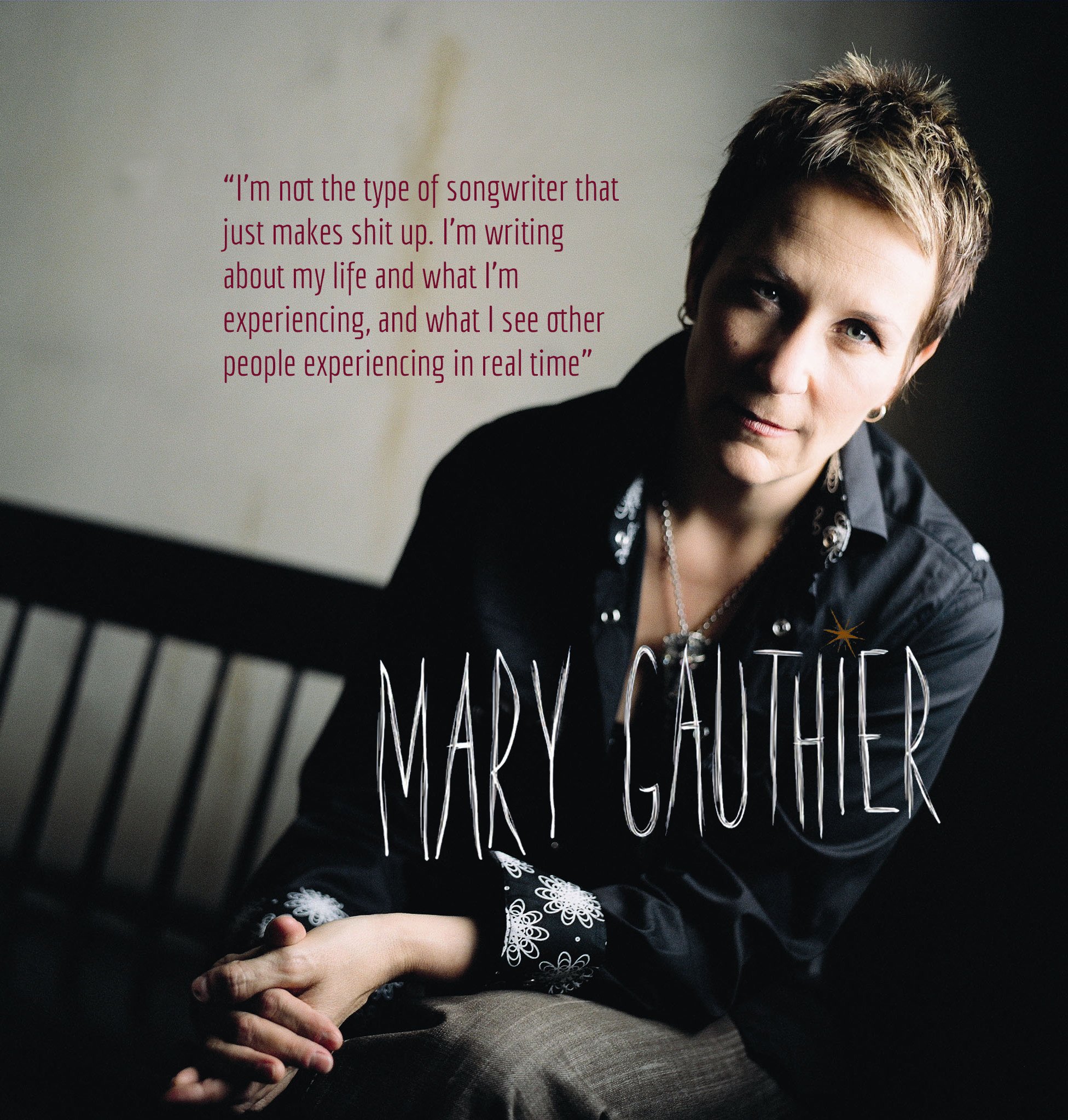
To be honest, I didn’t actually do that on purpose. What I do is to try and capture what is inside and in front of me and those songs are exactly how I’m feeling now. I’m just full of joy and gratitude. But of course, there’s grief on the record, too, because of the loss that we’ve all experienced in the last couple of years.  For me, I haven’t had to go through that alone. I’ve got someone with me that I love very much and we’re solid. I wanted to write about that. I’ve written about the difficulty of relationships my whole career because that’s where I’ve been. Finally, I’m in a place where things are solid and I’ve got this connection that is glorious, which I’m grateful for. The joy on the record is authentic. I’m not the type of songwriter that just makes shit up. I’m writing about my life and what I’m experiencing, and what I see other people experiencing in real time.

The track Amsterdam captures that tenderness and love beautifully. I understand that you ended up there quite unexpectedly with Jaimee (Harris)? 

That’s right. We were supposed to be going to Denmark a week early for a festival and the flight got messed up. I asked them to re-route us to Amsterdam and that was perfect. So, we got to go there unexpectedly, stay in one of my favourite hotels and have a few days in the city. I’ve written a lot of songs in Amsterdam; my first record deal was on a Dutch label and I established a relationship with the Dutch people early on before I had anything going on in the United States. That Dutch label was part of my life for the first decade of being a musician. I go there every year; it feels like a second home.

When were the songs for the album written and did you record in the studio or remotely?

All the songs were written after RIFLES AND ROSARY BEADS came out with most of it written during lockdown. We recorded in the studio with pretty much the same crew as RIFLES, and we also added Fats Kaplin to the team.  Neilson Hubbard was producer again; he also played the drums and Kris Donegan was on guitar. Michael Rinne was on bass, Danny Mitchell was on piano. Jaimee (Harris) sings on it which is great and Allison Moorer also came in and sang.

Beth Neilsen Chapman co-wrote the title track. Do you ever consider that artists such as Beth, Gretchen Peters and you are to other young artists what John Prine and Nanci Griffith were to you?

That’s really hard to understand, I couldn’t think about that. In my mind, I’m still the young person in awe going to a John Prine or a Nanci Griffith show and just watching them smiling uncontrollably, in love with their music and what they are bringing to the world. It’s impossible to fill those shoes.

With up to a dozen studio albums in your back catalogue, is there one that gives you the most personal satisfaction?

That’s like asking a parent who is their favourite child. I am actually quite fond of this one, because of the joy. It was high time that I chased down some joyful songs and I’m happy that I lived long enough to do that authentically and from the heart.

You only began to write professionally when you were in your mid-thirties. Had you dabbled in writing prior to that?

No, not at all. You know I wrote the whole book about that. It’s about what drives me as a songwriter and what I personally think songs and music are for. I see the music and the songs as part of my purpose and I had to find that purpose over time. I had a real problem with drink and drugs and after I got sober, I started writing. That was 1990 and I moved to Nashville to take this on for real.

How do you compare songwriting with your experience of writing longform for your book Saved By A Song?

I don’t think writing is ever easy and to write well is hard. The book took six years to write and I was only able to finish it because of the shutdown. For me longform writing is difficult, songwriting is difficult, and writing well is a big challenge.

With your love of food and cooking, maybe your next book will be about that passion? 

(Laughs) Yes, it will be titled ‘Cooking with Mary.’

With your upcoming touring schedule, I presume things are very much back to normal with you over there.

Everything is one hundred per cent back to normality here, we’re all acting as if Covid is not happening. Numbers are climbing but the vast majority of people have been vaccinated and for most people, if they get it, it’s like a bad flu. 

Can we look forward to you over this side during the year? We reminisced fondly at Kilkenny Roots Festival recently about you playing that festival back in 2018.

I remember that show well. It was as hot as hell outside and I was watching all the Irish fair skin burning to a crisp when I was waiting to sign CDs. I remember it well and wish I was there this year; I love that festival. We should be over to you in November of this year and hopefully also next April. I’d love to also get to Celtic Connections in Glasgow in January and if that happened, we’d also do a few shows in Ireland. I hope to be over with the new record several times. Hopefully Michele Gazich will travel with us in Europe too.

Interview by Declan Culliton

May 5, 2022 Stephen Averill

Photograph by Steve Lavelle

Born in Derbyshire in 1961, Michael Weston King played in a number of bands on the edge of the post punk scene in Liverpool during the late 70s and early 80s. He then became aware of bands such as R.E.M., Green on Red, The Dream Syndicate and The Triffids, whose influences mirrored his own newly found interest in Gram Parsons, Hank Williams, and The Byrds. So he joined country rock band Gary Hall and The Stormkeepers. In 1992, after their demise, he formed The Good Sons to further explore this emerging musical direction. When they broke up in 1999 he began to work on his solo career but rejoined the band for a fourth album HAPPINESS in 2001. In 2004 they released COSMIC FIREWORKS - The Best of The Good Sons (1994–2001). From 1999 to 2011, King released 10 critically acclaimed solo albums including in 2005 the compilation album THE TENDER PLACE: A Collection 1999–2005. Now, after concentrating on the more country orientated project My Darling Clementine with his wife Lou Dalgleish, he has released THE STRUGGLE, his first solo album in a number of years. Lonesome Highway took the opportunity to catch up with him recently for this interview.

Congratulations on the new album. It continues the fine body of work you have delivered so far, both as a solo artist and with My Darling Clementine. Had you been writing material all along that you considered more appropriate for you under your own name, rather than for MDC?

Well, I just write whenever I get inspired, and I don’t really think about where the song will end up or who will be singing it until it takes shape. I then tailor a song accordingly if necessary. But I did feel, with this, I had a bunch of songs, an album’s worth of material, that really hung together well, that was really just suited to one voice. They are pretty personal songs, many about my own feelings, no one else, so it was logical to me that one singular voice suits them better. The whole album is pretty intimate. 

Is it easier writing for yourself or do you find the MDC songs are now a part of your writing psyche?

You do have to be more disciplined when writing for two voices. I wouldn’t say one is more difficult than the other, just that you need to consider other factors when writing for a duet. Instinctively I tend to write, like most writers I guess, with just one voice in mind, usually mine but sometimes in the guise of a character I am channelling (such as the world weary beat cop in Weight Of The World).  But,  it will soon be time again to start delving back into that writing psyche you mentioned and get some new songs together, some “My Darling Clementine songs”, if we are indeed to make another album

You noted on the cover about the origin of THE STRUGGLE title, both as a particular place but also as a state of existence. Did it seem the best title to encompass this body of work?

Yes, it did. Not only this body of work but a larger reflection on most peoples’ lives in general over the past two to three years.  But to be honest, I really liked the title anyway. I have a note book with lots of possible album titles, song titles, ideas etc.  Even if the song doesn’t get written or the album made, I have always got a list of potential names on the go. This one came to me when when I was in the Lake District a couple of years back, and I saw a sign for the mountain pass ‘The Struggle’. It seemed such a potentially great album title to me. And after all that we have been though recently it seemed extremely fitting.

You produced this album, as you have other work in the past. Is that a process that you particularly enjoy?

I like to produce my solo stuff myself, as I have quite a singular vision and found it easier that way, to draw people into my way of thinking. It is different with MDC. We have used producers (or co-producers) on all those albums simply because, well, Lou and I need a referee! On my stuff I can be more indulgent in my influences and references and not feel need to explain or justify myself. 

Making this album was a special treat. I cut it in a beautiful location in Wales, it got me out the house, from what was becoming a very claustrophobic situation at home (as I am sure it had become for everyone), and it kept me sane. I could just disappear into these songs and into this process. That is not an option when making an album with a partner, especially your wife.

You take care with your cover artwork as you do with the music production. Was it a case here of finding the image and then the title or vice versa?

The image I chose in the end came quite late. As I mentioned I had the album title for a long time. There is a lot of ‘Welshness’ about the album, not only the fact it was made there but also was recorded and engineered by ‘Welsh wunderkind’ Clovis Phillps, who also played brilliantly all over it (guitars, bass, keys, mandolin, drums, backing box). He made an outstanding contribution. It then seemed natural to use some Welsh art and of a Welsh location. I met the painter Dan Llewelyn Hall though my son, the poet, Oliver James Lomax. He had illustrated one of Oliver’s collections. Dan was also painting his way along the Offas Dyke (the footpath that borders England and Wales) to celebrate it’s 50th anniversary. I like what he does with landscape. His paintings are kind of rough and rugged. I love the colours in this painting, the dirt brown of the earth. Again, it just seems very prescient to this collection of songs. In the painting there is what looks like a small figure almost at the top of the mountain, which to me, signifies someone who, after a long struggle, has almost made it to the top, almost made it through the obstacles he faced, but who still has a little way to go. Will he ever get to his final destination? That too felt very apt! The painting is called The Coalface and represents Aberfan.

Though you have added guests on the album, it is essentially you and Clovis Phillips. Were they added remotely, something pretty prevalent prior to the pandemic, though more focussed on now as a recording possibility?

Yes, it was just Clovis and I in the studio. Jeb Loy Nichols, who lives nearby, called in for a day to do some backing vocals and my daughter Mabel too came for her parts, but all the other things (trombone, strings, slide guitar etc) these were recorded remotely by the players that we chose.  So we had parts coming in from Paris, London, Liverpool, Sheffield and darkest Devon. 

Recording in Newtown in Wales, was that a place where you had a certain remoteness, that in the winter/spring when you recorded helped you to concentrate on the material and work without distraction?

Absolutely. After such a period of lock-down I was desperate for a change of scenery, for some solitude, for some remoteness in a rural setting. It is no coincidence that so many people have been fleeing the city recently. It was just what I needed. 

There are a number of fellow song writers mentioned in memoriam on the cover. Whom have you felt the loss of most profoundly, in terms of peers and influences?

Undoubtedly Jackie Leven. Even though it has been over 10 years now, I still miss him terribly. I miss his counsel, I miss his wit, his view on life, and especially his music. I miss playing shows with him, I miss drinking with him. He was a real kindred spirit. The songwriters mentioned in memoriam on the album (Eric Taylor, David Olney) passed more recently, in 2021, and were artists that I had worked with and was proud to call friends but I was not as close to them as I was to Jackie. 

I also wish I had had more time to get to know Townes, who I met 1993 but he was gone by 1996. I often wonder where that friendship would have gone had he got clean,  and if we had got to work together more.

You also, in that memoriam section, mention Valerie Dalgleish. I assume that Valerie’s Coming Home was inspired by her passing?

Yes, it was. We lost Lou’s mum in November 2019, a few months before the pandemic struck. She was in and out of care homes by then, so arguably it was a blessing. 

Is that type of song more difficult to write than any other?

Well, writing about a family member is a delicate thing. Naturally you feel under more pressure to portray them with a fondness that is shared by others. Thankfully, all the Dalgleish family members have really liked the song, but yes, the last thing you want to do is write a bad one when trying to remember someone that was so well loved by those close to you. This song though, it did flow. I didn’t have to labour over it. All the events recounted in the song all happened, so it was just my recollections of her, my relationship with her, images of her when she a younger mum, and the aftermath of her passing, so I had plenty to draw on. 

Weight Of The World, which opens and closes the album, has a political as well as personal dimension. How deeply do world events affect you as a writer?

I think any songwriter is, or should be, affected by world events.You cannot ignore what is going on around you. Phil Ochs is one of my favourite songwriters and, in my humble opinion, the finest ever writer of protest songs. I have lost count of the amount of times I have thought “I wonder what Phil would have made of this” while I watched yet another appalling news story. Of all the atrocious things we saw Trump do during his tenure as President, it was his photo op outside St John’s Church in Washington, where he had the streets cleared of peaceful protests so that he could hold a bible (upside down), that I found the most repugnant. I found it so utterly disgusting, and depressing. Weight Of The World uses the back drop of the killing of George Floyd, the Black Lives Matter movement and events of that day in Washington to express how it is really politicians who are the ones holding us all down.

It appears you are now a lifer in the music business. Can you reflect on that?

To quote your fellow country man Van, “it’s too late to stop now”. I turned 60 last November and can’t see myself doing anything else now. I don’t have any security or pension plan, retirement is not an option. Musicians, we just keep going until we fall over. And why not? We have been blessed, whatever the level of material success we have had, to live a creative life, a travelling life (a great reward), and one that has avoided us getting proper jobs! Apart from a brief spell in my late teens when I genuinely thought I was going to become a vicar, and a briefer spell before that when I thought I’d play for Man United, I have never wanted to work in any other area. Write, record, tour, repeat. Has always been enough for me. Yes I have got some other projects in mind, one is a film script about the late, great Mickey Newbury, and I also have a couple of books I want to finish at some point but I am a restless soul and the urge to travel makes it hard for me to sit and focus on things that take a long time to come to fruition. I need that instant gratification of writing a song or playing a show.

Has taking that path become clearer or is it as full of chance and circumstances as ever?

Well, over the years you build up a network of people you work with (musicians, promoters, agents, labels etc) so I guess that can make the path clearer but this is the music industry so nothing is ever really certain. People quit, venues close, labels go bust. Also, the internet has taken over to such an extent now too. We all spend too much time on line and musicians have to do the same to continuously self promote, which I must admit I find extremely tiresome. The mystery has gone, the veil between artists and audience, and I dont like that. So yes, I’d say it is as full of chance and circumstance as ever.

What do you look back on as achievements, and indeed look to the future as things left to achieve?

I think my greatest achievement is still doing it. Still being out there. Touring, making records, writing (and hopefully still getting better). David Olney once said his greatest achievement was the fact it said ‘musician’ on his passport. I tend to agree. This is such a competitive business and one that has seen millions of people ‘have a go’ and then drop out, or been chewed up and spat out along the way. You are open to great uncertainties and huge vagaries in opinion. It can be frustrating when you feel you are not as recognised as maybe you think you should be. But then again I have so many great memories, so many people I have met, places I wouldn’t have been were it not for the music. When I am asked what I do and I tell people I am a musician, you can see them come to life. The same would not be said if told them I worked in accountancy!

”What is left to achieve” is a tricky one. I have made a lot of records, written a lot of songs but an actual hit would be nice! ha ha.  I would also like to see a well put together box set come out, of all the studio albums. Either three separate ones to cover The Good Sons, my solo work and My Darling Clementine, or a ‘one stop shop’ of everything I have done since the 90’s. I recently did a deal with Cherry Red Records, so all the back catalogue is now available across the streaming platforms (a lot of it wasn’t up there)  but a physical version would be a nice thing too.

There are some collaborations I’d like to do that are on my wish list. Some achievable, others maybe hard to make happen. I am a huge fan of Robbie Fulks and would love to work with him at some point. So too Joe Henry. Joe nearly produced the third MDC album but logistics and finances prevented it. Still, maybe in the future.

There is a song on the album co-written with Jackie Leven and you have helped to put together a tribute to him and his work. Was that something that had its own rewards as project?

It did. Like all tribute albums, it is an eclectic mix but it sounds fabulous and there are some stunning versions of Jackie’s songs on it. The album looks wonderful too. Sarah Brisdion, who did the art for it, I used for THE STRUGGLE design too.  

Pulling the album together brought it’s own frustrations. I was angry nothing had been done sooner and it looked like nothing was going to happen, so I decided I had better do it. Frustrating too, as some artists (no names) I genuinely thought would get involved declined or didn’t even respond but, that aside, it was wonderful to get such a positive feedback from many fellow musicians, fans and admirers of Jackie who were keen to contribute. And then, once the process began, to have songs drop into my mail box was like Christmas Day every day. I am proud of it and would urge everyone to check it out. A gorgeous double vinyl version recently came out for Record Store Day too.

What’s next for you and My Darling Clementine?

The road. Two years  of not playing live means I/we have a lot to catch up on. Since Feb 2022, My Darling Clementine have toured Europe, UK and the east coast /mid west of America. More UK and Euro touring is coming before summer. Back to US later in the year too

I will continue to promote THE STRUGGLE and there will be more solo shows too. At the ones played so far, Clovis and I have performed the whole album, which has been really enjoyable. More of those for sure. Lou and I are also looking to do some shows with Steve Nieve in July, as we never got to tour the COUNTRY DARKNESS album when it came out. As for new recordings, the next album will be an MDC album, though I am not sure what direction we are going with that. Or maybe it is Lou’s turn for a solo album? And if so then, maybe, I will get one of those books completed!!

I am also currently working on and contributing vocals to an album project with Mark Brend (aka Ghostwriter). Very much an experimental sound-scape project based around hymns and even some “youth praise choruses” from our 1970’s church days. It is a curious project but what I have heard so far is fabulous. Mark is a really inventive guy and I love what he has done in remixing some of my songs, most recently his remix of Weight Of The World on the new album. 

So, will keep on keeping on, seeing what life throws at me, and what new musical avenues I can wander down. Right now though, a pint of Guinness and lunch with my grown-up kids is  my immediate concern.

Interview by Stephen Rapid

Dean Owens Interview

April 26, 2022 Stephen Averill

Photography by Gaelle Beri

Singer songwriter Dean Owens’ travels in recent years have transported him from rainy days in Leith, Edinburgh, to sunny days in Nashville, Tennessee, and further west to the scorching desert sun of Tucson, Arizona.  Kicking off his musical journey in his late teens with the progressive pop band Smile and moving on to more roots-based music with The Felsons, Owens’ solo career has subsequently yielded ten albums, together with a number of collaborations. The title track of his 2018 album SOUTHERN WIND, earned him the accolade of UK Song of the Year at the UK Americana Awards in 2019.  Its successor, the recently released SINNER’S SHRINE, is being hailed as a career highlight, with excellent reviews continuing to emerge from the U.K., America and Europe, including our own thoughts at Lonesome Highway. The album was recorded with Joey Burns and John Convertino of Calexico, a band Owens quotes as a firm favourite of his, way back to their early recordings. We spoke with Owens recently as he reflected on his early career days and ambitions, his love of American roots music and history, the recording of Sinner’s Shrine, and the three EPs titled THE DESERT TRILOGY, which he released in 2021. 

With your Leith, Edinburgh grassroots and your love of football and boxing, I would have expected your record collection to be packed with Bowie, Iggy Pop and Lou Reed albums, rather than American roots music?

Actually, I have all of those in my collection. I love a bit of Iggy, big Bowie fan as well. I have a very eclectic taste and I think that is reflected in my own music. Over the years my albums have been quite different and I like artists that do that. Even going back to the Beatles, if you listen to all their albums, they are quite different, there are all genres going on with their albums. Put on Sergeant Peppers and you get everything from blues to jazz and even country influences.

Going back three decades to your early career as a late teenager with the band Smile, what were your musical ambitions at that time? 

To be honest, I wanted to be on Top of the Pops like everybody else. That was the holy grail back then. Sadly, I never got there and Top of the Pops folded but I kept going. I’ve outlived Top of the Pops, that’s some claim to fame. Actually, it was never all about fame even back in those early days, I was always very interested in the song writing. Fame wasn’t something and it’s still not something that I have ever craved.

Your next venture was with The Felsons, who had a more roots sound. What marked the change in musical direction for you?

My old manager and friend ran a record shop and gave me some albums to listen to. They were pivotal records for me. One was Graham Parsons’ GREVIOUS ANGEL and GP, where you had both albums on one cd. I also got given an old vinyl record which was a Hank Williams’ collection. Those two records really opened my eyes to music I hadn’t heard previously.  Up to that country music was, for me coming from Scotland anyway, a guy called Sydney Devine that my granny listened to. I guess Sydney Devine was a bit like your Daniel O’Donnell, very tame and not what I was interested in. When I heard Hank Williams, and especially the song Ramblin’ Man, that really hit me hard. I started to delve into that area and once you go down that rabbit hole it is hard to get out of it, there’s so much great music there.  Through that, I discovered bluegrass and so many great artists and writers who heavily influenced the Felsons. The Americana genre did not exist when the Felsons were going. We were called everything from cowpunk to alt-country. When you mentioned boxing earlier, it’s like how many world titles there are now.  Similarly, there seems to be a new genre each week related to roots music. I certainly don’t mind the Americana term because I am heavily influenced by that music and not only the music but also American landscape and American literature from my travels there over many years. Around that time there were also a number of bands being labelled alt-country that knocked my socks off.  I was discovering bands like Wilco, Son Volt and eventually Calexico and Giant Sand. 

Your next move was to venture on a solo career with your debut album THE DROMA TAPES.

We had been together and making music since I was about nineteen with Smile and The Felsons. We just got to the point where we had been living in each other’s pockets for a long time and decided to take a break, but not necessarily a permanent one. I headed off to a remote cottage on a Scottish island and started working on songs that were in my head and probably for another Felsons’ record. A number of them were quite stripped back and mellow and sounded really nice with me and just a guitar.  That basically became the first solo album, THE DROMA TAPES. It was really an accidental album.  I recorded it in the cottage and when it did come out people liked the vibe of it. It was very much based on and influenced by two old albums I had, THE TEXAS CAMPFIRE TAPES by Michelle Shocked and The Original Harmony Ridge Creekdippers’ self-titled album. 

Moving forward eighteen years and eight solo albums later and you recorded the Buffalo Blood album with Neilson Hubbard and his fellow Orphan Brigade members Joshua Britt and Audrey Spillman. Was the album and its recording location a result of a childhood romantic fascination of all things American for you, from spaghetti westerns to your love of Muhammed Ali?

I think so, you are right about the westerns okay. When I first went to the States on a long road trip, I wanted to see all those big John Ford landscapes. I got very interested in the old days of American culture and history, and their story because growing up in Scotland we were only given one side of the story. I started to read a lot and study American native history, and go to a lot of places where events took place. That became a very big part of my life, travelling and studying history over there. My wife and I at one point bought an old airstream trailer and put it on a friend’s property at Joshua Tree. I’ve always loved the time spent out in the desert, I don’t know whether it’s the contrast in weather from Scotland where we have to suffer a lot of rain. For the Buffalo Blood project. I started writing a number of songs based on the Native American Story and their trail of tears. I was also thinking of what was going on in the world around me at that time and the number of displaced people in the world. I had these seeds of ideas for songs and I mentioned to Neilson Hubbard and Joshua Britt that I was interested in recording songs based on American history and the American native experience. Neilson really liked the idea as he has just done the first Orphan Brigade with Joshua and Ben Glover. They had done that on location and Neilson, in his crazy wisdom, suggested that we make the record and go out to the desert to record it, rather than doing it in the comfort of a studio. We drove from Nashville out to New Mexico and based ourselves around the Georgia O’Keefe Ghost Ranch in Abiquiu, set up our gear in various locations, strange rock formations, caves, and canyons, and made the record. It’s one of the things I’m most proud of. 

Did that lead to the connection with the Calexico guys for THE DESERT TRILOGY EPs and SINNER’s SHRINE?

Funnily it didn’t, although I do see the strong connection between Buffalo Blood and the new record SINNER’S SHRINE for sure. My whistling for one. During the process of being in these canyons, Neilson and others remarked that they hadn’t heard anyone whistle like me before. I started coming up with all these Ennio Morricone-inspired tunes and melodies. The hook-up with Joey Burns and John Convertino happened later. I was on tour in America in the spring of 2019 and had a week off. I wanted to go somewhere for that week and relax and soak up some local music. I had been in Tucson, Arizona once before with my wife, but only for a few days, and hadn’t really got a flavour for it, though I’d always loved the music coming out of there, Calexico and Giant Sand, in particular. I love mariachi music as well. So, I went down there to soak up the atmosphere and eat some good Mexican food.  I got invited to a benefit show for a local guy called Tom Hagerman, who is in a band called Devotchka, who have a great desert vibe. There was a mariachi band playing and Joey from Calexico was also performing. Long story short, but during the concert, I had gone indoors to the air-conditioned hotel where the outdoor gig was playing as I was suffering a bit in the Tucson heat. When I was coming out, I bumped into Joey and we just started talking about music as he was interested in Celtic music and I was interested in mariachi. We kept in touch after that and out of the blue he contacted me and said I should come back to Tucson and make a record with him and Jim Convertino, his partner in Calexico. I was blown away and it was an invitation that I wasn’t going to turn down. It was like being asked to play centre forward for my beloved football team Hearts, and scoring the winning goal. That was May of 2019 and I spent the next few months just getting songs together and the following January I went out to Tucson and recorded SINNER’S SHRINE with the boys from Calexico.

Tell me about the recording sequence from THE DESERT TRILOGY EPs and SINNER’S SHRINE?

As always, I had recorded too many songs. The songs on the EPs were ones, for one reason or another, that didn’t make the album. They simply didn’t make the album because I thought I had a nice sequence and flow to the album with the songs that are on it.  I had four or five left over from the recording session and during lockdown, I recorded the remaining songs for the EPs long distance with the guys. The EPs were released by necessity in a way. It didn’t make sense to put the album out when I couldn’t tour but I also wanted to pave the way for the album coming out. It also gave me the chance to use those songs that I really liked from the sessions. It was really pandemic driven but also a blessing because I got a much bigger reaction to the EPs than I had expected. 

I’m hugely impressed by the artwork on the EPs and the album. 

It came about through James Morrison, who has done a lot of my artwork over the years. His partner Luisa Carmela Casasanta is also a great artist so I gave them a basic idea of what I wanted and they ran with it. They came up with some really beautiful work, with a really nice thread through the EPs, the album, and also through to the merchandise.

Unfortunately, touring the albums has been disrupted. What are your plans going forward?

I was scheduled to launch the album at Celtic Connections in Glasgow in January with a full band, which didn’t happen because of Covid. I played a few shows last month in Scotland with an ensemble called The Sinners, and the plan is to do more of that along with solo shows, duo shows, and some more band shows later in the year. Thankfully, the press I have been getting for the album is the best I’ve ever got, which is a relief because it’s a slight step away from what I’ve done previously and a different flavour from my last album SOUTHERN WIND. I’m also aware that by taking a musical departure you risk alienating some of your original fans as well as getting new ones. I have to stay really focused on SINNER’S SHRINE in the short term as I put so much work into it. I think the album deserves a good life and I intend to give it one.

Interview by Declan Culliton

Alma Russ Interview

April 21, 2022 Stephen Averill

In a genre populated with many crossover country artists, North Carolina-based singer-songwriter Alma Russ is the real deal. Growing up with a farming background, she combines her independent music career with seasonal work, either on horseback in the great outdoors as a stable tour guide, or as a rancher in Wyoming. Her parallel career finds her touring for months on end, transporting her music across state borders to bars, honky tonks and clubs. She’s recently released her standout sophomore album FOOL’S GOLD, which not only showcases her quite distinct vocal range but also marks her as a talented tunesmith and writer. She recorded the album in a hundred-year-old church in a ghost town out in the Chihuahuan Desert. There is a charming innocence and simplicity to the album, which was described on the celebrated Saving Country Music website as ‘one of the best albums to be released in 2022 so far.’ That mirrors our opinion of the album that   the extremely modest and enthusiastic Alma spoke to us about.  

You appear to have the ideal life balance with your parallel occupations alongside music.

I worked on a ranch last year in Wyoming but I’m back in North Carolina now. I’m working at a riding stable where I used to work full time at one point. These days I work here when I’m around. The riding stables are in the Great Smoky Mountains National Park and I take people for tour rides in the mountains. I’m really thankful to get to work here when I’m not touring.

How does that break down time-wise for you ?

The work is seasonal for me, I do my music in the off season. This year I will be mostly playing music. When I left the ranch in Wyoming last October I was playing wherever I could get shows and getting by as the gigs kept happening. I realised I probably didn’t need another job, which was probably a miracle. I love my jobs, though the work on the ranch meant that I was holed up on a mountain for up to six months, which meant that I couldn’t play music. So, this year I decided to mostly focus on music. My boss here at the stables is really supportive and kind, so I’ll stay around here and then I’ll be on the road touring for three months. 

You are also from a farming background?

I grew up on a farm in Florida. We were actually a nursery, more of plant-based farm. We had forests and also rented out some of our land to other folks.  You don’t hear that much about farming in Florida because it’s getting so overpopulated, but I was the seventh generation born on that land. My family got the property after the civil war, the nursery closed down a while ago but my grandparents still live down there and I visit every once in a while. 

What are your earliest memories of being stimulated by music?

This is kind of different from what you’d expect. I started playing piano when I was five. An early memory is getting the soundtrack to the movie Shrek when I was a kid. It had Duran Duran’s Hungry Like A Wolf on it, which I loved. I don’t know if you’ve ever heard of the Country Bear Jamboree, but we lived an hour north of Orlando and when I was a kid we’d go to Disneyworld in the off season, when all the crazy summer season crowds weren’t there. There was this thing called The Country Bear Jamboree that, even then, was terribly outdated. It was a show in an auditorium where they had electronic bears playing banjo, bass and other instruments. You should look it up, it’s really bad. But for some reason I really loved it. It wasn’t until later that when I was twelve and picked up the banjo, that I realised that the spectacle really got me interested in playing music. After that, I spent a lot of time in the mountains getting into traditional mountain culture. Music is a major part of that and became a huge interest for me. It all started with The Country Bear Jamboree. As I got older, I loved Alison Krauss and Dolly Parton. I was really influenced by Alison Krauss because she played the fiddle and sang. I had also got into singing Scots and Irish ballads even before I took up the fiddle, singing songs about people getting their heads chopped off when I was only eight years old. 

I understand you were a contestant on ABC’s American Idol?  I would have thought your vocals are far too distinctive and edgy rather than the stereo-type singers they promote?

They don’t want folk singers; I knew going into it that it wasn’t my thing. It was really a fluke but my dad encouraged me to send them a video and surprisingly they responded. It was a free trip to Hollywood so I couldn’t really complain and I went thinking ‘I wonder how long this will go on for.’ I met some really cool, genuine people and there were a lot of very competitive people there. For me it wasn’t competitive, I was just waiting to get eliminated, I knew it wasn’t my thing. 

You released your debut album during the pandemic: when was it recorded? 

I recorded NEXT DOWN in Johnson City, Tennessee with Bee Hive Records. We started recording it long before the pandemic, it took us a long time to finish it because I was heading to Wyoming to work for four months. We finished when I came back and we decided to release it during the pandemic. With that album, I really didn’t know exactly what I wanted from it and had a lot of songs that I’d since written that I liked a lot better, which ended up on FOOL’S GOLD.

Your new album FOOL’S GOLD, sounds like a huge step forward. How did you end up in a ghost town nearly two thousand miles from North Carolina to record it?

I live on the road for months at a time. This may sound ridiculous, but I have a Prius which I’ve rigged out to live out of. I used to tour during the off season simply because there were so many places that I wanted to visit and see. To do this, I’d book some gigs to help me pay for gas and music wasn’t really the focus, I was just rambling around. I first went to Terlingua in Brewster County, Texas, last winter, it was during the pandemic and a good place to go because there was hardly anyone there. I have a lot of friends who had worked jobs at the Big Ben National Park there and wanted to see it. I had my instruments with me and there’s this place out there called The Starlight Theatre in Terlingua. It’s really cool, Willie Nelson and Jerry Jeff Walker used to play shows there. The stars out there are so bright because there’s no light pollution. Although being in the middle of nowhere, a lot of musicians go out to Terlingua . I ended up meeting some musicians on a porch out there and we just jammed. One of them was Bill Palmer, a dear friend of mine who recorded FOOL’S GOLD, and another was Myles Adams, who is a talented singer songwriter. At the time Bill was recording Myles’ album at the St Inez Church, it was the first album to be recorded there. They asked me if I’d play fiddle and sing some harmonies on the recording. I was already tired of my first album NEXT TOWN, loved the way Bill worked and was hoping he would record my next one, which he did.  With the new album I wanted to mix Appalachian music with Texas country. So, I decided to book my future gigs heading across the country towards Terlingua. I booked St Inez Church and we ended up recording the album in two days because, honestly, that was all I could afford.

There’s a delightful organic back porch feel to the album as if the musicians knew exactly when to support your vocals and when to withdraw. 

That’s really how it was in the church. Because I was on the road, I didn’t have a lot of time to practice with the musicians. I was playing a really weird gig in Houston, probably the weirdest I’ve ever played. It was in a place called Super Happy Fun Land. On their website, it said that they were open to all genres of music but when I got there, I knew it was really a venue for metal bands. Anyway, I ended up playing in a songwriter round in a metal band venue and one of the ladies that played was Mary Brett Stringer. At that time, she was playing washboard in the Austin band Feeding Leroy and, coincidentally, she was also heading to Terlingua with the band to record their album. So, she ended up doing backing vocals on FOOL’S GOLD. My one requirement for the album was to have pedal steel on it but I had intended to do that digitally, I didn’t think I’d get a pedal steel player out there. So, it just happened that Lee Martin from Feeding Leroy was also there the same day. So, because we had no practice time, Bill Palmer and my drummer Moses were the only ones that had got to hear the tracks beforehand, Lee had to do his playing on the spot.

Why did you select FOOL’S GOLD as the title?

That song is my theme song, the one I open every show with. I love what I do, I don’t make a lot doing it but I get by. Sometimes stupid things happen and I wonder why I’m doing it, but I love it. The title came from me doing what I do for the right reasons and not for the reward. 

Two tracks particularly stand out for me on the album, Oklahoma Freight and In Another State. Can you tell me about the background to them?

I was in San Antonio, Texas, when I was on the road for the first time by myself. I was nineteen at the time, playing in these bars for the first time and nervous, which can be intimidating sometimes. I was playing a show and this guy was giving me a lot of trouble. I went to the bartender and told her and she threatened to beat him up for me: it was a bit dramatic, for sure. She was a really cool lady and I ended up sleeping on her couch and hung out. She’s not doing that work anymore but she told me her story about hopping freight trains in Oklahoma - oddly enough I’ve made friends with a lot of hobos and I learned how to write songs from one. She initially inspired the song. It’s a combination of her story and also stories from other women I’ve met, and there’s a little bit of me in that song also. 

And the song In Another State?

There was this girl I worked with who was really mean to me. She’s not going to read this, so I may as well tell you. It was really hard for me, but when I heard her story, it made me be able to be kind and understand her.  She was the initial catalyst for the song, but I also wove other people’s stories into it from growing up in a small town. I loved living in a small town but also knew people that felt trapped by it and ended up in that song. 

You’re heading off on tour shortly. How difficult is it to self-manage and what are your ambitions? 

I love what I do and never thought that I’d be able to make a living out of it. The dream is to do it full time, but if I have to get a job next time, so be it. I would love to have a booking agent, but that’s not affordable at the moment. The worst part is the booking, but by doing that myself I get to go wherever I want. At the moment I’m fortunate with the people I’m doing seasonal work with. My boss is great, so it’s as much of who I’m working for as much as the outdoor work I’m doing. There’s a line in a Gillian Welch song, ‘Never minded working hard, it’s who I’m working for.’ I’m lucky to have someone who is supportive of my music and happy to have me work for him when I’m around. I’m also lucky that I can play with a band when I’m at home and when I’m on the road it’s just me, playing shows and sleeping in my car, keeping my overheads really low. It's really weird, but as a travelling musician, you meet a lot of people that want to be a part of your journey. I’m humbled by the number of people who invite me to stay with them, which I do sometimes. Other times, being an introvert, I’m happy to crash in my car in a parking lot. I love meeting new people as it’s part of the job, but I often get to the stage where I prefer sleeping in my car than couch surfing. In the meantime, I’ve made the album that I wanted to make, which is exactly what I was hoping for.

Interview by Declan Culliton

David Quinn Interview

April 12, 2022 Stephen Averill

Photograph by Laura E. Partain

It’s surprising that David Quinn is not yet a household name in country roots circles, given the quality of the three albums he has released over the past four years.  The arrival of Covid in early 2020 denied him the opportunity to tour his sophomore record LETTING GO, which he finished in Nashville weeks before shutdown. Rather than sit back and lick his wounds, Quinn abandoned city life in Chicago and relocated to a rural lake house in Indiana, where he wrote the material for his latest recording COUNTRY FRESH. His new surroundings and the enforced lockdown heavily influenced his writing, which is a fusion of nostalgia and an appreciation of the oft-overlooked simple pleasures in life. It’s a worthy companion to LETTING GO and, like its predecessor, features a host of top-notch Nashville musicians.  We recently caught up with Quinn via Zoom, where he was finalising his schedule to bring both albums on the road for the remainder of this year. We expect, following the tour, that his profile will be deservedly heightened. 

Do you have an Irish bloodline as Quinn is a very popular name over here?

Unfortunately, I don’t. A lot of Irish people out here ask me that. Quinn is actually my middle name; my last name is Italian, which nobody can pronounce. 

My introduction to your music was the song Long Time Gone from the Bloodshot Records compilation album TOO LATE TO PRAY, DEFIANT CHICAGO ROOTS from 2019. How has the demise of Bloodshot affected the music industry in Chicago?

It’s had quite an impact. A lot of people are still trying to figure out how to move forward. It’s unfortunate how it all happened as they supported a lot of great music. A lot of my friends who were with Bloodshot have moved on and are doing great music at other places, though. 

Is there a vibrant Country music scene in Chicago?

There is a small scene that is more specific to the honky tonk crowd, which is really where I started. Since then, I’ve explored other genres, which is what my last two records are all about, just letting all my influences show. There is a honky tonk scene alright and we have a dance crowd that comes out to those shows.  I feel somewhere in the middle. My sound is harder country, a little bit of everything, kind of bluegrass, kind of country, trying to carve out my way out there. There’s also a bluegrass scene and a big indie rock scene in Chicago. 

There appears to be a steady growth of appreciation for roots music in recent years.  Artists such as Colter Wall, Charley Crockett, Ian Tyson, Tyler Childers and Jaime Wyatt are getting deserved recognition.  

The market is growing and all those artists are beginning to become household names now. That would not have been the case five or ten years ago when this new roots movement wasn’t as well known as it is now. It’s growing every year, which is great.

I should also have mentioned Jeremy Pinnell, who you’ve recently played with. 

I played a few dates with Jeremy recently in Ohio and Kentucky, having played with him in the past. He’s one of my favourite songwriters out there right now, he’s a remarkable talent. 

You’ve been particularly productive over the past five years, recording three albums. You’ve also been very selective in the producers and players you’ve worked with and recorded the three albums in Nashville. 

The last two records, LETTING GO from 2019 and my new one COUNTRY FRESH were both at Sound Emporium in Nashville. Mike Stankiewicz was the engineer on both of those two records. The first album, WANDERIN’ FOOL was really interesting, recorded at The Bomb Shelter and produced by Andrija Tokic. Prior to the recording, I had literally sold everything I had, kicked off on a road trip, and wrote a bunch of songs. I hadn’t played with a band much at that time so it worked out perfectly when Andrija came on board. He was able to say ‘I have the perfect band for you’ and he brought all the players in, it all really worked well that way. After making that record, within weeks I had my own band together and some of those guys are still with me now. I had been playing those songs from LETTING GO on the road for over a year, so it was a different approach when I went to Sound Emporium to record that album. I really knew what I wanted going into the studio at that point so it was so much easier for me. I knew the melodies I wanted, the drum sound, the lead guitar, etc.  So, it was a learning experience with that album. With COUNTRY FRESH it was a combination of both experiences from the previous two recordings. I knew what I wanted for most of the songs, having written most of the songs by myself during the pandemic. I basically picked players for the recording that I knew and trusted, and would make the album a collaborative effort, but would also sound exactly as I had it in my own mind. 

Those players included Micah Hulscher and Jamie T. Davis from Margo Price’s band and Kacey Musgraves’ pedal steel player, Brett Resnick. Having them available without touring commitments was fortuitous? 

Absolutely. With the questionable timing of things and not knowing when things were going to get better, it also helped that those guys were itching to work. I had gotten to know a lot of those guys pretty well over the years. I was lucky to be able to reach all those favourite players of mine and each of them to say ‘yes’. 

You also recruited Fats Kaplin to play on COUNTRY FRESH. How did that come about?

I had known all the other guys and worked with them before. I knew I wanted fiddle on this record because I had written a number of melodies with fiddle in mind. I had the fiddle parts, figured out the songs I wanted them on. I asked a couple of people who I should reach out to. I had played with Kelsey Waldon in the past and she recommended Fats and Micah also said I have to use Fats. When he agreed to come on board he arrived with his fiddle, mandolin, harmonica and dobro. He had a number of ideas that made it onto the record, so it couldn’t have worked out more perfectly. It was an honour to meet Fats and play with him.

You left Chicago and went to rural Indiana to write the material for the album.  

Yes, I moved right at the start of the pandemic over two years ago now. I had just got back from Nashville after making LETTING G. I had that record finished and was figuring out what to do with it. I got back to Chicago in March just as everything was closing up. After a week or so I decided to pack up and move. I was never a city person, I didn’t grow up in the city and it was pretty easy to come out here, where I still live. I started writing that record right away when I got out here and it was almost like I needed to move here and write the album, as if it all happened for a reason. 

The material is very homegrown and reflective. Did the absence of time pressure help the writing process? 

A feeling of freedom is certainly reflected in the record. Ironically, it’s funny, with lots of time to write and no deadline the songs actually came very quickly. No deadline, no pressure, and no shows to play, I just wrote the record so quickly, the songs just came pouring out. You’d normally never get a time in life with no obligations and it actually felt a really nice time to write the songs. 

I’m intrigued by the origin of the album’s title COUNTRY FRESH, which I understood came from an ashtray you stumbled upon in the recording studio?

Yes, I came across the ashtray in the back of the studio at Sound Emporium. I asked my engineer Mike Stankiewicz about it and he reckoned no one had probably seen in in forty years.  That was during the making of LETTING GO and the name stuck with me and reflected the direction of the album’s songs. When I went back to record COUNTRY FRESH the ashtray was still there. 

You’re on record as being influenced by fellow Illinois legend John Prine. What other artists set you on your musical career? 

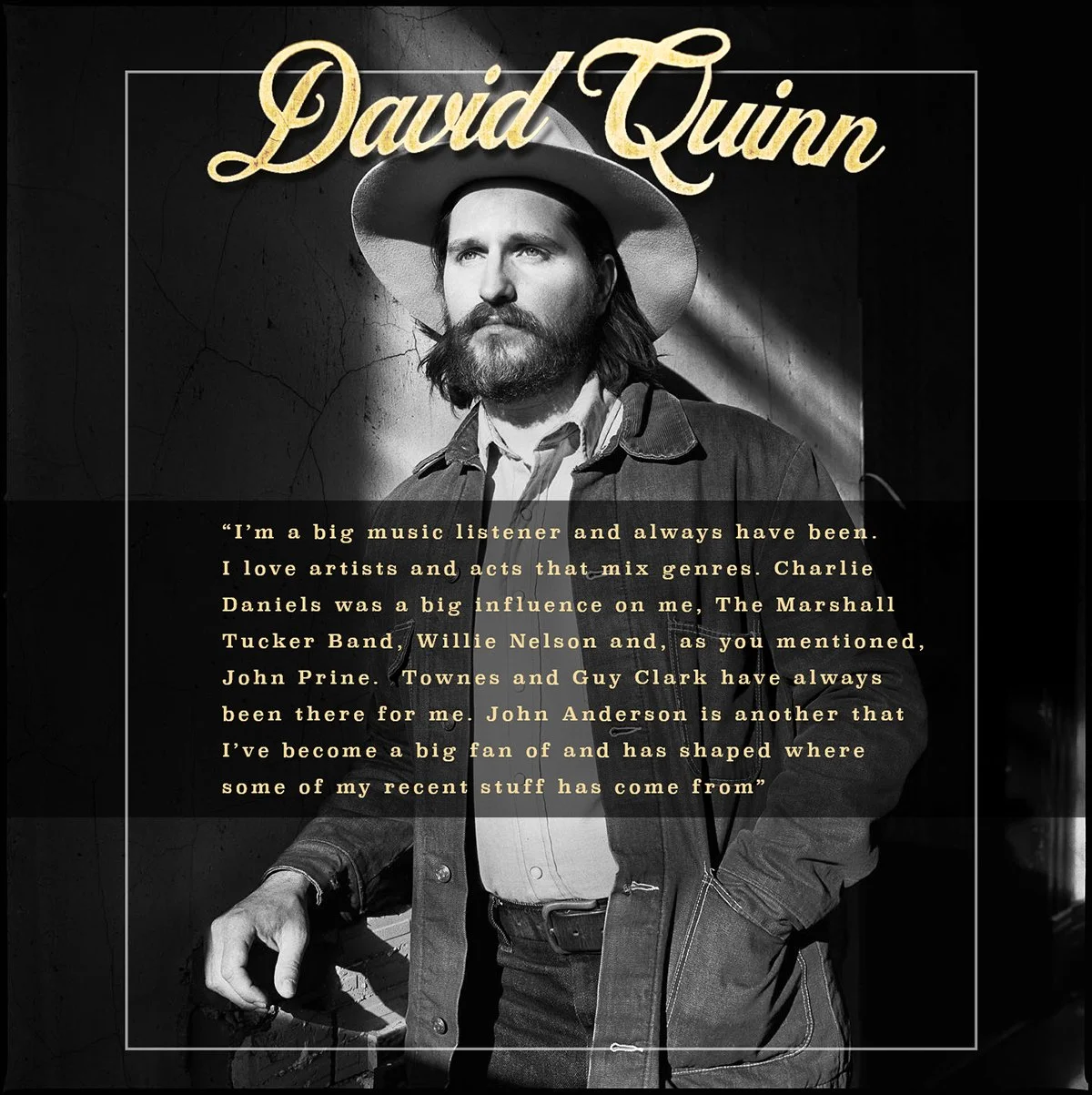
I’m a big music listener and always have been. I love artists and acts that mix genres. Charlie Daniels was a big influence on me, The Marshall Tucker Band, Willie Nelson and, as you mentioned, John Prine.  Townes and Guy Clark have always been there for me. John Anderson is another that I’ve become a big fan of and has shaped where some of my recent stuff has come from.  My dad had a large vinyl and cd collection and at weekends he’d be playing vinyl all night and really loud. He’d be having a drink and I’d be just listening. He’d play everything really loud, not only country but everything from John Prine to Willie Nelson, The Temptations to James Brown, Neil Young and Supertramp. The neighbours were always calling to turn the music down. That’s probably where I got such wide musical influences growing up. 

The songs are very personal and nostalgic, dipping back into simpler times in the past.  The ones that particularly come to mind other than the title track are Hummingbird’s Song and Cornbread and Chili. Are they also a reflection of your relocation to a more rural environment? 

Absolutely. It’s funny, I had made the record and was getting the artwork done and going through the process of getting the record ready for release. By stepping back and away from the music, I’ve been able to reflect on the songs a bit more. I’ve been noticing things about the songs when people tell me little things about some of the songs. Being able to step away and have a bit more freedom up here played a part in that nostalgic view of things and missing times past. Hummingbird’s Song, in particular. It is a song for my grandfather, each line from that song is true. I have his eagle tattoo on my arm. Cornbread and Chili is more about how I’m living right now. All those simple things in life that I was reminded about, things that are easy to overlook until they are taken away from you. 

You have the album release show scheduled for April 15th. Will that be in Chicago? 

Yes, it’s in Chicago. I grew up forty miles west of the city, so a lot of friends and family can come out and I’ve built a bit of a fan base in Chicago, too. So, that’s going to be a fun show. I’m hoping to be full time on the road after that for the rest of the year. 

Will you tour solo or with a full band?

A bit of a mix of both but I’m hoping that most of the tour will be with my band, probably as a four piece. I’m actually working on that right now.

You will actually be touring two albums having not had the chance to tour LETTING GO since its release. 

Yes, my setlist at the moment is half LETTING GO and half COUNTRY FRESH. Since I didn’t get to tour LETTING GO, I’m hoping people will come back to it and that it will eventually get its day as that record means a whole lot to me. I was going to wait to release that album because of the pandemic, but when it got to fall of 2020, I just decided to put it out and start working on a new one. 

Are you suffering from the dreaded ‘post-album depression’ that many artists suffer from having finished a project?

I haven’t yet, knock on wood. I’m actually almost finished writing the next one. It’s probably because of the year locked inside that I’m feeling backlogged, ready to go on the road and make more records.

Interview by Declan Culliton

The Delevantes Interview

March 30, 2022 Stephen Averill

Mike and Bob Delevante started performing in Hoboken, New Jersey in 1988 but decided to relocate to Nashville in 1992, on the advice of a Nashville music executive. The duo known as The Delevantes released their first album, LONG ABOUT THAT TIME, in 1995 on Rounder Records. Production was by fellow New Jersey musician and the E Street band member Garry Tallent. It received a good critical response including three stars by Rolling Stone Magazine.The album debuted in the sixth slot on the Gavin Americana charts thus making the group the first alt-country band to reach the top ten. In 1997 they moved to Capitol Nashville and released their second album POSTCARDS ALONG THE WAY. The album was again produced by Tallent and he also featured on bass alongside Heartbreaker Benmont Tench on piano. After a hiatus of over a decade, The Delevantes are again actively performing and recording with their most recent album A THOUSAND TURNS released last year it again saw them continuing their working relationship with Gary Tallent.


Tell me a little about the motivation that inspired you to reform and record the new album?

Mike: We had talked about getting together to record again for years but it wasn’t until the manager of Blackbird Studios here in Nashville heard us perform at a Tom Petty tribute and invited us to the studio to record. So we really hadn’t set out to do an album when we started. We had a great studio and engineers made available to us and we went in as friends just to create music. After that session we realized what was beginning to develop. We went back in to Blackbird for another weeklong session and came out with 14 songs that we felt great about and then decided we should release it. And I think that mentality of going in to a studio just to create something as friends in really a relaxed, joyous environment comes out in the record….vs. maybe a different scenario. Not that we didn’t enjoy making our other records, we did. We’ve always loved the recording process but motivations were different back then. Labels, managers, publishers as well as career decisiionswere all involved. This was purely friends creating music.

Bob: Our initial inspiration came from a show at the Stone Pony in Asbury Park, NJ. Mike and I were playing with Garry Tallent and we were joined on stage by Bruce Springsteen. Playing in Garry’s band, and that night at The Pony inspired and motivated us to start working. Soon after we took part in a Long Players show. (The Long Players are a band that perform a classic album from start to finish and have different artists sing.) Rolff Zwiep, the studio manager from Blackbird Studios, an incredible recording facility in town, saw us play and offered us studio time. We booked some dates and we were off!

Were they similar to the ones you had when you decided to perform together back in the late 80’s?

Mike: I think it was different in the sense that back in the 80’s our day-to-day life was centered around playing music every day, attending art school and then working in that field. After our second record on Capitol, I decided to take a break from music to return to art and design and Bob did a few solo records while also pursuing photography and design. Our desire to create and work together despite the medium hasn’t really ever really gone away. We’ve always stayed close and even worked together on projects over the years.

Bob: Yes and no. We’ve always enjoyed the process of recording so that was an overall motivator, but not having done it for so many years really made us want to get in the studio and start working.

What were the major influences you both had growing up?

Mike: NYC AM radio to start, which meant pop music of the 60’s and 70’s. Beatles, Bee Gees, Monkees, Motown. Then learning to play guitar led to folk/singer-songwriters of the time: Dylan, The Byrds, Jackson Brown, Springsteen. We formed our first band with a high school friend that turned us on to John Prine, Flatt & Scruggs and one album in particular that had a huge impact was the first ‘Will The Circle Be Unbroken’ album by the Nitty Gritty Dirt Band.

Bob: For me there were so many things. Family of course, and where we grew up. Being so close to New York City as well as the Jersey Shore were inspirations to me.

You moved from Hoboken to Nashville on advice. In retrospect was that good advice?

Mike: Absolutely. We knew that in 1989, a band that sounded like Creedence or The Byrds could have a really good following in NY/NJ but they weren’t going to get signed by a New York label. Jody Williams from BMI Nashville saw us perform at the New Music Seminar in NYC and invited us down to Nashville for a week to introduce us around. In that week we saw Steve Earle perform, met Garry Tallent who would become our bassist and co-producer, met Mike Porter who would play drums and co-produce. And met and saw U2 play in Tootsies in front of about 10 people. That was a good trip! There was just a sense of great possibilities. We felt like we were at home. We started to travel more frequently here to play and record until eventually we made it permanent.

We also knew that we’d always be a little different wherever we were. In New York we were a country band. In Nashville we were a rock band. But at the heart of it was the close-knit and creative community here that seemed to embrace a lot of different genres. The people here were accepting, all with relatively similar goals. And the last remaining real songwriting community was still in Nashville.

Bob: Yes, for sure! Living in Nashville certainly changed our music, making it more of what we had wanted it to be. Between the atmosphere, songwriting, work ethic, and musicians here in town, all these things had an effect on what we were doing. My wife and I also enjoyed living here and raising a family. I miss New York and New Jersey but I do get up there often.

Your first album was released on Rounder and then for the second you signed with Capitol Nashville. There appeared to a critical and solid fan base and the trajectory seemed upward, however you decided to quit not longer afterward. Was that a decision forced on you or one you made yourselves?

Mike: I was moving in the direction earlier. In my head I thought at some point I wanted to get back into art and design. I didn’t have a plan for when, but I knew that I missed it and at some point I’d like to go back to it. The major label industry experience was at some points ridiculous. There were wonderful people that we got to work with over at Capitol but when Scott Hendricks was fired and replaced by someone that knew nothing about music that just signaled that things wouldn’t be as planned.

Its a pretty common scenario I would imagine: Creative has a vision – they sign a certain act to fulfill that vision – the creative gets fired – the act gets dropped. What’s weird is we actually didn’t get dropped. The new president thought our record was the best record he had. When we met with him he just said “I was hired to sell country radio acts, this isn’t a country radio act. I’m not gonna drop you, but I’m not gonna work it either.” So, that moment felt like the right moment for me to move on to smething I’d thought about for a long time.

Bob: I would say a bit of both. Things at Capitol changed and we realized it wasn’t the place for us so we eventually decided to leave.

You both have creative souls and found careers in the graphics industry. Was that a good substitute for music at the time?

Mike: I never thought about graphic design or visual art as a substitute. Both Bob and I went to art school before being in working bands. So, from a timing perspective, art came first. Then as we progressed in music, we did both. By the time we had moved to Nashville and had signed with Warner Chappell publishing and Rounder records in 1994, for a 10 year period,writing,  making records, being on the road, I didn’t do a lot of artwork because there just wasn’t time.

Bob: Yes, definitely. And I would say far more than a good substitute. I studied design and photography at Parsons in NYC so there were many times when we were touring that I missed doing visual work. It was good for me to take a break, start photographing again, get back into the darkroom, and take on some design projects before I got back into the music world.

Bob, you of course, continued to make solo albums and released three under your own name. Were they labours of love or did you just want to keep that side of your creativity open? 

Bob: I love writing and recording so I really wanted to continue doing that. I set up a studio in my home and put my albums together there. I learned about the engineering and production side of the process which I found interesting. And I was able to produce some other artists as well. I was also able to incorporate my visual work in many of these projects. For example, my album Columbus and the Colossal Mistake is a collection of songs, and my photographs.

There’s 20 years between A Thousand Turns and 1997’s Postcards Along The Away on both you worked with Garry Tallent so there is an obvious continuity in the production. Was that the intention?

Mike: Not really … I think it was just us being us writing, playing communicating. It all just felt natural. In fact I remember after maybe tracking the second song, we walked out of the control room and Garry said “It sounds like you guys just never took a break.” We felt that way too. Specifically, our choice to go back in with Garry, that’s probably more centered around the idea that we’d become life-long friends. Our families became very close. It’s kind of like a band in that sense. And we’re so fortunate in that besides our friendships there’s no one else I respect more musically than Garry.

Bob: Yes, for sure. We’ve always worked with Garry so it felt like the natural way to go. He’s become a good friend, we love the way he plays, and working with him is effortless. He’s the third Delevante brother!

You recorded and released the album during the pandemic was that a enabling factor in the process or a hindrance?

Mike: A bit of both I guess. We tracked the 14 songs for the record before the pandemic and then when it hit we were stalled because we couldn’t get back in a studio to finish it up. After we realized the virus wasn’t going anywhere we looked into other ways to finish it up. For me, I taught myself ProTools so I could work on all the guitars in my studio. So, in a sense it became a very unique process for me…in the past I’d usually be in a studio with engineers and producers as I worked through parts and this time it was a solitary process. I can’t say exactly which I prefer more, they both have their merits. So again, both.

Bob: I feel like it was a bit of a hindrance. Fortunately we had everything tracked before we all shut down. We could still do some overdubs on our own at home, but it did make it a bit tougher. And we missed the best part of recording-we didn’t get to sit around and hang out!

How much, from your viewpoint, did the music coming out from mainstream Nashville change, both in direction and promotion, in the time between the last two albums?

Mike: I have to admit that I didn’t really pay close attention to industry moves in that time. To me commercial country Mike: became worse, aside from a few diamonds in the rough. But just overall what was becoming obvious was the format newly called ‘Americana’ was growing and growing. It was nice to see that format becoming more and more popular even though radio still doesn’t pay it that much attention.

Bob: I honestly don’t know very much about that world. Some things I hear sound the same thematically but change sonically to fit the time. But the genre is certainly growing and there’s many new artists

Was there a lot of pressure from Capitol at the time to change or compromise your music?

Mike: Not at all. Looking back I give them a lot of credit. In the world of commercial country music coming out of Music Row, we were pretty different so for a major label in Nashville, them releasing our record was pretty forward thinking.

We were signed by Mark Brown, head of A&R. He had worked with Steve Earle on the publishing side for years so he got us. And Scott Hendricks the president at the time. I had a conversation recently with Mark, we still keep in touch and we talked about this. He had a team of people there that had previously been over at MCA and worked on the Mavericks and a few other acts that leaned more roots than commercial. They told him they wanted a press act. One they could dig in and work on. Also, this new format called “Americana” was getting a lot of attention and they saw it as a bold step. I always remember Scott Hendricks introducing us the night of our record release party. He said something to the effect of “these guys are different, and that’s why we like them.” Scott is a mainstream engineer, producer so for him to give it his blessing was very cool.

I will say that when you go through all the steps of making a record in Nashville during that time…the studio choice, the engineers, mixer, masterer, etc. I think there was an element that made this maybe a bit more polished than what we were used to. Throw in the sounds of the ‘90s and yes listening back its maybe more polished but there was never any push from anyone to compromise.

Bob: No, not at all. I think we were so far out of the mainstream that they didn’t know where to start to try to change anything we did. We were always considered to be on the fringe in town.

For this album you called the shots, was that an important consideration being able to release the music you wanted?

Mike: I think it made the process very freeing, very open. So open we didn’t know we were even making a record as I mentioned in other answers.

Bob: It was great. I’ve always worked independently on my albums. For Mike and me, on both of the labels we recorded for, Rounder and Capitol, we were pretty much left on our own so we’ve always been fortunate enough to release the music we wanted

You played in Dublin back in the late 90s with Steve Earle. Do you remember much of that trip to Europe?

Mike: I do. It was an amazing experience on a number of levels. Steve Earle was probably one of the most influential artists to us back when we were starting, so to be able to open for him on that long of a tour was over the top. And then to be able to do it in such diverse places as Dublin, Bergen Norway, Zagreb Croatia where we were really bonded together … just added this element of discovery camaraderie that made it really a once in a lifetime trip. I also want to mention that Steve brought his then 14-year-old son Justin along that we got to know very well. We all got to play together every night for the encore. 

Bob: That was such a great trip! I don’t know where to start. The wonderful receptions we received  from audiences, to travelling with Steve. We had a blast! Eating raw herring in Amsterdam…drinking at the Guinness factory in Dublin…playing a huge auditorium in Edinburgh and then a basement club in Croatia. The list goes on and on!

I believe you had a brief encounter with U2s Bono and Adam on Lower Broadway. What were the circumstances of that meeting?

Mike: That was our first trip to Nashville, actually our first night in town. We hadn’t even checked into our hotel yet. We drove in on a Monday night and arrived around 10pm. We thought it’d be great to drive into downtown, see the Ryman and check out what the city looked like. Back then downtown Nashville was nothing like it is today. There were just a few bars open, stores were boarded up. It was a pretty typical sleepy southern downtown area then. You could park anywhere you wanted on Broadway. We saw one bar open and I can’t recall the name of it but it was right across Broadway from Tootsies. We decided to have a beer, I think there was a country band playing, maybe just a few people, pretty quiet. We left after the beer and decided to head to the hotel. I’d parked the car right in front of Tootsies and as I was getting into the driver’s seat, Bob looked in the front window and said in a deadpanned tone “I think we should go in here, U2 is playing.” That sounded absolutely crazy to me. But sure enough, we walked in and Bono and Adam Clayton along with a 70-something year old guy on pedal steel were playing I Still Haven’t Found What I’m Looking For. There was a total of maybe 10 -15 people in the whole place. Coming from New York nothing like this could ever happen and if you found yourself near a situation like this it was probably some special/private event that you were likely to be tossed out of. We sheepishly headed to the bar (Sure we would be asked to leave, but never were) and had a beer and listened to them do about 3 or 4 songs. After a few conversations with the bartender and later the steel player we came to learn that no one knew who they were except a few friends at a table in the back. On their last song, the bartender, unimpressed with how we tried to express their fame to him said to us “Man, we get ‘em all in here. You guys pickers? You’re next.” So, sure enough, Bob and I headed to the stage and played about 4 songs and the steel player joined us as well. Bono danced with a friend to one of the songs…it was a surreal but wonderful evening. As our first night in town was closing we thought if this is Nashville, I think we’re gonna like it here.

Bob: Our first night in Nashville. We pulled into town around 10:00pm and we were tired from driving so we went looking for a beer. We parked our van on Broadway and looked into the window of a bar called Tootsie’s. I said to Mike, “that looks like Bono singing”, and sure enough it was! We wandered in, sat at the bar, and ordered a beer. He and Adam were playing I Still Haven’t Found What I’m Looking For with the house pedal steel player for an audience of about 10 people (including Mike and I and the bartender). We were served our beers and invited to play a song when they finished. We got up and played and Bono danced as we did an old song of ours called “The Mandalay”. After they left we looked at the bartender and said that was amazing! We couldn’t believe they were in the bar. But he had no idea who they were. He asked if they were big! A very surreal first night in town.

There are other sibling acts round now such as the Cactus Blossoms and while they have similar roots your sounds are quite different. Is that something inherent in the distinctiveness of a unique family voice?

Mike: I think yes. And we discovered this as we went from a band with 2 brothers in it to being a duo. There is of course the similarities as sharing DNA that your voices could blend in a unique way, but beyond that there is an unspoken language from the history of growing up together that comes into choices you make, directions you take. We’ve just done so many things together for so long that you just know where to go.

I’ll also throw in that while we’re not brothers, we’ve been friends and played with Garry so long now that we have developed that language as well. As I would assume most long standing band members have.

Bob: I guess so. There are so many factors besides just physical differences in voices. Songs, melodies and lyrics, and how you approach music is affected by where you’re from, your family, and experiences you’ve gone through. All these things inspire and inform your sound.

What other brother acts influenced you or was that a factor in your music?

Mike: When we started, I think the fact that we were brothers was less a factor then it was when we decided to go it alone. We started as a 4 piece with high school friends that happened to have 2 brothers. Although vocals were always a huge part of what we did and made us unique. A lot of bands were loud and good but we could sing. That really was different. We all sang…3 and 4 part harmonies. So vocals from The Beatles, Motown, Byrd … AM radio that we all grew up on were all influences. As Bob and I decided to do our own thing and sang more and more directly together we discovered a blend that we maybe hadn’t focused on before. In college I took A History of Rock and Roll class as an elective which was one of the greatest experiences I’d ever had in school. One class, I was introduced to the Louvin Brothers through the song “Make Me A Soldier”. The moment the instructor dropped that needle it really was quite an awakening for me. I had never heard anyone sing like that. It seemed just effortless. God-given. I ran out and found that record and brought it home to Bob and we listened over and over.

Bob: The Everly Brothers and Louvin Brothers of course. But there’s also the Wilson brothers of the Beach Boys, Ray and Dave Davies of the Kinks, and Phil and Don Alvin of the Blasters.

Does the title of the new album have a particular significance?

Mike: I came up with the idea for the name but its from a lyric Bob wrote in one of the songs. So that was a nice collaboration. We had a few titles going but we were stuck. One other title was “Come And Go” which would have made sense too but didn’t feel exactly right. To me “A Thousand Turns” felt like a continuation of the previous record titles. “Long About That Time”, Postcards From Along The Way” and…“A Thousand Turns”. They all speak to time, journey and relationships. And maybe most importantly choices you make along the way. Bob and I have done many things together and apart over the years. Some people have said “why did you wait so long to work together again?” We don’t really feel that way. We’ve collaborated on many artistic projects whether its music or visual art since those days. Plus we remain in the same group of friends from high school and here in Nashville. Our families are together here and we see each other like other families do: Christmas, Easter, birthdays.

Bob: It had been such a long time since we’ve recorded, and so much has happened during that time. Families, moving, career changes, that “A Thousand Turns” seemed appropriate.

Did you go through any disagreements along the way, as often happens with brothers, or was it a harmonious experience overall?

Mike: Do you mean this project specifically? This project was extremely harmonious. It was just easy and fun. We really didn’t have any agendas and just enjoyed everything. If you mean since the ‘90s I’d have to say yes. To be best friends and brothers and work partners, traveling together sharing rooms and beds sometimes is pretty difficult to without any disagreements. But I think all in all we weathered it better than most…there really weren’t that many and we got over them.

Bob: Sure, there’s always bumps along the way when you’re working with someone for a long period of time, especially family. But overall it’s been pretty smooth.

Do you have any plans to tour when things get a little easier in terms of post-pandemic travel?

Mike: I think we’d be up for touring depending on what it is. I don’t see us getting into a van and playing wherever and whenever like the old days! We both have so many other projects going on. But certainly Europe is something we’d like to do and any other dates/tours that come up that make sense we’d love to play. At this point we have some things being booked in for the spring and summer.

Bob: We’ll see. I’m sure we’ll try to do some isolated shows but it’s been hard trying to put anything together these days. Hopefully that will change.

Finally, as you are both graphic designers can you tell me some of your favourite album covers?

Mike: Great question. And actually the first time anyone has asked us that I think. I would say 2 of my favorites would be from one of my favorite artists: Born To Run and Nebraska stand out for me. The beauty and simplicity of early U2 albums. The “Elvis Presley/London Calling” connection is great. I would have to say overall, the Blue Note catalog still just blows me away. And some of those covers are anonymous. The choices they made, they way they worked with their limitations which is a key factor in design…the ability to turn that around and make it work for you is a true talent. One of the biggest aspects should be obvious…does the art match the tone of the music? Does it help represent the artist? All of the examples I mentioned I think do that well and in some cases they add to the story.

Bob: I was at Parsons in downtown New York in the late 70s so I’ve always been partial to work from that time period. I love all the Talking Heads packages. I really like the covers Andy Warhol put together and for some older pieces, the work of Jim Flora and the illustrations of David Stone Martin.

Interview by Stephen Rapid


Hailey Whitters Interview

March 7, 2022 Stephen Averill

A small-time country singer with stars in her eyes heads to Nashville after graduating high school. Working three jobs and playing street corners and smoke-filled bars, she spends over ten years dealing with rejection and heartache, before overnight success propels her from down on her luck to a Grammy nominated singer songwriter, headlining her own tours and playing arenas. That might read like a script from a pilot TV script chronicling the life of a fictious country star, but it’s the real-life backstory of Grammy nominated country singer songwriter Hailey Whitters. Leaving her hometown of Shueyville, Iowa (population 731) at the young age of seventeen, having finished high school, she packed her bags and moved to the bright lights of Music City.  Ironically, it was her 2019 single Ten Year Town (‘I thought I'd be a big star now, I'm twelve years into a ten-year town’), written at a low point in her career, that eventually led to her richly deserved industry breakthrough. Three years later and the world is an entirely different place for Hailey Whitters as her industry profile continues to escalate. Hailey plays the C2C Festival at 3 Arena in Dublin on Saturday 12th March alongside Luke Combs, Ashley McBryde and Flatland Cavalry. We chatted with the engaging and vivacious artist about those early years in Music City and her latest album RAISED due for release next month.

Three notable people are flagged in Wikipedia as coming from your hometown Shueyville, Iowa. A major league baseball player, a film and television actor and country music singer Hailey Whitters.

Really, I didn’t know that. Who are the others?

The actor is Robin Lord Taylor and the baseball player is Scott Schebler.

Ok, Scott used to date my sister. I’m not googling Shueyville on Wikipedia too often, so that’s very cool, I’m proud of that.

What were you listening to growing up in Shueyville?

Country radio drew me into the music industry. There’s not a lot of country music floating around Shueyville, Iowa, so it was very much a case of what I was hearing on radio that inspired me to want to pursue a career in music. The Dixie Chicks were huge, they were coming out with WIDE OPEN SPACES, I remember my mom bought that record and I just about wore it out. I was also into Shania Twain and Trisha Yearwood, Alan Jackson, Tim Mc Graw was starting to come out, mostly the stuff that was happening in the 90s. 

What prompted the move to Nashville?

I knew that Nashville was the place for country music and my mom booked me a trip for me and her to come down when I was fifteen. I’d never been to any city before, not even Chicago, three hours east of where I grew up. I was completely enamoured and taken in by Nashville.   I remember seeing people down on Broadway with their guitar cases over busking in the street, there was music everywhere, very much unlike what I was used to seeing back home in Iowa. When I went home after that trip I said ‘I’m moving to Nashville when I graduate high school’. My parents were scared but also very encouraging and supportive of me wanting to do that. I was pretty motivated and driven to try and make something of myself back then and my parents saw that. 

Was it difficult coping having  moved from a small town to a metropolis?

I just tried to make a lot of friends there. I’m from a very big family and tight knit community back home where you know everybody. I had that same approach moving here, trying to make as many friends as I could. So, I don’t think I was too scared by any of it.

How did you go about getting shows in the crowded marketplace that Nashville is?

I walked down Broadway and into Tootsie’s Bar at the weekend and asked the bass player during a smoke break what I had to do to get a gig. He told me to come back tomorrow and we’ll audition you, which I did. After that they gave me a few gigs playing down on Broadway on the weekends. I also played Tootsie’s out at the airport and little by little I just started booking shows myself. I’d go to a show and just walk up to the sound guy and ask who I needed to talk to play here. It all just snowballed from there, booking as many shows as I could at songwriter clubs.

You survived seven or eight years before making a commercial breakthrough. Was it difficult to survive those years?

Well, I did a whole lot of day jobs. I was a nanny, a receptionist at a hair salon, a waitress several times. I was looking for jobs that paid my bills but were also flexible enough to let me take a last-minute show, which was always my number one priority. It was eight years doing that in Nashville before locking in my first publishing deal, getting paid to write songs that helped pay my rent. It wasn’t until 2015 that I put out my first record, an independent record called BLACK SHEEP. 

Did you at any stage think of packing your bags and heading back to Iowa?

Everyone says that Nashville is a ten-year town, so the mark of when I was supposed to ‘make it by’ arrived at year ten. I began to second guess myself pretty hard for the first time. My friends back home were on baby two and baby three, buying a house or buying a boat and had all these tangible milestones. At that stage, I thought it might be the time to start thinking of something else for me. 

You then realised THE DREAM in 2020 on your own independent label. Such was the impact of that album that you got signed to Sons and Daughters and released THE DREAM (LIVING THE DREAM) in 2021. 

I had laid some solid groundwork as to who exactly I was, what I wanted to say and what I could do. When I put out THE DREAM independently on my Pigasus label, it just seemed like the response to that record was so validating. I put that album out as a last-ditch attempt to try and get my career going and I thought people were either going to hate the album or love it. The response to it was overwhelming, it was so special to me as a songwriter and as an artist. Having had the door shut in my face by the industry so many times, to have the fans love what you’re doing, that they feel it and resonate with it, that told me to ‘keep doing what you’re doing’. So, when a got the record label it didn’t feel like pressure, more like an extra part of the team that was going to help me take this thing even further. 


All of a sudden, after years of hard work, your name is appearing on co-writes with Brandi Carlisle, Brandy Clark, Lori McKenna, Brent Cobb and Trisha Yearwood. Did you find that intimidating?

I was super intimidated. I actually get more star struck by songwriters than I do by artists. I want to be respected by them; I want to belong in that room. It’s very nerve-racking writing in those sessions. 

Do you feel that the co-writing improved your songwriting as well as raising your profile?

It does improve my writing. Getting to work with writers of that calibre, they are the ultimate for me. I’ve studied their records and songwriting and tried to write like them and any time I get in a room with them it’s a challenge for me. It’s a challenge for me to try and prove myself and write lines worthy of being in a song with them. They are the barometer of quality for me and so any time I write with them it’s like, I better put on my big girl pants today and try and write something good. It pushes and challenges me in a really healthy way. 

A Grammy nomination followed for the song A Beautiful Noise, written with Brandi Carlisle, Brandy Clark and Alicia Keys. Everything that Brandi Carlisle seems to touch turns to gold. That must have been hugely satisfying?

Brandy Clark was the one that introduced me to Brandi Carlisle. I’m a huge fan of hers so even getting to be in the same room as her let alone on a Grammy nomination is incredibly exciting for me. It’s been a really crazy last few years alright.

Moving on to RAISED he your latest album. There’s a whole lot of music on it, seventeen tracks in total. 

Yes, it’s been released with all seventeen tracks on cd and vinyl. The record label is being very supportive.  I feel lucky to have their support, they have not tried to compromise my creative integrity at all, they’ve been nothing but supportive. 

The album  plays out as you reconnecting with your roots and heading back home to Shueyville. 

Yes. With THE DREAM people got to see the broken-hearted dreamer that was twelve years into a ten-year town and feeling very frustrated by that. With RAISED you get to go back and see the place and events that made that girl, shaped her and taught her to work hard, hang on, never give up on herself and see it through. In a way RAISED seems like the prequel to THE DREAM. 

Were the songs written after The Dream or written previously and parked?

Some of them are quite a few years old, a good batch of them were written before I released THE DREAM. I thought that they may end up on a record some time. I wrote Boys Back Home in the fall of 2019 and that song made me realise what the concept of this record might be.  We cut a few songs around that and the record started taking shape. When we recorded the title track Raised, that was the light bulb moment in deciding that the record would be about where I come from. We finished out the year writing with that concept in mind. 

Did being off the road during the pandemic give you more space to work on the album?

I did some touring in 2020 before the pandemic but when that hit it was all about writing songs and eventually getting back into the studio when it was safe to do so and finishing recording the record. The pandemic allowed me more time to be really thoughtful in making the record. 

I particularly love the tracks Big Family, Raised and In A Field Somewhere. They are wholehearted and genuine country songs. The track that took me by surprise was the muscular Middle Of America featuring American Aquarium. 

Thank you. I’m been a fan of American Aquarium for a long time and have written before with B.J. Barham.  That song needed a rock element to it and when we were looking around for someone to put on the song, it was a no-brainer to get American Aquarium. I’m so glad because B.J. was able to take it to where it needed to be. When it was just me on the song, I felt there was something missing, something lacking. He just elevated the song to the next level.

You’ll be over in Europe for C2C next week on the bill with Luke Combs, Ashley McBride and Flatland Cavalry. 

Yes, I’m finally coming to Europe for C2C. It’s been a long time coming but it’s almost here. I’ve in the middle of my first headlining tour with my band now, getting to play ninety-minute shows. We go to play New York next week, then Boston and Philadelphia and then we’re getting ready to leave for Europe. 

Finally, tell me about your admiration for the work of Phoebe Bridgers, which I read about? 

What draws me to her is her very intimate performance, maybe more on STRANGER IN THE ALPS than on PUNISHER. She has these really raw stripped moments which is very captivating to me and it’s a thing that I could see in myself with my song Ten Year Town for example, which is a very raw, stripped and intimate song for me. I’d like to channel more into that side of me production wise. I’ve been told that I should make a record with just me and my guitar, maybe that’s a hair-brained side project idea but it would be interesting to do that at some stage.

Interview by Declan Culliton

Jeremy Ivey Interview

February 17, 2022 Stephen Averill

The last few years have been traumatic for Jeremy Ivey. The arrival of a baby daughter to him and his wife, Margo Price, in June 2019 was a high point, as was the release of his debut album THE DREAM AND THE DREAMER in the same year. His sophomore album, the politically charged, WAITING OUT THE STORM was already recorded and due for release. However, things turned on their head on 2nd March 2020 when a violent tornado, the sixth costliest in terms of financial damage in U.S. history, caused extensive damage to East Nashville.  The passing of their dear friend and mentor John Prine brought further heartache and was preceded by Jeremy, at high risk due to underlying medical issues, contracting Covid that left him severely debilitated for a couple of months. The pandemic effectively put the couple’s careers on hold. Those harrowing times have passed, thankfully, to give way to brighter ones including the emergence of Jeremy’s third album, INVISIBLE PICTURES – and he recently took the time to discuss the background to it with us. 

How are things health wise with you at present?

I had Covid for about two and a half months in 2020, but I’m fine now, I don’t have any long-term effects. I’m pretty healthy now.

There are a lot of dark titles such as Black Mood, Downhill, Silence and Sorrow, on your latest album INVISIBLE PICTURES and yet the album plays out quite upbeat and optimistic. 

What happens is that I naturally write from an upset and dark place and when I develop the songs, I find hope in there. That tends to be the theme. I never really thought about the titles reading so glum, that’s just how it turned out. 

Was that a reflection of your mood or what you were listening to at the time of writing the songs?

Yes, I was listening to a lot of Elliot Smith for the first time in a long time. I was also listening to a lot of flamenco guitar and also listening to The Handsome Family around the time I was working on the songs. And as always, The Kinks and other British rock bands. 

I certainly get a Lennon/McCartney vibe to both Black Mood and Silence and Sorrow. 

The Beatles’ music is ingrained in me, their music has been inside me for a long time. There’s always a little bit of that coming out in my music.

You got Andrija Tokic on board to produce the album. Does he still work at The Bomb Shelter and what drew you to him for this album?

Yes, he’s still working out of The Bomb Shelter in East Nashville and we’ve been friends for a long time. The first time I recorded with him was in 2008.  Me and my wife’s old band Buffalo Clover used to record with him, so I knew him from those days. 

Did he select the musicians who play on the album?

Yes. I had heard an album that Andrija had recorded just before mine called START IT OVER by Riley Downing, from the band The Deslondes. He’s the guy with the real deep voice in that band, he kind of sounds like Blaze Foley in a way. The production and the arrangements were incredible on that album and what really drew my ear to it was the rhythm section. When I heard those guys play, I just said: ‘I need that’. I basically asked Andrija to get the same players from that album to play on my record. So, we had Megan Coleman, the badass drummer who plays for Yola and other people, Jack Lawrence from The Raconteurs and Dead Weather on bass, a couple of different keyboard players, one of them being Margo’s keyboard player Michael Hulscher. We added string arrangements and a number of random people came in playing marsophone and a couple of Asian instruments that I can’t even pronounce, adding a lot of colour.  I was connected with all those weirdo musicians who are legendary in their own right. Usually, I record with my band so it was cool to branch out this time and give the control connected to Andrija.

You’ve been prolific in recent years despite all the distractions. The title of your 2020 album WAITING OUT THE STORM was fairly prophetic? 

WAITING OUT THE STORM was written in 2019, before the pandemic. It was about things that I saw coming down the line politically. I didn’t know there was going to be a pandemic but with all the racism and polar opposition, everyone was being divided in our country. It was coming to a boiling point, apocalyptic in a way, I suppose.  

Do you consider if things have moved on at all?

I see myself moving away from paying so much attention to it. With the pandemic and going through Covid myself, that taught me, even though I need to know what’s going on in the world, that’s important. But it’s also important not to let yourself be too affected and doom orientated by it, to the extent that you can’t enjoy a day with some sunshine in it and your family, the things that really matter. I do like that sort of political writing but also think that some of the causes that I wrote about, although I can help in my own little way, but as a white male, I can fight the fight, but I’m probably not the right voice to express that side of the story. 

Are you seeing things returning to normal career wise for you?

The new Covid strain seems to be really weak and things are getting back to normal. I’m going on tour next month, fingers crossed, on a tour that has been rescheduled twice already. Margo is going on tour later in the year, so it seems to be getting back on track.

Is Margo working on new material at present?

Yes, we’ve been to California recording and have finishing work on a record up here. I don’t know when it’s coming out, hopefully later this year. That’s been fun too, it’s cool for me because there’s a thing that happens to most musicians which is like post album depression. You put a lot of work into an album and then everything just stops and you’re thinking ‘what do I do with my life now.’ Having Margo’s project was great because just as I finished mine, I got shipped over to work on her album. 

With two working musicians, recording and touring, and two children, how do you keep all the balls in the air? 

It can get a little hairy but we have great support from both our parents, which helps us. We make it work because it’s what we love to do. I don’t do a lot of media or interviews, except when I have an album coming out. Mostly I have the time to do the dishes. Right now, Margo is doing another interview in the other side of the house. Thank God for school for the kids. 

It’s such a wonderful story of how your career’s have developed since the release of Margo’s MID WEST FARMER’S DAUGHTER in 2016 after many years of hard work prior to that. 

Speaking of which, Margo is just finishing writing a book about it all. She’s been writing it since she was pregnant with our daughter who is two and a half now. It’s an early life memoir, talking about her growing up, meeting me, the whole story. 

Finally, will we get to see you perform at AmericanaFest again this year?

Hopefully, I will be playing some shows. Last year I was supposed to be on tour and didn’t get to play any gigs. That tour got cancelled the week before AmericanaFest, so I wasn’t booked for anything. That was life in Covid times, hopefully this year they’ll put me on something.

Interview by Declan Culliton

Anna Ash Interview

February 11, 2022 Stephen Averill

Los Angeles based singer songwriter Anna Ash recently released SLEEPER, a collection that enhances her reputation as an artist with striking vocals and soulful arrangements to embrace the sadness, vulnerability and optimism in her song writing. Her debut album THESE HOLY DAYS from 2012, follow-up FLOODLIGHTS (2016) and L.A. FLAME (2019) introduced these qualities – and on her latest they are confirmed. We took the opportunity to speak with Anna, via Zoom, about the album, its recording process and the in-depth messages in a number of the songs. SLEEPER came out last month on the Black Mesa label and is highly recommended. 

Looking back during these strange times, how have the past two years panned out for you?

I was okay financially because I had a regular side gig and enough hours at a restaurant and I was really grateful for that. So, I was able to sit back and look at my life and not panic too much. It has been a journey. On the financial side of things, I grew up poor and pretty scrappy, and did not have too much luxury, so it was interesting to take that baseline of mine and even lower it (laughs) and think ‘I’m still fine, we’re ok.’

Is Los Angeles a permanent home for you now having moved from the Mid-West and how does the music scene there compare with Michigan’s?

I’ve been here for ten years now but go back to Michigan at least once a year to visit family and also because I’ve stayed connected to the music scene there. There’s a really beautiful and strong music community in the northern part of the State. There are no cities there, so bands don’t tour up there, it’s all just local stuff. I have friends up there, one of them is the delightful singer songwriter, May Erlewine. She’s very regionally famous and doesn’t tour that much outside of Michigan and I really enjoy plugging into her world. I also spent a couple of months in upstate New York as my best friend lives up there and that world is very cool, very hip but it’s still living in the middle of the woods and I’m thinking ‘I’m not quite ready to do this yet’ So, I’ll be in L.A. a bit longer. It has a lot of magic to it, there’s everything musically here. There’s a strong singer songwriter scene here, but also a strong country scene that a lot of people don’t realise. Like a lot of people, I was really lonely for the first few years here, playing in the wrong rooms and wrong scene. I met a guy, who I ended up dating. He was in the country scene and he told me that even though I wasn’t making country music, that scene is pretty open minded in L.A. and that they’re going to love my music. He had come across my music on Spotify and was a fan. He came to one of my shows and hadn’t realised I lived in L.A. He was totally right. I changed my view and went in that direction and was welcomed with open arms. Unfortunately, that community feels like a ghost right now. Even for a town that could have outdoor shows all year round, things have not really come back yet. 

If I had not heard your music previously, how would you describe it to me?

Well, I don’t put it in the Americana genre because I don’t think it’s acoustic and rootsy enough. I don’t really care where people want to throw it and I think each of my records has a slightly different feel. My 2016 album, FLOODLIGHTS, had this very soul and funk thing going on, particularly because of the type of band that I played with then. I was in college with those guys; their band is called Vulfpec. L.A. FLAME had a completely different crew of people and was probably more indie rock. SLEEPER was recorded in two sessions. The first was just me and one other guy Eric Kune, who is a really talented multi-instrumentalist. I had him running all over the studio, so maybe those songs did come out more Americana because they’re acoustic. The first half of the record was recorded with a band and people keep referring to a 70s singer songwriter sound, I don’t really know.

Where do your musical influences stem from?

I did listen to a lot of country when I was young, lots of Bonnie Raitt and Patsy Cline. I also listened to a lot of Emmylou Harris but not her country records. WRECKING BALL is still my favourite record. Also, a lot of 70s stuff that my parents listened to such as Neil Young and James Taylor. I didn’t start singing and playing stringed instruments until I was eighteen or nineteen in college. I started off very folky, playing the banjo and really into roots music. That’s probably why I don’t think of myself as Americana now because I did that back then. 

You released SLEEPER on the Black Mesa label. Tell me about your relationship with them?

As an artist, it feels like being part of a clubhouse with Black Mesa rather than being your own lonesome voice. It’s a very hands-off deal with them. You come to them with a record and they’re not trying to tell the artist what sort of songs to write. They are very artist friendly and always want to get the ball rolling for the artist. Chris at Black Mesa helped me press my last album L.A. FLAME to vinyl, but I was too far down the line with that album to do a full release with them. He knew exactly what I was doing with SLEEPER. In November it felt fine to work in the studio with just one person and not bring a whole crew in.  So, I decided to record the ‘B’ side of the record first and either release it as an EP or sit on it until the full album is released. There were so many question marks about how long it was going to take to make the full record, how and when we were going to be able to release it. Chris agreed to just go ahead and release the first songs as an E.P. and even though it was recorded in two sessions, it was always going to be a full record.

SLEEPER sounds like a movie soundtrack or the opening up of a personal diary as the lyrics are very deep and introspective.

They’re very personal, we can run through every one of those songs and I can describe where they came from.  They’re not always about me, some of them are from stories told to me by friends and their lives. It’s not all first person. 

I’m getting a sense of agitation and stress from many of the songs. I’m particularly intrigued by the title track and am interested to hear the story behind that song.

I have been trying to figure out how to talk about that song. It came from a conversation I had with an old friend. He’s a photographer who actually took the album cover shot. He kind of dropped off during covid and I hadn’t heard from him. I had one of these feelings of abandonment at the time and was wondering what was going on with him. We made plans for me to come and visit him because he had just moved. During covid we all had our own sad stories based on what we had been going through. He told me the most crushing story about a woman who had lost her whole family in a really intense tragedy. It was from a sleeper wave, which is one of those waves that come up on the shore, you can’t see them because they are underneath the water. It’s one of those stories that in perspective takes over whatever you’re going through and I was overcome with sympathy and grief. That’s where that one came from.

And the song Dress Rehearsal?

That was a song I had been sitting on for a long time. The very first lyric from that song (‘This ain’t no dress rehearsal, if it breaks in your hands, you broke it man’) came from my housemate, who had just broken this ceramic bowl of mine.  He left it in a pile in a bunch of pieces and I just loved what he said. ‘It was crazy, I was just washing it and it just broke in my hands.’ He genuinely did not think that he had broken it or that it was his fault. I loved that as a metaphor, we do that so often, not realising how much damage we can do while doing very little.

There’s quite a lot of unease and disquiet in the song Fire Season. 

I just have to get out of town for September and October every year because of my anxiety, I’ll regularly refresh the Twitter local Fire Department page. I live up on the side of a mountain and I can see fires on the next hillside. The hill burns every year on July 4th from fireworks. For years I’ve been thinking that I have to get out of here and that probably comes from being mid-Western, because there are not any natural disasters in Michigan. Many people live in places where their houses could be destroyed from natural disasters and all of a sudden, I found myself living in one of those places. But I don’t want to leave, this is my home, but I also feel crazy sitting here watching the hillside burn. 

Was it difficult putting all these songs together and recording them without the prospect of bringing them on the road?

To be honest, I have never had a full team behind me when I’ve recorded an album that would arrange a tour after the album’s release. So, with this one, not having any real plans to tour it felt fine to me. 

When you do eventually get back on tour, will it be solo or with a band?

I love playing with a band, a little trio usually and having background vocals. When I go back to Michigan for a little tour, I’ll bring a band. If I’m just going to New York or Chicago for a one-off show, I’ll play solo. I’ve also been doing this for so long that I can just find out who is in town at the time I’m playing and call up a guitar player to show up at the gig 

You actually made it over to the U.K. for live shows late last year.

Yes, that was a tour that was postponed from the previous year. It just happened to work at that moment, a nice little window at that time that allowed me to come over. It was just me and a tour manager which made it a lot easier. It was great, I’ve only since played one show in New York and one show in Los Angeles in addition to that tour. It was good to play great little shows to that many people in neat venues over there. 

Do you actually listen to much music yourself?

It goes in phases. If I’m writing music I don’t listen to a lot of music, I read a lot of books and poetry. I do a lot of my own engineering, the editing and recording overdubs on my records, so when I’m in that phase with headphones on tens hours a day, I’ll then listen to very specific and familiar music, stuff I already know and don’t have to work too hard with. I used to have a lot of vinyl records and for me, that was a much more comforting way of listening to music, and I like the commitment of how long I’d listen to an album instead of the downloaded playlists. 

Finally, tell me what do you do by way of relaxation, I did read that you used to practice ballet?

When I was much younger, I was into dance, I’ve never been a very serious dancer. I made a joke once that I used to just get stoned and do ballet then. I live in a beautiful neighbourhood, it’s very rural even though it’s close to the city. I can just tumble out my door and hike up the mountain. I do quite a bit of that. I also used to be a pretty intense yoga practitioner but I’ve fallen out of practice a bit with that.

Interview by Declan Culliton

Mose Wilson Interview

January 19, 2022 Stephen Averill

‘It's the best country album I've heard all year, to be completely honest’. That was the opening line of the email sent to me with a download of Nashville-based Mose Wilson’s self-titled, debut album. Hardly an original approach but on this occasion that declaration was spot on as the album was one of the best of 2021 at Lonesome Highway.  The ‘who’s who’ list of Nashville session players on the album is impressive but I was equally struck by the songwriting and style of the material which makes it a genuine ‘country’ album. Not unexpectedly Wilson is no newcomer to the scene. He has served his time as a hired hand as well as being a member of the Florida-based band, Hotel Oscar, before getting down to business and writing and recording this solo album. We caught up with Mose recently in snow covered Nashville via Zoom, where we heard of his career backstory and his enthusiasm about the resurgence of traditional country music in East Nashville and further afield.

I saw an Instagram post and photo from Grimey’s Record Store in East Nashville earlier this morning and the area was like a picture postcard. 

Yes, I live down the street from Grimey’s and we’re (turns the camera in the direction of his back yard) covered in snow this morning, it’s beautiful.

You started singing at a very young age at church. Was that by your own choice or pressure from your parents?

I didn’t have the choice as to whether I was going to go the church, that’s for sure (laughs). It was a really small church in a small town in Tennessee, at the foot of Sewannee Mountain, between Nashville and Chattanooga. Every Sunday night at church, song leaders just came up to sing songs and anyone in the church that wanted to sing could come up and lead a song. When I was five years old, I told my parents that I wanted to lead a song, I had already picked out the song I wanted to sing, There Is Power In The Blood. I couldn’t read but I learned every verse and got up and sang my heart out, though I was holding the songbook upside down.  I still love singing gospel songs and get together with friends here in Nashville that also grew up that way and sing Gospel songs, even though there’s a bit more alcohol involved these days singing the songs. 

 I believe that your mom was a classically trained pianist. 

Yes, she was. Her teacher had been a professor at The Juilliard School in New York for a long time and had retired in Tennessee. She can still do it, if you put a sheet of music in front of her. Whatever it is, she can play it. I remember her playing Chopin pieces when I was a kid, followed by Scott Joplin. I used to try and get her to play the blues or a country song with me but it just didn’t register.

What music would have been around you other than Gospel in your childhood? 

Everybody in my family enjoys music, even though myself and my mom are the only musicians in the family. My dad is a big country and classic rock fan and my grandparents were huge country music fans. My grandad listened to the Grand Ole Opry every week and he got me into Hank Williams when I was young. I also got into the blues real young as my uncle was a big blues fan and he gave me some Muddy Waters cassette tapes when I was in first or second grade. I had a little Walkman and used to walk around with my earphones in listening to those tapes all the time. He also gave me a tape of Buddy Guy’s Damned Right I Love The Blues. I remember hiding it from my parents because it had the word ‘damn’ in it and I was afraid they’d see it and take it from me. 

You moved to Nashville at eighteen years of age. How did the migration from rural Tennessee to Music City pan out for you?

I wasn’t ready for it; it was a culture shock. I went to school here at Belmont for a semester, it was a songwriting major, the first one that they had there. I did not like anyone I was going to school with because most people at the school were from out of State. There was a lot from New York and a lot from California. After one semester I became discouraged, I didn’t like the music, didn’t like my classes, but I did like going down to Broadway and picking up gigs. I started playing guitar in bands when I was eighteen and I left school and stayed in Nashville for two and a half years just doing that, playing gigs downtown. I wasn’t supposed to be playing bars at that age but they let me play and served me beer. That was twelve years ago and Nashville was very different to what the city is now, much more hometown. 

You then headed southward to Florida. What triggered that move?

I was twenty-two at the time and had just broken up with my long-term girlfriend. I wasn’t getting many gigs and Nashville was beating me down. I wasn’t really ready for city life yet and had a friend down in Florida who offered me a job to work on the beach for the summer. I went down there and loved it, working the beach every morning, hanging out with the tourists at night and taking my guitar out and playing songs. By the fall I had started getting steady work playing music and gave up the beach job. I started a band called Hotel Oscar and put out a record that got really popular on The Gulf Coast and basically spent the next six years touring out of there. I lived in Pensacola and then lived over in New Orleans and all of that culture had a really big effect on me. 

Hotel Oscar’s sound was more roots and southern rock than country. Were you still a country artist at heart back then?

Yes. I was still writing country songs but with Hotel Oscar we were playing other styles and I think that helped with the appeal. People were able to latch onto soul music and punk music in the songs and could go out and dance, and have a good time. The guys that played in that band have all gone on to do great things, the drummer is with Tedeschi Truck Band now and the sax player plays with Marcus King. 

What triggered the move back to Nashville?

I started a country band in Florida and it was working ok, but country music wasn’t accepted as much down there as when I was living in Tennessee. A country rock band in Nashville reached out to me because they needed a lead guitarist for a tour. They offered me a full-time job which was the perfect opportunity for me to move back to Nashville. It gave me steady income, so I moved back in 2018. I still had a bit of a bad taste in my mouth from my previous time in Nashville and I was a bit hesitant going back, but it’s been a completely different experience this time. I got back into the country scene that didn’t seem to exist before. Having met some great people in the country scene in Nashville now, I was able to make my record the way I really wanted to. I also got lucky in a way because with Covid in 2020 and everything shutting down so much, nobody had work. I was able to call up all these guys that I admired so much and asked them if they wanted to be a part of the record and nobody said no. 

You certainly got your own Wrecking Crew onboard to play on the album and the legendary Matt Coles to produce. How did you connect with those guys?

Matt Coles is a great engineer and has worked on some great albums, and working with Compass Records is his main job. His wife is from my hometown and her and my dad grew up together. I didn’t know it but my dad had sent her some demo recordings that I had done. She played them to Matt and he really liked them and asked me if I’d like to come into the studio and work on some songs. At first, we were going to put together some demos to shop around but after that session, Matt asked me if I wanted to write songs for other people or try to cut a record. As I really wanted to record my own record we started brainstorming from there. A lot of the players came from Matt. He has a good concept of players that work quickly and efficiently and players that would suit my sound. So, he brought in Miles (Miller), Casey (Driscoll) and Dan (Dugmore). Dennis Crouch is a friend of mine: we had met at a honky tonk Tuesday at American Legion. My friend Mark Pointen, who played guitar for Jerry Reid for a while, introduced me to him. I didn’t know who he was at first, I just thought he was a really nice guy. He told me he was a bass player and when I went home later, I looked him up and realised who I’d been talking to. He’s not at the American Legion often so I’d say I got lucky that night as we’ve been friends ever since. My girlfriend lives near him, there’s a big park where I go to run and he walks his dog there, so I run in to him all the time and catch up. He’s a great guy and my favourite player in Nashville. 

How long did you spend in the Compass Record Studio recording the tracks?

We cut it in two sessions pretty much. It was kind of spread out: the first day was in July 2020 and then we came back in at the end of August. We cut the acoustic tracks first, Cornered, She Don’t Live Here No More, Blue and ‘89 Lariat, and we came back and cut all the full band stuff in one other day in under five hours. None of the players had heard the material before. I had written everything out and would play through the acoustic. Everyone would read the charts and make notes, we would go in the studio and three takes later it was done. All very old school style. Dan Dugmore was the only one that we had to overdub; he was a little worried about the virus. He came in later and I was there when he played. It was amazing watching him work.

You also had siblings Johnny & Mary Meyer from The Meyerband lend a hand. 

They sing on several songs; Burning Memory is probably my favourite one that they sang on. They are so professional. Mary took charge of the vocal instructions for the two of them and Johnny was in charge of the musical ideas. You can tell they have been playing their whole lives as they have their own language. They were in two different rooms but could see each other through the windows. They played everything live, sang, played the banjo and the mandolin.

Over what period had the songs been written prior to recording?

They were written over a long time. The first one I wrote, This Time It’s You, goes back to 2015. I had a lot of songs, probably thirty, that I had written over various periods. The most recent is the single, Don’t Need You, which I wrote not long before we recorded the album. I was watching the Superbowl with some buddies and I just had this idea that popped into my head for that song. I walked off into another room, wrote the song and missed the whole game. 

Dare I ask if that song is based on personal experience?

Kind of. The original lines came from something I was going through at the time.  Any sort of heartache seems to be a good thing for any country songwriter, at least you get something out of it. 

I love the YouTube video with that song. It’s pure country, featuring everything from moonshine, pick up truck, fishing and beer. It even has a hound in it.

That’s my sister’s dog. His name is Ruby. The video was all shot in my hometown.  I had visually come up with the ideas of places I wanted to shoot, places I loved growing up, and places I thought would look cool on a screen because I’ve loved movies all my life. Michelle Kowalski, the cinematographer from New Orleans, worked the video and she has a great eye for capturing what you’re going after. I sat down with Hannah Juanita, who has done several videos and is really good at writing a script, and she helped me lay it out on paper, stayed in charge of the video and directed it as we were shooting. There was only the three of us. The lake beside where I grew up, close to my parent’s house, is in the shoot. I grew up in a valley at the foot of the mountains and we went up to the top Sewannee Mountain for the cabin shots, which is a good friend’s family house that’s been in their family since before the Civil War. It was a long shoot. It took all day long but we really had a lot of fun.

The album criss-crosses various aspects of country music including bluegrass, Cajun, traditional and blues while avoiding going down the dreaded pop crossover road. It reminds me in many ways of the musical variation on another East Nashville resident Sierra Ferrell’s recent album LONG TIME COMING.

Sierra is awesome and a good friend. I remember my first year here in town. She had already been here a couple of years and we would all hang out after the Honky Tonk Tuesday shows at American Legion. We’d all head back to somebody’s house, build a fire and sit around and pick and sing. I remember hearing Sierra singing up close and in person for the first time and being blown away. I’d never heard anyone sing so powerfully and with so much confidence. She’s simply amazing. She knows exactly what she wants to do and does it. I was torn between so many styles recording this album and I was worried that I was having too many styles on it and that it wouldn’t have a cohesive sound.

Do you sense and witness a resurgence in popularity for real country music in Nashville? Artists like yourself, Sierra Ferrell and Joshua Hedley are making true country records in Nashville and Jesse Daniel, Charley Crockett and Jason James are doing the same in Texas.

Yes, definitely. Actually, I was just talking to a good friend of mine Aaron Goodrich, he’s a great drummer in town and used to play with Colter Wall and Jaime Wyatt. We were just talking about the resurgence in country music around here and a lot of folks think that the Ken Burns Country Music documentary is doing the same thing for this generation that O Brother Where Art Thou did twenty years ago, bringing it back to the forefront for people that really like country music. 

Despite that, those artists I mentioned are not going to be played on Country Music radio?

Well definitely not over here. I think that Europe has a better sense of what country music is than people over here. Pop country over here rules the radio, that’s all you’re going to hear. 

Is the album a ‘one off’ country album for you or where do you see your musical direction in the coming years?

Country is where I want to be. There might be times when I dabble in other things but if I’m putting music out under my name, I want it to be country or some form of country. I still do feel that in a way I want my projects in the future to be more centred, maybe dedicating an album to a certain type of country and getting deep into that avenue for a period of time. Maybe I might cut a bluegrass album because as much as I love writing, I’m probably more of a player than a writer. I write every day but the musician inside of me always wants to dig deep into the styles of country music. 

Have you got plans to get on the road and tour the album?

I’ve done some shows already and am heading to Texas this weekend for two more, one solo and one with a full band. They’re both with Gus Clark, who is another up and coming guy in Nashville, who’s put out some great records. The band I’ve got are guys that I toured with in Texas last November, so they’re familiar with my stuff.  I’m still working on getting a full-on tour together for later in the year.  

Many artists like yourself avoid playing too many shows in Nashville, preferring to play outside of Tennessee.

Yes, that’s very true. Willie Nelson called Nashville ‘The Store’, where you go to buy and sell things. That’s the truth: you don’t want to play here all the time but you want to be here and be around the people here, and be influenced by all that. Having said that, we played in Dee’s Cocktail the other night with Vaden Landers and Hannah Juanita. It was a great show. Dee’s has a built-in crowd on Mondays because East Nash Grass play from six to eight every Monday. There’s always a good crowd to see those guys because it’s the best bluegrass in Nashville. The first time I played a headline show in Nashville was three years ago at Madison Guild Show on a Monday night at Dee’s. There was an ok crowd there back then but these Mondays are great, there’s huge crowds there. It’s also always hard to make money in Nashville and its never about your artistry, but if you leave Nashville with Nashville players you’re respected more, paid more and the shows are better. It’s a tough balance and I always realise that when I leave to go on the road for a couple of weeks and come back and am picking and playing with my friends, I feel a little bit rusty having been gone for a little while. Everything here is so tight and everybody is pushing it so hard. It’s competitive but it’s good competition, everyone gets along really good here.  

Have you ambitions to get over to us in Europe?

Definitely, as soon as I get the opportunity. I can see where my record is getting played and bought the most – and both Ireland and Germany are the biggest ones. I’d love to get over there.

Interview by Declan Culliton

David Gideon Interview

January 12, 2022 Stephen Averill

David Gideon has just released a brand new album that reinforces what is good about country music right now. As his bio points out he was born to artistic parents and often on the move, bouncing between Austin, Key West, and rural Tennessee during his formative years. Early on in his life he was given his access to a drum set. From there he trained in jazz and worldbeat percussion but broadened his skillset to include guitar and songwriting, too. He later headed west, where he performed hundreds of shows. He also worked as a DJ in clubs, logged multiple years as a ranch hand in Northern California, and eventually settled in Billy the Kid’s hometown, the rugged, remote town of Silver City, New Mexico. It was there he wrote many of the songs that would later be included on LONESOME DESERT STRUM. Being mightingly impressed with the album Lonesome Highway took the opportunity to ask David some questions. His honest answers are below:

How long did it take to put the album together? As it would appear some of the songs go back to the Drifter EP and possibly before.

The short answer is twelve years. The writing of my oldest song on the album; Movin' To The Country dates back to my time living in the mountains of Northern California. It was initially recorded for a seven song CD (which was never published) entitled Can't Keep Me Down. I toured the West Coast with that first CD and when it sold out, it was never reprinted. I went back to the drawing board with a much clearer direction and recorded a twelve song CD entitled; Southwestern Skies. Again, it was never published and I only printed a hundred copies. Although decent, it lacked the professionalism of my new work, naturally having been recorded in a home studio. It included early versions of songs like Southwestern Skies, Drifter and Red Boots which would later be re recorded in Nashville for the Drifter EP, three songs of which are on the album LONESOME DESERT STRUM. 

Are you a prolific songwriter with a lot of material or how does that work for you?

I am not as prolific as some of my friends who seem to come up with songs in their sleep but I'm constantly milling about five different ideas around. I know I have a good one when it makes me form a tear. The good ones do. I think every songwriter knows that feeling. Lately I have taken to the Nashville tradition of co-writing with the likes of Wood Newton. If he didn't have a Grammy, I'd probably have passed on the idea. I'm certainly glad I didn't as Ashes and A Woman Like Her are two of my favourites from the new album, both written with Wood.  

Where does the love of such a classic country direction spring from?

Growing up in Baton Rouge, Louisiana, Austin, Texas and Southern Middle Tennessee, I was exposed to alot of classic Country. My mother dated JC, the bass player for Threadgill's house band in Austin, TX when I was a kid and Threadgill taught me to yodel at six. Since my dad lived an hour south of Nashville, I also grew up with Hee Haw on the TV, George Jones on the laundromat speakers and Hank Jr. and Alabama trading cards in the gas stations. While I have had my phases in life, you can't take that experience away and when your looking at who you really are, those early impressions last a lifetime. I suppose that's why, all said and done, I found my voice in Country. It's just who I am. 

You put together a great bunch of players who excel on the album how did that come about?

I had someone who heard my music online invite me to Nashville to co-write and produce a song, which naturally  I agreed to do. This was honestly my huge break and while that person isn't a name I drop, I owe them a lot.  After being flown to Nashville and while at that session, I met Johnny Cash's five Grammy winning bassist; Dave Roe Rorick who took a liking to me and he invited me to work with him, Kenny Vaughan, Chris Scruggs and Pete Abbott to record anything I had in mind. I took what I thought were the best songs I had and rearranged them. The rest is history. I have been working with Dave, Pete and Kenny ever since. In fact we are cutting new stuff now. 

Did you, as the artist, have the final say in how the songs went down or was it more a collective decision?

There was really nothing collective about the decisions  outside of that time when we all were sitting in different rooms with headphones on discussing the feel or approach to a song. Kenny definitely made a few decisions about a certain vibe like for instance on My Birthday. We played it like my demo felt and then he decided that we should try it really groovy and slow and that's how it got cut. I'm a gigantic Fabulous Superlatives fan so anything Kenny said hit me like a ton of bricks. Most of these were recorded in an old fashioned, live setting with no click track. Some had to be cut remotely due to the pandemic. So other than the sequencing, no. I was open to suggestions in that process and my mastering engineer, Billy Stull lent a hand in that process. The final say on everything was most certainly mine. I was hands on for every tiny detail of the mixes as well. 

It is undoubtably difficult to survive financially as an independent artist, especially in these times, so did you work outside of the industry to make ends meet?

Yes. I rolled sushi at Acme on Southern Broadway while recording these tracks and I also briefly was the chef at a well known songwriter joint named Belcourt Taps in Hillsborough Village in Nashville. I also worked for Gavin DeGraw at Nashville Underground for awhile. Lots of stuff. Painting houses in rural Tennessee, let's see..  I worked as a handy man in a house one of the Dixie Chicks lived in during that period as well and the house was being sold. The owner let me hold court there for months to the neighbors chagrin. I was playing at old bars around town like The Springwater, Belcourt Taps, Tootsie's, Betty's... Wherever I could. I should also mention I had private investors to boot as well as had to sell my mother's inheritance of some very old coins she had gotten while being the art director of Mel Fisher's Maritime Heritage Society in Key West where I spent grades 7-10.  The museum and crew headquarters for the Atocha shipwreck is a place I spent a lot of time roaming the halls as a kid while my mother documented the treasure. Mel was like an uncle and to use those coins he found on the bottom of the ocean and which my mother got as part of her "division" to fund this album is the only reason we are talking, today. It took everything I have. Literally everything and then a whole lot more to make this album. I want people to know it was the hardest thing I ever accomplished and I've done a lot. There's real blood in those notes. Real tears. Believe it. A lot of nights living in a very poor section of Nashville with no power in the dead of winter. Popcorn and jolly ranchers for dinner. Yup. 

Is Ashes a song that mirrors your own wishes in any way or a general nod to the spiritual places of country music?

Good question. In reality, I buried my brothers ashes in Tennessee and when my mother recently died, she wished to be buried next to him after her cremation. I knew there was a song in that and had concieved it to be, "Bury My Ashes". As the story goes.... Manuel Cuevas, the legendary clothing designer to the stars, dropped me off from his house to the "Dixie Chick" house where I was staying in West Nashville and I grabbed my guitar and walked to Neighbor's, a pub in Sylvan Park, owned by former Tennessee Titan, Zach Pillar. Zach asked me to play him a few songs on the little stage (which I informed him would cost him a pint) and upon hearing me, invited Grammy winning songwriter, Wood Newton (Something Said Love - Rita Coolidge, Riding With Private Malone - David Ball, Twenty Years Ago - Kenny Rogers) from off the golf course to hear me play and sing, as well (which I informed Zach would cost him another pint.) I played a few for Wood upon his arrival and after I did so, he took me out to the patio of the bar and played me one of his; I Got The Hank Williams Blues which he wrote with Jett Williams, Hank Sr's daughter.  I then pitched him my idea for Bury My Ashes. He told me I should consider changing it to Scatter My Ashes and invited me to his office to write it. Upon arriving in an Uber to the address at the predetermined date, I realized I was standing in front of RCA Studio A on Music Row. We talked a lot about the direction of the song and the history of the recording industry that day. The song morphed into something about Tennessee's rich cultural heritage and that was fine with me although certainly not something I'm going to hold my friends too. Although, If they can pull it off ... Please do that for me, folks. Thank you.

What inspires you the most to put pen to paper?

A good chord progression or lyrical idea. I'll just write some crazy line down and find it later and add to it or dig through my old fashioned lined notebook and scrap an old lyric and fit it in to something I'm working on. Just a really half hazard process with no rhyme or reason. All I know is that the final product is all that matters. If I have to some words I don't like in the second verse because verse one and three are working for me, two will have a way of sorting itself in private performance. You know when it's feeling right and you know when you’re just making due to get through it. Two different feelings. There was very little making due on this record, lyrically.  

Given the album title is the desert a place you like to visit?

I live in the Chihuahuan Desert in a mountainous region called "The Gila Wilderness". It is the birthplace of The Apache Native people. It also happen's to be Billy The Kid's hometown, Silver City, New Mexico. This is dangerous country. Kenny Vaughan made a reference to my playing in the studio as a “lonesome desert strum”  and I just thought it was such a cool thing to say as is everything that man says, that I kept it as the title. I wrote the song to the title and not the other way around, to be honest. 

You wrote the majority of the material yourself along with a couple of co-writes. Do you have a preference for either way of working?

While I prefer writing by myself for all the freedom it offers, lately I have had some really special co-writes go down which have me believing in there power more and more. Do I want to be stuck in some fancy room with five major songwriters? Not really. I'm only concerned with the song having my soul in it and the final product feeling like 'David Gideon'. I need to be feeling it. If I am writing with someone, there has to be a very special reason. A story. 

There are currently a growing number of artists and bands who are following the path of traditional country rather than looking to the mainstream success at all costs. Do you align yourself with those contemporaries?

I look up to these people. I have met some of my modern heroes like Sierra Ferrell, Charlie Crockett and  and I look up to them. They just have something nobody else can do. I also look up to anyone who can thrive in this business regardless, across the board. Doesn't mean I'm turning on the radio but you won't find me bashing Luke Bryant. I have no idea what he sounds like and I have used a steel guitar player he used. It's all music to me. I can't deal with those records coming from Nashville though. I just can't do that to my ears. I like raw and rough. I like dust on it. The old Country had more dust on it! I like when music was more like that. 

Do you actually see a shift back to a more old school sound at radio?

Ummm ... No. While it's cool, nostalgia music is novelty music. Advancement is needed. There will never be another George Jones or Merle Haggard and some of these new artists never got that memo. It's ok to do your thing any way you see fit, though. Just my opinion. It's just good to be aware it is a box you’re in. I don't want people to be able to put me in a box and I dare them to try. 

When touring comes back how difficult is it for an artist like yourself to put together a band both in terms of finding the right players and make it financially viable?

Well.... not for me. For others it might be. The reason being, I have come from the bottom up, been doing this forever and know a lot of people. If the price is right I'll bring you the players on my record or someone who can play those parts almost as well. The Texas and Tennessee music communities are like a family. There may be fights and squabbles but I think it's all about keeping country music and dare I say, the Country tradition alive. Now, I don't mean that in the way of holding on to the bad stuff or the whitewashing of the role of African Americans in the development of country music but rather the tradition of small farmers, old small town mom and pop joints, traditional playing of instruments in village and pub type gatherings, bon fires and cool vehicles, buisness of every ethnic variety thriving and of course ranching and farming. We all want that for the world and for our Country and we all have a common goal. The real question ... is the world ready for David Gideon? I don't know. That's up to you all to decide. 

What are your hopes for the coming year?

I'd settle for living through the year. That seems to be more than many are able to ask these days. If I can wrap all my productions that are in the works currently, I'll be happy. I don't talk about it much but I produce music for other artists and the world will find out more about that in time. It would be nice if the pandemic went away as well as it's painfully taken some of our best. I'm gearing up to play some shows in Texas and Tennessee. Nothing big.

The Ballad Of Crazy Horse suggests you have an interest in historic storytelling. Do tend to read and research when writing about a subject like that?

I read three books about him, my favourite being The Journey Of Crazy Horse by Joseph Marshall III. I tried not to overstep my bounds writing this song and maybe it made me hold back a little more than I should have. As one critic stated, I made it sound like a football game. It was a slightly sticky subject in that I knew I'd be performing the song in rough Honky Tonks so how controversial did I really want to get in front of a bunch of drunk cowboys and how much license does a white guy from the South really have to sing about Crazy Horse? I just tried to keep it reverent, beautiful and factual. 

How has the pandemic effective your life and music?

I was already a hermit so not much! lol. We lost some great people in music so that's been really horrible to me. John Prine, who I never got to see live and is one of my biggest influences for instance was devastating and Charley Pride really hurt. I could go on and on. As for music, Dave Roe Rorick and I work together to produce these tracks now, remotely, with him charting them out for Kenny and Pete and then I bring in steel and fiddle after we cut drum, bass and guitar tracks. Everything is done remotely now due to Covid. Luckily, most of the album was cut live, with all of us together in a studio. I don't mind working remotely as it saves alot of money I used to spend putting myself up in Nashville whilst recording but yunno ... Nothing like being in a room with those guys. 

Do you write from a personal perspective or create characters and situations for the purpose of a song?

Most always from a personal perspective although my friend Donna Overbey, former back up singer on the Grand Old Opry with Connie Smith, and I, just wrote a song based on her friend Waylon Jennings' style. They were close and she wrote the song for me. It's called Love Is A Gamble and we cut it next week. That's my first time really telling a story that wasn't my own. Thank goodness cause this guy hangs. Wouldn't want that.

Who do admire as a songwriter in country terms or in other formats?

Townes, Guy, Joe Ely, Dylan, Steve Earle, Hank Sr., Willie. Johnny. The one's you'd expect. I also loved Nanci Griffith a lot. The Blues cats, as well. Robert Johnson, Lightning Hopkins, Mississippi John Hurt, etc. I always wished I could write and sing like those players.

Are you thinking about the next album or is it too early to even contemplate that?

I have six songs in production, currently. That would put me about halfway through my next album. Pete Abbott who plays drums on my tracks has been on tour with The Average White Band lately so it's been slowing things down a bit. What can you do? Being this album is just dropping, I'm feeling thankful to be that far along. 

Are you happy with this album or would you have changed anything?

I can honestly say I'm happy with the album. I hope you are, too. 

Interview by Stephen Rapid

Ken Pomeroy Interview

December 21, 2021 Stephen Averill

Ken Pomeroy Interview

To release three albums in a four-year period is a notable achievement for any artist, but to do so by your 19th birthday is quite exceptional. Oklahoma singer songwriter Ken Pomeroy has done exactly that with the release of her latest album CHRISTMAS LIGHTS IN APRIL on the Horton Records label. With a voice that is rich in emotion, accompanied by minimal instrumentation, Pomeroy has created a suite of calming and meditative songs that suggest some intense personal searching. An artist with the talent, potential and acumen to establish herself as a serious player in the industry, we caught up with Ken on the day her delightful new album was released. 

Where exactly in Oklahoma are you living?

I’m in Moore, a suburb of Oklahoma City. 

If I had not heard Ken Pomeroy’s music previously, how would you describe it to me?

I’d describe my music as a mix of folk and Americana, with a kind of hopeful sadness to it. I write a lot of sad and emotional songs in a very vulnerable sense.

I understand that you started at a young age so were you formally trained?

My dad has always been in a band and because of that I’ve always been interested in music from a very young age. I started playing baritone ukulele at nine and did get formally trained for about two years. I transitioned into the guitar from there and took my own initiative, and I’m still continually learning. 

What music initially made you set your sights on a career as an artist?

I was definitely influenced by John Denver. He would have been the reason I started playing music. When I was about six years old, I got obsessed with his song Leaving On A Jet Plane. I hadn’t heard that type of music before or music that made me feel like that song did. 

I do not expect that you were listening to the same music as your peers in your early teens.

No, I was always a little bit different in as far as I was listening to Joni Mitchell when I was twelve or thirteen. It was always hard for me to connect with my peers in school because I was listening to very mature music, whereas a lot of people my age were just listening to what was on the radio.   

Three albums to date is a prolific output. Were all the songs on your recent album CHRISTMAS LIGHTS IN APRIL written after the two earlier albums were recorded?

Some of the songs on the new album had been developed earlier, the oldest song on the album, Cowboy Song, is five years old. The album is a mix and medley of songs I had written years ago, and also songs that I had written during the pandemic. 

You won the Jimmy La Fave songwriting contest in 2018 with the song The Sidewalk Song. Did that bring you to the attention of Horton Records who released both HALLWAYS and CHRISTMAS LIGHTS IN APRIL?

The initial Horton Records’ relationship started when I played Folk Alliance in 2017. That was just after I had recorded my first record MINUTES TO HOURS. I was working on and in the process of recording my second album, HALLWAYS, at that time. Horton had seen me play previously and wanted to work with me. They have been so helpful, recording my music and helping me to go overseas to perform and get my music out there. They have also helped tremendously with promotion.  They gave me a complete free hand with my music, which is the really cool thing about them. First of all, they are a completely non-profit record label and only want to help musicians. They allow the artists to do there own thing, what and where they record, all those kinds of things.  Their artists are generally out of Tulsa orr Oklahoma City. 

Your songwriting is extremely personal and honest, leaving little to the imagination.

I sometimes have to separate Ken the person and Ken Pomeroy the writer. I’m a pretty introverted person when it comes to everyday life. I’ve always had to be extroverted as a musician, maybe putting on a brave face at times. I could record records the rest of my life and never release them. I think the recording process definitely helps me, it’s like going to therapy in a way, emotionally releasing. Performing live can only go two ways, really good or really bad for me. When it is good, performing live can be an out of body experience in a way where I get to feel what other people feel, like an emotional gain and loss, which is pretty special. 

The songs are also very forthright, intimate and sad. Are they mostly fuelled by actual experiences?

Well, Flannel Cowboy was originally about the first time I felt I was truly in love with someone, and then it transitioned into the story of Rip and Beth from the television show Yellowstone. The song Joan is actually about my take on Bob Dylan and Joan Baez’ relationship. Most everything on the album is about something that I have experienced or witnessed.  

Where did you record the album?

It was recorded at Fellowship Hall Sound in Arkansas with Jason Weinheimer, who engineered the whole thing. It was such a good emotional experience, we did it over a weekend. Most of the songs were recorded live. Joan was the only one where I recorded a guitar track first and sang over, but the rest of the album was recorded live.  

What songs on the album are you most proud of?

That is always a difficult question. I was almost not going to release this record because I find it really difficult for me to put myself out there. These are the most vulnerable songs that I have written, and it’s hard to be young and not always understanding how you feel or how others perceive how you feel, it can be overwhelming. My favourite tracks on the record would probably be Joan and Truth.

Kyle Reid features prominently on the album playing guitars, pedal steel and Hammond M3. I’m familiar with his work on albums by other Oklahoma artists, Carter Sampson and Samantha Crain. How did you connect with him?

We have a concert venue at my dad’s shop, which is a hot-rod shop that my dad works out of. My dad created this super cool music venue at his shop called The Shop @ Skippy’s. It’s very much a strictly enforced listening room and we hold regular shows there.  The first time I met Kyle was when he was playing a show at our shop. While I was wanting to become a musician, my dad would expose me to local artists. I’ve been playing music with Kyle since I was thirteen, so I’ve known him the longest of anyone in the music scene. 

I expect that your dad has been hugely supportive of your development as an artist. Is that correct?

Absolutely, he and my step mom have helped me so much. They have been so supportive from the beginning. I hear stories from friends of how their parents were not supportive of their music careers, telling them that they needed a real job. My parents supported both my music and my college career where I’m studying psychology, I want to get a PhD in psychology and psychoanalytics.    

What are your options to play live shows at present and in the near future?

It’s quite difficult. My album launch is happening at The Shop @ Skippy’s. Because of Covid, it is going to be the first show at the shop in about a year and a half, so I’m very excited about that.  A lot of the artists that didn’t get to perform during Covid are getting the roll over from shows previously booked into this year and next year. It means having to book two years in advance for festivals. I’m actually working on more music right now and recording with producer Chad Copelin to try and get singles out and have them rolling out about once a month. That’s my big goal for the next year alongside trying to tour.  

Given that you are writing more music and may not be touring for some while after this album is released, does that create a dilemma in choosing setlists?

The setlists will probably be a selection of the new compilation that I’m working on now as well as this album: it will be a medley on the songs that I’ve written over the past years. It’s difficult because I’m actually in the midst of finding a new and hopefully improved sound. I’ll keep to my folk and Americana roots but closer to a mix of Fay Webster and Phoebe Bridgers is the vibe I’m going to. I will definitely also try to tour with a minimal band. 

Given that your music is so considered and mature for a young artist, what age profile would a typical show of yours attract?

Since I started performing my audience age profile has been late thirties to beyond. However, recently I’ve been playing in a band with guys my own age, playing sort of folk/rock which has expanded my profile to younger people, which is cool. That’s a new thing for me.

Are you a listener to music as well as a creator?

Yes, I’m a huge music listener. I have a very diverse palate when it comes to music. I’m the type that dives deeply into a genre or sub-genre and listens to that for a bit before moving on. I’ve got into classical and modern classical music recently. When I was in high school, I listened to a lot of Ska, hardcore punk and black metal. I also love and listen to alternative folk.  

Final question. Do you set yourself long term goals?

Yes and no. I do like to have a logistic plan to back up my goals, although I haven’t got that far yet. My five-year goal is to be successful enough that the people that I care about and look up to know who I am, while being content with what I am releasing. I want to reach out to as many people as I can with my music and not get sucked underneath the tide and get lost. I feel that sometimes with a lot of folk and Americana artists, it can be hard to listen to a whole album of sad songs, even though it’s my favourite type of music and I’m grateful that I’m able to create it.

Interview by Declan Culliton

Gary Waldman Interview

December 6, 2021 Stephen Averill

Gary Waldman has been in music all his life. He is an entrepreneur, with interests in a number of areas across the industry, and a track record that has seen him wear many hats as he juxtaposed different interests. He is the owner of  Morebarn Music and TourProLogic, two companies that are involved in covering artist, producer, and musician management, as well as tour production. Gary is one of life’s gentlemen and very humble in taking credit for the huge support he lends to artists over his many years of advice and sharing his experience in an open and generous fashion.

The reason for my interview request with Gary is to learn more about his life-long friendship with the gifted musician Neal Casal, who sadly died two years ago. Gary was a true friend, manager, and confidante throughout the entirety of Neal’s career. His role in mentoring and guiding such a great talent throughout his life, cannot be understated. Today, he also acts as the founder and executive director of the Neal Casal Music Foundation. Gary is also the executive producer of Highway Butterfly: The Songs of Neal Casal, a tribute to his life and music and this collection features 41 artists performing Neal’s songs on 5 LPs or 3 CDs.  Gary is also the perfect custodian of the legacy that Neal has left behind.

Hi Gary. It’s good to talk with you and are you currently in New York city?

No, I'm actually in Woodstock, New York. I was living in New Jersey for years, and then I lived in New York City from 2003, up until earlier this year. And then I moved up here. So, now I live in a 200-year-old farmhouse that I'm renovating and it's probably going to take the rest of my life to finish! I'm actually right across the street from the Bearsville Theatre, which is a somewhat famous music venue, and the land behind me, up in the woods, was once owned by Albert Grossman, Bob Dylan’s manager. He was the guy who kind of got everybody to move up here in the 60s. 

Did you actually go to school with Neal in the New Jersey area? Is that how you first met?

No, I did not go to school with him. I was a few years older and we lived a town apart, about ten miles from each other. When I got out of high school, I was going to college and I got a part-time job at a record store. Neal was in his last year of high school and he had a hard rock band called Exire. The bass player in that band used to shop at the record store I worked at and one day he came in, and gave me the band's cassette, which they had just recorded. I gave it a spin and I actually thought it was pretty good. I then went to see them play. They were playing at a venue right down the street and I thought that Neal was really good. And we just became friends; we had a lot in common. I had been working at the record store, and I had a pretty good record collection. So, Neal would come over and, you remember the back in the day, recording albums onto cassette? He would pull out albums and be like, ‘What is this?’ And I'd be like, ‘Oh, that's Free, they're one of the great English hard rock bands and you’ve got to record that.‘

You were something of an influence on his early music education then? 

Well, I turned him onto a lot of music and, I just started helping him out. One of the things that we really bonded over was our shared love of a band called Blackfoot. They were a Southern rock band and they were really popular in the 70s. But they had moved to New Jersey in the mid-70s when they were looking for a record deal, so they could be closer to New York City. And when Neal and I were teenagers, everywhere we went, everybody was like; “Oh, Blackfoot, Blackfoot, Blackfoot.” And so, we both, separately of each other, had become big fans of theirs. And by the mid-late 80s, Southern rock was out of fashion, but they were still going as a band, with one original member and you know, playing clubs and not doing all that great in their career. I had become friends with their manager when I worked at the record store. I would just call him up and be like, “Hey, is there anything we can do to promote the band?” And then eventually, he was like, “Yeah, we're looking for some new musicians.” And I said, “Ah, I’ve got a great young guitar player.” How old is he? Yeah, he's 19. And they're like, he probably can't do it. I said I'll bring him out there to Detroit where you guys live and let him audition. And so, we went out there. Neal was just so good - he was so prepared and he knew every song inside out on guitar and he could sing all the harmonies. They were rehearsing and Rickey Medlocke, who was a fairly legendary rock and roll singer and an original member of Lynyrd Skynyrd, and Blackfoot, when they had been a big band; he looked around, and was like, “Who's this kid at 19 playing so great?” And so, Neal got in the band and played with them for a couple of years all over the world.

So, you played a key role in getting Neal his first start on the road to being a full-time musician back then? 

Yeah, I mean, I was a guitar player as well. So, I knew enough about guitar to, you know, help him there too. But he eventually met a guy named Davis Jaynes, who worked at a music store where we lived. Neal got a job there and Davis had played for years with Leslie West of Mountain. So, Davis was really Neal's guitar mentor and really got Neal to pull his own style out of himself, rather than trying to copy other people, which, you know, when you're 18 years old, is all about “ I'm going to be Eddie Van Halen.”

Did you continue as a musician, Gary? Or did you go into management at a fairly young age?

Well, after I was working at the record store for a few years, I got a job at a record label. I worked there for seven or eight years. And then, I started my own management company. So, I always had a guitar around, but I didn't play all that much. But in the last 15 years or so, I've been playing endlessly. Learning all kinds of stuff on instruments. 

And when you say you started your own company, was that MoreBarn music? 

No, I started that in 1994. Actually, MoreBarn was a term that Neal and I loved. It was a Neil Young story. And Neal Casal, his original publishing company, was called MoreBarn, and then we morphed that name of my management company. (The story goes that Young shouted to his producer on the album, Harvest, that it needed "more barn" ambiance – from a rowboat in the middle of a lake with Graham Nash…)

You've been such a true friend to Neal over so many years, and I know that he gave you a production credit on the Rain, Wind and Speed album (1996). 

Well, you know, could I sit there in the studio and offer Neal, my opinion? Sure… You know, if he wants to call me producer; I don't know if I'm really a producer. I've been involved with a lot of records over the years. And so, with Neal, I think we kind of had a shared vision for what we wanted it to be. So, he trusted my opinion. He gave me a producer credit, but I wouldn't be the guy who's like setting up microphones and going for a sound. I was more like a sounding board, which a lot of times, that's what a producer is, right? The producer is somebody who can listen and go, that's the best version right there. Or, that part you need to do again, or we should switch this. So, I helped him out a little bit here and there. But he didn't need much help. Neal had a very clear vision of what he wanted to sound like, especially in those early days.

We will define your role as spiritual guidance then…

Yeah, that’s probably better (laughs)!

Neal first came over to Dublin in 2001 and the trip was arranged as part of his promotion of the album, Anytime Tomorrow. He played shows in Dublin and Cork on a short visit.

He was helped a lot by a lady, Pierangela Manzetti, who was building an awareness of Neal’s music at the time and booking tours in England. She wasn't, per se, really in the business. She was trying to book some shows. She'd become a fan of Neal and just through sheer will - you know I've always said this; you could sign with a big booking agency and get nowhere, yet somebody like her, who really believed and really was going to push, made a lot of things happen for him. And you know, he toured quite successfully in the UK for a few years there, from 1998 through 2001, and she was great.

Neal loved Ireland, and he was particularly proud of the television slot he played; it was a perfect performance. Yeah, he loved coming there. And I know that the Ryan Adams in the Cardinals gigs he did there; he was so excited about those. He said those were great shows. (Neal played on Open House,  RTE 1 and you can watch the performance at; https://www.youtube.com/watch?v=B8LdKR8qWaU ).

There's so much to talk about. I think that the new tribute album, HIGHWAY BUTTERFLY, is absolutely incredible. I'm so delighted with it, even though there is no distribution for the music into Ireland. To try and get the album stocked over here is really difficult as there are so few record stores left. These are the barriers that you're up against in trying to break it into markets overseas. 

It's due to be distributed by Proper in the UK. They told us that they sold out of the initial batch of CDs  and I'm always asking our US distributor, “What is going on with Europe?” We're getting orders, and I get so many messages from people. The vinyl also was very delayed and I'm hoping that we'll have it shortly after the New Year. You've probably heard about a worldwide vinyl shortage and also because of the Adele and Ed Sheeran new albums co-opting all the vinyl plants to print their vinyl?  I'm glad that people want to buy vinyl, but it's very difficult right now, and also with our box set, it's five LPs. We've had some quality control issues and we've gotten a few test pressings that just didn't sound as good as it's supposed to sound. We also had a couple where the centre hole is not centred, it's a little bit off centre. So, if you're going to print vinyl, like job-one, print these center holes in the exact center, or else the music is gonna sound weird.  

So, we just can't in good faith, say that it’s good enough to put it out. I hate that it's delayed but we're getting a new test pressing tomorrow morning, which we've been assured is ‘the one,’ and then we're going to be on a fast track to pressing them and hopefully have them fairly quickly. But it's been very frustrating because we put a tremendous amount of effort into this, you know, obviously the quality of the recordings, the sequence, everything we wanted to be perfect. And we've run into these delays with just quality control because vinyl is just difficult right now.

There's the whole issue of vinyl in the first place because of the eco-friendly argument; people are saying that you shouldn't be buying vinyl. But given the resurgence of an interest in vinyl this is hard to reconcile. 

It's a really difficult thing. What's happened with streaming, and I like streaming as much as anybody, when I want to be able to find anything I want so quickly. At the same time, just for musicians, I mean, it's not free to make music, it's not free to record it. It's not free to devote your life to it and not have a normal life. So, you know, you go in there and you record, and then people are getting your music for free. It's really tough. And I know you hear these people saying, ‘Oh, stop your whining.’ Well, I mean, how do you expect musicians to continue? Sure, there's always going to be the Adele's and the Ed Sheerin's but, you know, for working musicians like Neal was, or for a lot of the people who are on this record - they have to go out there and work endlessly on the road because record sales are just not really a thing any more; certainly not for mid-level artists.

Talking about the new album, did you allow the artists complete discretion on which tracks they picked?

You know, the way it worked, it's funny, because there were a lot of songs where definitely we thought, ‘we got to get somebody to do this. We got to get somebody to do that.’ Well, it didn't quite work out the way I imagined. Each song has a little bit of its own story. There were some, where I was, ‘Ah, I know the perfect song for her to do, like Feel No Pain,  Lesley Mendelson. I knew that I wanted her to do that one. And then there were some that Dave Schools and Jim Scott, who were the co-producers of the record, directed people towards. A lot of the time we got surprised by the songs that people wanted to do. So, let's say, myself, or Dave would send five or ten songs, that we think could be suggestions for an artist, and a lot of the time they would choose one that we didn't expect. There were also some people who had something in their mind, like, ‘Oh, this is the one I want to do.’

It was just that there's so many songs; that was the thing, right? So, we didn't really pay attention to let's make sure each album is represented. It was more like, “here's a bunch of songs we think would be good for you,” or a lot of people came to us with,’ this is the one I want to do.’ And I think you see a lot of people did songs from Sweeten the Distance, because Neal’s renown had grown from the time he was with Ryan Adams and the Cardinals. And then, when he was with the Chris Robinson Brotherhood, a lot of people had discovered Neal by then, and Sweeten the Distance was one of the main records he'd put out in that period. He didn't put out a lot of solo music while he was in those bands. And so, a lot of people fell in love with Sweeten the Distance. We had so many people like; ‘I want to do this one. I want to do that one.’ So that's why I think that the focus was on that. There's so many great songs, particularly on Basement Dreams, and The Sun Rises Here, that haven't been touched. Zephaniah O’ Hora, for example, did  Best To Bonnie, which is on The Sun Rises Here. That's one of my favourite Neal songs, and I was like, you gotta do that one. So luckily, he was good enough to do that! There are lots of other songs. I thought that someone would pick Real Country Dark, or Reason, which were suggestions put forward.

I always liked Dandelion Wine and Bird In Hand, neither of which are included either.

Do you know that band, Railroad Earth? They've been playing Dandelion Wine in their live set for 15 or 20 years now. The main guy in that band, Todd Sheaffer, is a friend of ours who grew up near us in New Jersey. And many times, when they played, Neal with joining them for that song - which was always great. And I said to Todd, “do you want to do Dandelion Wine on the record?” And he really wanted to do a solo version of December and I just love his version of that song – it’s one of my absolute favorite songs on the record, it's just so beautiful… 

Bird In Hand is one of my favorites too.  Actually, the guy that I mentioned earlier, who was Neal's guitar mentor, Davis Jaynes. I wanted him to do a version of that song. He's In his early 70s now and he was having some health issues, he wanted to do it, but we just couldn't get it done by the deadline. So, I’ve kind of held that song for him. So, you know, if we do have a volume two, will get it on there for sure. 

I wanted to ask was about the Music Foundation. You're a registered charity, so I guess that the only form of income that you have is through donations. Unless you receive grants in the United States for setting up such a foundation?

There are grants that you can get as a non-profit charity that we're working on. We've been lucky enough to also have a couple of very generous private donations. We also sell some merchandise on the Neal Casal website. So, there is a steady flow of income. We really are trying to make the foundation something that can live on for a long time, and we've been able to raise enough money to help some musicians who are having health issues. We’ve also given away quite a few instruments to kids in schools, young musicians, and we're working on much more of that - we're about to roll some out next week. 

We are just trying to make it a place where people want to help musicians, and we can help facilitate that. And, you know what a difficult lifestyle it is for musicians. You're doing a long drive; you're going to a truck-stop for food. You do that for 200-some days a year. It's exhausting. And, musicians wind up ignoring their health; “Yeah, I’ll go to a doctor next year; I'll do this next time. Yeah, I'm going to be healthier on this tour.” It's just hard to do. So, musicians need assistance, and we want to assist them because we love music. 

It's such a wonderful thing you're doing. The health and welfare of musicians is something that has been ignored for so long. It's great when you're young, and the world is at your feet, but when you get to the middle years, and suddenly you're looking around and thinking, ‘Well, how much longer can I keep this up? That's a really tough realization.

When you're young and you're doing this, yeah, you can go and do it. And you could do a nine- hour drive, and you can laugh about it and have fun. When you get into your late 40s, early 50s, you're looking back and going, well, what is my life now? And I think this is what happened to Neal and unfortunately, to me, it was obvious what Neal could do. He could have such a nice run here in his 50s and 60s, you can play guitar on other people's records, you can produce records, you could have a lovely career; go on the road less and we talked about it many times. But it just got to the point where he burned himself out. The exhaustion and the lack of a (quote), ‘normal life,’ I think just really caught up with him.

How do the daily activities of the Foundation work?

Really, the main bulk of the foundation work is done by myself and Michelle Augis. She is the marketing director, and she was a close friend of Neal’s. She has been amazing. You know, she's worked in the music industry for years and she's phenomenal. And the other people who are on the board; it's really for them, the occasional meeting and to check in. Willa Scantlebury has known Neal since he was born. Her mom and Neal's mom were best friends. So, basically, Neal and Willa were close enough to call them cousins. When Neal would come back to New Jersey, he would stay with Willa and now she is helping us with a lot of the musical instrument donations. So, in the schools that are in the area where Neal grew up, Willa is interacting with them and helping us set up donations. Kenny Roby as well. Kenny was a great friend of Neil's and a great artist. And Kenny has been helping out too. Neal was due to produce Kenny’s new album before he died.

And with that, it’s time to say goodbye to Gary.

He is a very generous and accommodating person and we could have easily continued on for another hour – swapping stories and speaking about Neal and his legacy. One of Neal’s last wishes was that a book be made of the photographs he has taken over the last 20+ years, while he traveled the world as a musician, surfer, and global explorer. 

Jay Blakesberg and his team have brought to fruition a 240-page hardcover coffee table book that features over 250 beautiful photographs all taken by Neal. The book is titled Tomorrow’s Sky: Photographs by Neal Casal. It is available to order on the music Foundation website, as is the wonderful music project that deserves a home in every music lover’s personal collection.  https://nealcasalmusicfoundation.org/

Interview by Paul McGee

Margo Cilker Interview

December 2, 2021 Stephen Averill

It’s always rewarding to come across a debut album from an artist previously unknown to you that stops you in your tracks. Such was the case with POHORYLLE, released in November on the Loose label by Margo Cilker. With echoes of a young Lucinda Williams, the album is packed with tender and bruised lyrics across nine perfectly- tailored songs. Cilker knew precisely what she wanted from them when she brought her demos to the door of Sera Cahoone to work her magic on them. Cahoone’s input ensured the songs were swaddled in warm and rich arrangements, the perfect accompaniment to Cilker’s sweet vocals and thought-provoking stories. It’s easy to form the opinion that the material on the album was just what Cilker was born to make and a stepping stone to an artist with lots more to offer. We chatted with Margo recently to learn of the interesting backstory that led to the new album.

Where are you living at present?

I am in Washington as my husband and I moved to a farmhouse for the winter on a ranch here close to the Columbia River.

I understand that you have shared your time between America and Europe for quite a number of years?

I studied Spanish in university and was intending going abroad to Europe to be immersed in language. My father had studied in Madrid in the seventies, he was there when Franco was still in power, so it’s interesting to understand what ties the history of Spain together from that perspective. I was following in my father’s footsteps in wanting to travel to Spain. I picked Bilbao because the Basque country is just so off the beaten track. It’s a place where the culture is so rich, the food and wine is exquisite, I was really drawn to it. I moved there and eventually extended my trip, I could not bear leaving. Ultimately, I did head back to the States and started doing music but travelled back to Spain every couple of years. I’ve been there five times, staying in Bilbao for between three weeks and nine months at a time. My adopted mother, Judy, over there, is a woman from Wexford in Ireland, actually.  She moved there when she was seventeen, married a Basque man and has spent her whole life there ever since. She’s my companion over there.

Were you writing music when you went there in your younger days?

Yes. I was still a student when I went there first. If you ask any of my teachers, they will say I was always missing classes, showing up late, but I was always writing songs, ever since I could string a few chords together. I started putting together my own songs when I first moved to Bilbao and I recorded my first EP there.

And that songwriting from an early age eventually developed into a career choice?

As a songwriter you just feel lost if you are not pursuing it as a career and it gets to the point where nothing is going to stop you making it your life’s mission. As far as making a living out of it, I’ve done a lot of different jobs to make sure that my life remains inspired and that I can also afford myself the time to write songs. That’s the focus for me. If I were not making time for that I would feel very lost.

For a debut album, POHORYLLE has been on the receiving end of glowing reviews.

Yes. It’s really so encouraging to read people’s responses, particularly when there is so much music coming out.

Listening to it I got the impression that I would be talking with an introverted person, but that does not appear to be the case.

Oh my God, I could not be any more of an extrovert (laughs)

You describe your music as ‘not country and western’, just ‘west’. Is that accurate or whimsical?

No, that’s probably about right. Music is so inextricable from my being that it’s hard for me to accurately describe my music. Growing up on the West Coast, the spirit of The West Coast has definitely left an indelible impact on my music. It does tend to be eclectic because I’ve been absorbing music obsessively for so long, my whole life in fact. I started taking guitar lessons in school when I was twelve. I was into Cat Stevens and Simon and Garfunkel back then. I was so hooked. In high school it was Bob Dylan and Gillian Welch. I was diving into their music then. Alternative rock, too. Me and my buddies would call the radio stations and request songs on rock stations. That’s another interesting vein of influence. Funnily, moving to Bilbao is where I really got into Americana music. They’ve always had a strong love for both American and English music in the north of Spain. My friends over there really turned me on to Lucinda Williams and the cult of Lucinda took over my life for a while (laughs).

When were the songs on the album written?

One of those songs was written in 2017, so it has really been a long time in the making from start to finish. The songs were basically written from 2018 with the exception of that one song. OK, here’s the timeline. In 2016 I move home, lived with my parents and worked in a German bakery. My grandfather died on January 1st 2017, as mentioned in the track Wine In The World. I got on a flight to Paris and stayed in Europe until June of that year. That time in Europe was awesome. I was touring but wasn’t writing, just busy playing shows. I got really burned out and moved back to California to rest and settle down. I worked on a dairy farm for a while and I had a lot of spare time in 2018 and that’s when I started writing the songs for the album.

You then brought the bones of the songs to Sera Cahoone to produce the album. What drew you to her?

Yes, they were acoustic demos at that stage. The inception of the album was happening and I was getting ready to record. I had heard of Sera but had not dug into to her music. I checked out some videos of hers and was so overcome and smitten with her approach. It’s funny, with some people, especially in the world of country music, the music serves as a bravado and a means to project something that is maybe an aspiration. It can be the bravado that the artist wished they had. With Sera there is none of that. It’s not at all pretentious but exactly who she is. She simply radiates love with her music and from an earnest place. That was what was so important for me, finding a producer with that goal, not hiding or projecting anything. Because she’s also a drummer she knows how to make the drums sound productive in the mix. They’re never overpowering, they chug the songs along in a beautifully lush way. I hear her influence and her own albums in my album, and that’s exactly what I wanted. She’s a musician that just has that basic organic sound and her arrangements and style are so lush. 

You engaged some big hitters to contribute to the album’s sound. Jenny Conlee (The Decemberists), Jason Kardong (Son Volt), Rebecca Young (Jesse Sykes) and Mirabai Peart (Joanna Newsom) and Kelly Pratt (Beirut) all feature. Were they selected by Sera?

Yes, she corralled everyone together and I did not have any say in who she was bringing on board. We tracked drums, bass and guitar, and a scratch vocal as a trio, and then added everything else. It was super fun and very easy arranging all the songs from there.

When did the recording take place?

This was in the fall of 2019 when we were making the record. Because it’s my debut album, we needed the time to iron everything out. With Covid it was very hard to coordinate everything, including signing to a label at the peak of Covid. I had to drive to the city to meet John Skepsi of Fluff and Gravy Records. It was strange having to meet wearing masks but I wanted to know who I’d be working with. I didn’t get the chance to meet Tom (Bridgewater) from Loose Music in person, but that will hopefully come soon.

Are the songs in general autobiographical and who is Kevin Johnson, the title of the second track on the album?

The songs are generally autobiographical. Kevin Johnson is not a real character but it’s inspired by a real character. Kevin Johnson is a placeholder name, and it was inspired by certain individuals’ actions. 

Chester’s is a song that speaks so elegantly of escapism and uncertainty. Where did that song come from?

It’s very much a traveller’s song. I actually wrote that song in chunks. I had the line ‘I’ve seen the drunks in a line at Chester’s’, and I had the idea of this roadhouse bar called Chester’s.  I remember when I was living in Petaluma, working outside on the dairy farm and just singing that line, probably singing it to the cows (laughs). When I moved to Oregon something evoked the rest of the song, probably about being in a desolate place at that time.

The closing track Wine In The World invariably has me hitting the repeat button. No doubt it was inspired by your times in Northern Spain?

Yes, most definitely.  There is something about living in the Basque country and enjoying wine together. There is so much affection for the actual experience of wine drinking there, which is totally different to the drinking culture in the U.S.

For someone who travels so much, how did you cope with the enforced lockdown?

Obviously, it was peaks and valleys. Last winter was very difficult when it was very cold and I couldn’t visit my family but I had some fruitful times during Covid. I already have another album of songs written. I was blessed to have some stability; I had a roof over my head and some fabulous housemates to share with and we made the most of it. Something that was fruitful and a blessing was having a lot of time to spend with my husband, working on domestic life together. We were able to really galvanise our relationship. 

He is also a musician I understand. Is it ever a case of too many chefs in the kitchen?

(Laughs) He’s a musician too but also a cowboy. He keeps pretty busy also working on ranches as well as his songwriting projects.

Are you intending touring the album solo or with a band in 2022?

I tour both solo and with a band. One of my backing bands is actually located in Brighton in the UK. In 2019 I was able to get them over here for a tour. We went from San Francisco to Nashville and back, which was really fun.  I don’t know what the next year will hold for me but I’m grateful to be in a place where I don’t have to be say ‘yes’ to every little show I’m offered. It’s a blessing to be at a stage where I can be selective about shows and I know some great opportunities are down the road for me. I’m putting my songs out there and letting them do the work and I think the right people will come to me.

Will we see you over this side of the world in 2022?

We are working on it. I’ve never been to Ireland and I’m afraid I’ll never leave if and when I do get there. 

Interview by Declan Culliton

Side Pony Interview

November 23, 2021 Stephen Averill

Photography by #cowtownchad

 With contrasting musical backgrounds and widely different personalities, Caitlin Cannon and Alice Wallace might appear to be a most unlikely combination to form a band. Alice’s musical background is very much West Coast country rock, as unveiled on her excellent 2019 album INTO THE BLUE. On the other hand, Caitlin’s debut album THE TRASHCANNON ALBUM from 2020, was a hook-loaded collection of songs that were self-deprecating and laced with cleverly unfussy lyrics. But they did, in fact, form Side Pony during the pandemic, writing and recording, LUCKY BREAK, an album that drifts seamlessly between country ballads and powerhouse retro pop. With live shows off the agenda in 2020, the duo hosted a number of live streams that were laced with humorous interaction alongside elegantly delivered songs. From those streams, Caitlin’s demeanour is very much ‘shoot from the hip’ – she has a mischievous expression that leaves you in little doubt that she’s most likely to shoot first and ask questions later. In contrast, Alice appears somewhat more composed, yet wholly amused by her partner’s unpredictable antics. It’s a natural fusion clearly visible when they chatted with me recently from New York via Zoom.

I understand that you both met in Nashville at a songwriter round and made an immediate connection?

Alice: We met at that song writing night and it was pretty immediate, we actually wrote a song the next day. We have known each other for a few years now as we actually wrote our first song together about three years ago. We would see each other occasionally in Nashville and L.A. and had written a few songs over the course of a few years. It was only during the pandemic that we decided to write and record an album. During the pandemic when everything was shut down, we started to do zoom writing sessions. We did everything pretty quickly after that. The world shut down in March and by October we were in the studio recording our first single.

You hired Doug Lancio to produce the album at his studio in East Nashville. How did that connection come about? 

Alice: I had recorded a couple of singles with Doug, part of a project I was working on. I had been introduced to him by a mutual friend and recorded with him in 2019 during Americana Fest. Caitlin had actually come to the studio that day when I was recording. We then asked him if he wanted to do this project with us.  

It’s difficult to ascertain who the lead songwriter is on the tracks on the album. Was there one or are they all collaborations?

Alice: Most of the songs were in fact collaborations. We bring out different aspects of each other’s writing, naturally.

I have this mental picture of you both - in Thelma and Louse style - tearing around America in a flat-top car creating havoc while on tour.

Caitlin: (laughs) Not exactly, but that is actually a very good idea for a photoshoot or a video.

How are the shows going and what is a typical Side Pony audience?

Caitlin: It is a little bit tricky touring in the middle of Covid time. Alice and I have a lot of people who knew us, respectively, on the West coast and middle America, places like Colorado. I spent a lot of time in New York and I had only put out my record THE TRASHCANNON as I was leaving New York. I was still really cutting my teeth there. So now as we are touring up the east coast, we have to work on winning people over. This is the process whereby we are making real fans rather than hundreds of friends on Facebook, that might never come to see us play. We are pounding the pavement that way, which is a little bit old school, going out making actual physical connections with people, and creating that relationship from the experience of the show. I’m not sure whether this actually happens anymore during the digital age, especially if you do not have a lot of capital behind you. Maybe we are the only ones out there doing this. 

You recently played in New York. Is country beginning to come hip there?

Caitlin: It is at present, but if anything, it is probably getting copied and parodied more than ever now. I lived there between 2003 and 2011 and country music was not on the radar at that time. None of the hipsters were into that. At first, some of my friends would be saying: ‘My God, this is so embarrassing that she is doing this.’ Whereas now all the hipsters in Williamsburg are wearing knockoff cowboy attire and singing with fake country accents. 

Have your live streams during lockdown been helpful in generating a fan base?

Caitlin: Probably, I am not sure we would’ve met guys like yourself without the live stream experience. There are also quite a lot of people who discovered us because they were searching for new music. We know many people actually looking for entertainment online that maybe travels beyond just the music. People who had discovered us in a live stream have shown up in person at a concert. This is great because you get to actually meet the person that you would not have got to meet otherwise. Certainly, there are some silver linings there with live streams.

Your shows are quite unique in that they switch from heartfelt ballads to vaudeville at the drop of a hat.

Caitlin: I actually don’t know how that developed because we didn’t intend doing that in the first place. People will come up to us after our shows and tell us how much they liked the variety in our performance. We didn’t actually know that we did have a variety show until people began commenting after we played. Our shows probably reveal the type of personalities that we are and maybe this project brought those personality traits out into the open. Alice is pretty measured and level about things and I’m usually trying to get her to do weird stuff. 

Alice: For the most part it has been pretty natural, we haven’t made a calculated effort. The show just is what it is, and I guess we’ll see how it develops as we go along. I’m not sure that the audiences know what they are actually in for, but it seems to work. 

Do your shows vary depending on where you are performing? What goes down well in New York might not be as well received in rural Texas.

Alice: We are really only discovering this as we go touring on the road. Prior to this, we were performing live streams to fans that we probably already had on board. But I do think depending on the show, we read the audience and lean a little bit more into the gloss or the crass, depending on who’s out there and that particular night.

Caitlin: As house concerts sometimes, I’ll ask Alice if this is the type of audience where we can perform some of our toolbox songs. Sometimes we will simply play some songs from Alice’s album and some songs from my TRASHCANNON album, to show people what the collaboration is and where it comes from. Other times I won’t lead into that and we get requests for material from those albums which often surprises me. Actually, last night I think I tracked a few F-bombs, which I don’t think were very well received (laughs). It is all about trying to read the room, but I do think when we play with a full band we lean more towards the musicality of the act, whereas if we perform as a duo, we tend to do more storytelling.

Have you a touring band at the moment?

Caitlin: We do indeed, we have a whole band on this tour. What is most impressive is that we found awesome musicians that are prepared to sleep on a couch if they have to.

Was LUCKY BREAK, the title of the album, selected on the basis of anticipation or recognition of the opportunity to start the band?

Alice: Well, I suppose when we wrote the actual song it was more in anticipation. It is a story in that we formed a band during the pandemic, which I don’t think is something that would happen very often. So, the title of the album has probably evolved over time in its meaning.

Caitlin: Yes, I think when we wrote the song, we were trying to write ourselves out of fear and depression. We wouldn’t have actually had this band had it not been for the pain during the lockdown. It was like you thought you were getting to the end of your life but it was actually a new start, which probably flipped the meaning of the title of the album. It would be nice if the album is a lucky break and we get Live Nation backing and we don’t have to sleep on couches and floors anymore. But we’re lucky enough that we got to make this record and that we were able to express ourselves as artists.

Is Side Pony a long-term collaboration or do you intend to record solo albums?

Alice: It is our intention to also keep both our solo careers going and also see how far we can take Side Pony. As many creative projects as you can have going on can only be a good thing, it keeps things flowing.

Caitlin: I think of us along the same lines as The Highwomen. They all have their individual projects.  We will also continue to invest in our solo projects. I do think Side poorly will be better for that. 

You performed at Americana Fest in Nashville earlier this year. How was that experience given the presence of Covid?

Alice:  Well, they did require vaccines, so everybody had to be vaccinated to be there. People were there and enjoying it, but that was probably less than half of the normal attendance. A lot of the shows were very sparse as a result.

Looking back over the past eighteen months, what were the upsides?

Alice:  Well, we got an album out of it. If I had to boil it down to one thing, it would be Side Pony.

Caitlin: I also was splitting my time between Colorado and Nashville before that. I was supplementing my songwriting habit by hairdressing and ended up with back surgery. I knew I needed to stop cutting hair but it was the only way I could make reliable money at the time. So, in the middle of the pandemic, I actually closed my salon and moved to Nashville full-time. It is a scary time to be doing music full time. But I am also now doing what I want to do.

With you both residing in Nashville at present, are you likely to be found at Honky Tonk Tuesday Night at the American Legion?

Caitlin: I love the American Legion but I do not know how to two-step. Alice is a really good two stepper so she swings around that dancefloor and I am the wallflower.

Have you planned a trip over to Europe?

Caitlin: Yes. At present we are looking at the beginning of April 2022.

Interview by Declan Culliton

Tony Poole Interview

October 31, 2021 Stephen Averill

Formed in London back in 1973, Starry Eyed And Laughing’s early gigs brought them to the attention of the music press and particularly Melody Maker, who were well impressed by the band’s live shows. Extensive gigging in colleges and pubs across the U.K. followed, leading to sessions on the legendary John Peel Show on BBC Radio and an appearance at The Roundhouse in London, alongside Michael Nesmith and John Stewart, for Zigzag’s 5th Birthday Party. A record deal with CBS soon followed, and they released their self-titled album in 1974, followed by THOUGHT TALK the following year. Their harmonies plus hook filled and note perfect West Coast-influenced songs, prompted an invitation to tour The States as part of Columbia Record’s ‘New Faces of 1975’. What was to be a ground-breaking experience was dogged by misfortune from day one with a hundred planned dates being reduced to just thirty. When they returned home, their management company collapsed, which essentially resulted in the band’s demise. Original members Tony Poole and Iain Whitmore have remained close friends and they started to write material back in 2013 for the third Starry Eyed And Laughing album – now 46 years since their last recording BELLS OF LIGHTNING has finally arrived. Their wondrous harmonies, alongside Poole’s trademark Rickenbacker playing, embrace musical arrangements that recall their passion for the West Coast sound of the late 1960s. It’s a triumphant return to recording and another chapter in the Starry Eyed And Laughing story that is most likely not over quite yet, as Poole explained when we chatted recently. 

How are things at the Starry Eyed And Laughing HQ these days?

The last couple of weeks have been pretty intense. Having put out the word about this record, the pre-orders have been in the hundreds. I’m operating a one-man mail room here because Iain (Whitmore) is living in Devon. I’m a little anxious this week because the Royal Mail are saying that European deliveries are about four to five days, but I’ve only had two people confirm that they have received it. I also got a couple of messages from people in America saying that they received it. Having said that I didn’t ask people to confirm that they received it. Also, in Europe they are starting to charge import duty. 

Iain and yourself are the two remaining members of the original Starry Eyed And Laughing four piece. Did you stay in contact with the others after you disbanded back in 1976?

Sadly, Michael Wackford, the band’s drummer, passed away in 2016, and he wasn’t old by today’s standards, only sixty. I had not seen him since around 2000 when we were putting together a retrospective of the two Starry Eyed And Laughing albums. I lost touch with him after that. I sometimes felt guilty that we had not continued with the band from the early days. After we broke up Michael went to Spain and joined a band that played U.S. bases there. I did keep in touch with Iain because we lived quite close. I don’t know what happened to Ross (McGeeney), I did see him at Michael’s funeral and strangely he did show up at a Bennett, Wilson, Poole gig. I don’t know if he is playing music anymore. 

Did the band consider regrouping in the ‘80s or early ‘90s when alt-country became popular and bands such as The Jayhawks, The Long Ryders emerged, with a sound similar to your own?

No, strangely not. At that time, I was doing engineering and production work. I ran into the guys from the band, The Men They Couldn’t Hang, when I was playing in a wine bar in Shepherds Bush. Stefan Cush from that band actually died earlier this year. I ended up producing them and also managing them. A journalist from Melody Maker called Will Smith was a big fan of that band and used to come to the gigs and he introduced me to R.E.M.  who reminded me of our early sound. The former band members weren’t in touch, this was before internet, so the band just seemed like history. I was also doing solo gigs and Iain came to one of the shows and we started doing duo gigs after that. We played in pubs around London. I remember making a sign that read ‘Tony Poole and Iain Whitmore ex-Starry Eyed And Laughing’. We were playing some of the band’s original material but also new songs because we were both writing quite a lot of songs at the time. We just carried on playing. We had a band called The Sun and we made a record. We recorded an album with another band we formed called The Falcons, which was a country record. All of that was done for pleasure, none of it bought us a swimming pool (laughs). 

What was your intention when you started writing the songs that ended up on the new record back in 2013? Were the songs specifically for a Starry Eyed And Laughing album at that time?

Yes, it was something that Iain and I had talked about for many years.  We started it in 2013, I then got polymyalgia, which knocked me about for three and a half years. Soon after that this wonderful thing called Bennett Wilson Poole happened, which took care of another couple of years. Iain was working on the songs here with me in 2013 and then in both 2017 and 2018, we did quite a lot of work then. We had part recorded about twenty songs by then. Then the lockdown came about. That actually helped to get the album finished, but it meant working on the songs remotely over the internet.  More so than putting closure on Starry Eyed And Laughing, it was about the beginning of finishing what we started. When we broke up in 1976 there was a lot of unfinished stuff, though I wonder how you can wait nearly fifty years to finish something. 

By the sound of things, the reaction among your followers has been very positive.

Indeed. I’ve been selling CDs of various albums for twenty years now and I keep a data base of around two thousand names of buyers. All I did with this album was put it on Facebook and Twitter and we’ve already sold hundreds of copies. It was mentioned to me that had I registered with Americana UK, we would certainly be in the charts. I’m certain of this based on Bennett Wilson Poole getting into the top five with their sales. With all the mailouts I’ve been doing, I still have about sixteen hundred people in my data base who are not on social media and have yet to hear about it.  Hopefully, that might mean that I’ll continue to be a mail boy for the next while. I have done a number of archive releases over the past number of years, mostly demos of the band to keep things going and I’ve sold up to five hundred of those, so it feels like a nice little family of people that support us. 

Will you be kicking down the doors of the popular music press to have the album reviewed?

I actually feel that the connection with people like yourselves is actually more important. Shindig magazine have also been good to us, they did a three or four-page feature on us a few years back. I often feel that getting a review in the larger music magazines can be vanity. What’s more important is people like yourselves who are dedicated, so I’m more inclined to contact people that I feel are genuinely interested in what we do. This is not a money-making exercise for us at this stage.

With a lifetime in the industry, I’ve no doubt that you have a very good idea how it operates. 

Back in the day, we always felt we were lumped in with pub rock, whereas we were more outsiders. The agents, managers and the labels make a lot of money and you read so many stories of people who were extremely successful but never got any royalties for their music. The wonderful thing nowadays, with the internet, is that I have a direct connection with our fan base, friends really and that means so much more. Back in the early days our manager contacted us to tell us that a particular radio station was looking for payment from us to play us on their station. We didn’t pay and didn’t get played. 

You are credited with all the instrumentation on the album, with the exception of bass and acoustic guitar, which Iain contributed.

Yes, you could probably call it megalomania. Over the years I had compiled a long list of guests who might play on the album, but the logistics of actually doing that seemed crazy. When Danny Wilson and Robyn Bennett approached me about working with them, I worked on all the tracks on that album, adding their guitars, vocals and harmonies and I played the rest of the instruments. I did something similar with this album, it can actually make the process easier. Having produced records for so long, I know what I want to hear and how to get that sound. There are some non-guitar, bass and drums instruments on the album, not many, they are just things I played on keyboards. Iain and myself did all the vocals and harmonies, he sang the songs that he had written and I sing my songs. There is a song we co-wrote, Love Still Speaks Your Name, where we sang a verse each. 

Does Harry Arthur, who was credited as drummer on Bennett Wilson Poole, not get a mention this time around?

On the Bennett, Wilson, Poole album, I was credited with playing the bass, keyboards and lead guitars. I didn’t want it to sound like it was a one-man show and credited Harry Arthur (my middle names), as playing drums on that album. When Fin Kenny was playing drums at our gigs with Bennett, Wilson, Poole, he was getting fed up with people coming up to him after gigs and saying ‘you were great Harry’ so he put him to bed. He designed a tee shirt that read ‘I shot Harry Arthur.’ This album is anything but a one-man show. Iain and I really worked out all the arrangements together and it’s as much Iain as it is myself. 

Do you think it will generate interest from people previously unfamiliar with the band?

It already has.  I’ve had sales of our previous albums already on the strength of this album. The extent will depend on what sort of spread the album gets. At the moment that spread is essentially everyone who already knows the band. We also did not want to use the word closure about the album, because, although it is a case of finishing what we started, Iain and I have great ideas about a next stage for Starry Eyed And Laughing. I’m not sure we will do what Danny Wilson has done with his latest album, introducing funny bleeps and noises: we definitely won’t be doing metal machine music. 

Though you incorporated both sounds on your earlier albums, I get a sense that the album is somewhat less power poppy and more West Coast.

You’re absolutely right, it was certainly a conscious decision to stay tuned to the original West Coast sound. We wanted the album to have a very uniform sound. We started recording about twenty songs but half of them seemed somehow to fit another genre. In my mind, and Iain and I had discussed this, we wanted it to sound as if The Byrds had not gone on to record SWEETHEARTS OF THE RODEO.

You reminisce of former days and your tour of The States on three consecutive songs on the album. Three Days Runningrecalls being stranded in Boston for three days.

We were on tour in the States for three months and there was a time when we were stuck in Boston and couldn’t get to New York because of flooding. Iain actually wrote the song in that period and we did sing it once at a gig. It was done for a radio station in Long Island called My Fathers Place – I actually have a recording of it. We were singing it without playing any instruments because we hadn’t properly learned the song. That one and two other songs on the album are about that U.S. tour. I wrote the first of lines from Dreamyard Angels back in 1975, the rest of the song is like a journey of some of the episodes from the tour. I got electrocuted in Atlanta on the very first date. Something was wrong with the wiring. I picked up the microphone and just saw this blue flash and I was hospitalised for a night, so that episode is included in the song.  Iain wrote the song Faith, Hope and Charity back in 1976 and it was about the disastrous situations that we landed in. Those three songs are like a little trilogy of things that happened to us. On the record, I put a little snippet of the intro to Simon and Garfunkel song America, to introduce that trilogy of songs relating to the tour of The States. It’s probably a bit self-referential.

Is it true that The Flying Burrito Brothers arrived on stage with you during the tour?

Yes, Gene Parsons, Joel Scott Hill and Gib Guilbeau joined us on stage one night. Another night Dr. Hook and The Medicine Show were on the same bill and I remember they got busted for having dope in the dressing room.  

You were mixing with some big boys then; did you think you had it made?

Yes, we thought we’d have our own jet. We supported Dave Mason, who was very big in The States at that time. We also supported the J. Geils Band and a little-known singer at that time called Jimmy Buffett, who is now a millionaire. Originally the tour was to be about a hundred dates but it had not been organised very well and we ended up doing around thirty dates over a three-month period. The illusions of limousines vanished quite quickly. 

I understand that your management company vanished just as quickly?

Yes, they were actually lovely guys, but had too much faith and too little knowledge about the business. 

Do you have plans to play the music from the album in a live setting?

Iain and I have talked about it. We’ll bring in some other musician friends to fill the band and do a proper album launch when things do settle down some more, Covid-wise.  

And hopefully some shows in Ireland might happen?

I would come over and sing on a street corner in Kilkenny. The weekend I spent in Kilkenny playing the Roots Festival with Bennett, Wilson, Poole is such a memory, I long to get back there. We played our first of four shows there on the Friday night and the next morning I was rooting around looking for somewhere for breakfast and someone I didn’t know from across the street called out: ’Hey, Tony, how are you?’. You become a Kilkenny legend after one night.

Interview by Declan Culliton

Tony Kamel Interview

October 23, 2021 Stephen Averill

Photograph by Josh Abel

A member of the Grammy-nominated bluegrass band Wood and Wire, Texan Tony Kamel’s recently released debut solo album BACK DOWN HOME takes the listener on a musical pilgrimage that announces the arrival of an artist fully embracing the world of Americana music. Old-time country, folk, bluegrass, Cajun and even a smidgen of funk combine to form what has been described as Third Coast Roots Music. Produced by Bruce Robison and recorded at his analog studio, The Bunker in Lockhart, Texas, the album is smile inducing from start to finish.

Congratulations on the release of your solo album BACK DOWN HOME. It’s a really fun album and I get the impression that you guys were having a good time in the studio?

I am so glad that you get that impression, it is something that we had hoped would come across, and you are correct, we had a great time. Especially after we tracked the first song because up to that, I was a bit nervous. Once we settled in on the second song, which is actually the first song on that record, titled Amen, I was fine. It was so much fun playing with those fantastic musicians. 

I understand that you were a late bloomer to the industry and that you did not play professionally until 2012. 

Yes, I always played at home for fun, but I did not really step on the stage until around 2011 or 2012. 

How did that come about?

Well, I started playing a little bit with a guy called Graham Wilkinson, who is a songwriter here in Texas and we are still great buddies. He gave me my first shot at playing in a band, which was at the end of 2011. I did not have a professional music career at all prior to that. I was actually studying bluegrass music around 2009. I began by learning how to flat-pick, I could always sing songs quite well but could never keep up with other players, so I started to study the techniques. From there I went to some jams and everything really snowballed after that. I was just into enjoying music as a listener, and as an occasional recreational player. I fell into a blue grass career accidentally. I linked up with the guys and we became Wood and Wire. I had always written songs for fun but not necessarily bluegrass songs. I reached a point where I had to decide whether I wanted to keep my day job or go on tour playing festivals with the Wood and Wire. I chose to do the latter and I am glad I did.

How did the idea of recording a solo album of your own come about?

I met Bruce Robison about four or five years ago when Wood and Wire’s bass player Dominic Fisher and I went in to record a song at Bruce’s’ studio with a great songwriter Christy Hays. I subsequently became friends with Bruce, having got to know him while recording with Wood and Wire, and he just liked some songs I had written. As his record label The Next Waltz was growing, he encouraged me to record an album under my own name. I had been listening to all sorts of music before I got into bluegrass and he thought it would be fun to make a solo record with me. I wanted to do it but was very busy at that time. So, eventually with the pandemic and babies coming into the mix, I became freed up somewhat. After four years of talking about it we finally came together and knocked it out.

Had you got many of the songs written prior to your decision to record the album?

There are a handful that I wrote in 2020 but most of them were written before that. The oldest on the record was probably written seven years ago and the most recent one I would’ve written towards the end of the summer last year. There were a number of those songs that we tried in Wood and Wire that didn’t fit. I had quite a number of other songs that I could have used, but Bruce felt that they did not work for the record, and I appreciated his honesty.

You had some serious players record with you. Were they selected by Bruce or yourself?

Noah Jefferies and I are very close friends, we have known each other a long time. He was the one guy that I insisted was in there. I was definitely interested in bringing in Jeff Queen, he is one of my favourite players. The bass player Bill Whitbeck was a last-minute add, he tours with Robert Earl Keen and I assumed he would not be available. There is a song on the album that he and I wrote together called Slow On The Gulf. I called Bill a few days before we were to begin recording and he asked me who is going to be playing bass. Scott Davies the multi-instrumentalist was supposed to play bass. We were going to have him overdub after we had recorded the rest of the instruments.  In the end we had Bill in to play bass and that allowed Jeff play the other instruments live. The rest of the musicians were Bruce saying ‘let’s bring these other players in and see what happens’. I really wanted the Shinyribs crew to come in to do backing vocals, including Kevin Russell and not just the Shiny Soul Sisters.  I thought that would be really cool.

How did the recording process compare with your experience in the studio previously with Wood and Wire?

In the sense that we were all playing live in the studio together, it was quite similar to recording with Wood and Wire. There are certain limitations that we had with this recording, that did not happen with Wood and Wire. For example, when Wood and Wire we use live tapes, we would occasionally grab a part of one live tape and switch it with another live tape. We only did this on some occasions but that option was always there. That was not available in the setting for this recording. With analog you have destructive editing, when you record background vocals to over dub, you have to decide right there if that is the one that you want to keep, because if you do it again, the previous version is gone. If it feels really good you have to decide to go with that one. It may not be perfect, maybe a couple little things are not perfect, but I found over time that those little things often add character. So, it was quite similar to the bluegrass recordings, because I actually like to record my vocal live with the band playing. With analog we had fewer tools at our disposal, so tracking the album only took a few days.

You open the album with Amen, which is a very reflective song, and end the album with Change, which offers a hopeful note. Was there a lot of soul searching deciding on the track sequencing? 

Definitely. It’s funny because I spent so much more time on everything else than the recording. The least amount of time was on the actual recording. I also decided to leave out another song that we had recorded, because I wanted the album to be under 40 minutes, the way it used to be when recording for vinyl. I prefer a concise record of good songs. I thought about the track listing quite a lot until I finally decided that this is the one. It could’ve been done a few other ways but I think we landed on the best one in the end.

The album’s title suggests being wrapped up in a blanket in a safe and secure place.

We went through several options for the album title and eventually landed with that particular one. As that theme started to emerge, I began to rewrite some of the songs to bring that theme of back home out even more. It represents a familiar place you will go when things seem weird or maybe falling down around you and I hope that there is a backdrop of positivity that people sense on the album.  I also like when album titles are from the lyrics of a song but not the title of the song. You have to find this little piece of gold that is in there somewhere.

You blend old-time country alongside some laid-back roots tracks before bringing in a horn section on the swampy track Heat. 

That was Bruce’s idea and I was resistant to it at first. I did not think I could recreate it on stage. I wasn’t sure whether it would work, but I was wrong, I really enjoy it now and I think it adds to the record. I was worried at some stage that the record would be a bit of a hodgepodge, but eventually it all seemed to come together. 

I’m also hearing shades of J.J. Cale on Slow On The Gulf and Let It Slide.  

I love that comparison, I’m glad you said that.

The songs, in the main, lend themselves to be performed solo or with a band. Was that on your mind when you were writing them?

I enjoy playing by myself and try to write songs that I can perform solo. I also like to tell the stories behind them when it’s appropriate. I have worked very hard to create an interesting solo show also, studying and learning from other artists like Hayes Carl and Rambling Jack Elliott. In general, with the solo shows, I like to talk, play some claw hand banjo and electric guitar, to change it around a bit. I have also been working with a great group of musicians who can play live with me, which brings out the best of the songs on the record. You don’t have to perfectly recreate the songs on stage but I’ve got Scott Davies, who played on the record, and Noah’s been also playing with me. I have played a few shows already with these guys and we really hit a stride where we feel that the songs are right on time.

How do you intend touring the album?

Well, I’ve got a baby at home no. I’m not sure if you can hear her screaming in the background. I plan on taking this album everywhere I can in the midst of what I hope is a dying pandemic. But, it is still here and people are still hesitant to buy tickets. So, for now I’ve got to focus on Texas and the hopes of doing some good support slots with bigger artists in 2022, together with some solo work. I’m looking at the spring of next year and beyond. It seems people really like the album and the radio DJs are also playing this. I’m told that they find it different to a lot of the stuff they get to play and review. I will do the work to build on the album as this is what I do for a living and I want to build on it. With my bluegrass background I didn’t even know about the alt-country charts and I hit number one this week. That’s something I’ve never done before; my only previous number one was for sticking my feet foot in my mouth. 

Can we expect more shows from Wood and Wire?

I would love to. There is a so much going on at the moment with babies arriving and different issues.  All I can say is that I would love to play more shows with them at some point, but I’m not sure when that is going to happen. I am super proud of the songs that were recorded and the accolades that we received. Given all the family situations, it’s unlikely that we would be in a position to tour as hard as we used to do. We were doing a lot of dates on the road which is unlikely to happen again. 

Interview by Declan Culliton


Mikaela Finne Interview

October 14, 2021 Stephen Averill

Born in Finland and currently based in Stockholm, Sweden, Mikaela Finne is yet another hugely talented country artist from Scandinavia flying the flag for roots music.  Her latest album, TIME STANDS STILL, shows once more that country music is very much alive and kicking in Europe, particularly in Scandinavia, where the Nordicana genre continues to grow. The album was produced by Brady Blade (Emmylou Harris, Steve Earle, Patty Griffin) and features the celebrated pedal steel player, Al Perkins. We spoke with Mikaela recently about the album and the challenges and pressures facing artists as we continue to deal with the aftermath of the pandemic.

How are things progressing in getting live music up and running again in Stockholm?

We are not back to normal yet. It’s been very difficult to get back to playing live music here. We haven’t opened up but a lot of mid-level and smaller artists like myself are facing competition from artists that usually sell out arenas because they also want to play, but now they are going to be playing the venues we usually play. It’s a bit problematic.

I understand that metal music was your obsession in your younger days in Finland?

I’m from Vaasa on the west coast of Finland, about six or seven hours drive from Helsinki.  Metal was my first obsession; I was a listener first and foremost and then did my fair share of metal performances in bands growing up. It was a lot of fun doing that but not what I was organically looking for. However, I could see similarities with metal and outlaw country, the whole idea of doing what you want. Things became really interesting for me when I began to see and explore the connection between metal and country. 

Were you also exposed to country music growing up?

Yes, I grew up with country music. My dad listened to a lot of Dolly Parton and Creedence Clearwater Revival; I was also exposed to country music at home at the same time as my own dive into metal. I’ve always loved both of them. It was totally uncool to like country when I was that age but I wanted to listen to what made me happy and what I enjoyed.

Can you tell me about your progression from a listener to a songwriter and performer?

I’ve always enjoyed writing from when I was young and before I could play an instrument, and I wrote lots of poetry. Once I learned to play the guitar the rest came naturally. I went to music school here in Stockholm and things just evolved naturally from there. I began to play as a solo artist and formed a few bands.  I enjoyed playing in bands but I felt that I really wanted to advance my career as a solo artist.

Do you feel part of the Nordicana genre that is coming out of Scandinavia with artists such as Malin Petersen, The Country Sound Of Harmonica Sam and The Northern Belle releasing roots albums?

When it comes to Nordicana or the country music movement, I simply think that we are all going back to our roots. We tend to label country music as American, but what is America?  It was built on immigrants, a lot of whom came from Europe. They brought their songs and their instruments. They brought the fiddle, the accordion, the banjo came from Africa. These instruments and songs got incorporated into the music culture over there. We brought parts of it to America but it’s also our roots and the Nordicana scene is us getting back to that heritage. It is growing over here and it is about time that country music got more attention here, because it’s also our music.

Is the music that you and your peers are recording getting radio play in Sweden?

No, it is so under represented on radio here. There is no country music on radio, which does not help to generate a younger audience or following. From my own experience, the audience is probably thirty years old and upward, the main audience is still very middle aged and upward.

You had been booked on an extensive tour with Caleb Caudle last year just before Covid hit.

We were to go out last year for about forty-five dates in Europe. We were to play Sweden, Norway, Denmark, Germany, Switzerland, Belgium and The Netherlands. Because of the pandemic the tour was postponed and then cancelled. It was massively disappointing but it was so out of our control. I’ve just had to move on the best that I can.

Had your new album TIME STANDS STILL been written pre-pandemic?

The material for the album had been written before that tour was due. The oldest song on the album would have been written in 2018. I picked and chose the songs I wrote after that for the album and the most recent song I finished the week before we recorded the album.

You engaged one of the most sought-after session drummers and producers Brady Blade to produce the album. His clients include Emmylou Harris, Dave Matthews and Solomon Burke to name a few. How did that come about?l

It’s a funny story how I first met him. In 2017 a mutual friend of Brady and mine called me to tell me that Brady Blade was looking for a country singer for a pick-up band to play at a seventieth birthday party at one of the islands here in Stockholm. He had given Brady my name and was checking if that was ok with me, and could he pass on my number to him. My reaction was ‘is this the Emmylou Harris Brady Blade’ and yes, if it is, you can give him my number!  We did that pick-up band gig at the party for a neighbour of Brady’s and we just remained friends from then. He was the obvious choice and it turned out great. He knew exactly what I wanted from my sound, the exact vibe I was going for.

He also got Al Perkins on board to play pedal steel on the album?

That was hugely exciting. I’m a big fan of The Flying Burrito Brothers, so for me, it was amazing having Al Perkins play on the album. We laid down all our tracks in the studio and when we were done, we sent the tracks over to Al in Nashville and he recorded the pedal steel in his studio.

On the album’s opening track What I, you describe yourself as independent and stubborn. Is that an accurate description?

(Laughs) Yes, that’s pretty spot on for me. I am pretty stubborn.

You describe yourself as an outlaw artist and include the track Outlaw Women on the album. What female artists, past and present, best represent the title ‘outlaw’

For me an outlaw, regardless of whether it’s a man or a woman, but especially a woman, is a person who does things their own way and are uncompromising with their art. A past artist is certainly Patsy Cline.  Emmylou is very much an outlaw artist for me, she does what she wants and is quite unique in her type of artistry. Dolly Parton is one hundred per cent an outlaw woman and, of course, Loretta Lynn. Tanya Tucker is another of course.  I saw her at 3rd & Lindsley during Americanafest 2019 in Nashville and if she’s not outlaw, I don’t know who is. She was amazing. These women paved the way for younger artists coming out and gave us the confidence that we do not have to allow someone to tell us how to go about our art. They showed us that we can do in our own way and that nobody knows their art better than themself. Nikki Lane, Amanda Shires, Jaime Wyatt and Elizabeth Cook are also absolutely amazing and, like myself, are very unapologetic in doing what they want, in the way they want to do it. It’s so important. I don’t want to compromise about what I want to sing and write about. That would be unauthentic and I don’t want to be that person.

Tell me about your thought process behind the track and album title TIME STANDS STILL.

Time stands still is a description of an emotion, how it can feel when you are in a moment with someone and everything else seems to have just stopped. It feels as if there is nothing else going on in the world except you and that other person. The song and album title reference the emotion of being so close to somebody that it feels like nothing else is happening around you. 

What are your plans to market the album and get to tour it?

The competition for live shows this year is immense, particularly with the larger artists scaling down and taking shows at our venues. Planning ahead, our real focus is for next year. I have a great management team, but it is very difficult, especially now. With the pandemic there is so much pressure on artists to do something special and there is so much music coming out, it is insane. The cloud that you have to get through in order to get exposure is getting thicker and thicker. I try not to worry too much about it, otherwise it would drive you crazy. I just keep faith in my own work, it’s a challenge out there at the moment for sure, but I’m up for it. 

Interview by Declan Culliton

← Newer Posts Older Posts →

Hardcore Country, Folk, Bluegrass, Roots & Americana since 2001.