• Radio
  • Interviews
    • Music Reviews
    • Live Reviews
  • Features
  • About Us/Contact
  • Search
Menu

Lonesome Highway

Street Address
City, State, Zip
Phone Number
Hardcore Country, Folk, Bluegrass, Roots & Americana

Your Custom Text Here

Lonesome Highway

  • Radio
  • Interviews
  • Reviews
    • Music Reviews
    • Live Reviews
  • Features
  • About Us/Contact
  • Search

Eilen Jewell Interview

May 18, 2023 Stephen Averill

Eilen Jewell has bounced back from a gruelling period when everything was falling apart with a stirring album, GET BEHIND THE WHEEL. The Idaho-born singer-songwriter, on top of general pandemic-related problems, had to come to terms with the break-up of her marriage to Jason Beek – he was also her drummer, band manager, and the father of their young daughter – as well as the deaths of family members and some close friends. In an attempt to overcome her plight, Jewell temporarily moved to a small cabin in the Idaho mountains and spent some time alone there, hiking, embracing her surroundings and writing daily. This new album was conceived in that period and it includes the most personal and heartfelt writing of her career. Bringing those songs to the studio, she called on Will Kimbrough to co-produce, the first time she had outsourced a producer. With her trusted band of Jerry Miller on guitar, Jason Beek - returning to the fold as drummer and band manager - on drums and Matt Murphy on upright bass, Jewell has delivered an album of strikingly evocative songs to add to her impressive back catalogue.

In our recent review, we described your new album, GET BEHIND THE WHEEL, as your bravest and most personal album to date. 

Yeah, it was. Previous albums have always been a mix of autobiography and fiction. This one is the most personal, the closest to the bone. In a lot of ways, it was just a really difficult time for me in general.  But at the same time, it was my favourite writing process of all the albums I’ve written even though it was really difficult. I had started to wonder if I was ever going to be able to tour again after the pandemic and if there would still be venues open. I just kind of started to realise that I couldn't take anything for granted, so the album is very meaningful.

To deal with the issues you took time out for reflection in a cabin in the Idaho mountains. Were all the songs written during that time? 

I was reading a lot while I was up in the mountains. I wasn't really necessarily writing songs but I was just writing something every day just to keep myself sane. I honestly wasn't sure if what I was writing would someday become songs but I hoped that it would.  Most of what I wrote up in the cabin did eventually become songs.

What was the timescale between writing and recording the songs for the album?

I started writing in the cabin when I went up to the mountains in 2020 during the pandemic. My husband at the time, was also the band’s drummer, and I had separated and I continued to write like crazy for two years, I guess. When it suddenly became apparent that I could get back into the studio in the summer of 2022, I had those two years of writing for the album.

Rather than self-produce, as you have done in the past, you brought Will Kimbrough on board to co-produce this album.

I've always wanted to work with a producer. I never really had and always produced albums with my band or on our own. But I always thought it would be interesting to get another set of ears on a project. I just could never really think of anyone who would be a good fit and then someone suggested Will Kimbrough. I remembered meeting him at a festival some years ago when he was playing with Emmylou Harris, and just thinking he was so down to earth, easy to talk to and a really normal person. So, when his name came up, I thought, yeah, let's reach out to him because he seemed like a person who would be a good fit. And he really was, he played all kinds of great stuff on the album and I think he was a real asset to us.

What did he bring to the album that would not have happened had you produced it yourself?

He did this cool thing that I had never heard of before where he played a baritone guitar in a certain way and when he ran it through a certain kind of pedal it sounded just like a horn, like a saxophone. That really blew my mind, I would never have come up with that and I don't think anyone in my band would have either. He also played some really cool slide guitar and we don't do a lot of slide when we’re left to our own devices. That kind of pushed us in not an entirely different direction but just gave it a new flavour that I thought was really cool. He had great ideas for the first song on the album, called Alive. It's a cool song and we did it in one take and were making it up as we went along.  It kind of meandered along for a while and then came together. It was just really magic and it wouldn't have been even half the song if it weren't for Will.

Fats Kaplin’s pedal steel on the tracks Crooked River and Winnemucca emphasises the raw emotion in both of those songs. Did Will Kimbrough bring him on board?  

I agree, that was exactly what I wanted to hear in those songs. That was Will, he and Fats go way back a long way so he roped him into the project, and I'm so glad he did.

There is a sense of sadness and distress on the album but the overriding signal is one of defiance and rebirth.

I think defiance is a great word for it and I did get a sense of rebirth from it. But there is a lot of sadness on the album. too, but I don't think it dwells on that, it doesn't just get stuck there. At least that's what I hear. I hear the full range of experience you know, there is some bitterness in there on some of the songs. The Bitter End for instance.  There's also a lot of grief in it, but I think there's also a lot of joy. I think of the album as a circular piece, it starts pretty defiantly and it ends kind of cynical and bitter – it's all part of being human, the whole experience of all the joy and all of the difficulty. Now I feel like I've been through a lot more than I ever thought I could survive and that’s what I wanted to address.

You have nearly two decades behind you with, essentially, the same band which is quite unusual these days. Could you imagine ever playing without Jerry Miller and Jason Beek?

I can't really imagine that. I thought about it for a while during the height of the pandemic and if we were ever going to travel again. I thought that there was a very real possibility that we wouldn’t get to do this again, and it just seemed very bleak.  I wouldn't want to try playing with others. I think that we really have crafted a sound together and the way we've done it, it's just been so serendipitous.

Your vocals and Jerry Miller’s guitar playing is your signature sound across all your albums. You seem to work hand in glove alongside each other.

Isn't he amazing?  I taught him everything he knows (laughs). A lot of people mix him up with the Jerry Miller from Moby Grape, but I don't want to get that Jerry mad, so I better be careful what I say.  Jerry and I are the ones in the band with the fewest words, we're the quiet ones. We don't like to give each other much direction and we don't communicate about what we want to hear, we just do it. We don't even need to discuss what direction we’re going, we just kind of get it instinctively and that’s the kind of thing that you can't force. We just click.

What was it like getting back on the road after all the uncertainty and stress?

It was really exhausting at times at the start.  I think we might have tried to get back on the road a little too soon. Looking back, it was kind of scary. We were still wearing masks and Jerry worried about COVID even though we were vaccinated as there were still breakthrough cases. So, our numbers were down but the cost of everything was up and for the first time it wasn't working financially, and that was really stressful. I lost a lot of money on touring at that time. But it's now getting back to normal and so there’s less stress about money.  I know it's probably in poor taste to talk about money in an interview, but we have mouths to feed.

You also have to deal with motherhood as a touring band in recent years which must also be difficult.

Motherhood has changed everything about life for me. At first, it was pretty doable because we could just bring my daughter along and she didn't know any other way. Now she’s older and really loves her school, she really excels at it and doesn’t like to miss school.  So, we have to leave her for most tours with my mom.  I'm happy they have a good relationship, but my heart just aches the whole time I'm away from her. 

One of your idols, Loretta Lynn, sadly passed away last year. Was it her vocals or fearlessness as a writer and performer that drew you to her?

Definitely a bit of both. At first it was really just her voice when I heard Honky Tonk Girl for the first time in a cafe in Boston. I just froze when I heard that., I just thought that's the voice for me, that's the essence of classic country. Then, the more I got to listen to her stuff, the more I noticed that she wrote so fearlessly. She just kept rocking the boat and was a genius, sassy songwriter. It was so sad to lose her last year.

Your first trip to Ireland was to play at the Kilkenny Roots Festival in 2008. Any recollections of that?

Oh yeah, I remember that one. It was memorable because we had a problem getting the bass over on the plane from England. There was this whole piece of drama where we had to borrow one at the very last minute and our tour manager had to ferry it over from England.

You’ve played Ireland a number of times since then. Any ambitions to get back over to us?

Yes, Ireland is honestly one of my favourite countries. I'd love to get back and hope to in 2024.

Interview by Declan Culliton

Sam Munsick Interview

May 7, 2023 Stephen Averill

Sam Munsick has just released his excellent second album JOHNNY FARAWAY, an album that fits with a growing number of artists who are proud to reattach the “Western” designation of their music to the broader “Country” definition. This generally denotes a sense of authenticity within the music. Lonesome Highway took the opportunity to catch up with Sam and ask him a few questions about his music and lifestyle.

Sam, tell us a little about how music came into your life and your involvement with your father and brothers in the Munsick Boys?

Music has been a part of my life since I can remember. My father is one of the best musicians I know. He plays fiddle, guitar, piano and basically any other instrument you can imagine as well as writing his own music. We have been playing music together as a family our entire life. It is just in our blood.

Growing up you most likely heard country music at home. Were there other forms that you listened to?

Traditional country music is obviously what would be playing around the house the most growing up, but we were raised to listen to everything. I played piano for many years as well as fiddle. So with both the fiddle and piano I was taught the classical method. I still love classical music to this day.

How important is the landscape and heritage of where you were raised in your music?

Growing up in rural Wyoming on a ranch the landscape has been a huge factor in my life. I have worked on ranches all over the western United States in different landscapes from mountains to the deserts. I love them all. When you aren’t surrounded by people and just have horses, cows and nature, you learn to really appreciate what is around you. 

Do you consider the musical aspect of your life to be your career or are their other working considerations?

Just over the last few years I have started to take my musical career more seriously. I have a wife and 2 children and I own a fence contracting company in our hometown, so music is not necessarily my first priority but it feels great to be back on the road playing music and making a supplemental income doing so. Right now I am on a plane flying to California to perform with The Munsick Boys for the next three days. 

You all seem to be steeped in the Western tradition of country music. Who are your influences?

My father would have to my biggest influence. He is such a great story teller and has mastered the art of putting stories into song in such vivid detail. Along with my father there’s Ian Tyson, Tom Russell, Merle Haggard and the list goes on …

There seems to be a growing number of younger artists drawn to the stories and lifestyle of the west. How aware are you of these?

I try to keep up on the new up and coming artists as much as I can because I love finding new western music to listen to. Wyoming is developing a very good western music scene that several of my friends are involved in as well which makes it really fun. Colter Wall is knocking it out of the park lately and I sure enjoy his music. 

You released your album yourself does that make it easier or more difficult for you?

It was kind of a difficult process because I am not real tech savvy nor am I good about pushing my music on social media, but it feels very good to have the album out and I plan to keep them coming. 

You recorded the new album in Texas and brought some top players into the studio. Were you nervous at all about how the recording would go?

That was the first time I had ever been to a professional recording studio. It was a very awesome experience getting to play with such high caliber guys. I definitely felt like the weak link! 

The use of the full band certainly opens the album up to a wider listenership than some western themed albums that are more acoustic and campfire. Is that the kind of music you personally love to play?

I generally just play acoustic solo shows so the use of the full band on the album was just something I wanted to do once in my life and I’m very glad I did. 

Are you a writing regularly or how does inspiration come to you?

I always have song ideas rolling around in my head and at any given time have multiple songs I’m working on. Usually a line to a song will pop into my head and from there I will try to develop a story. 

The song 1922 evokes an earlier time through a painting of C.M.Russell. Does that kind of evocative depiction of the west still connect with you?

1922 is probably my most popular song. I love Charlie Russell and all his artwork and stories. I really just love the west and wish I could have been a part of the old west. 

Were you a fan of western movies grown up?

We were raised on old westerns. John Wayne and Clint Eastwood. 

Authenticity seems to be a key word to many who listen to this genre of music. Was that further helped from being raised in Wyoming?

I think that is absolutely true. Being raised out in the country in Wyoming just creates an authentic person. I sing about what I know. 

What are your plans for the future as regarding promoting the album?

I have been playing a lot of music and traveling a lot with my music lately. The album has been getting quite a bit of attention and seems to be getting me better gigs in awesome places. I’ve been to Florida twice, San Antonio, Arizona, Nevada, Montana and now California. All within the last few months, so I’m just going to keep rolling with the flow. 

Will your and that of you brother Ian’s career mean that the Munsick Boys is on hold for a time?

All of us have our own individual music scenes going on but we still make time when someone calls wanting The Munsick Boys.  Ian lives in Nashville and his touring schedule keeps him pretty busy but my older brother Tris, my dad Dave and I still perform multiple shows a year together, which is always fun. 

Interview by Stephen Rapid

Amanda Fields Interview

May 4, 2023 Stephen Averill

The resurgence in traditional country music is gaining pace in recent years with artists such as Charley Crockett, Sierra Ferrell, Jesse Daniel, Brit Taylor, Kelsey Waldon and Joshua Hedley, to name but a few, all challenging the crossover pop music that is seeping out of Nashville, masquerading as ‘country’ music. Another name that can be added to that list is Amanda Fields.  Her recently released album, WHAT, WHEN & WITHOUT, is a classic example of an artist with the ability to combine themes of sadness, joy and closure, across ten songs that play out like a movie soundtrack. Produced by Megan McCormick and backed by some exceptionally talented players, it marks the arrival of an artist with one foot in the past and one in the present. We spoke recently with Amanda and learned of her passion for bluegrass and country music, and her career in music that was launched at a very early age.

I understand that you are currently living in Nashville

Yes, I live about ten minutes north of downtown in a neighbourhood called Pleasant Acres in Madison, Tennessee. Three houses down from me was Loretta Lynn's first house when she moved to Nashville. If you go down the other side of the street and take a brief ride it's about maybe a half a mile to June Carter's house when she was married to Carl Smith. And just on the other side of that property was Mother Maybelle’s house. Kitty Wells was a mile away as was Patsy Cline and Hank Snow. I had no idea about all this when I got this house. I started discovering that after the fact and it's just it makes me so happy to be here.  

You should be conducting country music tours in that neighbourhood.

(Laughs). I thought about that because I tell everybody about the area. I just love country music so much and country music’s history. 

You are not originally from Tennessee.

No, I was born in Salem, Virginia and I lived in various locations in southwest Virginia during my childhood. It’s about six or seven hours from Nashville towards the Appalachian Mountains.

I expect your move to Nashville was prompted by your love of country music.

Absolutely. I always wanted to be a country singer growing up and I always wanted to be in Nashville and that's absolutely what brought me here.  I came here right out of high school and then I spent a few years traveling and I moved out to California for a couple of years. I've always been somewhat of a rambler type of person, a traveling spirit.  I would say that was from my upbringing, my family moved us around quite a bit. I've been in Nashville now for about ten years and I’ve got roots here now.

Was bluegrass your initial exposure to music?

 That's right, bluegrass and gospel music, actually.  My family had a Pentecostal church in Virginia and my first taste of performing was in church.  I don't know if you're familiar with that sect of Christianity but the music in that church was very lively, there were tambourines, drums, guitars and bass guitars. It was just a very high-spirited environment and so that kind of led me into bluegrass and then country music.

Was your introduction to performing on stage at a young age?

It was a pretty young age, about ten or eleven. My aunt taught all of us to play guitar, we would learn the chords, about two or three chords at home and then go to church and she would teach us in church while she played piano. She would lean over and call the chords out to us to play, it was really neat.

Was the single Brandywine, which you released in 2021? Your first recording?

That was not my first recording. I've actually been recording since I was about eighteen in various capacities. When I was that age, I bought a little tape machine that I could record on and make my own demos of songs I was writing. I actually went to school for music business here in Nashville and so I did a lot of recordings at school. My first recordings where the music was released with my voice on it was a series of albums called PICKIN’ ON. It has tons of albums and it's bluegrass versions of popular songs.  I was on a couple of those records, maybe seven or eight years ago. I've also recorded demos and printed up CDs to sell at my shows but officially Brandywine was my recorded introduction to the bluegrass world.

There is a definite connectivity with the songs on WHAT, WHEN AND WITHOUT. Are they based on personal experience?

I would say that most of it is personal experience but then some of it is secondary personal experience of things that other people that are close to me have experienced and where I felt a great deal of empathy for their story. I wrote it from first person but also telling somebody else's story that maybe didn't have that outlet.

The tracks play out very much like a movie soundtrack. 

It's very perceptive to have you notice that as it did play out like a movie in my mind.  That's exactly what I was thinking with the sequencing.

I can visualise the credits rolling on the last episode of the TV drama Twin Peaks on the closing track Without You.

That is so funny. Do you know what inspired that song and what I was watching during that time, Twin Peaks?  I just caught wind of Twin Peaks a couple of years ago. I love that show and love the music in it.

The three words in the album’s title are represented in the names of the opening, closing and middle songs on the album.

I really don't know how the title came about; it just came out of nowhere. It was a coincidence that the first words of the songs in the beginning, middle, and end were ‘what, when and without.’ It's a play on words because in the song Morning Dove, I asked the question ‘what went without a goodbye?’ which is something that came to me through thinking about the grief that can come when you're not able to have closure and we're not able to say goodbye to somebody before they leave.

Over what period was it recorded?

There were four sessions in total. Chris (Contreras) came and added piano and sang one day. Ryan Culwell, who sang on Trail Of Unforgiveness, came and sang another day. The band and me all tracked live except for the piano and there just weren't very many overdubs. I wanted it to be authentic and I wanted it to capture the moment and what felt like the magic of us all coming together and playing that music. It happened very organically and it was an incredible experience to work with those people.

The pedal steel playing by Russ Pahl captures the atmosphere perfectly in the songs.

Yes, I love pedal steel and it’s one my favourite sounds.

Given your bluegrass background was it a conscious decision to record a traditional country album?

Yes, it was. I wanted to make a country record. I've played and recorded a lot of Bluegrass through the years and I love it, and I'm sure I'll play more and record more bluegrass but I wanted to make a country record.

Despite Country Music Radio being dominated by strictly ‘pop’ music, there is a noticeable increase in the popularity of traditional country music. Are you finding that?

Definitely. I think I think that traditional country and 90s country is making a big comeback. It is really nice to see it growing and I think a lot of that is down to people like you all at Lonesome Highway, Saving Country Music and other people that are shining a spotlight on independent country artists who are making music more traditionally and more organically.

That is also down to the growing popularity of Honky Tonk Tuesday at American Legion Post 82 in Nashville. Have you played there?

I've been going on and off going there for some years now but I haven't actually played Honky Tonk Tuesday.  They do a bluegrass night on Wednesday nights and bluegrass was primarily my community for some time, so I have played bluegrass Wednesday nights there quite a bit.

There are a number of issues in Tennessee presently that are not at all positive. The recent expulsion of two politicians in Tennessee for their gun protest and the anti-LGBTQ bills come to mind. You posted recently on social media about cancelling a show at The Station Inn. Do you want to speak about that?

Well, it's a sensitive situation. I've known the current owner of The Station Inn for many years, and I've played music with him. I spoke to him directly about my decision to pull away from that gig and he and I left the conversation with ‘I love you and I care about you.’ I'm not sure that I would say too much about it other than that if I feel like a place is not safe for any marginalized group of people, I'm not going to go to that place. If I know that there are guns inside of a venue, I'm not going to go to that venue. If I know that there are people that are openly homophobic or transphobic, I'm probably not going to go to that. The purpose of my creating music is to heal myself and to hopefully heal other people. I feel that music creates a safe place to do that. And I don't want it to ever feel otherwise to myself or anybody else that listens to my music.

Megan McCormick had quite an input on the album as producer, player and backing vocalist. I believe she is also part of your live band.

Yes, she is. She's musical director in the band and plays guitar and sings. We wrote quite a few of the songs from the record together: she's my primary writing partner. I can't imagine writing without her now. I write on my own every day, but there's a synergy between her and me when we make music.  She's also a very gifted producer and I was grateful that she took on my project, and I'm hoping that she does more records because there are not very many women producers, especially in Nashville. There's only a handful of women producers that I know of and I think that Megan has such a special gift to bring the musicians together, bring the songs together, and is just an incredible musician.  She was born into a musical family and her grandparents are in the Western Swing Hall of Fame.

With a number of your peers like Sierra Ferrell, Brit Taylor and Kelsey Waldon getting signed to established record labels, were you tempted to knock on a few label doors?

I haven't reached out to any record labels. I think that they keep an eye on what's going on anyway.  If they were interested, I think that they would find me.  My record was put out on Meghan McCormick's record label, Are and Be, which she just started and is building. She wants to approach it more like a collective than a traditional record label. I like to kind of take the alternate route anyway as I'm really more after the intrinsic benefit.

I know the album has only been released for a few months but are you already planning more recordings?

I've already started working on something else, so we'll see how long it takes to get another album together. I've got about half the songs ready but, as you know, the biggest obstacle is financial. There are ways to get it done. Where there's a will there's a way, so hopefully, it won't be too long.

Finally, will we get to see you perform your songs on our annual trip to Americana Fest in September?

Yeah, I think I've got one show lined up for that. As I said, I'm more into the alternate route of things and a little bit of an outlaw spirit, so I didn't even submit to play as an official artist. A friend of mine puts on an event during Americana Fest, you might be familiar with him, but I won’t spill the beans now. But, I hope to play at that.

Interview by Declan Culliton

Diana Jones Interview

April 27, 2023 Stephen Averill

Released in 2009, BETTER TIMES WILL COME, was a masterclass in roots and Appalachian music. The song writing, instrumentation, and Diana Jones’ vocals remain timeless on the eleven songs with their tales of hardship and struggle. The recently released, reimagined and remastered version of the album marks the 15th anniversary of its recording. Under the guidance of studio engineer Steve Addabbo, the project has resulted in the inclusion of an additional song, Call Me Daddy, the resequencing of the running order and a version of the title track that included an additional chorus. We spoke recently with Diana about the album as she prepared to embark on an extensive tour of Europe which includes a show at The Workman’s Club in Dublin on 4th May.

You are about to start a tour to coincide with your most recent release, BETTER TIMES WILL COME – REIMAGINED AND REMASTERED.

 Yes, that seemed like a good idea for a title in 2009 and even more so now.

Revisiting the original recordings must have been an emotional exercise, in particular the songs that the late Nanci Griffith sang on.

It was really interesting going back into the studio with my friend, Steve Addabbo, who's such a great engineer, has wonderful ears for a song and is such a tender guy. We were sitting there and when we called up the title track and the different versions of the mixes that we had done, we both had tears in our eyes at that point when Nanci comes in.  We found one version with an extra chorus and so that's the one we used for the album. The way that Nanci comes in on that one and you hear her voice it just felt was exactly what I wanted, just more of that beautiful voice and spirit, and to remember that she was with us and that she gave us that gift.

You have altered the track sequencing also. Appropriately, given the issues at large with gun control, If I Had A Gun follows the opening and title track.

If I Had A Gun is a hard song to sing. It is an anti-gun violence song and because there isn't an actual gun in the song it's meant to be a song about domestic violence. The main issue is, if there's no gun, then no one gets shot, a very simple equation. I had a whole row of people in California once in the wine country, walk out when I started to sing that song, I don’t think they got it. That song came from a conversation that I had with my co-writers, Rebecca Folsom and Celeste Krenz. We were meeting up to share some songs and a couple of bottles of wine had been opened before I got there. We were talking about ex-boyfriends and girlfriends and husbands. The real conversation was that we had all experienced that moment of passion, mixed perhaps with anger, and discussed what might have happened had there been a gun around at that moment. All of us might be in a different place, which is a great argument in itself for gun control.

You also included the song Call Me Daddy, which was not included in the original release.

It had been recorded but it just didn't make it onto the album because it didn’t seem complete at the time. But it was great to hear it again in the studios and it did sound complete.  I think at the time we also thought that maybe there were enough songs dealing with women’s safety already with If I Had A Gun and Evangelina, and we were saving it for another record. But I when I heard it again, I thought ‘let’s put this one out into the world.’

There was a sense of optimism on the album when it was released, yet fifteen years later things have not moved forward. Does that upset you?

I try to take things in small increments in my life at this point. My dad always used to say ‘a day at a time’ and when I was a kid that frustrated me because I wanted everything all at once. And now I realise the wisdom in those words, sometimes there's only so much that we can do and if we take things in a twenty-four-hour period, it seems more manageable.

You mentioned to me a few years back that you were writing your memoirs, is that an ongoing project?

I actually took a break from that and worked on another book, which I've just finished.  Working on that book helped loosen something for me in terms of the memoir and I'm ready to revisit it. I think these things have their own time and there's no way that I can impose my time on it. I have given myself over to it but I can't really say when it will be finished. I would also like to make a record that has collaboration. I had that idea before the refugee record and it’s still in the back of my mind.

How difficult is it to survive as a professional artist and songwriter today?

We just do what we can. Being a songwriter and a storyteller, in general, is just a way of life for me. It is interesting in that it's easier for me to play in Europe and in Ireland than it is for a British person these days, which is really tough on my friends in England who are musicians. There are parts that are tough for all of us. There are different platforms like Patreon, which I think helps artists a lot and then there is Spotify, which has always been a struggle. For me personally, I’m putting out vinyl right now, I've also made mugs, tote bags, tea towels and some really nice posters. I’m finally taking the plunge into merchandising because I think ‘better times will come’ is a good thing to have in front of you with your cup of coffee in the morning or something.  

Your tour brings you back to Ireland with a show in Dublin alongside numerous dates in the UK. 

I'm really excited and so happy to be back in Dublin. I've got some time between being in Ireland and my next gig which is back in England and I’m hoping to spend some time in Ireland because I found my birth father about four years ago now. If he had been my acting father and not just my birth father, I would have been a Murphy as his whole family was from County Cork. I know he passed away in 2005 and I now know his whole family in New York, all my cousins. I don't think anyone from the family has been to Cork so I really want to go and explore some of that.

Were you aware of your ancestral background when you majored in American history in college? 

No, I had no clue about my heritage at all or where anybody in my family was from. I found them the year after I graduated from college. It's an old family line that goes back to the Mayflower ship that transported families from the UK and back to other early settlers in Virginia, Connecticut, and New York. It’s kind of crazy because I don’t feel particularly proud of that colonial background at this point. I have always felt very close to the Irish culture when I’m over there. It’s funny because when I’m in Ireland people always ask me for directions.

When we last spoke back in 2020, I recall your parting comment that your dearest wish would be that Biden would be the next president and that the change of power would be trouble free. You got one of your wishes but certain issues remain volatile in America at present.

Yeah, it's hard being an American right now. I think we're going forward with certain things, but the gun laws are getting less and less. With the ongoing school shootings, you open the paper and you just expect something awful now. You have to brace yourself for it all the time; it just wears you down after a while.  The three politicians who protested against the NRA in Tennessee recently, look what happened to them.

You were particularly upbeat following the release of your album SONG TO A REFUGEE in 2020.  The lockdown denied you the opportunity to tour that album but you still managed to get its central message out there by other means.

I did a lot of things online, including benefits for different organizations and we did the best that we could. I think that the release date was timely given what was happening at that time, but then COVID took centre stage worldwide.  But I feel that when I finally did get a tour - I was one of the first artists over in the UK and also in Europe - I think people were just so grateful to be in a room together that we listened in a way to each other that we hadn't before. That intimacy was really an experience that I wouldn't trade.

The album’s content resulted in your continuing involvement with The Hearts and Homes for Refugees organisation.

Absolutely. I’m doing all that I can do for them, all the time. It’s a grassroots community-based in New York and it's amazing the work that they do. I had a small part of helping to rehome a family at one point, which got me in touch in a really special way. That was before the pandemic. I’m still involved in raising money for them and getting their name out there as much as I can, and for other organizations as well like the Helen Bamber Foundation in the UK.  I make sure to mention these organisations at my shows, so people have something that's fairly local that they can contact if they want to help.

I was recently reminded by one of my colleagues in Lonesome Highway of an interview with you on one of your first visits to play Dublin. You were proudly showing off a recently acquired pair of red boots for the photo shoot and were anxious that they were featured in the photo. Do you still have them?  

I do believe that they're in storage somewhere from the time I moved from Nashville to New York.

Interview by Declan Culliton

Diana Jones plays The Workman’s Club, Dublin on May 4th. 

William Prince Interview

April 17, 2023 Stephen Averill

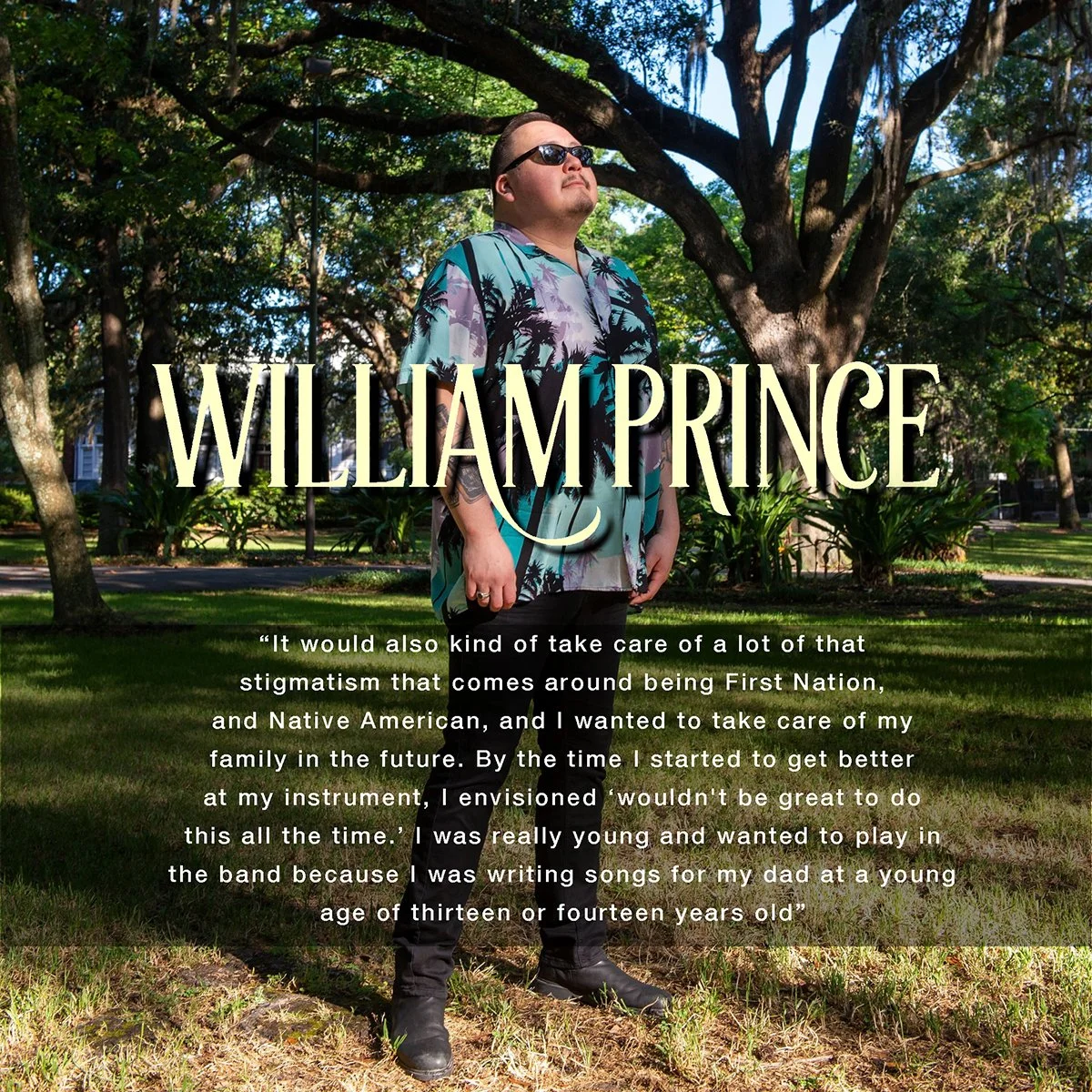
Canadian singer songwriter William Prince was born in Winnipeg and at a young age relocated with his parents’ to Peguis First Nation Reserve in Manitoba. Growing up, he shared stages with his father, who was a musician and a preacher, and his love of music was further fuelled by his parent DJ business which opened his eyes up to the music of Johnny Cash, Paul Simon, Merle Haggard, alongside the gospel songs performed and recorded by his father. Despite writing songs as a young teenager, Prince did not record his first album titled EARTHLY DAYS until 2015. The following year he won the Western Canadian Music Award for Aboriginal Artist of the Year and subsequently won a Juno Award for that debut album. He released two further albums in 2020, RELIEVER and GOSPEL FIRST NATION, and his latest recording STAND IN THE JOY, produced by Dave Cobb, is a joyful and impassioned stockpile of songs. The album is also a reflection of an artist brimming with contentment and positivity which was quite evident when we recently spoke with him.  

You made quite an impression at your AMA UK show in Hackney earlier this year.

Yeah, it's really nice over there. I love the UK and I love Ireland. I bet you get it all the time but Ireland is truly some of the most gorgeous countryside you could see. It’s a really nice feeling having the Ireland and UK support growing, it’s like a second home to me. Going over there has been very rewarding each time.

Outside of your native Canada and The States, did you deliberately target Europe?

You have to build your audience in other places besides Canada.  It's important that we extend our reach to other places that appreciate this kind of music. I found that the people in Europe have just been so receptive. I got such a huge break when my song Breathless was the Vodafone hold music for a couple of years and that kind of brought me over there ahead of time.  I think especially the Irish just have a real love for storytelling and songwriting, it’s a part of your tradition. It's also a part of First Nations culture, to tell stories and sing in this way and I think that's why we connect the way we do.  I actually started building over there before I started building in the United States. It continues to grow in a really great way and that excites me for the future because it's a beautiful place and I love the culture and I love a lot of the people. When people come to shows over there, it feels very respectful and it's just like shows in Canada. That’s the beauty of it.

I understand that you were playing tambourine on stage with your father from a very young age.

My dad started teaching me guitar when I was about eight or nine years old and before that I took to the tambourine. That’s the way I could play in his country band as I didn't have enough proficiency on any other instrument at that stage. But it taught me rhythm, which was really important. His influences are always felt around me, I still love all the music he loved when he was alive. And he taught me so much about singing, about how to string a guitar and all those things. My foundation was very much built around his love of music.

I believe if your parents also had a side-line DJ business. That must have given you the opportunity to listen to a lot of music.

Yeah, they would go and play music at weddings and different receptions. I guess that was an unknown privilege to me at the time to have a house full of music where I could pick anything off the wall. They say not to judge anything by its cover, but that's all I was doing when I was a kid. It was like ‘this album cover looks interesting.’ I'm thankful for that. So, I guess music has been a part of my life since I was just a kid.

As a teenager, did you rebel against the music your parents were listening to and playing or did you embrace it?

Largely embraced it.  I was a teenager when I was part of what would have been my dad’s church country band that he was leading and singing. He was a preacher when he was alive and that was my first exposure to song writing, song structure and traditional music.  And then, of course, when I wasn't doing that, I would have been playing Metallica and all the hard rock stuff that teenagers would do, but he was really great about that, he wanted me to explore it all.

Were you always going to pursue a career in the arts rather than an academic direction?

I was actually very much geared towards an academic career, I wanted to be a doctor. That was my first dream because I thought of the financial stability that comes with something like that and the respect that comes with a position like that. It would also kind of take care of a lot of that stigmatism that comes around being First Nation, and Native American, and I wanted to take care of my family in the future. By the time I started to get better at my instrument, I envisioned ‘wouldn't it be great to do this all the time.’ I was really young and wanted to play in the band because I was writing songs for my dad at a young age of thirteen or fourteen years old, writing gospel songs that he could sing on his records. From there, it just became the thing I found myself doing all the time. Since I was that age, it's been years of always thinking about songs, always writing songs, and it's just the thing I do now.

There appears to be a great amount of support for the arts in Canada. Was that beneficial to you as you built your career?

Of course. When you're starting out, exposure is gold at the beginning, but it's also nice to get paid, and Canada allows for both. Both of those things happen because we have so much grant funding for the arts because we value it in our country. We recognise that art is life and I'm happy that we have that here. I've toured the States just on tickets and you’ve got to pay the sound guy at the end of the night and you might walk away with a hundred bucks, which, if you're lucky, will get you to the next show. What's really great about the Canadian system is that we have a great folk community that will present shows so that you can show up to a city and play to that city's audience, rather than having to bring your own. I owe a lot of my growth to those folk festival communities presenting shows all year round, the Calgary Folk Festival also does a winter version, and a summer and spring concert. It’s the same in every province across the country. And it allows you to go and grow an audience rather than having to bring one to your show and then you get paid on top of it. So, that's a pretty great system that they have going on.

Dave Cobb produced your new record, STAND IN THE JOY. You worked previously with him, that obviously was a rewarding relationship?

Yes, I love his musicality and his sensibility for song. He's just such an easy hand too, which is really good for me presenting the songs to him. He's always excited about new songs and he's very keen in making music in a certain way, has a very set intention and a clear vision for each artist that he works with. He will always meet you in the middle. We had done things in the past together and it felt like the right move now to go make a full-length with him. I just love the music he makes; he makes most of my favourite records these days.  He understands that we're not here to make hit music all the time. We're here to make really great music that resonates with the people that are keeping that music alive, he cares about that a lot. You feel that when you're with him, he's just a very down to earth guy. We're both just country boys with a love of music. Our friendship has grown and it's conducive to good music.

Tell me about the background to the songs on the new album?

This album is about my love, a love letter to my wife-to-be. It’s about how I feel right now, in a place where I feel joy and happiness. I'm just obsessed with the concept of how much time we have left, while still enjoying life. Legacy is a word I've used a lot while talking about this record and I think this is a definitive collection of songs for me.  It reintroduces me, aside from songs of grief and having to live through a lot of hardship that I’ve written before.  It's not just about surviving, we're thriving, and it's truly the joy in my life that I get to do this record. I have a really great family so why not share what makes me happy and make a record that's still very serious with its intention. That is exactly what I wanted to do. I think that's what we accomplished here.

You’re about to embark on an extensive tour with The War and Treaty. Their country/soul sound is very similar to that of Yola, who you previously toured with. Is that purely coincidental or by choice?

It’s coincidental. On one of my first big tours, Yola brought me to that beautiful theatre in Dublin, The Olympia, what a place to be. She's so great and I think we are all kin when it comes to that country soul sound. The War and Treaty were kind of the natural fit because they had just finished making a record with Dave Cobb when I arrived in Savannah, Georgia, to work at his new studio on my record. I actually made friends with Michael and Tanya (The War and Treaty) in Germany, I love what they do and I'm blown away by their shows. So that was an easy ‘yes’.

Interview by Declan Culliton

Spencer Cullum Interview

April 7, 2023 Stephen Averill

 It’s 10 am in Las Vegas when Spencer Cullum joins my Zoom call. He’s coming to the end of a three-week residency playing pedal steel guitar in Miranda Lambert’s band in Nevada’s Sin City. It’s a different world to Romford, Essex, where Spencer was born and bred but a pointer towards his professional progression following his move from the UK to Nashville. Alongside his stage and studio work as a sought-after hired hand, he’s also a member, alongside Jeremy Fetzer, of the Nashville-based psychedelic instrumental band Steelism. A further string to his bow in recent years has been his self-penned COIN COLLECTION records, the first of which was released in 2021 and is about to be followed in a few weeks’ time by a further selection of alt-folk, psychedelic rock and free form jazz.

How are you enjoying Las Vegas?

I'm not the biggest fan of it, to be honest. It's a bit of a rough town. We’ve recently had a shooting at the hotel. I was playing a show two nights ago and we had a lockdown at the hotel and a fourteen-year-old kid was murdered. I was chatting to people in the band and they're like: ‘Oh, that is the norm now.’  

You play there regularly in Miranda Lambert’s band.

Yes, Miranda has got a Vegas residency, which is really fun actually. The best bit of Vegas is the ninety minutes on stage. We do a three-week residency here three times a year.  It’s great being able to balance what I’m doing with Miranda and my own music and tours.

How did the Miranda Lambert connection come about? 

Ian Fitchuk, who is now a producer - he has produced Kasey Musgraves’ records - was the drummer who played on Miranda’s studio records. I was working with him in the studio a lot and he gave Miranda my details. She was looking for a steel guitar player to tour with and her band leader gave me a call and I’ve been with her for quite a while now.

I recall seeing you play with Jeremy Fetzer in Steelism at an in-store show in Grimey’s record store in Nashville when it was located on 8th Avenue South about eight years ago. Is Steelism still alive and kicking?

Yes, but we haven’t done too much recently. We took a bit of a break; I was touring a lot and Jeremy was doing other things but we’re planning to get together again towards the end of the year.  It’s really good fun playing live and we’ve done a few records. Instrumental music is freeing but you also want each record to feel a bit different so we need to think of what we want to do next.

Tell me about your initial connection with pedal steel. I don’t expect that Romford was the hotbed for the instrument.

No, it’s not exactly the mecca of pedal steel.  I got obsessed with pedal steel guitar after hearing Torn And Frayed by The Stones and hearing pop and rock from the 60s and 70s that had pedal steel. I actually bought my first pedal steel guitar from a guy called Ted Nesmith, a steel guitar dealer in Drogheda in Ireland. I bought this old showboat from him. I was going through all my vinyl records looking out for pedal steel players and I came across the U.K. steel player B.J. Cole. I tracked him down at a London show and asked him to teach me. From then on, I just got sucked into it.

What were you listening to at that time? 

Humble Pie, a lot of Beck and the Burrito Brothers were a big thing for me. They were my first sort of inkling into the West Coast Country sort of country. 

Had you been playing guitar before pedal steel?

Yes, I played guitar beforehand in a number of bands around London. There was one band that allowed me to practise my pedal steel in a few pubs in London which was a start because when you start playing pedal steel it can sound like you’re killing cats.

Did you take formal lessons with B.J. Cole?

Yes, formal lessons. He really helped me out and we became good friends. I gravitated towards playing traditional steel but using it in different types of music. BJ always pushed me forward in that direction. I then started playing in a lot of Nashville bands that were touring Europe. That led me to move to Nashville and having to learn more country pedal steel stuff.

You toured the States with The Deadstring Brothers before moving to Nashville.

I did. I would have done anything to tour and play pedal steel in a band so I got to tour in America with them. I was much younger then so it was fun, sleeping rough wasn’t a problem as long as I was playing music.

Was relocating to Nashville a conscious career move?

Yes, after playing with The Deadstring Brothers I moved back to Whitechapel in London for a while. I started playing with Caitlin Rose, she was doing really long tours in Europe and getting a lot of good press. Her guitar player Jeremy Fetzer and Caitlin convinced me to move back to America and Nashville because she was recording there. I moved in with the singer songwriter Andrew Combs and it felt really encouraging in Nashville as there was a nice group of people and I was getting a lot of work. It seemed to be easier than lugging my steel guitar around on the tube in London – it’s a heavy instrument.  

Was being from the UK an advantage or disadvantage in getting work in Nashville?

I feel it was a little bit of an advantage because I think they liked my sort of approach to the instrument as it was similar to BJ Cole. I definitely had to quickly learn Nashville country numbers and to play quicker to get more work. When I was playing on records that I could branch out on, they definitely liked that. I think they were more intrigued by my playing than the typical Nashville player, no disrespect to that wonderful world of Nashville players. I think that adding pedals and adding effects and whatnot, is still frowned upon in some circles there but it worked for me. But definitely moving to Nashville made me learn more about the traditional steel guitar world to have in my pocket.

 COIN COLLECTION 2 is being released in May and is in a similar vein to your debut album as it explores a wide range of musical styles but in particular UK classic folk. Were you listening to that genre growing up?

When I was about sixteen, I definitely loved my Canterbury scene sort of music. I was a huge Soft Machine fan and loved bands like Gong but also a lot of folk artists like Bert Jansch, David Graham and Fairport Convention. I had been touring before the pandemic and feeling a bit homesick and lost in the States and I became intrigued in writing that style of music and trying to create an identity for myself. When the pandemic hit, I would meet up with a guitarist in Nashville called Sean Thompson and we would hang out and listen to and play a lot of that music. 

As well as Sean Thompson and others, you’d had Erin Rae and Caitlin Rose record on your albums. Can you take the credit for introducing that music to those artists in East Nashville?

Surprisingly, no. Erin and others were already into it, which was great. I had seen Erin play at The Fond Object and I thought she really had a Sandy Denny-type voice. Caitlin has amazing musical influences so it was easy to get them to play that music because they were already into it but hadn’t actually played it before. 

 The track Betwixt and Between, on the new album, is classic U.K. late 60s folk.

We had a Halloween fun horror night in Nashville with Erin Rae and Andrew Combs and covered The Wicker Man soundtrack. It was so much fun that I decided to write Betwixt and Between along those lines. Even though Erin is from Tennessee and can sing amazing country songs, she can also do Sandy Denny and Shirley Collins well.

Given the personnel involved did you record the songs on COIN COLLECTION 2 piecemeal?

It was tracked in two days with the band.  We got the drums, bass, flutes, clarinet and guitars all down in those two days. It took me some time to get the overdubs because I had to reach out to Tokyo singer Yuma Abe to record over there and it took some time to get the other singers to overdub as some were touring. 

 Have you toured the new material in The States yet?

I don’t really tour in The States so it will be April and May in Europe. I’ve done one-off shows in Nashville, Vegas and L.A. but I’m more intrigued to tour in Europe, it’s so much easier. We’re doing quite a long run. As well as Ireland we’re playing London, Brighton, Leeds and Glasgow. Before that, we’re doing Cologne, Copenhagen, Hamburg, Paris and Belgium. It’s a lot of driving but over here a short drive is nine hours, so I’m looking forward to it. I’m also back over to the UK in August to play The Green Man Festival in Wales and I’ll probably do some shows before that festival. I’m actually terrified of being a singer songwriter, it scares me a bit. I’m used to hiding behind the pedal steel.

 Who will you have on stage on tour?

It’s me, Sean Thompson and a guy called Rich Ruth, who is an ambient free jazz composer. I’ll play pedal steel, guitar and sing, Sean will be on electric guitar and Rich on synths and also guitar. It’s different instrumentation but it’ll be fun, we’ll bring an Eno aspect to the music. I’ll try and fit a few of Sean’s songs in the set too, it’s an opportunity for him to do his Jerry Reid, Richard Thompson thing.

Is Nashville home for you now?

Yes, Nashville is home for me, my wife and our two dogs. My wife runs a really cool bookstore in East Nashville that just opened recently and I’ve been helping out a lot with that, sanding floors and doing some woodwork.

Interview by Declan Culliton

Spencer Cullum plays Kilkenny Roots Festival on Friday 28th April and Whelan’s Dublin on Saturday 29th April

Brit Taylor Interview

March 14, 2023 Stephen Averill

‘Well, everybody plays with the cards they're dealt, everybody's gotta work it out for their self, and I wouldn't wanna be anybody else but a workin' girl,’ announces Brit Taylor on Rich Little Girls, one of the standout tracks on her recently released album, KENTUCKY BLUE. No throwaway line, it’s a truthful reflection from an artist who has experienced the highs and many lows of surviving in the cut-throat and unforgiving music industry in Nashville. Like many fellow Kentuckians beforehand, a music publishing deal soon followed her arrival in Music City. But her career soon turned sour when she became disillusioned with the controls being placed on her writing. Ditching the deal, Taylor also had to confront a broken marriage, losing her band and the prospect of also losing her house. Rather than close up shop and head back to Kentucky, she dusted herself down, regrouped and financed her independently released debut album REAL ME by hard graft and long hours cleaning houses and churches. A deluxe version of that album followed a year later in 2021 and in February of this year came the release of her David Ferguson and Sturgill Simpson co-produced album, KENTUCKY BLUE. The icing on the cake for Taylor has been an invitation to perform at The Grand Ole Opry, a further indication that her talent, combined with a steel-edged work ethic, is finally yielding the rewards she truly deserves.   

Firstly, congratulations on your new record, KENTUCKY BLUE, which is my most-played album of this year so far.

Thank you so much. I'm so glad you're playing it and that you like it.

Apart from recently releasing the album, you also had a resident DJ slot on Gimme Country which I enjoyed. Is that a side project you intend to pursue in the future? 

No. I was so nervous. Jimi Palacios from Gimme Country was really sweet to help me out and teach me how to do it. I'm not much of a DJ.

Loretta Lynn, Patty Loveless and Crystal Gayle are country music royalty from your home State of Kentucky. Kelsey Waldon, S.G.Goodman and Brit Taylor are the current women flying the Kentucky flag.

Yeah, I love S.G.Goodman and Kelsey Waldon. I just got to go on tour with Kelsey for a few shows and it was a lot of fun. She's really talented.

Tell me about your journey from Kentucky to Nashville.

I moved to Nashville to follow in the footsteps of Loretta Lynn and Patty Loveless. I had started writing songs myself but when I would take the lyrics out of the jewel case from the CDs I was buying from Walmart, I noticed that there were names under all the song titles. So, I quickly learned that there were songwriters that were writing the songs and that it wasn't always the artists.  I thought, I really want to do that, too.  I really just wanted to learn how to write great songs and get other artists to cover them and cut records for myself.

You got your publishing deal but after a while, you realised that to quote yourself: ‘You’d rather clean shitty toilets than write shitty songs any longer.’

Yeah, I think that Nashville eventually just became something that I don't think I would have moved to that town for. I probably would have stayed with my family in Kentucky if I'd known Nashville was going to change like that. I don't mind music being different and music that I don't like, because there are obviously a ton of people that do like it. But it came to a point where there was no room for anything else but a certain sound and no room for women all of a sudden and that's the thing that bothered me. I don't care if things that I don't like get played, if other people like it, that's fine, but everybody was just aiming for the same sound and it just got monotonous and really boring.

Did you ever reach rock bottom and feel like packing your bags?

Multiple times. Nashville is just a crazy town and one minute you feel like you're on top of the world and somehow simultaneously you feel like you're sinking in quicksand. The meltdowns are a daily occurrence and it's just a matter of being able to get your mind straight and really focus on the things that are happening, the things that are really important. The important thing to me right now is that I've made a record that I love, I've done it the way that I've wanted to and people are hearing it. I'm proud of that and I'm just thrilled. I know how lucky I am to have been able to do this.

Fortunately, you did brave it out.

Yeah, something said to me, stay here. At one point I made a phone call to a buddy, a long-time mentor of mine and asked if this was the time to pack my bags. He said ‘no it’s not’ and actually happened to be in town from LA that day. He said ‘let's go to lunch, I got somebody I want to introduce you.’  He introduced me to the producer Dave Ferguson that day.

Have you felt pressurised to go down the commercial pop/country crossover that is the mainstay of country music radio in America?

Not anymore. In my early 20s, I really felt pressured to do that, because when I got to Nashville Spotify wasn't a big thing, and releasing your own music wasn't really a possibility. Around 2015 and 2016 I figured out that the power was kind of back in the artist’s hands and out of the label’s hands, because all of a sudden, there was nobody there to say no.  It's still hard, there are lots of excuses you can make not to record your own music because it's very expensive. It's a lot of work and terrifying because it doesn't pay you back immediately, if ever. It’s a big risk and a big investment to believe in yourself. But I knew that I had to do it because I wasn’t finding that big record label that was going to do it for me.

You self-released your debut album REAL ME in 2020. It was written at a time when you were dealing with a number of personal problems including a broken marriage. What were your expectations for the album?

I didn't really have a lot of expectations for it. I just knew that I moved here to release music that I loved and I made a record that I loved, and I was going to release it, whatever happened.  My main goal was just to be in control of my own career and the music that I write, how I want to release it, and how I want to introduce myself to the world. My main goal was just to be authentic in who I am and see what happens from there.

KENTUCKY BLUE has been released three years after REAL ME. Are you working towards a three-year cycle for releasing records?

I always want to release records and I feel like I can never get them out soon enough.  We actually finished tracking Kentucky Blue back in 2021 and then everything kind of slowed down.  We were trying to find the right time for the release when you’ve got all these other album releases coming out. We stalled for a year but I think that everything happens for a reason. It came out exactly when it was supposed to and now I'm itching to make another one already.

Stuart Duncan’s fiddle playing is all over KENTUCKY BLUE. It kicks in within seconds of the opening track Cabin in the Woods. It instantly reminded me of Tyler Childer’s wonderful album COUNTRY SQUIRE and very much a Kentucky statement on your behalf.

Yeah, I love Tyler’s record. Stuart Duncan is the man, he's the go-to guy. He’s just so great and I grew up on Patty Loveless and Ricky Skaggs, songs with fiddle all over them. I just wanted to get back to my roots and some of the stuff that I love. I really love that retro sound and I wanted to combine all the things that I love, some of that retro pop country from the 50s 60s 70s, and then some of the Appalachian bluegrass vibes too.

The combination of David Ferguson and Sturgill Simpson producing was also a master stroke. Sturgill tends to be quite experimental with his own recordings. Was he totally committed to the musical direction that you wanted for the album?

I think that's what makes Sturgill such a great producer. He is experimental on his own stuff. If he wants to make a country record, he’ll make one and if he wants to make a rock record, he'll make a rock record. I was very clear that I wanted to make a country record and that's why he and David Ferguson worked so well together. They knew exactly what my record needed to be. I don't know if there's any way you could even make those songs anything other than what they are. They're just written that way, they might sound a little silly if we had put some crazy beats or rock and roll guitar on them. It just wouldn’t really fit the lyrical content or the feel of the songs.

The track Rich Little Girls on the album sounds like it was written from real-life experience for you.

Oh yeah, when I was putting out that first record, I was cleaning churches in the middle of the night and getting up early in the morning to write a song and then going back to clean something else. It was just a really frustrating time. But it was also a big blessing to have that work because that's how I paid for my record.  That song, Rich Little Girls, is my life in a nutshell. I think if it were in the 90s Patty Loveless would have recorded that song.

You appear to be pointing a finger at Nashville on the song No Cowboys.

I was with my husband and we were on our way to Music Row to write a song with our buddy Nick Autry early one day. We passed this pickup zone for a pedal tavern downtown and there was one of those pedal taverns full of bachelorettes and they were already drunk and hollering. I just looked to my husband and I said, ‘I hope they didn't come to this town looking for cowboys because there ain ‘t none left.’ Adam started laughing and said, ‘Honey, I think that's the song we're supposed to write today.’  So, we wrote it and it quickly became one of my favourites.

You brought Matt Combs on board to oversee the strings on a number of tracks, giving them that classic 60s Countrypolitan sound.

Oh, yeah, definitely that Bobbie Gentry sound.  Matt Combs was my first call for the Christmas song, Lonely On Christmas. I released it with Mike Harmeier from Mike and The Moonpies and my husband and I produced it. I sent Matt a few Bobbie Gentry references for that song – I even sent those references to Nick Autry who mixed the song because that was the sound that I wanted.  I love that sound on Glen Campbell and Bobby Gentry records and it's a challenge to really try to blend that with the Appalachian things that I love.  I think Sturgill and Ferg did a really good job of blending it all together on the album.


There were some heavy hitters in the studio alongside Matt Combs and Stuart Duncan. Dave Roe, Myles Miller, Russ Paul and Mark Howard all contributed. Was it a collective decision to get these players on board?

Yes, we all had people in mind and then we just kind of threw all the names in the hat and decided together. 

How important was having the support of the Thirty Tigers label for the album?

Thirty Tigers is a dream. When I put out my first record I would have loved for them to have put it out but I didn't really have a way into them as I didn't know anybody over there. When David Ferguson said he’d produce my record he said he’d ask Sturgill to co-produce. I just said ‘I can't afford you guys, I have no money after I put that record out last year and will be paying for it for the next 30 years.’ I was like, ‘I can't pay for it. I don't know what to do.’ And Ferg told me not to worry and that we’ll figure it out. Next thing Sturgill got on the phone with Thirty Tigers and told me we're all just going to figure this out together. Thirty Tigers have been a dream to work with, so supportive and real cheerleaders for the record. I always tell everybody at my shows that there are so many people in Nashville that will make you big promises and I mean, huge promises. ‘I want to make you a star.’ I think that they mean well and obviously want to do those things, especially when they've invested in you, or signed you to a publishing deal, or signed you to do this or that. They want that stuff to happen and make these big grand promises with the best of intentions but they can't do shit about them. Sturgill and Ferg and Thirty Tigers can.

The album’s front cover has Loretta Lynn era 70s all over it. Your costume, the rocking chair, the guitar, and even the dog on the front porch reflect that dynamic. Was that your intention?

Yeah, I wanted it to be very Appalachian very Loretta, but a little darker than Loretta. I wanted it to be almost a little scary, like a kind of Appalachian witch woman. That's what I told the photographer and the stylist and they nailed it. The number one rule was that my dog was going on the cover, so he’s there. His name is Whiskey, he’s my baby.

There appears to be a growing audience and appreciation for authentic country music amongst younger people in recent years.

Oh, definitely. I think that the more traditional style of country with this fresh new twist is growing and I think it's unstoppable.

Your album launch was at The Basement in Nashville last month. How did that go?

It went great. I was so afraid that nobody would come. I was so tempted to just play it for free but my agent was like ‘No, you need me to charge for tickets, let people buy tickets, then you'll be able to pay your band and you won't be so stressed out.’ I was afraid that we'd have twenty or thirty people there, but we sold the place out. I feel like I have a really good support system in town. I'm really involved in the song writing community and I feel very lucky to have a lot of friends that show up for me and I show up for them. There's a community of really awesome people in town right now. 

What plans have you got in hand to tour the album in the short term?

We’re doing a run at the end of March and one in April with Brent Cobb. I'm so thrilled, I've been such a big fan of Brent ever since he had that Lee Ann Womack song come out, Shot On A Rainy Day.

Any plans to get over to us in Europe?

I hope so, I have actually never been to Europe. I cannot wait. I'm just itching to get over there.

You also have a booking to perform for the first time at The Grand Ole Opry

Yeah, it’s a dream come true. It’s the one thing that I've dreamed about forever.  I know most girls grow up dreaming about white dresses and getting married and walking down the aisle. I’ve just always dreamed about singing on the Opry stage.

Interview by Declan Culliton

Interview Archive: JP Harris (first posted on 29th May 2015)

March 11, 2023 Stephen Averill

In the light of JP Harris’ latest tour of Ireland promoting his most recent album Don’t You Marry No Railroad Man, which he recorded with Chance McCoy, it was suggested that we repost an interview we did with JP when he first toured with his honky-tonk band. Picture below taken during this recent visit where he played with John R Miller and Chloe Edmonstone.

He was born in 1983 in Montgomery Alabama, which claims it is Hank Williams’ Snr. hometown. “You know the song (Kaw Liga) about a wooden Indian statue? Well my parents used to go to a diner where they had that wooden Indian that he wrote the song about standing outside”. But it was in punk rock where JP first made a musical mark and that experience was a formative one. “I’m still a punk rocker at heart. I think that the DIY ethos of punk music and culture is what really stuck with me in my later life. It drove all the decisions I made outside of music. I feel fortunate to have grown up in my teenage years in punk. I gained a lot of useful life skills from it”. I wondered; was he influenced by the 80’s cowpunk movement at all? “Well my whole crew listens to a lot of different stuff and there was so much of that hillbilly/outlaw stuff crossing over into what we did. There was a peripheral rockabilly scene but we were really into a more 70s and 80s stuff from England and Sweden. I’d heard country music a lot when I was growing up. But it was when I left home at 14 that I started to identify more with the Johnny Cash and Hank Williams message. It started to make sense to me a little more”.

We talked about our respective musical paths and my involvement with punk through my band The Radiators from Space. I told him of my journey to country via punk and electronic music. JP explained how for a time he moved away from loud electric guitars and listened to a lot of old time music. “There is an inter-connectedness with all times of music, but there was a time when I was disillusioned with punk. I think I grew out of some of it while other parts of it I still absolutely loved. It was more I grew out of the culture of inaction in the scene. There was a lot of rhetoric that wasn’t backed up. So when I was 16, I left cities for good”. He spent the next 13 years living in the country where he did a variety of jobs including logger and carpenter as well as working with heavy machinery such as bulldozers, and also a time sheep herding for some Navajo ladies. In the live show he spoke of an injury sustained while trying to multi-task - hauling a bulldozer balanced with logs while trying to text a girlfriend!

He listened to lot of early country music and immersed himself in old time string bands and at 18 he started to play the banjo. He also then worked with a banjo maker learning how to build them. “That became an all consuming life for me. All I wanted to do was go to fiddler’s conventions all summer long and play music till the sun came up. So, at that time, I was really opposed to plugging anything in, even people putting pickups on their guitars”. He played at a lot of square dances playing around the single condenser microphone the way it had been done in the past. “I reset my musical clock. I’d started with music from the Civil War and earlier and progressed through the Carter Family. It’s a very powerful community and I basically forged my career out of that old time music. The more I became a singer the more I began to get into the country and bluegrass stuff and that progressed into the kind of country I play now”. That sound incorporates some western swing and 70s country as well as Bakersfield, outlaw and truckin’ elements. It is an overview of classic country at its best.

JP began to notice that many of the people he played with also played with other bands. He has toured as a duo with Chance McCoy opening for Old Crow Medicine Show. “I became aware that they played old time as an inner passion but had other options to play”. He knew that he had a base of people who potentially would come and see him because of his reputation in the old time music scene. That spurred him back to the idea of playing electric music again. He misses that side of his music but will doubtless revisit it again. I mentioned how JD Wilkes had balanced his work as a solo artist with the Dirt Daubers and The Legendary Shack Shakers. “Over the years people have asked if I’m ever going to incorporate any of the old time stuff into the set. But while I love that stuff, it was more to do with the community aspect and [while] I do appreciate the people who perform it professionally, it has never called to me although I had an old time band just before I started this”. He had realized that in playing the acoustic music outside of that community, he was beginning to water it down. “We were used to playing banjo tunes for 5 to 10 minutes and now they need to be around 2 minutes. When me and Chance got together to tour that was a way to step back into that, but with his schedule with Old Crow it’s a little harder”. But it was an opportunity for both to step away from what they were doing with their main bands. “It was a way to reconnect with that music”.

Bluegrass and old-time have obvious similarities but JP reasoned that bluegrass was more of a performance format while old time was meant more for dancing to. Both, for him, are more oriented to a back porch setting that to bars and smaller venues. He sees the music growing as an important part of the music developing and noted the inclusion of drums to the Old Crow lineup as adding a new dimension to their sound. As is the bringing in of pedal steel - an instrument I have seen but not heard in the mix at recent more mainstream acts gigs. “Jimmy Martin used have a snare drum but then there was this weird new traditions thing that didn’t allow it”.

Much of the old time music was used as dance music and what he does with The Tough Choices is similar. Indeed back in the States people nearly always dance at the gigs. Not so here though, as we are often more reserved at gigs and being seated doesn’t usually help. But there is another side to what JP is doing. “For me playing country music is that it is just as important that it be a community function as it was when I played old time music”. He thought that musicians often evolve by pushing the limits of what they do, and try to reach a broader audience by branching away from traditional county which is something that, at this point, he has no intention of doing. We discussed the current crop of major label acts who add rap and soulless rock to their definition of country, while alt. country acts should also shoulder some responsibility for taking the music away from its roots. Some of those albums were really just singer/songwriter style, which may have included a banjo or steel guitar, but that didn’t make them country. Country really can’t stray too far from its roots before it becomes something else. There’s nothing wrong with that, but it belongs in another genre. JP thought that “over the last three or four years I have really softened that edge, it’s the same detriment to a style of music that to reference it by name but to water it down by bringing in a lot of other influences so it barely resembles the original thing. Adding a Telecaster doesn’t make a country band in itself, that would be like saying that the Drive by Truckers were a traditional country band which they weren’t. The same thing is true of modern pop country. It would be great if we could name what we do as hillbilly rock or something”.

“The biggest crime in the whole thing and I’m not going to feel bad for myself about it is that there are a ton of people for whom it is almost a family tradition to be country music fans. Their parents and grandparents listened to country music so they’ve just grown with it and they don’t hear it”. He knows that there are a lot of people coming to his shows who tell him they are so sick of what’s being played on country radio, that 1 in every 40 songs is a country song. But he also feels that there may be recognition of the fact that there is an audience for something truer. The success of Sturgill Simpson is an indicator of that. As is Jamey Johnson, who he feels makes music that is very commercial and modern. “There’s a message, a vocal style and a song writing capacity, that is very true to the original themes of country music in what he does even if he has a glossy Nashville production and some rock guitars in there. I think that the doors are going to have to slowly swing open”. Amen to that. JP hopes for a time like that when Dwight Yoakam got through the cracks and showed that there were alternatives to the mainstream that could still sell a lot of records.

There was a time in the 90s that he felt the older generation could hear in Alan Jackson or Randy Travis a continuation of the music they loved, but would now not recognise it at all. I know from experience when you went down to Robert’s back in the day, there were couple in their 90s dancing along side 19 years olds which is something that wouldn’t happen now outside of some small local honky tonk when the right type of band is playing. “Nobody’s grandparents particularly want to listen to Jason Aldean” he opines.

I asked JP about the sort of country he felt most at home with and he said that he’d been aware of the 40s and 50s music for a while and there were a number of bands that reference that era very closely in sound and who were perhaps a little stagnant. He never wants to be pinned down in any one sub genre of county music and he felt that in some ways he has ruined old time music for himself. He explained “Once I went on tour with this old time band in bars and clubs and I realised that while this is the environment I wanted to be in, these instruments don’t have the power to hold their own in these places”. He had been listening to a lot more of the 60s and 70s country and it had opened his mind up to that music. “I feel that the 60s are really the heyday”. We talked about Buck and Merle and that Bakersfield sound. (JP Harris has in recent time become friendly with the great Red Simpson and plays Simpson’s songs in his live set). “You had hillbilly bop and honky tonk two-step which then led, at the tail end of the 60s, to the outlaw sound”. The airwaves were open to hard Buck Owens next to the Beatles next to Otis Redding on the radio; an openness that now, sadly, for the most part has been lost. It was an era he felt that revolutionised and revitalised the music. Times were changing and that was having an effect on songwriting too “the lyricism then became a little deeper, people were better educated so writers could be a little more analogous about the stories they were telling”.

On his new album there is one song he said the band call the “arena hit” because it could be a George Strait song from 1983. Then there are songs that sound like they could be from 1962. He doesn’t feel the need to pigeonhole himself to one sound. He hopes that the recent success of the indie label which released Simpson, an act whose music he really admires, might become even more so when his next album on Atlantic Records is released. “I think Sturgill covered a wide range of topics and sounds on both his albums. County music often recycles sounds and themes and there’ve been psychedelic country records in the past, but no one has done that in so long and he did it with a cool, individual approach. He and I had several conversations about the music”.

He concluded by saying “my music is personal and is current. I’m not just trying to recycle the same ideas. The title track of my first record is about an answering machine. Back then in 1960 when the sound of that song was set, an answering machine didn’t exist”. In other words this is an evolving music, one that remains true to JP Harris, his life and the language and mores of today, yet it would be recognisable to someone who was a fan back in the 1960s. That’s the way it should be.

Interview by Stephen Rapid   Text editing by Sandy Harsch  Photography by Ronnie Norton

Additional Photograph by Kaethe Burt O’Dea


Kaston Guffey Interview

February 28, 2023 Stephen Averill

Photography by Will Payne Harrison

My Politic is the Folk/Americana duo Kaston Guffey and Nick Pankey who grew up together in Ozark, MO and started creating music at High School. With the release of their latest album, MISSOURI FOLKLORE: SONGS & STORIES FROM HOME, the duo has taken their talents to a new creative peak. This is music for the mind and the soul. We recently caught up with main songwriter Kaston Guffey and asked him to reflect on the journey that has taken My Politic to their current status of one of the most promising bands on the circuit over recent years.

Congratulations on the release of the new album - MISSOURI FOLKLORE: SONGS & STORIES FROM HOME. It was released in December last year and I wonder about the timing. Was the media response impacted by the clash with the Christmas festivities?

You know, it’s always hard to decide when to release something. This is an album that we had planned to record back in 2020 but things went in a different direction with the pandemic and everything shutting down. We ended up writing, recording and releasing a whole other kind of album (SHORT-SIGHTED PEOPLE IN POWER) and waited on this one. It ended up working out for the best and I think I had written three to four more songs that ended up on “Missouri Folklore,” some of my favourites on the record actually. We recorded it in March and April of ‘22 and felt like we ought to get it out that year, so we picked December. I figured we’d have a couple weeks before outlets turned to holiday fare but given the year, it seems like the cut-off was the week before. Win some, lose some I guess. All that said, the album has been received very warmly and we appreciate everyone that’s been listening and spreading the word. We are as independent as they come and every person listening/talking about it is vital, so eternal thanks to all those that have helped spread the word.

This represents your ninth official release. The new album includes fourteen songs across very expansive fifty-plus minutes. How long was the project in delivery and were the songs written over a lengthy time period?

I’d say maybe nine of the songs on Missouri Folklore were written between 2017-2020 and another four were written between 2020-2021. A couple of the last songs I wrote that ended up on the record made the concept of the whole thing much clearer. Those songs, Cursing At The Night & At The Morning and Vanishing Vapours really gave us the idea to kinda set the whole album in the Ozarks where we grew up and have it be kind of a tapestry of different fictional and non-fictional characters and stories with varying degrees of autobiographical material running throughout.

It’s a reflection of growing up and the ghosts that linger in memories. The songs are both personal and also highlight local characters that impact on a typical rural background. How connected to your upbringing and youthful memories did you feel in the writing for the album?

I’ve always written a lot about where we grew up and how I grew up. I think some of that has to do with the fact that writing has always been part therapy for me. A way to deconstruct lots of different ideas and things that have happened in life so in that sense I don’t think Missouri Folklore is much different... but I do think over the years I’ve gotten a little better at it. I also started writing this album in my late 20’s. I think it’s just a naturally reflective time in a person’s life, trying to figure out how you ended up the way you have. Of course the last seven-plus years in this country have been very eye opening in so many ways. I was certainly grappling with growing up in an area that was/is extremely conservative and evangelical from this new vantage point, post 2016.

Your early releases; A Few Words I Couldn’t Find Yesterday and Not Gone, Just Asleep were released back in 2008/2009. Can you reflect on how your song-writing has changed from these early recordings, and how does the journey look from those early releases to where you are now as a songwriter?

Nicholas and I started recording albums in high school. I think we started on the first one before I was even 16 back in Ozark, MO. The songs aren’t good by any means but we did learn a great deal. A friend of ours, Blake Brandell’s step dad had a basement studio & he taught us so much about recording our own stuff. Jamie Carter is his name. We did three albums of original stuff down there and he taught us not to wait on other people, to just do the work, record the songs and just keep at it. So we did. With song writing, at least for me, it’s been a long process to get halfway decent at it. All those early songs aren’t good but they allowed me to understand my process early. I kinda see all that early stuff as the material you have to get through in order to get to the better quality stuff. I’ve always been really prolific so I think learning how to write, record, release a whole project at that age really helped us get better, on our own time and in our own way.

You followed up the early albums with the ongoing momentum of YOUNGER STILL (2010), AMERICAN WILL (2012), and LOVE AND A MOTOR HOME (2013). That’s five albums over a six-year period. Was it at this point that you decided to move to Nashville?

AMERICAN WILL and LOVE & A MOTOR HOME were the first two albums we made on our own. Nicholas was hitting the buttons/engineering. We moved to Boston in 2010 and immediately started writing & recording in our 400-square foot apartment. We started singing a lot more harmony at this time and started to listen to a lot more songwriters that had become extremely influential to us. Diving deep into John Prine, Towne Van Zandt, folks we’d not been introduced to as much when we were in junior high/high school. These two albums get a little better, song writing-wise but it’s definitely a period I look back on & see that we were still very green. We had no formal training of any kind so just had to learn what we could, when we could. This is also around the time we started booking tours and getting on the road. Then we moved to Nashville at the end of 2013.

ANCHOR, in 2015, seemed to be something of a breakthrough album. Did you see it that way and did it result in increased media attention?

“Anchor” was the first album we recorded in Nashville. We recorded it at our pal Josh Washam’s home studio and we were basically finding little windows of time to record after I wrote songs and over a few months time, we ended up with nine tracks and released it as ANCHOR. That record feels like the first record of pretty decent songs, we even play God Vs. Evolution and Nobody To Blame on the road, still. It definitely felt like a turning point for us both in terms of the quality of the writing and also the harmonies & instrumentation were more fleshed out. It’s hard to say how much attention it got but it certainly felt like the strongest project that we’d put together up till that point.

TWELVE KINDS OF LOST followed in 2017 and I wanted to ask whether you actually felt somewhat “lost” in the Nashville music scene around this time?

It can be a tough city in which to get noticed. I’m sure that was a part of it... we had basically a full band on that album and if memory serves, I remember actively trying to write songs that were a little “bigger” just to make a fuller sounding album. I think for the most part we succeeded. We tracked it all live at The Sound Emporium and that was a really fun experience.

SHORT SIGHTED PEOPLE IN POWER laid your political frustrations on the line in 2021. It was very much a home recording, during Covid, and I wonder whether your criticism of the Republican Party led to some challenging fallout and closed doors in the very much ‘Red’ state of Tennessee?

That album is such an interesting case. We had plans to record what became about 80% of Missouri Folklore in 2020 but of course everything went out the window in March. Nicholas and I were still living together at the Mad Valley (our house south of Nashville) and since we had no idea when we could record or get back on the road, we decided to lay down songs as I wrote them and release a little ep. I was doing nothing but consuming the news and going to marches. We recorded all of it in Nicholas’ bedroom and it really turned out exactly like we wanted. A kind of document that reflected the craziness of that moment. It was only after; when we actually played these songs in front of folks that we’ve had a few tense situations on the road in the south, but nothing too bad. We play a lot of house concerts in rural areas and get folks that disagree with us but it’s been mostly civil so far. We will see if that continues.

The innate conservatism in Tennessee must have been hard to reconcile with your deeply held political and personal views at that time?

We grew up in the Ozarks, a very conservative, extremely evangelical area and Tennessee feels very similar. I’ve never particularly seen eye to eye with this worldview... The thing is, there are a lot of folks in red states like that that aren’t of that political persuasion. We certainly grew up that way so I like going into places like that and singing songs like ours.

Your song-writing craft has been likened to the legendary John Prine. Whereas this is the ultimate compliment, I have to wonder about the weight of expectation that you feel regarding such comments?

Well, I absolutely love John Prine. He’s certainly had an undeniable influence on my writing. While I appreciate that comparison it’s never crossed my mind that it could be true. I just care a great deal about the process and I want to keep grinding at it and getting better at the things about song writing that I think are deeply important. I’m an atheist, science-y kinda person and while that is true, it is also the case that this song writing/creativity thing feels very close to magic. So I’d like to keep getting to the bottom of that. Nicholas and I talk a lot about the deeper philosophical nature of the whole thing and it’s something that keeps us very bound to the work.

Your heart-on-the-sleeve approach to song-writing has gained you many admirers of your craft. Do you separate the personal from the observational in your writing?

So often, I’m not exactly sure what the song or the line means in the early stages of the creative process...the discovery or the untangling, all of that can reveal something deeply personal or observational or maybe a character sketch or some kind of metaphor. So it feels like it’s all tangled up and I’m just trying to reveal whatever it is. So I guess I would say that I don’t separate the personal and the observational at first. After that, ideas start taking shape and then I can usually see a little of my “personal” self in the thing but hopefully it’s turned into something else as well.
Does the growing popularity for your music in Europe excite, or is it a sense of frustration given the constraints that travelling to new audiences brings since Covid?

Gosh, if our music is growing in popularity over there, we wanna come hang out! I hope that can happen sooner than later.

You recently moved to a new life adventure in Pittsburgh. How has that been so far and having spent close on ten years in Nashville, how do you look back on the experiences gained?

Me and my Fiancé Georgia English (fantastic songwriter and music educator) moved to Pittsburgh at the end of October last year and we are absolutely head over heels for it. Nashville has become so expensive and after Covid, we consistently felt less and less like we belonged there. I mean, one could argue that we never really belonged there … My Politic hasn’t been about playing the game or trying to fit whatever new fad is being fed through the machine. It’s also going in the absolute wrong direction politically. It’s illegal for women and people that can get pregnant to seek an abortion. They are passing law after law criminalizing LGBTQIA+ folks. A lot of wealthy far right media types and bad faith messengers are moving there. It’s just getting worse by the day. Pittsburgh on the other hand… I find myself having so many more intellectually stimulating conversations and stumbling into more alternative art spaces. We’ve met so many songwriters and musicians already. The city and our neighbourhood of Millvale are very inspiring in so many ways. I think the future here is very, very bright for us.

Interview by Paul McGee

Kassi Valazza Interview

February 22, 2023 Stephen Averill

 It’s 10 am local time in Portland, Oregon when Lonesome Highway makes contact with Kassi Valazza via Zoom. An early bird by nature - ‘I usually get up around six, so this is late for me,’ she says - Kassi is between tours, having recently completed a run of solo dates on the West Coast. She heads for Europe in April, for dates in the UK and Ireland, including two shows at Kilkenny Roots Festival. Recently signed to Loose Records in the UK, her latest recording, KASSI VALAZZA KNOWS NOTHING, is due for release in May. Born and raised in Arizona but currently living in Portland, her music on the album is a cosmic journey with gentle and considered ballads plus more diverse and psychedelic inclusions. The album’s title is somewhat tongue in cheek with her studio backing band being TK & The Holy Know-Nothings.

 Was your relocation from Arizona to Portland, Oregon career related?

 No, I actually wasn't even playing music when I moved to Portland. I went to school there to study painting. I had friends who lived in Portland and I wanted to leave home but also be close to home. So, I stayed on the West Coast and went to Portland and I've been here almost 10 years now. I actually only started playing music professionally in Portland.

I understand that your dad was a musician. What type of music was he playing and listening to?

Yeah, my dad was a little bit of a music snob and also my mom was kind of strict about what I could listen to. So, I felt that it was easier to just listen to whatever they were listening to. My dad listened to a lot of folk and country music. He grew up in the 60s and bands like Jefferson Airplane and Crosby, Stills and Nash were really big influences for him. That's kind of what I was hearing. 

I can hear a lot of West Coast 60s music in your work, but also UK folk music from that decade with Sandy Denny certainly coming to mind.

I actually didn't grow up with Sandy Denny or Fairport Convention’s music. It wasn't something that my dad was actively listening to in America. I found that stuff on my own and over the years I’ve fallen in love with that electric folk sound. It's incredible.

Whereas many of your peers might quote Townes Van Zandt and Joni Mitchell as their main influences, you’re more likely to make reference to the lesser-known but hugely talented, Michael Hurley.

Yes, I got to know him through Portland. One of the first shows I played in town was opening for Michael Hurley and he completely blew me away. I'd never seen somebody able to play music in any kind of way like him.  He'd either have a sax player with him or just a bass player. He always has these weird combinations of performers and ensembles of players and it always sounded so interesting. You'll still never hear anybody like him. He's completely his own creature, which I love about him as an artist. I think that's what makes a really incredible artist, somebody who sounds entirely like themselves.

He's been recording music back to the mid-70s and yet he is still very much an underground artist.

Which is also why I love him. I don't think his intention was ever to get famous. I think he just does stuff because he likes doing it and I think that's often where really good music comes from 

There seems to be a vibrant music scene in Portland with The Laurelthirst Pub very much the centre for alternative roots music.  Looking at their listings I see that Jerry Joseph, TK & The Holy-Nothings, The Pine Hearts and you are all due to play there soon.

Oh, yeah. And that's where Michael Hurley plays all the time too. We're really lucky to have that space. I've had an excellent time playing shows in Portland, everybody here is so supportive of the arts. Even during COVID, they were trying to find ways to safely put on shows and support musicians. I feel like we've been doing great here. 

Your last full-length album DEAR DEAD DAYS was released in 2019 but I understand it had been shelved for a few years before its release.

Yeah, well, we had recorded it and it was pretty much done. There were things about it that I just didn't like, so I just wanted to redo it. It took almost four years to finally finish it and put it out. And I'm glad I did that because it sounds a lot better than it would have. I did it with a group of friends, I didn't have a label and was not working with a manager. It was literally me and a group of my closest friends just trying to make art. And I was lucky that years later people found out about it and liked it.

What changes did you make and what did you not like about the original recordings?

There were people on it that I felt weren’t doing what I needed for the songs and so we changed a bunch of songs and I wrote some new ones. It was like when there's no time limit and you don't have professionals glaring at you trying to get something done. Why not just take as long as you need to make something? I think there was something really magical about those days in the process of making that album. I've definitely done recordings where I could have worked on it for ten years and probably never have been satisfied. But I do think there is something special about that project when we all knew that it was finished. It was recorded all over Portland. It's so hard to get housing here because it's so expensive. I had moved in those four years maybe seven times. So, all of those songs are recorded in different houses and basements. What makes it such a special record is that it was really disjointed, kind of a mess, yet like a quilt, it finally came together.

Your 2022 four-track EP HIGHWAY SOUNDS is a genre-shifting listen that includes desert noir, country and folk. Was it your intention to create four distinctively different tracks for that record?

There were four different types of tracks on the record all right. It's funny and may sound stupid, but I never intended DEAR DEAD DAYS to be a country album and I never intended HIGHWAY SOUNDS to be a Western album. I just like a lot of different sounds. I think as an artist you can't put yourself in a corner because if I was just doing the same thing over and over again, I would be miserable. And I'd probably be a banker rather than an artist.

Watching Planes Go By, the first single from the new album opens with the lyrics ‘Michael blames his broken foot on lost time, sitting by the window watching planes go by.’ I wondered if this was a reference to Michael Hurley.

I don’t know, maybe. I think all of my songs are just reflections of myself and people I know. I don't think that we should take them super literally. That’s the fun with songwriting. When you hear something, you should be able to relate it to yourself in some way. I like a lot of balance in everything that I do and I think a lot of the melodies and the way that I write music is very much the way I feel. There’s also a lot of sunshine in my music. I feel that it's really important to balance that out. Also, I just might not be a very positive person in general.

That track and others on the album like Welcome Song are beefed out with some fabulous fuzzy guitar breaks yet other tracks on the album are considered mid-tempo ballads.  What are your criteria for both musical directions?

It's all different, it's all depending on how I'm recording.  On the new album everything was live, all the vocals and all the instrumentation. We recorded in a room together with the band TK and The Holy Know-Nothings, who are just such incredible musicians. You're rarely going to find a songwriter that writes and composes every single song; it's a combination of people working things out together, a combination of what I want and what the band hears. It’s all about collaboration. They hadn't heard the songs before we went into the studio and within the course of five days, we had it done. Anything can happen when people don't know the songs because it’s a lot looser and more magic can happen, and you don't overthink it. And I think that's what happened with this album.

The guitar work on the album is amazing.

Yeah, that's Jay Cobb Anderson and Taylor Kingman playing together. There's a song on the album where they're kind of playing duelling guitars. And that was really fun for me because my favourite part of playing music live is just not doing anything and watching the others play. It was really fun for me to record those with them – they're incredible and I also feel the songs worked out.

You delayed the release of the album until May of this year. Was there a particular reason for that?

I think that was mainly down to the problem of getting vinyl. Some of the wait time for labels is up to two years so I got really lucky working with Fluff and Gravy Records and Loose Music because this album is coming out way sooner than I thought it would. They are getting it out way quicker than most labels would have.

You’re due to play dates in late April and early May in Ireland at both Kilkenny Roots Festival and The Workman’s Club in Dublin. Will you be solo or with other players?

I’ll have two friends with me playing keys and pedal steel. We’ll be doing a different rendition of the majority of the songs from the new album. With a little trio, it will be a psychedelic quiet intimate time at the shows.

Interview by Declan Culliton

Pug Johnson Interview

February 16, 2023 Stephen Averill

As well as being one of our favourite album titles of last year, the full debut album from Pug Johnson and The Hounds, THROWED OFF AND GLAD, featured in our ‘Best of 2022’ at Lonesome Highway. The album’s sound is unadulterated Texas outlaw, exploring life’s darker side in places but also loaded with high spirits and wicked humour. Much of the material also mirrors Johnson’s real-life trials and tribulations as he finds his feet in an industry that is seldom easy to navigate. It’s still very much a ‘work in progress’ but heading in the right direction, as Johnson explained to us when we spoke with him recently.

Tell us a bit about yourself and your musical career to date.

Okay, I'm from Beaumont, Texas, which is in the southeast corner right next to the Gulf Coast and Louisiana. I started playing music when I was 13, trying to learn to play the guitar. I started off writing poems when I was a kid and eventually it kind of transitioned over into songwriting. When I was in high school, I started my first band. We took it pretty seriously and I wound up going to a school for music close to home. When I graduated, me and a few members of the band moved to Nashville. 

How was that Nashville experience for you?

We were all music majors having just graduated and we all knew that we needed to get somewhere where there was a music scene going on: it was either go to Austin or go to Nashville. We all had some friends that had already gone to Nashville and we thought that Nashville was where we would have a better bet of actually catching work as sidemen. I went there also trying to sell some of my songs. We pretty much all just went our separate ways eventually in Nashville. I had just turned 21, so that wound up kind of like really being my college experience and so that was two years that I didn't really get a lot done. I wound up working at a Kroger grocery store and trying to go to writers’ nights. I also wound up selling weed for a while. The big lesson that I really learned is that I wasted quite a bit of time there. I was living in a one-bedroom apartment with two other guys that I went to college with. Three of us crammed into this one bedroom and that was when I first really started drinking heavily. But I got some great stories worth telling and writing about from that time.

Did you get to play many gigs there?

Me and a friend would do a set every Thursday night at the Nashville Palace, which is just by the Opryland. It’s one of the touristy areas and we had a six-hour set and there were no breaks.  It was mainly covers but we could also do songs that we had written. I built up a pretty good repertoire of covers –when you're playing for six hours, doing it every week, that happens. I also started playing a lot of writers’ nights, though I felt that I wasn't good enough at first.  You only get the chance to play two or three songs so I was getting far less playing time than I wanted and had to learn how to stand out really quickly. That's where I came up with a lot of songs for THROWED OFF AND GLAD.

It's a great title for an album: where did the idea for the title come from?

It's a classic cheesy story.  I had just moved to Nashville. I'd probably been up there for two months or so, some friends and I were having a little get-together and I went to the patio to smoke a cigarette and wound up kind of stumbling out the door. And one of the guys there said: ‘throwed off and glad.’ Eventually, I wanted to write a song with that title because I thought it was a funny kind of notion, and it can go different ways. I pictured a stoned cowboy laying back in the corner of this smoky dive bar bobbing his head. It wound up being my theme song while I was in Nashville.

There are some powerful tracks on the album. Miss You All is particularly dark. 

Yeah, I was kind of isolated at one point while I was in Nashville and getting into a dark place, which can happen when you start kind of spending too much time by yourself. You get to think of all kinds of nonsense. You think, maybe because people aren't reaching out to you that they don't care about you. It's pretty easy to make yourself feel down and isolated if you're on your own.

Angel is another track that is extremely soul-searching.

That was the first one I wrote after I moved to Nashville and it was about being homesick, missing a girl, and a little bit of guilt because I was pretty promiscuous by nature at that time.

Did you record the album in Texas?

Yes, in a studio here in Beaumont called Four Eyes. It was started by a guy that was one of my professors in college and I reached out to him, telling him that I'd got all these songs. He had sold the studio to a guy that was a fellow student in music college with me, I think he started a couple of years before me. He was one of those guys that I just knew even back then that he was on a whole other level than the rest of us. That's Ryan Johnson, and ever since he's been my producer, who I go to when I want to make a record.

You’re due to embark on a fairly extensive tour right now.

Yes. I still haven't even toured as I should have. My wife, Mindy and I have been in the process of changing our living situation so that I can do that better. We’re getting ready to move to Hill Country close to San Antonio. Mindy’s managing me, she quit her full-time job and right now she's taking care of the business end of things, and I'm the creative side of the partnership. We’ve sold our house and bought a motorhome, so now we're about to hit the road in a big way. 

Will you play solo or with a band?

We're hoping to put together a touring band, it will probably be the group of guys who will be on the next record as well.  I’ll tour solo at first, but we have room in the motorhome for a few guys to crash. But, the plan is to get a hotel room and let the guys take the room and Mindy and I will stay in the bus. 

In a very crowded marketplace and without the backing of a major label, how difficult is it to get your music recognised?

We had some good fortune through my friends in the Teague Brothers Band.  Through John Teague we were actually able to hook up with the Smith Music group. They've been a big help because before that we were just doing CD Baby, and with that we weren't really seeing a lot of growth. Through Smith Music, we were able to get on a couple of playlists and get into some rotations, and we're seeing a lot more growth that way. We’re also just spreading ourselves by word of mouth.

Slowly but surely there appears to be more recognition for roots music in recent times. Are you noticing this in Texas?

Yes. One of my professors back in college talked about the music business and music tastes as a pendulum that swings between the poppy commercial stuff and the grassroots. It's going to go back and forth. And I think right now people are leaning more towards something more roots’ based. 

What’s on the Pug Johnson music playlist in recent times?

In the past couple days, it’s been The Stanley Brothers. I'm not going to lie; I've still been listening to THROWED OFF AND GLAD quite a bit. It’s like Tarantino when he talks about how he makes his films for himself. That's exactly how I feel about making records. I still also go back to the classics a lot, Waylon, Willie and Merle. I was recently doing a deep dive back in to Merle’s early stuff with The Strangers and there’s some really good deep cuts there that I need to go back and check them out again.  

Is that similar to what you were listening to when you were younger?

Like most kids my age, my brother was into modern rock, but he would also play rap and hip hop.  I was listening to Waylon and George Jones; I got it from my grandpa and my dad. They would love to listen to music and sing along. My dad would come home from work on a Friday and we'd be getting ready to go out to dinner and he would turn on these country tunes. There was a Johnny Bush record that he had that he would put on all the time and pour two fingers of whiskey into a glass for himself.

Interview by Declan Culliton

Greg Cahill Interview

January 9, 2023 Stephen Averill

On the eve of their extensive Irish and UK tour in Jan/Feb 2023, including a Celtic Connection date, Greg Cahill, anchor man and founder of the long running, multi award winning, bluegrass ensemble, Special Consensus, sat down with us for a wide ranging interview. Past illustrious members of the band include Robbie Fulks, Chris Jones, Josh Williams, Rick Farris and Dallas Wayne. Bucking the trend by always touring here in the post-Christmas winter season, Greg gives us some insight into what makes him tick, and the secret of maintaining a successful band over such a long period. Long may they run.

What is the current Special Consensus line-up?

The current band comprises Dan Eubanks on bass, Greg Blake on guitar and Michael Prewitt on mandolin. I am very happy to have each of them in the band - they are all superb players and singers and wonderful human beings. I thoroughly enjoy making music with them and can't wait for the recording we just finished in the Compass Records studio (with Alison Brown producing, as usual/thank goodness) - should be released in the spring of this year. 

Being an Irish publication, I have to enquire about your Irish heritage?

My mother had a bit of Irish but more German in her family tree. But my father's dad was born in Chicago in 1898, soon after his mother arrived from Ireland. The Cahill and O'Cahill clans we apparently have in our lineage were primarily from the Tipperary, Kerry and Clare regions. 

What are your earliest musical memories and influences growing up? Where did the swing influence originate? 

My grandad was a great harmonica player and he began teaching me how to play when I was around 5-6 years old. My grandmother would often give him a new harmonica for Christmas and he would give me one of his used ones. When I stayed with them, he would show me a tune in the evening and then I would sit and try to learn it the next day while he was at work. I often could not get it exactly as he played it but later learned the hand-me-down harmonicas often had a blown reed or two. My mother was a great piano player who learned from her mother, who played for the silent movie houses. My grandad (mother's father, whom I never met) worked for the railroad and was killed in a railroad accident when my mother was quite young and her mother gave piano lessons in their apartment to support them. We always circled around the piano at family gatherings - mom played the old standards and everybody sang songs like Five Foot Two, Eyes of Blue, All of Me, Baby Face, etc. I wanted to learn an instrument so I began taking accordion lessons when I was about 8 and did so for maybe 6 years. I learned how to read music and play some of those old standards, which is where my penchant for swing music began. My accordion teacher also began introducing me to some of the jazz standards as well. My folks listened to Dixieland music recordings when I was in bed falling asleep so I heard lots of tenor banjo music (like Eddie Peabody) and I'm certain that definitely enhanced my liking of swing music and the sound of the banjo. My father sang in the church choir and one of my younger sisters took accordion lessons and the youngest took piano lessons so we had plenty of music around the house.

How did an Irish-American from Chicago become interested in bluegrass music, and end up playing the banjo, in particular?

A friend brought his 5-string banjo to our high school graduation picnic and I thought that was the coolest sound. He was playing Kingston Trio and Peter, Paul and Mary folks songs and I just really loved the sound of that banjo so I bought an inexpensive long-neck banjo and carried it with me to college in Minnesota. I eventually co-founded a folk trio with friends and found my way from the "new" folk music scene to Pete Seeger and ended up buying a Sears, Roebuck and Co. 5-string banjo, a red "How To Play The 5-String Banjo" book by Pete, a 6-string and a 12-string guitar to play Pete Seeger and Weavers folk songs as well as the more "current" folk songs like If I Had A Hammer, Charlie and the MTA, etc. I soon traded in that banjo and bought a Vega long neck 5-string banjo to play in a folk trio through my last two years of college in Minnesota. Then I heard the 5-string banjo on The Beverly Hillbillies and I was hooked. I met a banjo player in the Chicago area who showed me some licks and tunes and the journey began. I went into the Army after graduating college in 1968 and came back to Chicago area in 1970, where I worked for the Cook County Dept of Public Aid and then went to graduate school (on the GI Bill) to get my Master's in Social Work degree. I had a day job and a wife and son but I was playing the banjo as much as possible and I sold the Vega and the 12-string guitar and bought a Gibson Mastertone 5-string. Richard Hood played banjo in the Greater Chicago Bluegrass Band and he brought me to bluegrass festivals and concerts and I was now very deep into the music.

You formed ‘Special C’ an unbelievable forty seven years ago. Does this mean you hold the record for the longest running bluegrass band ever? And who among the band’s alumni holds the record for putting up with you the longest?  

We actually formed The Special Consensus around 1973 - just friends trying to learn more about bluegrass music and eaten up with playing. We played just for fun, then at parties and eventually started to play in Chicago clubs. But by 1975, the bass player Marc Edelstein and I decided we wanted to try to play professionally as a touring bluegrass band. The other members were finishing degrees or working day jobs they did not want to leave so we basically reformed with guys who were of the same mind and that is why we call 1975 the beginning of The Special Consensus as a touring and recording full-time bluegrass band. The name began as The Special Consensus Bluegrass Band, then we dropped "Band" from the name, then "Bluegrass" and finally "The" because everyone called us "Special Consensus" or "Special C."

I believe Rick Faris gets the prize for staying with the band the longest, which is 11 years.

’No bus wreck, bounced check, or personnel change can shake this band’s determination and joy in making great bluegrass’ (Tim O’Brien 2005). My overriding feeling that remains after seeing you play over the past twenty years (only!) is of that of the sheer enjoyment of the band members, which is contagious for the audience. What is your secret? 

When someone leaves the band, I don't try to replace that person with someone who plays and/or sings just like the departing member - I look for someone who will bring his/her special talent to the band. I of course want people who at least know of us and some of our music but who are also on the same page, so to speak, with the kind of music we play and our sheer love of bluegrass music. We love the traditional bluegrass and consider ourselves to be pretty traditional sounding but with some material that is newer and perhaps not exactly what might be called bluegrass but we then make it our own and love to play songs from different genres that we "grassify.". And personality has everything to do with joining the band - we want people who love making the music as we do and who are willing to work at it and grow with us. Sometimes even the greatest player or singer may not be the right fit with our "band personality" so we don't ask them to join. 

Some readers will not be aware that Robbie Fulks (guitar ’87- ‘89) and Dallas Wayne (bass ‘88 - ‘92) are two artists who graduated from ‘Special C’ in the early days, and have gone on to make names for themselves in the country/Americana sphere. Can you tell us a bit more about their days with the band? (We love a bit of gossip, so don’t hold back)

We had the best times together! Robbie and Dallas are superb musicians, songwriters, wonderful human beings and true music scholars. They have studied and lived music most of their lives - both are voracious readers and both know so much about music history, especially country music. There are too many stories to tell - I truly would not know where to begin but will say we have the utmost respect and love for each other to this day - friends forever. One brief story about the silliness and fun we had is that we often had lodging provided for the band but not always the most comfortable sleeping situations for all. If there were different degrees of comfort, we had the "system" of flipping coins in various combinations until a winner was declared. The winner could choose whatever bed/room he desired. We would continue the process until we all knew where each of us would sleep. One morning, after a night of not very comfortable beds/quarters for any of us, Dallas and Robbie came skipping out of the building singing "Rollaway, rollaway, rollaway bed..." They made up an entire hilarious song about the situation right on the spot, singing as we laughed hysterically. Talk about making a difficult situation into a fun experience... great guys!

Apart from songs penned by yourself and other band members, you always include several covers on your albums. What are the considerations when deciding on other writers’ songs to include - are you driven by the lyrics, or the instrumental potential for live performance, perhaps?

We are always on the lookout for a good song. We are always making lists that we all contribute to and when we are preparing to record, which now is usually bi-annually for the Compass Records release schedule, we let our professional songwriter friends (especially those whose songs we have recorded on previous albums) know that we are on the search for new songs. We do receive many unsolicited songs from people we do not know and we try to listen to all of them as well. We primarily focus on our original material and that of the songwriters we have worked with. Sometimes a theme begins to appear as we listen to so many songs but sometimes there is no obvious theme and we look at songs from other genres that we feel would be fun to record. We have often included old country songs, swing songs and tunes, classic rock and roll songs and gospel songs. I must say that we work hard at our music - we are always listening, always trying to perfect our stage performance and always trying to learn and to raise the bar. It becomes a "leave egos at the door" and work together mission to make the best band song selections and performances. We are so very fortunate to have Alison Brown as our producer, who is just brilliant at hearing songs that fit our band sound, at arranging any type of material with us and at pushing each of us to raise our personal bars as well as the band bar.  

Tell us a little about the TAM (Traditional American Music) programme which you instigated in the 80s. Were you the first band to do this outreach into schools and institutions, something that has now become very common practice?

Other bands brought bluegrass music into schools before Special C - the McClain Family, the Goins Brothers, to name only a couple - but we were at least one of the first to provide written materials for teachers to use in the classroom before and/or after we came to make our presentation. In the early 1980s, a teacher friend of mine in the Chicago area asked me to bring my banjo into her classroom to play for the students, most of whom had never seen a banjo in person. I did this and then other teachers asked me to do it for them and I eventually asked our guitar player at the time (Chris Jones) to come with me. Soon the band would come in and there was clearly interest in having us introduce primary and even high school students to bluegrass music. I went to the library to do some research (there of course was no internet, no cell phones) and I wrote our description of our TAM Program that included pictures of the instruments and the basic history of bluegrass music. We eventually brought the program into schools around the country and even to schools in Ireland, England, Scotland, Canada and South America. This written TAM Program material became the model for the International Bluegrass Music Association (IBMA) "Implementation Manual" to help bands create their own school programs and that led to the IBMA video production that Nancy Cardwell and I produced to encourage bands to go into schools and also to hopefully inspire students to learn more about bluegrass music.    

Generally, you don’t have a fiddle player in the band. Is this a conscious decision?

We all love playing with a fiddle in the band! We always have a guest fiddle player of two on our recordings (and usually a dobro player) for that "full" bluegrass sound. The reason we don't have a fiddle player in the band can be summarized in one word: economics. We already split the band income six ways (after paying our booking person commission). We each get one share and the band gets two for operating expenses that include having a band vehicle (Sprinter) and paying for all travel and some lodging expenses. Hence, there are four seats in the van and we have four rooms in our booking contract - the fifth person would increase our expenses and make the split reduce our individual income, which is the primary job income for all of us. 

You travel extensively across the US and further afield, playing at festivals etc. Which up-and-coming artists and/or bands have impressed you recently, that you think we should keep an eye on as the future of the music?

I see so many great young bands - I can hardly remember names but I am very impressed with so many of them. The obvious are Molly Tuttle (who sang and played clawhammer banjo on one of our recordings) and Billy Strings. There are many others  like Kody Norris, East Nash Grass, Po Ramblin' Boys, Laura Orshaw, Henhouse Prowlers, former Special C members Rick Faris and Nick Dumas (who left with blessings to begin their solo careers) and a band you may know (said tongue-in-cheek) named We Banjo Three.

Interview by Eilís Boland

Emily Nenni Interview

December 9, 2022 Stephen Averill

Traditional country music is attracting more attention from new and wider audiences both in the States and Europe and the likes of Nashville-based Emily Nenni is keeping the honky tonk flag flying vigorously.

Despite the many hurdles that women face in a male-dominated industry Emily’s career has moved at a brisk pace through hard graft, attention to detail, dedication, and no end of talent, which has resulted in three solo records over the past five years. She independently recorded her debut album, HELL OF A WOMAN in 2017 and followed that with her 2020 EP LONG GAME. Both provided glimpses of an artist whose enunciation and vocal range are pure country, allied to an ability to create songs rich in both detail and content.  Emily has turned up the heat a number of notches with her latest album ON THE RANCH. Written in the main on a ranch in Colorado during a period when Covid deprived her of employment in Nashville, it’s a noble effort in keeping real country music alive. A giant leap forward for Emily has been the support of New West, who added her to their roster. Just off the road from a tour with Kelsey Waldon, we caught up with Emily before she packed her bags for Australia for a tour with her label mate, Joshua Hedley.

How daunting was it for you to move to Nashville at twenty-one years of age?

It was daunting, but because I was so young, I didn't think too much of it at the time.  I didn't know anybody there. I had been to Nashville once before and I really just put myself out there because I was so young and it was also exciting there. I just went there and worked hard. I knew I wanted to make music and be a part of it, but I wasn't sure if I wanted to just be a songwriter. I didn't really think I had the courage to sing in front of people. I was still pretty shy singing in front of larger groups, so I had a couple of beers and started singing in front of some folks and that happened about six months after moving into town. Robert’s Western World was where I first cut my teeth. I would watch their house band, Brazibilly every Friday and Saturday: they are so loyal to traditional country music and they play it so well. I learned so much from listening to them. I was then introduced to the folks at Santa’s Pub where they do a similar thing to Robert’s but to a younger crowd and in a much more laid-back way.

At what stage did you progress from spectator to performer?

I played my first show playing originals with a band at the first-ever Honky Tonk Tuesday at American Legion Post 82.  That was about eight years ago and I probably played to about five people. There was still a table in the middle of the dance floor back then. I didn't have my songs recorded at the time and didn’t have consistent players because Nashville is a busy town and a lot of the players were also touring.  So, I had to get players to learn my original songs and I was still learning how to lead a band. That took some time. I'm still learning, learning a lot, that's the beauty of it, you're always learning.

The American Legion has become a ‘go to’ venue for traditional country music in Nashville. It’s attracting increasingly large numbers of younger people every Tuesday night to both dance and enjoy great music.

I think that's a beautiful thing. I'm really glad that a number of us are keeping traditional country music alive. The Honky Tonk Tuesday nights started with some older folks there but as the crowds got bigger over the years there have been more and more people in their twenties coming along. I toured with Charley Crockett for a month and saw a lot of younger folks in their cowboy hats and a lot of them were still in college, which means a lot because there’s a lifetime ahead of those people to continue to support country music and spread the word. It is still far and few between but I'm hoping it will get much bigger again.

Where did your love of traditional country come from?

My parents listen to every genre, we listened to music all the time in our house. My dad worked in radio since the 70s and my parents moved from New York to California in the 80s. We’ve always been a music loving family: my mom played a lot of Patsy, Willie and Hank Williams. Those are really the three that I heard a lot of growing up and I took that with me when I moved to Nashville. I never really leaned towards pop/country. I still think Shania Twain is great and I love her but we are more of a Patsy Cline and Willie Nelson household.

Your 2017 album HELL OF A WOMAN is anything but pop/country, more a statement of your intended musical direction, would you say? 

Yes, I recorded that with my former guitarist Mike Eli. We actually met at Robert’s Western World. I showed him a couple of my songs that I'd written and we just started recording and writing some more just from home. We recorded that probably over the course of a year and a half and I wasn’t really trying to shop the record or have anyone release it. I had a lot more to learn and a lot more people to meet back then. There's a combination of quite a few musicians on that record because I recorded it over a year and a half but a couple of those songs I'd written when I was nineteen years old, like Hurt All Over and Canyon. The song Hell Of A Woman wasn't initially going to be on the record, but it ended up being the title track and that logo is on my T-shirts now. All those songs except for Canyon are autobiographical and about what I felt and experienced when I was twenty-one years old, living in a new state and a new city.

In terms of autobiographical writing, the songs Gates of Hell and Matches from ON THE RANCH read like exorcisms. 

(Laughs). Yes, Gates Of Hell is definitely a very therapeutic song, it's about a relationship when I was twenty-one. And you know, I started to think about these things during the lockdown. During that time, I had a lot of free time on my hands and was thinking about a lot of things for my writing, so yeah, very therapeutic.  Song writing is a very therapeutic thing, so I'm very grateful to have that outlet.

 ON THE RANCH has been released on the New West label. Had you recorded the album prior to signing with them?

Yes, I had just started working with one of my booking agents and I had just finished the album six months beforehand, having recorded it at a friend's studio. I told my booking agent that I wanted to shop the album as I'd already released a single from it. New West had heard of me and enjoyed my self-released last EP LONG GAME. They had been listening and had an eye and ear out for me a year, and they liked the record. After we sent it to them, I had to play a couple of very intimidating shows for them. They're just the nicest folks and they're working so hard for me; they liked the record just as it was and I'm really grateful for that. They appreciate that I'm making my own music and that it’s more traditional.

What difference has signing to them made for you?

It has made such a huge difference. Before then I was surprised anyone heard my music at all, I just put it out. My single Long Game ended up on a big Spotify playlist, probably just by chance, but now I have a fantastic team working with me on publicity and digital radio. I've also got a great booking team who know the market. I have no knowledge of all these things.

Were the songs for ON THE RANCH written at the ranch in Colorado where you spent time during lockdown and how did you end up there?

I had a few songs written, In The Morning and Matches were written before we went to the ranch in Colorado. Mike Elijah – who I had written the last couple records with – his wife was turning thirty and she was working at the ranch. So, we said: ‘why don't we just drive up, work more on this record and write some more songs.’ We came back to Nashville a few weeks later with the rest of the record written. I messaged my buddy, Jake Davis, who had engineered and mixed my other records and we got some studio dates on the books.  We had recorded demos in my basement and I went into the studio with Mike Eli and Alex Lyon, who co-produced the record, and also played bass. We had a couple of other folks play in the studio and we got it done in three or four days.

Did the environment at the ranch in Colorado have a marked input on your writing for the album?

Anna, Mike's wife, grew up barrel racing in rodeos when she was younger, so Can Chaser is a song about that sport. I got a perspective on a different career on the ranch that expanded my subject matter and I definitely gained a lot of respect for that different career.  It's just like being around women in country music as you get to talk about the good and the bad and your experiences as a woman. I dated a cowboy when I was twenty-one. The majority of the time you're born into that life, I certainly wasn't as my parents are New Yorkers and I was raised in California. I really admire that lifestyle, it's a lot of hard work. When I worked at the ranch, I was doing what I did in Nashville, serving breakfast and dinner and playing music for the guests. I did take care of a calf named Scott that lost her mom, I tried to try to get her to gain some weight and feed her, but I'm not a cowgirl by any means.

Are you a ‘nine to five’ writer or do your songs come to you in bursts?

It does just come in bursts. I jot down my ideas or some lines as they come to me. With the song Hell Of A Woman, I think I was just sitting at my kitchen counter and that song came out in ten minutes. Sometimes the songs come out of nowhere, sitting on the couch or I might be walking the dog and the song will be finished by the time the walk is over.

You’ve recently played two album release shows at Santa’s Pub in Nashville with Pat Reedy and Hannah Juanita supporting you.

Yes, I've known Pat since I was twenty-one, he's such a good buddy and we've played quite a few shows together over the years. Hannah Juanita is wonderful. She moved here just a few years ago. Her voice is so easy on the ears, I love her. It was really great to play those shows at Santa’s and celebrate with people that I have known since I moved here, and that have always supported me

You’re also busy on the road and have just returned from touring with Kelsey Waldon are due to head to Australia with your New West label mate Joshua Hedley.

Kelsey and I have known each other for a while. The tour with her was the best, the month really flew by. She has such an incredible band and she’s a great songwriter. She was also very encouraging of me and my music which means a lot, coming from another woman. We all stayed in Joshua Tree together for a couple of days and went hiking and had a lot of meals together. I was given twenty-four hours to decide about the dates in Australia when I was on the road a couple of weeks into a tour. I really can't wait, I'm really excited.  Joshua Hedley’s band The Headliners will be backing me up. It's going to be half travel and half shows, a two-week ordeal. I think it's going to be a lot of fun.   

Any plans to get over to us in Europe?

I’m very excited about getting over to Europe. There are talks about shows over there and I hope that happens soon. I’ve only left my country a couple of times, a few hours in Mexico and then a week in Cuba. In the meantime, I have my first headlining tour lined up here for March and April next year.

Interview by Declan Culliton
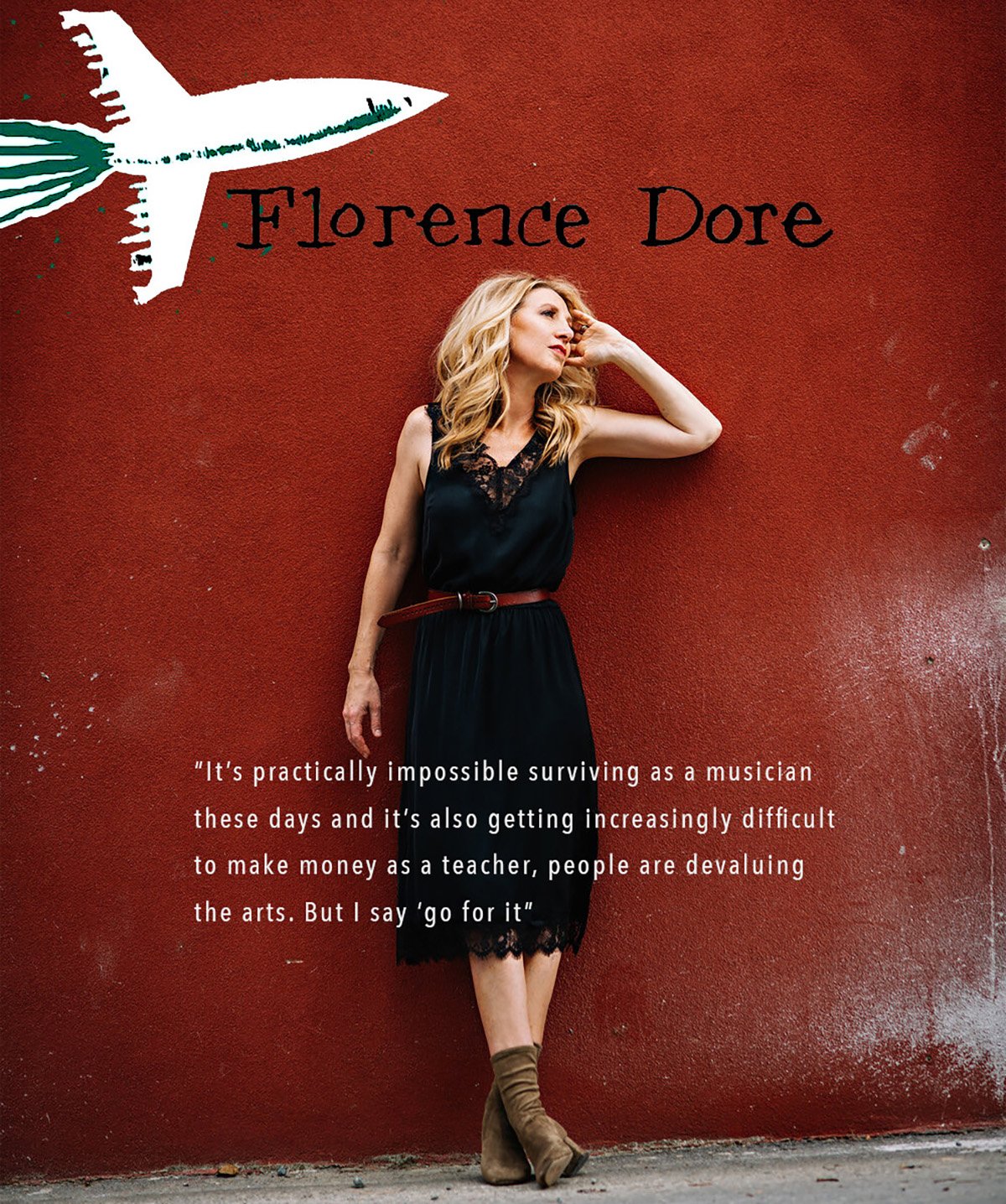
Caleb Caudle Interview

November 29, 2022 Stephen Averill

Photograph by Joseph Cash

The past two and a half years have been a rollercoaster ride for singer songwriter Caleb Caudle. A few days before the release of his 2020 album, BETTER HURRY UP, a tornado struck Nashville, where he was living with his wife, followed a few weeks later by the pandemic. With his touring schedule interrupted and with no notion of when it might resume, he headed back home to North Carolina to ride out the storm. Caleb spent that enforced time during the pandemic hiking in the woods near his home and taking inspiration from the natural surroundings and overall peacefulness. His recently released album is titled FORSYTHIA, named after a plant that flowers in spring, heralding new birth after the winter months. Given the album’s conception, it’s little surprise that the material is calming, tranquil and deeply personal. It has been the subject of hugely positive reviews with Lonesome Highway’s among them. We spoke recently with Caudle and found him in assured and upbeat form, and enjoying being back on the road doing what he loves best.

I understand that you are living in rural North Carolina at present. 

We moved back to North Carolina a couple of years ago. We were living in Nashville for a while but we're back here.   

How does that compare to living in Nashville?

We're in what we call ‘out in the sticks.’ So, no stoplights and just a lot of land and animals. It's a good place for me when I come off the road. Nashville is great. It's a big musical community, but it's also a big city and so I feel like I thrive a little bit more when there's less noise and I'm out in the country. I like them both for different reasons but I'm really drawn to the more wide-open spaces. When I played in Dee’s Cocktail Lounge in Nashville for a tornado relief fund in 2020, that was the last time I was on stage prior to the pandemic, just before we moved back here.

That tornado struck Nashville just before you released BETTER HURRY UP in 2020, immediately followed by COVID. So, you haven't had the opportunity as such to tour that album prior to releasing FORSYTHIA earlier this year. 

It's kind of like I'm getting to tour two records at the same time now, which is kind of interesting. 

You had both your parents and your wife singing backing vocals on the track Bigger Oceans from the BETTER HURRY UP album.

They didn't know they were going to be doing that. My wife brought them out to the Cash Cabin, where we were recording, and they were just listening in. I said ‘all right, you're up,’ and so my wife and both of my parents went into the room, put their headphones on, and they sing along to the chorus. That was a really fun experience. 

You suggested that you felt that FORSYTHIA might be your last record when you were working on it. What bearing did that have on the preparation and recording?

Well, I think there probably was a pretty good amount of pressure as a result. But it was also kind of freeing in a way because I felt like I needed to just be myself. I didn't have to do anything other than that.  If this was going to be the last record, I was going to put forward my best ten songs and surround myself with legendary players like Dennis Crouch, Sam Bush and Jerry Douglas. I knew they'd all do a great job and they really did. So, it's a really special record and I think that the mindset of going into it as if it might be my last record is one that I'm going to carry forward into all the records I make.

I'm intrigued by the list of artists that contribute backing vocals on the album. Gary Louris, Elizabeth Cook, Courtney Marie Andrews and John Paul White are all credited.

They were just people who I'd met and become friends with and I just thought they would all do a great job and of course, they did. It was just all really natural. It’s cool to get to meet so many people throughout the world touring and just become friends and be able to collaborate with them.  

How did the connection with John Carter Cash come about?

I had worked out at the Cash Cabin once before and John’s house is right there. We met through that and started writing a few songs together. We wrote The Gates together, which is on the new record. When the pandemic hit, we were just hanging out and he offered to produce the new record and since no one was touring, Jerry Douglas, Sam Bush and Dennis Crouch were available to come and play. I think everybody was just kind of antsy and wanted to play music with other people instead of singing into their phones. It was just kind of a really nice pandemic project, a little silver lining for us.

Over what period did the recording take place? 

It was from the winter of 2020 into the following summer, over maybe a course of about six to eight months.

FORSYTHIA is your ninth album. That’s a fairly prolific output and suggests someone who is constantly writing songs.

I try to just keep it constantly moving and record a new record every couple of years. It's kind of the pace I've been working at. Luckily, I feel like I've toured so much now that I've built enough of a fan base that really wants to hear another record and they're all really supportive of that. The writing is sort of the hard part for me, all the other stuff like recording and touring, I can kind of figure out, but I always want the writing to be as good as it can possibly be.

I believe that you spent some time in New Orleans. I can hear influences from that city on the new record.

I was down there for about maybe a little over a year. It's a very vibrant city with a lot of culture and I felt like the thing that I took away from there was a lot of the grooves that they work with. I try to incorporate some of that into what I’m doing now. So, hopefully, that comes across. 

You grew up surrounded by music from a young age, but similar to many of your peers, you got into punk and new wave before returning to roots and country. 

When I was younger, I was really influenced by bands like The Clash and The Replacements, although I grew up around country music as it was inescapable where I grew up. I wanted to get out of that and explore other music. You're trying to escape and get away from that and blaze your own trail but it was cool to rediscover country as an older man, the stories are just so meaningful. I like the plain speak of it. You know, it's almost conversational. I re-found the music through the likes of The Byrds, Gram Parsons, and Emmylou Harris and worked my way backward from there. It's just kind of a big web and I feel like everything is sort of connected – the blues and country, it all comes from a similar place. And so, I just try to blend all that together.

Have you been busy touring both albums of late and is that solo or with a band?

Well, I've done some stuff in Nashville. We did the 1,000th episode of Mountain Stage in Charleston, West Virginia. Then we played in Atlanta, Georgia and then North Carolina and then headed northeast to New York and a couple of other places. We're touring as a trio, so it's me and then there's upright bass, and then there's a dobro player.

You are returning to Europe in the New Year for some dates. 

Yes, I was over in the U.K. in early 2019 and went to Scandinavia as well. I'll be over there again playing solo in January and then I'll come back later in the year with some more musicians. I've had nothing but good times as far as all the shows I've played over there so I'm looking forward to getting back. I've never played in Ireland and I've got to correct that.

How have you found the dynamic performing live again after the pandemic?

You know, I think I first got into this industry for the connection between the performer and the audience. Everybody feeling the same thing in the one room is like a religious or sacred kind of experience. Having not had that for a while and now having it again, I’m just not taking it for granted and am really making the most of each show and just having a blast.

Are you constantly writing?

I'm always writing a bunch. I'm always trying to think about what's next; you have to plan so far ahead.  I feel like I'm in a constant state of trying to write the next best song, it's kind of what keeps me going, keeping my eyes and ears open, just trying to look around and take note.  There are songs and there are stories everywhere around you. And I think to be a great writer, you just have to really pay attention and so I'm just trying to work on that. 

Are you your worst critic?

I do bounce ideas off different folks that I trust, but at the end of the day, I kind of know when a song is great, and I know when one isn't as great.  So, yes, I am my own worst critic, but I think I'm just trying to perfect myself.

Interview by Declan Culliton

Pete Gow Interview

November 22, 2022 Stephen Averill

London-based Pete Gow’s three solo albums have been a dramatic departure from his work with Case Hardin, the band he fronts and is credited as the leading songwriter. The most recent, LEO, was released in April this year. It followed on from HERE THERE’S NO SIRENS (2019) and THE FRAGILE LINE (2020), and its recording took place in a starkly contrasting environment to the earlier ones. We recently caught up with Pete to learn about the recording of LEO and some of the contributors to what is a stylistically impressive venture on all fronts.

As I recall, you had already done the spade work for your latest album LEO, when we spoke back in May 2020. Did the enforced lockdown, which I understand delayed the completion of the album, change the musical direction of it in any way?

The lockdown - and the attendant inability to be together in the studio - certainly meant we had to make a number of decisions in isolation, without the usual studio practice of throwing ideas around, trying things on for size, then sending them back if we don't fit. This environment was oddly conflicting. It encouraged a certain level of efficiency, otherwise things could/would be left unresolved for days, even weeks, but it also allowed a freedom, especially for producer, Joe Bennett to take an idea and run with it or overdub it as far as he wanted. So, as far as that changing the musical direction of the album, it did. We had originally chatted about bringing back some lead guitar, maybe adding female vocalists, all of which had to be discarded quickly and without room to ponder, or regret. But it meant that the horns, also something we discussed 'introducing' to this project in pre-production, were allowed to become central to its sound.

LEO took a somewhat different musical direction with the introduction of a horn section, as you say, yet in many ways, it seems like the completion of a trilogy following your earlier albums. Was that a conscious thing?

It really does feel like a sister or brother, I guess, to both those albums. I've always slightly struggled with seeing 'The Fragile Line' as an album in its own right. It was devised as a companion piece to the live shows, an antidote to the somber mood of HERE THERE’S NO SIRENS. I once said those songs on SIRENS made a brilliant record, but a terrible set list – however, it soon took on a life of its own and contains many folks’ favourite songs. What was conscious was to expand the sonic production on 'Leo' so it could - as you say - sit alongside its predecessors without feeling like a re-tread.

You teamed up once more with Joe Bennett to produce the album with you and contribute instrumentally. Were the recordings conducted remotely given the environment at the time and, if so, do you feel that had any marked effect on the final product?

We actually beat the clock on recording the basic tracks by a matter of days. Fin (Kenny, drums) and I were at Farm Music in late February and recorded the drums, guide vocal and guitar for what became Leo plus Cheap & Shapeless Dress and Happy Hour at the Lobby Bar and a couple of covers (Elvis Costello Oliver's Army and Jimmy Webb's paen to bro-mance If You See Me Getting Smaller.) A week, or so, later, the shutters came down.

Was it just Joe Bennett, yourself and Fin Kenny playing on the album? Were the horn parts performed by Joe?

It was. As with both its predecessors, Fin and I recorded our respective parts and then left Joe to the rest. It's not simply that he is capable of playing all these instruments, he is quite brilliant at them. Once this stuff gets transcribed and given to the members of the 'Siren Soul Orchestra' for the live concerts, everyone is amazed by just how crazy good all these parts are.

The final touches came courtesy of Tony Poole, an individual highly regarded by us at Lonesome Highway. What did Tony bring to the party?

He brings the greatest ears in the business. I don't pretend to understand the 'dark arts' of mastering, but my aim is to get your listening experience as close as possible to when I first heard the completed tracks blasting out of Joe's studio speakers. Tony has taken these songs, like those he worked on before them, and puts you in that room with us.

There are lots of references to bars, rock and roll lifestyle and personal struggles on the album. Is there a degree of personal reflection mingled with imagination?

Ha, good observation. In fact, it gets better, or possibly worse. I mentioned earlier two additional songs recorded for the project that we ended up peeling off and releasing as a vinyl only single during lockdown. One was specifically about a hotel (Happy Hour at the Lobby Bar) and the second about a hotel (Cheap & Shapeless Dress).  I'm not sure when, or even how, the next batch of songs will come, but I have promised my partner and all those that hold me dear that there will be no more hotels, no more bars and no more drinking (in songs).

Tell me about the character Leo, in the track Leonard’s Bar. He reads like a character in an American hard boiled noir novel but must be hugely significant to have the album named after him.

You will be relieved to know he is a composite of both the real and the imagined. The earliest genesis of Leonard, as a character for a song I can recall was a guy who served me in a bar in Baltimore, who had 'This' and 'That' tattooed on the knuckles of each hand. That's the first reference in my notebooks I can find of someone who could go on to become that character. During that same trip, staying with family, my partner, Mikaela's brother - Nathan - was sleeping off a divorce back at their mothers for a few weeks, so that fed into some of the colour we get in Leo's life in the second verse of the song.

Listening to the album transports me back to Van Morrison’s work with The Caledonia Soul Orchestra in the early 70s. Was that an influence?

Not directly, but I'll take it. I've always been a huge fan of that period Van Morrison: the live album 'It's Too Late To Stop Now' has always been a favourite, but we never really discuss influences ahead of recording. I think I tried that with Joe ahead of the first Pete Gow album and he completely ignored me, so I haven't bothered since.

The Pogues are referenced on HERE THERE’S NO SIRENS and The Clash this time around. I get the impression that LONDON CALLING is possibly closer to your heart than SANDINISTA?

I mean, for sure there are a couple of great tunes on SANDINISTA (Somebody Got Murdered and The Magnificent Seven to name, well, both of them), but LONDON CALLING, man, what an album, top to bottom. I stand by my assertion that side III of that record - Wrong 'Em Boyo, Death or Glory, Koka Kola and The Card Cheat - is pretty much a perfect run of songs. To tie into your question, I saw Joe Strummer perform with The Pogues as a guest during their 1988 run of shows at what was The Town & Country Club in Kentish Town.

I have to compliment you on the album’s artwork and packaging, something that is often neglected on releases in recent years. Who can take credit for this?

Thank you and thank you for noticing. I recently took delivery of the vinyl pressing of LEO and it looks simply stunning. Since Case Hardin's third album (PM - Clubhouse Records) I have used Rumney Design for everything: album art, promotional materials, merchandise, and Darren Rumney and I have still never met in person. We always work the same, I send him the finished recordings and a lyric sheet, then, once he has lived with the album for a few days, we start discussing artwork. He is so in tune with what we are trying to achieve. It's scary as he pretty much nails it in concept first time, every time.

Interview by Declan Culliton
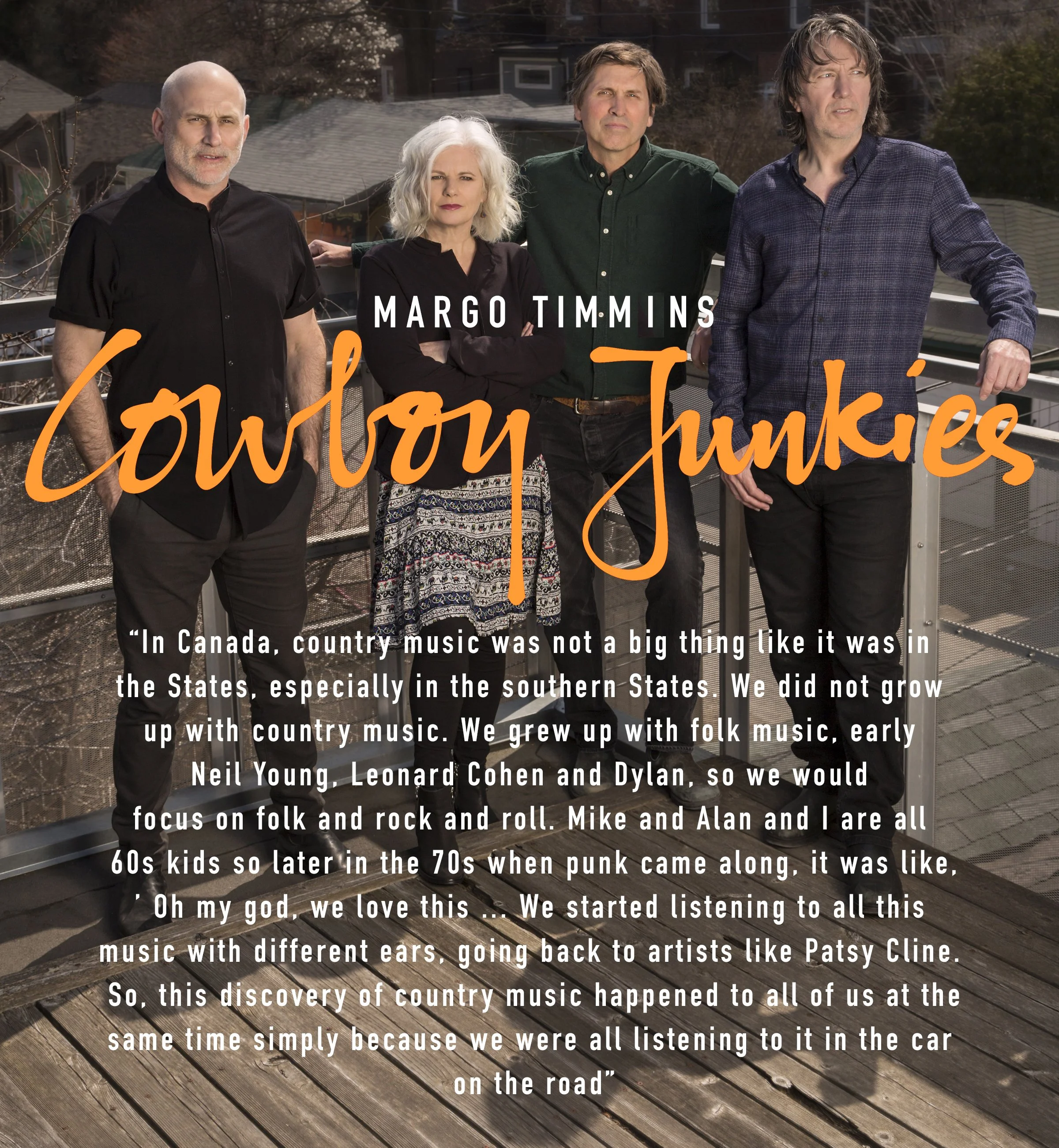
Florence Dore Interview

November 9, 2022 Stephen Averill

North-Carolina based Florence Dore is a singer-songwriter, a musician, an author, an academic who teaches creative writing, song writing and literature at the University of North Carolina, and a mother. She released her debut album PERFECT CITY back in 2002.  Blending punk, folk and country, it earned her comparisons with Lucinda Williams, Laura Cantrell and Liz Phair. Her second album, HIGHWAYS AND ROCKETSHIPS, was released earlier this year on the Propellor Sound Recordings label. We were present when Florence and her band featured the songs from the album at a knockout gig at Dee’s Country Cocktail Lounge in Madison, a suburb of Nashville, during Americana Fest recently. Those band members were Mark Spencer of Son Volt on guitar and two members of The dB’s, her husband Will Rigby on drums and Gene Holder on bass.  Here Florence fills us in about the time gap between her albums, her early days growing up in Nashville, her academic career and her rediscovered passion for songwriting. 

I understand that you were born and raised in Nashville.

Yes, I grew up in Nashville, my father taught at Vanderbilt and met my mom there. My grandmother grew up next door to Minnie Pearl, who ended up being my cousin through marriage.

Were you into the music scene there growing up?

Yes, I was, even as a small child. I mention that in the intro to the book that I wrote titled THE INK IN THE GROOVES, which refers to the writing in the grooves of the records, it’s about rock and literature, which are my two passions. Music was in the air back then; my mom was into Bob Dylan and The Band. The song Rebel Debutante on the new album talks about E.R.A. and Dylan on the radio, growing up there and the Robert Altman movie Nashville. That’s my Nashville, when I see that movie, I think of the early 70s empty vibe downtown. I had a session guy who was my guitar teacher when I eventually got lessons and he actually took me to see Linda Ronstadt in concert. My mom took us out of school when I was in the second grade to see Johnny Cash play at Opryland. I had an academic dad, he was a philosophy professor, so we were not a rock and roll or musicians’ family, but I was obsessed with artists like Crystal Gayle. I saw her play when I was a little kid. I grew up and started filling in the dots, to create the history and actually understand exactly what was happening in Nashville. When my dad talks about moving to Nashville, which he did in 1957, he says there was only one radio station there back then.

What changes do you particularly see when you return there?

The last time I spent a significant time in Nashville was when my husband Will was about to retire from playing with Steve Earle, having played drums for Steve for fifteen years. We went down there when our daughter was very young, she’s seventeen now. Will was working on Steve’s album TERRAPLANE BLUES, which was in 2015, and when I got to see Nashville, I realised exactly how much it had changed. I had previously moved back to Nashville after college with some friends and it was still that Robert Altman version of Nashville back then, deserted downtown but had a beautiful sort of fallen glory to it even though nothing was really happening there. Yet there was Tootsies and the old Ryman which wasn’t really being used but it still had these great storefronts selling old treasures and cool thrift stores. I remember buying old bricks from a building that had been decimated. When we stayed there when they were recording TERRAPLANE BLUES there were bachelorette parties crowding the streets and it just felt so commercialised. I’m glad for the booming industry but it definitely makes me a little sad. I do love Nashville.

You were pursuing an academic and artistic career when you released your debut album PERFECT CITY. 

Yes, I was really doing both until I had our daughter. My husband Will was going on tour and I had health insurance and a regular income from my academic job and I love teaching undergraduates. But the real reason for the break from music was that I wanted to be a mom, two travelling musician parents is very hard on a child and I really wanted to be with her. The music industry is a hard place for women, generally. We’re told on the one hand that we can do everything and on another hand that we’ll neglect our kid. I tried to do one thing at a time.

Do your current students realise that you have a parallel career as a ‘rock chick’ as well as a lecturer, if that is not a politically incorrect description?

No, I’m perfectly cool with that, I’ll take it as a compliment. Now I actually teach songwriting and I made a record when the pandemic hit with three other people called COVER CHARGE, to support The Cat’s Cradle music venue, and I had one of my students on the record. I was telling a colleague of mine who teaches creative writing how different teaching creative writing is from teaching literature classes. He replied that when you’re teaching creative writing you are in among the students, which is true. You are vulnerable with them, we all become students of the song and it’s a lot less top down. HIGHWAYS AND ROCKETSHIPS came out in June so more of my students do know now, but that’s cool. I do try and bring rock and roll into the lectures anyway.

Do you find writing literature or songs more challenging?

I have never tried to write a novel, my books are all non-fiction, but all writing is difficult in some ways. When I just came home from being on tour for a month it took me a few days to get into writing mode again. I think that’s true for any king of writing – it is for me anyway as I have to re-enter the writing frame of mind. We are friends with The Mastersons, because they played with Steve Earle for many years, and they write when they are on the road because they have to with so much touring. I couldn’t do that, unless I had a tour manager to take care of all the other bullshit for me.

When were the songs on HIGHWAYS AND ROCKETSHIPS written?

The only song on the album that I wrote back in my last album THE PERFECT CITY days, was Sweet To Me and that song was about my grandmother. I really wanted to write another record and I was working on another project with Jefferson Holt, the former manager for REM, also known as their fifth member and an old friend of my husband.  When he heard PERFECT CITY, his reaction was ‘holy fuck, let’s do that.’ So, I took about six months to write about twenty songs in 2019 and Jefferson put me in the studio with the other DBs including Chris Stamey, who I didn’t mention earlier, and from there we just decided which ones were the best. We recorded the album at Mitch Easter Studio in Connersville, North Carolina with Don Dixon, which is the same place where Don and Mitch Easter recorded those REM records.

You do say that your writing is autobiographical, but I don’t expect the song Rebel Debutante is.

You want to know something, that’s about my mother, she was a real rebel debutante. There are some fictionalised pieces in there, together with pieces that are completely true as well (laughs). One thing about returning to write songs, I realised that you ought to take some poetic licence. It’s not always about telling your own truth, it’s about telling a truth. When we were out on tour we drove through Oklahoma and Arkansas which I hadn’t done before. There are a lot of Trump supporters out there and people who are allured by fascism and that led me to try to write a song about someone that is out in the middle of nowhere and feels forgotten and how that frame of mind can be manipulated by people like Donald Trump.

Your show at Dee’s Cocktail Lounge during Americana Fest in Nashville was one of the highlights of our annual trip to the festival. Is that your regular touring band?

That was our favourite show of the tour. When you’re on stage the energy and positivity coming from the audience really matters and you were all bringing the love, we had a great show there. Because I’m married to Will Rigby, I’m in The dB’s’ family, so Will is my drummer. Mark Spencer is an old friend from back when I used to play in New York a bunch, and he’s my touring guitarist also on the record. Peter Holsapple, who is one of the other songwriters in The dB’s, plays guitar on the record. He mentored me in coming back into music. Gene Holder, who is also in The dB’s, doesn’t normally tour at all but Will told me to ask him if he would come along with us and everyone was shocked that he agreed and he’s coming on the next tour and is totally into it. On the record, we had Jeremy Chatzky on bass, but that was our regular touring band.

Would you recommend your students pursue a literary or artistic path by way of career advice?

It’s practically impossible surviving as a musician these days and it’s also getting increasingly difficult to make money as a teacher, people are devaluing the arts. But I say ‘go for it.’  You have to try, otherwise, we are going to kill it, we can’t all be bankers or lawyers. I used to be much more practical in giving my students advice but it matters so much in life that people continue to create art.

Given your parallel careers what two current writers and musicians are impressing you mostly?

Two writers, Roddy Doyle, I love his writing, and over here in the States, Lorrie Moore. She has a collection of stories called Birds of America, which is brilliant and my favourite of her books. She makes all kinds of rock and roll references in her writing. The singer songwriter that I love right now is Daniel Romano, he is an absolute machine and has so much music. Luckily, my husband Will culls Daniel’s music for me. I feel like a late comer to the party but I’m really enjoying Margo Price’s music as well, particularly her debut album.  

We’re hardly going to wait another twenty years for your next album.

No, because I’m too old to have any more children (laughs). I’m actually working on songs for the next album right now. I don’t know what the timing will be, that’s up to my record label but I want to have twelve songs ready to go so that we can go ahead and start recording whenever they are ready. I’m extremely privileged to have an amazing label behind me. Jefferson Holt, who supported me when I returned to writing songs, has started a label, Propellor Sound Recordings in Nashville together with a guy called Jay Coyle. That label is about to also put out early DBs stuff that’s never been released before.

Interview by Declan Culliton

Interview with Whitehorse

November 2, 2022 Stephen Averill

Luke Doucet and Melissa McClelland were on the Lonesome Highway radar even before they joined forces and Whitehorse came into being in 2010, a move that made perfect sense for the Canadian husband and wife duo. It was a decision that has yielded eight full-length albums and four EPs. In a particularly creative purple patch during Covid, they recorded three of those full-length records, MODERN LOVE, STRIKE ME DOWN and I’M NOT CRYING, YOU’RE CRYING, the latter due for release in January 2023. Despite the daunting and uncertain times that motivated the new album, it’s possibly their strongest recording to date, combining classic country ballads and 70s’ influenced roots tunes. We spoke recently with Luke and Melissa about the stimulus to record a full-on country album, the writing and recording process for the record, and Luke’s tip for the perfect Bolognese sauce.

I recently read an interview with Jeff Tweedy where he described writing country songs for Wilco’s latest album as being like ‘comfort food.’ Does that resonate with you given the musical direction of I’M NOT CRYING, YOU’RE CRYING?

Luke – I love that metaphor about comfort food, there is something comforting about understanding what the rules of engagement are when writing songs. When it comes to art forms that have a long history, we tend to know the rules. It’s not that they are enforced in a draconian way, but we don’t stray too far, because there is comfort in the writing, just like food. It also liberates you to focus on nuances because some of the big questions are already answered. What’s going to happen next musically? We know what’s going to happen next because it’s country music and we know what comes next. That frees you to focus on other things like the minutiae of the storytelling. Whereas, with us, going back to roots or country music there was comfort in going back to a place where there are guard rails that you are familiar with and that allows you to focus on the minutiae.

Melissa – It definitely gives you a licence to be a little more sentimental and liberating in the song writing. It allows me to be a little sappy without being cheesy, which is not an approach I usually take.

The lyrics are certainly anything but cheesy. When I listen to songs such as Six Feet Away, I think of the lockdown when people could only visit their elderly parents by looking through a window at them from a distance. Was the pandemic the primary influence for much of the album?

Melissa – Yes, you’re absolutely right. We wrote this record during the first six months of the initial lockdown and when, like the whole world, we were in shock at what was happening and how we were all going to move through this. John Prine died from Covid and it was a very intense time, so that is very much the theme of this record. People are probably sick of talking about Covid but there were so many real emotions that still reverberate to this day, we’re still climbing out of it and returning to some kind of normality, still feeling its effects and trying to navigate the future.

I really enjoyed your live streams during that period of lockdown

Melissa – The technical side of it was hilarious as neither of us is good at that. We didn’t have a proper set-up, we’d have the iPhone balanced on a stack of books. We initially set it up wrong so the opening part of our first performance was upside down. I think people were just laughing along with us. It was very telling of that time and place, and what everyone was going through. We had our fancy performance clothes on but had our slippers on off-camera, and our son was bouncing on the couch behind us.

The two previous albums that you released last year, MODERN LOVE and STRIKE ME DOWN, incorporated a range of genres from power pop to rock and indie to disco. What directed you down the country route forI’M NOT CRYING, YOU’RE CRYING?

Luke – It was almost like an accident. Melissa makes the point about John Prine passing away and that kind of set us off. My recollection is us sequestering ourselves into corners of this not enormous house in Toronto – no one has large houses in Toronto. Melissa had managed to claim the bedroom with the big TV, I was relegated to the kitchen, which made sense because I am a kitchen-pottering type of guy anyway. We are both night owls, but I do tend to stay up later, so we established this routine, because we were locked in our home for so long. We would both put our son to bed, he was staying up late also. I would have a nap for an hour, wake up at midnight, put on a podcast for an hour, maybe open a bottle of wine and listen to country music, artists like John Prine and Kris Kristofferson. It wasn’t deliberate or a conscious thing but for some reason, I just gravitated towards those songs and then started writing songs. All of a sudden, I had a pile of songs.

Melissa - It was a very prolific time for Luke He kept sending me demos of these beautiful country songs that he was writing, so at some point, I said: ‘Ok, I gotta get on it.’ So, I picked up the guitar and started writing some country songs, too. I could see where Luke was going grammatically, very much of the moment and inspired at that time. There are moments with an artist where it just flows and pours out of you, and Luke was in that creative headspace. At that point, I started to write some songs that fitted what he was doing.

Luke - I’m flattered when Melissa says I was prolific. What she really means is that in order to get six good songs I have to write twenty-five. For her to write six great songs, she writes seven.

Were the songs co-writes or written individually?

Melissa – We typically write separately and then edit each other’s work to compile the songs. We co-wrote all the songs from the ground up on the MODERN LOVE record from last year, which was the first time we had ever done that. Otherwise, it’s a solitary and personal process for each of us. We both need to feel connected to the songs, so we are at ease picking and choosing the ones that work, and the bottom line is that we both need to feel good about the song. We’re quite good at not letting our egos get involved. We may need to rework certain songs to get to the place and that’s what we often do.

Tell me about the recording process for I’M NOT CRYING, YOU’RE CRYING?

Luke – We recorded this whole suite of songs off the floor, just like a band would. Melissa would be singing; I would be playing guitar and we had drums and pedal steel. We just played the songs until they sounded right. It was recorded close to home in a studio in Toronto. There’s no percussion added, no piano or keyboards, the production is very much what you would expect from a four-piece band on stage.

Melissa – That was about it and after that, we just put a lot of focus on Luke’s guitar and my vocal. I don’t think we spent as much time on any other record making sure those elements were as good as they could be. It was still very much lockdown mode in Toronto, a pretty intense time and we were getting our temperature taken going into the studio, filling out forms, and wearing masks. It felt very tentative and we really had not done anything up to that point in a studio, literally sitting at home, so actually going into that studio, taking off our masks and picking up our instruments, playing music with other humans, it felt so intense.

Luke - Yes, there was and is a feeling of ‘this might be the last time,’ which might sound fatalistic and apocalyptic, but there was a feeling of needing to savour this. I was playing country licks, drawing from Albert Lee, James Burton or Pete Anderson from Dwight Yoakam’s band.  You kind of have to get it right and I spent a lot of time just doing that. We were trying to get closer to the genuine article stylistically. When something has that amount of history it’s important that you pay tribute to the past. As an aside and in a similar way, I made a big pot of Bolognese yesterday. It’s been my fixation since the pandemic and every time I do that, I’m also trying to get closer to the genuine article.

A chef friend of mine gave me a tip passed on to him from an Italian grandmother for Bolognese sauce; never use red wine, always white wine.

Luke – Wow, that’s great. I love that. An Italian friend told me that at the very end, add a clove or two.

What triggered holding back the release date until January 2023?

Luke - We’ve been kicking things around for a while now and we had entire tours planned that we had to cancel and then try to gauge whether audiences are ready to come back to shows again. We made four albums during the pandemic. Our label Six Shooter know that we don’t idle very well and, as you pointed out, there is a combination of a lot of music on MODERN LOVE and STRIKE ME DOWN. Both ourselves and Six Shooter felt it was right to conclude that recording period with those two albums, as it would have been too jarring to put those two records out and follow them with this album. It remains to be seen but if people enjoy this record we may follow it with the covers compilation, and stay in that place musically for a while, we may spend the next few years staying in that lane.

Melissa - Country has always been a part of what we do. If you listen to our first self-titled record, there is a lot of it in there. This may be the first time we have fully stepped into country but, stylistically, there are a lot of roots and Americana right through our catalogue, so it’s not totally out of character with us. It will be interesting to see what people think of it and if it clicks, because it would be nice to stay here for a while. It’s an inspiring headspace to be in, to write songs in this genre and style. Singing and playing a beautiful country ballad is wonderful. We’ve just finished a tour playing a bunch of songs from this album and it did feel very exciting.

You included a couple of killer cover versions of Summer Wine and We’ll Sweep Out the Ashes in The Morning in your showcase at Americana Fest earlier this year. Were you tempted to include covers on the album?

Luke – It’s a funny thing about covers. When I was growing up in Winnipeg it was always ‘are you a covers band or are you a real artist?’ I say that tongue in cheek because great artists like Elvis Presley never wrote songs. After I’M NOT CRYING, YOU’RE CRYING comes out and if people seem to enjoy it, we do have the option of releasing a compilation of mid-70s inspired Americana covers that we’ve recorded.

Melissa – It was very intimidating approaching some of those cover songs, because artists like Tammy Wynette and George Jones, Emmylou and Gram were classic voices. Well, maybe not Gram       (laughs).

Luke – Gram wasn’t a great singer so can you imagine how emboldening it was for someone in my position? ‘If Gram can sing with Emmylou, I can sing with Melissa and get away with it with my croaking toad of a voice (laughs), and we can get something together as a collective.’ I get a lot of solace from Gram and Emmylou that way.

I remember the last time you both played Ireland at Kilkenny Roots Festival prior to forming Whitehorse. You were telling us how excited you were to visit Kilkenny Castle, given that there were no castles in Canada.

Luke – I remember that well. Actually, I didn’t realise until that weekend that my family roots go back to Kilkenny. I’m Doucet, which is French, but my mother’s side of the family are Ormonde. I learned that the castle in Kilkenny that we visited was previously in the ownership of The Earl of Ormonde, which is an interesting family connection.

Interview by Declan Culliton

Margo Timmins of Cowboy Junkies Interview

October 30, 2022 Stephen Averill

The word ‘unique’ can often be bandied about when describing a particular band or artist. But, when referring to Cowboy Junkies, whose signature sound over three and a half decades and 25 albums has remained distinctive and individualised, it is wholly appropriate. From their ground-breaking recording, THE TRINITY SESSIONS, to their recently released full covers album SONGS OF THE RECOLLECTION, their ability to combine elements of folk, country, rock and blues, both on original material and well-chosen covers, remains unmatched. It was a great pleasure to chat recently with Margo Timmins, who talked freely about the band’s early days, their collective love of playing live, and their longevity. 

‘Staying together in the band was always more important than winning the argument. So, we always seemed to be able to solve it, before we became like Oasis,’ she joked.

 Your recently released album SONGS OF THE RECOLLECTION was your first full covers album. Did the enforced downtime of 2020 have a bearing on that? 

Yes, I don't think it would have happened otherwise. It was a project we had been talking about for a long, long time, a complete covers album. It took a lot of time because it wasn't as simple as ‘Okay, let's get together and do some songs.’ It took so much time going through the archives and listening to so many songs and then trying to find different versions of those songs. That’s why I don't think it would have happened without COVID, which gave us the time.

What is the band’s process in selecting suitable songs to cover?

When you choose the song, you're choosing songs that you love and grew up with and meant something to you, that's always the first step. The process is then what do you do with that song? More often than not when we are doing a cover, we may find that we are not doing it in any way that offers any value from the original. We’re not a covers band, so we are looking for reinterpretations rather than simple covers and if you can’t do that what is the point?  That happens quite a lot.  I might love the song, the boys can play it and I can sing it, but the last question is always ‘what is the point?’ That often leads to songs being shelved and sometimes we might go back to them in later years. For example, we recorded Thunder Road and when we first attempted it, I couldn’t find my way into the song. It’s such a big song to take on. We shelved it but brought it out a number of years later, maybe I was a little bit older and wiser then, possibly a better singer.

You have also just released your ‘lost album’ SHARON, thirty-three years after it was recorded live at the iconic Sharon Temple in Ontario. What was the deciding factor in not releasing it back in 1989?

SHARON was our next recording after THE TRINITY SESSIONS. We were then in the business with a record company and the expectations that go with that.  What the record company really wanted was Trinity Sessions again.  We weren't averse to doing another album off the floor like that, but we also didn’t want to redo THE TRINITY SESSIONS.  And of course, that was always the conflict between us and the record company. So, we said, ‘okay, we'll do it off the floor, and we'll see what we get.’ We went to Sharon, which we knew had this amazing sound and quite a history. We recorded the album and we liked what we heard, but it was too similar to TRINITY SESSIONS, it was just more of the same, and we just didn't want to become that type of band at that time. So, we said ‘no’ and, luckily, our first record contract gave us a lot of power and we had something to bargain with. Instead, we went into a studio and did THE CAUTION HORSES, which is sort of SHARON revisited but in a studio.

Your debut album WHITES OFF EARTH NOW!! mainly featured blues covers. Had you also been interested in country music prior to the recording of THE TRINITY SESSIONS, which followed?

You know, it's interesting but in Canada, country music was not a big thing like it was in the States, especially in the southern States. We did not grow up with country music. We grew up with folk music, early Neil Young, Leonard Cohen and Dylan, so we would focus on folk and rock and roll. Mike and Alan and I are all 60s kids so later in the 70s when punk came along, it was like,’ Oh my god, we love this.’ Toronto had a huge punk scene at four or five different clubs. All the bands came through, we saw all of them in small clubs like The Edge. Everybody played The Edge, we saw The Cure and The Police there, they all pulled up in their station wagons. That era was huge for us as young teenagers. It was punk that told Alan and Mike that you don't have to be a big rock star. You can just pick up a guitar and just do it, that was the message.  That's when they started to pick up guitars and started making noises and soon, they had a couple of bands together. Hunger Project was their first band, very punk-oriented and then Germinal which was more sort of jazz instrumental.  That led to Cowboy Junkies and our first album WHITES OFF EARTH NOW!!, which took us into the States. We toured for months on that album in our station wagon and while we were driving around the States we were listening to Willie Nelson, Lyle Lovett and Steve Earle on the local radio stations, and reading articles about who influenced them. We started listening to all this music with different ears, going back to artists like Patsy Cline. So, this discovery of country music happened to all of us at the same time simply because we were all listening to it in the car on the road. That opened up a whole new world of music to all of us and vocalists who were just phenomenal. The fun thing was traveling around looking for gigs and going into these towns that had huge used record stores. We'd be finding all this new stock and having so much fun listening to it. What none of us realised at that time was that it was really helping us also become the band we became by dipping into that sound.

Had there been a degree of music snobbery on your behalf previously when it came to country music?

Oh, yes, one hundred percent. Country music was for hicks, not for sophisticated people like us. But it was so mind-expanding and hit us at exactly the right time.  Punk gave our generation the permission to go where you want to go, listen to whatever you want to listen to, do what you want to do and who cares what anybody thinks. So, when we came home from that tour we wrote THE TRINITY SESSIONS, which had more of a country vibe to it because of the point we were at just then.

So, what were your expectations recording THE TRINITY SESSIONS, and was it simply a self-indulgent project based on where you were all at musically at that time? 

Well, firstly we were a Canadian band and Canadian bands really weren't on the map then. There were a few but not really a lot of young bands. Our expectation was just to put out a record that we liked. We had put out WHITES OFF EARTH NOW!! ourselves, we sold it out of our band house and through the mail.  Before rehearsals every night, we would fill the orders and mail them out the next day, and that's what we expected from Trinity. Especially in 1988 when Michael Jackson was at the top of the charts and big production was what was out there. Certainly, THE TRINITY SESSION was anything but that.  Our intention was just to create a good record. We walked into Trinity Church with that expectation that day. If we hadn't gotten what we wanted, we would have just walked away. We had no record company, there was no time limit. We would just have gone and recorded it again elsewhere if we didn’t like what we got, there was no pressure that way. However, once we set up the sound, the whole thing took about seven hours. Most of it was just trying to find the right position for the mics and the musicians. We found that, because there were no overtakes or overdubs, if you made a mistake, you screwed it up. I can remember as if it was yesterday, singing I’m So Lonesome I Could Cry, hearing it floating around the room and thinking ‘don’t screw up.’

Not only did it launch the band’s career, but its success allowed Peter Joseph Moore, who produced the album, to leave his nine-to five-job and launch his career as a full-time producer.

Peter has always been there and still is when we take our stuff to him to mix or master it, depending on what it is. You know, he has a very unique ear, so he's been important, very important. He’s been with us forever.

Your lifespan as a band has been extraordinary with no line-up changes over thirty years. You seem to have taken control of your own destiny and operated on your own terms throughout those three decades.

It's not that we haven't had our troubles and our differences, of course, but I think at the end of the day, we love playing as a band. You know, the Junkies is the four of us playing and if you change one of us, not to say it'll be better or worse, but it would be different. Even now, after all these years, when we get on stage and play, it's the same if not better.  I don't mean musically, I just mean getting the feeling we get from the appreciation, the joy, contentedness, whatever it is, It's the same as when we were young people playing in the garage. And I think at the end of the day when we had differences, the music always won out, you know: staying together in the band was always more important than winning the argument. So, we always seemed to be able to solve it before we became like Oasis. We always seem to be able to solve any problems and nobody's ever quit.

With four individual parallel lives outside the band has it been difficult to schedule your regular tours?

Everybody has children but I was the only mom. So, when my son was a teenager and before that when he was a young kid, we set up a sort of routine where we would go out and play Thursday, Friday, Saturday, and Sunday, and then get home. In that way, I could keep an eye on my son and luckily, we have always had an easy-going relationship. That’s what we did pre-Covid and now we’re back on the road and my son is part of our crew as well as having another day job when we are back home. We are actually touring more now, out for two weeks at a time with a six-week gap in between. We’re heading to Europe soon for a month, which we haven’t done since my son was a little baby when he also came on tour with us.

Collectively do you still get the same buzz from your live performances?

Yes, we do. Playing live is really why we make records. It doesn't really make much money for you, but it gives you the income to tour, and that's what we do. We are a live band. That's where our joy is and as we've gotten older and moved further away from the industry and business side of things, it’s actually got better.

Looking back at your career, are you happy with the way things have worked out for you individually and for the band?

I think I'm really happy with the way they went. Joining a big record company and getting that early money gave us income and freedom, it also bought my house, which was nice. More importantly, it also gave us our audience. We reached a lot of people and remarkably they're still there. We wouldn't have been able to reach out and have a power machine pushing us out there and putting us on radio without a label behind us. So, we created this audience that is fiercely loyal. I'm always amazed that they keep coming back to our shows. What I would tell my younger self is that if you have bad managers and hangers-on, you need to let them go and not keep them around too long. We also had a period when we tried to manage ourselves and that didn’t work out, we needed a manager then. Those things could have been managed better but that’s all hindsight.

Finally, given your surname, I presume that you have Irish Roots?

Yes, we do.  Our ancestors all came over on the boat, I'm not sure exactly when but it was in the mid-1800s. They came over to make a better life here, apparently. Some succeeded, and some didn't. The story has it that a lot of them went to Northern Ontario and got into prospecting and mining.

Cowboy Junkies play at The National Concert Hall, Dublin on 17th November 2022.

Interview by Declan Culliton

Mariel Buckley Interview

September 4, 2022 Stephen Averill

If you need a pointer for the talents of Canadian singer songwriter Mariel Buckley, look no further than her winning the annual Project Wild contest in 2019. The competition, sponsored by radio station Wild 95.3 and Alberta Music, earned Buckley a cool $100,000 towards her career overheads and she put some of that funding towards the recording of her fine, recently released album EVERYWHERE I USED TO BE.  With the production overseen by Marcus Paquin (Arcade Fire, The National, The Weather Station, Tim Baker, The Barr Brothers) plus a host of Canada’s finest session players contributing, it’s an album that packs a hefty punch from start to finish. It features Buckley’s most unguarded writing to date as she lifts the veil on some difficult personal issues. We spoke recently with the career-focused artist about the album and her musical influences. 

 Where are you based at the moment?

I am in Edmonton, just three hours north of Calgary but I'm originally from Calgary.

I understand that you grew up in a fairly conservative environment. How difficult was that for you?

It's a fairly conservative part of Canada, for sure.  The Far West is kind of in that right hand cradle but honestly, it was not too bad. There were obviously exceptions that I talk about on the new record and there was certainly an old-fashioned mindset in a lot of religious and social values for sure 

Did that draw you to music as a way of kind of dealing with that?

Oh, definitely. I was a big music fan since I was just little, I would burn CDs and really dive in and I definitely felt understood and heard when I listened to music. So, definitely being an outsider was a big push for me to get into music.

When did Mariel the listener become Mariel the writer and performer?

It took some time. I was pretty shy about it. My brother is also a singer, songwriter and performer. He was ahead of me by quite a few years and when I started to see him performing, I would have been about fourteen and I was kind of toying with the idea. It still took me another five or six years of practicing in my room before I would be comfortable sharing my own stuff.

Was there any particular artist or album that convinced you that you had the songs and the talent to take the next step?

Not that made me feel more confident. I certainly heard a lot of records that made me think that I really needed to practice more if I wanted my own records out there. Right around the time when I wanted to start performing, I heard a lot of Neil Young and a lot of Lucinda Williams, which would have been both from my brother's collection. When I heard Neil Young for the first time, I certainly learned that there's room for some strange songwriters in folk music.

Winning the Project Wild commercial radio artist contest with a prize of $100,000 must have been hugely rewarding both in respect of the income and also an endorsement of your talent.

Yes.  It was a development kind of contest that took about a year to complete from start to finish. There were ten people accepted and there was a series where we had to write a marketing plan and a grant report. We then had to do a performance piece, just like one of our shows with original content. We were then essentially scored and graded and the winner was allotted the prize money. The money was facilitated through our provincial Music Association, so I don't actually receive the funds directly. But the funds go towards touring and recording.  So, it was a huge help.

There appears to be a huge support for the arts in Canada.

Oh, yeah, we're very lucky in Canada. I think we are up there with some of the most federal arts-funded people in the world. We're also very fortunate to have this Project Wild project, which is a privately funded contest. So, I was just lucky to tap into it, I guess.

That must have been a huge confidence booster for you.

Well, yes and no. I obviously was so excited to win, but I was also like, ‘oh my god, what sort of expectations do folks have now, can I live up to those expectations?’  There was a bit of reckoning that I had to do but that didn't take too long to get over.

Your latest record EVERYWHERE I USED TO BE arrived four years after your last release MOTORHOME, which was released four years after your debut album DRIVING IN THE DARK. Was this an intentional four-year cycle or a coincidence?

So far, it's been coincidental, and I would say, you know, with semi-confidence, I'd like to shorten that significantly with the next follow-up. The only reason this one took four years was partly because of the pandemic. But things do seem to happen for me in four-year bands. I don't like to put things out before I feel like I've got something reasonable to say.

I believe you were going to call the album SAD ALL THE TIME.

That song Sad All The Time is a B-side now. It was just a satirical song I'd written for the record that I was sort of toying with using as the title because I just found that sort of satirical and funny, and for all the depressives out there. But I waffled back to EVERYWHER I USED TO BE for the title. I just felt that that one really encompassed a lot of the themes that I'm talking about on the whole record, that feeling of growing in a liminal space and moving on, so all that stuff seemed to be wrapped up nicely in that tune. So, that's why I ended up picking that one.

I read that you wanted to make a good pop/country record but the album is far removed from what is masquerading under the pop/country genre coming out of Nashville.

Well, what I mean when I say that is that nobody can argue that great pop music is some of the most influential music that anyone's listened to, as well as some of the most interesting stuff to listen to. When I made this record, I wanted it to say things that would complement my very traditional sensibilities of songwriting and production. I wanted something that was more contemporary in feel, and less contemporary in content because I like that sort of juxtaposition. I think that to do pop music with that sort of polished sound really well is an art and especially without all the digital stuff and much of the crap coming out Nashville and, on the radio, which I agree with you it's not good. It's very fun to do that but it’s also difficult to do well.

Less than a minute into the opening track Neon Blue, I was reminded of Kathleen Edwards and that comparison remained with me both in the songwriting and delivery of a number of the songs 

Yeah, she's the best and a big-time influence for me in songwriting. She was such an original voice coming out of Canada. There hadn't really been a female singer like her, especially out of Canada, until she came out. That was a very promising thing to see for a young songwriter like myself at the time. So yeah, she’s top of the batch for me.

There is a lot of soul-searching on the album. The track Hate This Town particularly stands out. Mixed emotions?

Yeah, it's obviously super heavy. But I loved writing that song. It came out to me very quickly, as difficult things often do, because it feels very cathartic to get them out. So, as much as the song is dark, it’s also a little bit sickly and funny in spots. I really like playing that song because it really disarms people quickly.

I love the lines on the song Love Ain’t Enough, ‘Thought I saw you in the back of my car, you were combing your hair in the mirror, I was falling apart.’ Are lines like these personal recollections or part imagination?

Mostly recollection. With that particular line, I think I was I was trying to do a Bruce Springsteen thing. He does such good artistic call-backs and memories and tells them in a way that makes you feel like you're in the back of a 1960s Muscle car. So, I think I was doing something similar there, but a lot of that is from my own experience

You called on Marcus Paquin to produce the album. He previously worked with Arcade Fire, The National, Tim Baker, The Weather Station, and The Barr Brothers. Did the funding from Project Wild give you the freedom to choose your producer?

Yeah, it certainly did. That was a huge help in landing Marcus. The National and Arcade Fire are great bands, but certainly his work with Tim Baker, The Weather Station and the Barr Brothers was a big reason that we chose him because he has such a cool approach to music. Marcus is not prohibitive by any means but, as you know, the costs to record an album are immense and to be able put all the finance down at once as opposed to paying it back over time really allowed me to kind of get everything in place with all the people that I wanted, and in a relatively short window to get it all done. That was a very big gift.

How long did it take to record?

Everything was recorded live off the floor except for my vocal, which is doubled on the record. There are a couple of synth patches but mostly everything is live off the floor with me in the band and Marcus playing percussion in a room. We did it all in about twelve consecutive days, without any pre-production. So, everyone came in pretty fresh which was also really fun. On this record, the only returning staff from my previous albums was Tyson, who is a bass player from Vulcan, Alberta. Everyone else was a session player from Alberta or Ontario or Quebec.

You are due to continue your hectic touring schedule supporting The Bros Landreth in the U.K. and Europe soon.

Yes, we're in Germany and Denmark after the U.K. dates with them, and then I’m over to Sweden with my full band.  I start touring again in February and March of next year, that's mostly in Canada and then the spring and summer will be in North America. We'll be back to Europe in the fall of 2023.

Are you happiest on or off the road?

Most of the time on the road. But everybody's always the same. You get about three weeks in and then you kind of want to be at home. And then when you sit at home for a couple of weeks, you start to want to go back on tour. It’s always one or the other.

You appear very structured. Do you have a career game plan in the short to medium term?

Yeah, absolutely. I certainly am a person who likes to make plans and try to hit my milestones. Hopefully, we'll get another record out in less than four years and then just keep touring, and keep growing it. But, you know, I'm glad people are listening to it so far and seem to dig it. I want to be able to work and keep playing and make a little bit more money as the years go so the band gets fed and everyone’s doing okay.

Interview by Declan Culliton

Michelle Rivers Interview

August 22, 2022 Stephen Averill

Unlike most aspiring singer-songwriters who head to Nashville to follow their dream, Michelle Rivers chose a somewhat different career path. Although she grew up in the small town of Leipers Fork, barely thirty miles from Nashville, the bright lights of Music City were not for her. Instead, she headed north to Montana, where the more peaceful lifestyle and environment fuelled her passion for song writing. Her latest record, CHASING SOMEWHERE, which follows her debut recording BREATHING EMBERS from 2016, has been getting lots of love both in her homeland and Europe. It’s an album loaded with tracks delivered with discipline, confidence, and grace by Michelle, and includes gilt-edged playing by some household names in country music. Speaking with Michelle, we got the impression of an artist with a definite game plan, which appears to be progressing very much as intended to date.

Your father is a singer songwriter and had a studio in Tennessee, so music was there for you from a very young age. Did you buy into what he was playing or rebel as a teenager and seek out other music?

I loved what he was doing, especially when I was younger. As a teenager, I definitely went through a phase where I was listening to pop punk and bands like Green Day.  I got really into that in high school. For me, it was the contrast between the very polished and perfect Nashville sound that I grew up with that I loved. But I didn't necessarily feel like I fitted into it so that was what drew me to punk music.  I think it was just the wildness and the rawness of it. That kind of led me into bridging those two worlds and discovering Americana and Outlaw Country, Red Dirt Country, the different subgenres of country where the music is a little bit freer and less polished. It's not that I don't like music that sounds polished, but I just love the authenticity of somebody expressing themselves through music and not trying to create something that has a commercial sound.

Despite growing up in Tennessee, Nashville did not appeal to you career-wise?

I love Nashville, and I still love to visit Nashville. I’ve lots of wonderful friends and family who still live out there. But yeah, it just wasn't my place. So, I went to Nashville for that one year of college. That wasn't for me, then gradually started making my way west to Texas and went to the same college that many family members had gone to. But then after that, I was like okay, now it's my time to move to the mountains and also make music a part of my life.

 Montana is a long way from Nashville. What drew you to that part of the world?

I had always wanted to live in the mountains. We grew up in Tennessee, out in the country. Walking down to the creek and walking through the woods, was a big part of my childhood. My parents would drive us to Colorado to learn to ski, but also to go hiking and fishing and all those things. That happened every summer and so when I became an adult, and it was time to make my own decisions, I planned to move to Colorado, but my sister had already beat me there as she found herself a rancher cowboy and moved there. My mom had visited Montana and she came home from that trip just raving about how incredible it was and that I would love it, So I ended up getting a job up here in Montana and never looked back. I moved here fresh out of college and just never want to leave.

Is there a strong music and art scene in Montana?

Yeah, there actually is. It's such an interesting place for music and for me as an artist to grow and develop. There are lots of artists who make pottery, paint and do different creative things, but also, there are quite a few singer songwriters. I live just north of a very quirky area called Whitefish Mountain Resort, close to Glacier National Park, which is very popular to visit. A lot of tourists come in summertime, which is good for musicians, except that there's also the expectation for artists to play cover songs. There’s such an interesting collection of musicians up here who can play shows five nights a week and get paid to do it. I grew up in Nashville where if you're a small independent artist, you don't really get paid to play until you've done your time. You have all these waitresses and regular everyday workers who are spending their nights playing for free or for tips. Up here, I can play music and I can get a little extra money for it and have the opportunity to play live music in a regular way. The area has also definitely helped me to grow as an artist and there are quite a few wonderful songwriters in the area that you just wouldn't think would live in the middle of nowhere Montana. It is such a beautiful place to live and such an inspiring place to live, I’m inspired by this kind of lifestyle. Montana has created a pretty neat musical culture. I'm not the only one that uses a ton of natural imagery and small-town life is woven into my music. That's something that quite a few of us are doing up here.

Have you found yourself more productive in your song writing since moving there?

Yeah, absolutely, I've always loved nature. I recognised a little bit later in life that nature is very calming and very healing for me, and when I go into a city it's fun for a while. I can handle it for a few days and I really enjoy it. I do enjoy just being around a lot of people and enjoy playing shows in cities. But that creative part of me is most inspired when there's stillness, and there's quiet.

There are a lot of songs on CHASING SHADOWS, fifteen in total. Were you tempted to save a few for your next recording?

Yes, I was tempted to and I was advised to consider that by some other independent artists and friends.  People in the industry telling me:‘Well, it'd be smart if you release ten songs, and then a five-song EP later, or save some to be singles after the album.’ Every one of those people was totally well-meaning and I did consider it. It costs a lot of money to make a record and you do want to maximize what you've done profit-wise.  We live in a generation where releasing content regularly is so important, and so I get that side of things.  But when it came down to trying to narrow it to ten or eleven songs, I just could not let go of any of these songs because it feels like a complete body of work. So, it was a difficult decision, but I definitely feel like I made the right one. And you know, I do see more artists doing that. I mean, Zack Bryan releases nearly forty songs on a record, yet he has this incredible following of people who are listening to all of those tracks. I think sometimes, as independent artists, we try so hard to do what the ‘right thing’ is, make smart business moves and I think sometimes you can lose the artistic presentation of your work when you focus too much on that.

Was the album recorded in a studio with the various players or did they record remotely?

It was kind of a mix of everything. We recorded in October of 2021. I flew to Georgia, which is where my producer Jason Hoard lives. We could have recorded in Nashville, but Jason has a friend who owns this little cabin in the middle of Georgia and he's like: ‘I think that's where your record needs to be made.’ Jason has his own studio, so he brought all of his studio gear to the cabin. We recorded most of the bones of the album live. I did go in and cut my vocals later, as I sang a scratch vocal while we were recording live. We then sent it off to a few other musicians that we wanted to add in different parts, mostly players that my producer uses on his own recordings.  

Those players include big hitters such as Jenee Fleenor on fiddle and Barry Bales on bass. You also had Al Perkins playing pedal steel.

Al Perkins is a family friend of ours from our Nashville days.  When we were talking about pedal steel, Jason had someone in mind for it. I very shyly said that I would really love for Al Perkins to be on this record.  It was an incredible experience to have him play on it. I'd heard him play live with different groups growing up and even heard him play at church. That was the closeness of our family friendship.  Just to hear him play on my record and knowing that he's played with Emmylou Harris and Buffalo Springfield was really, really incredible. Right before my record, he played on Miranda Lambert's huge radio hit ‘If I Was a Cowboy.’

The track Buy Myself A Job on the album sounds autobiographical?

Yeah, I think I was reflecting on my journey as a musician. I don't own a Westphalia camper van, that's like a dream for me to own a campervan and just travel everywhere I want. But, you know, aside from that, it was mostly a reflection on the journey of all of these musician friends that I have, and just how hard it is to be playing for tips playing or free, spending gas money trying to do all of these things because you feel you are called to this music career. It’s a career that has not got a path, there is no path to take and the road is always winding and difficult.  I tried to capture as much of that as I could in the song but at the same time, I had that hopeful feeling of someday I'm going on the radio, touring, and that things are coming to fruition.  I think that that happens when you don't give up and you just keep that positive mindset, reminding yourself that this is what I'm meant to do. 

Last Cowboy is another favourite track of mine from the album.

I actually co-wrote that with a friend, Jessee Lee, who I met in Wyoming at a songwriter festival.  I'd been sitting on this song idea for a little while, it's really just about what a cowboy means to us. There's an old cowboy culture in Texas and a little bit in Tennessee, although it's mostly a horse culture and country music in Tennessee. Jesse and I both come from these rural backgrounds and have so many definitions for what a cowboy is and what that means. Is it that hat that makes you a cowboy? Is it the way you dress? Is it the fact that you actually have cows?  What makes you a cowboy? All of those are the questions that kind of influenced us to write the song, so it's really just a reflection of who we think a cowboy is. My favourite line on the song it is ‘he's denim in a black suit kind of crowd.’ A cowboy isn't necessarily a very popular thing at this point in time and this particular cowboy is trying to live life in the city where he stands out like a sore thumb, even in a city like Nashville.

You have quite a number of shows lined up this year, where will you be playing?

I'm mostly playing Montana, Wyoming, and Washington this year. I still have a part-time, day job teaching elementary music for half days. During the school year, I'm like a weekend warrior. I'm really working hard to plan my first big tour in June 2023. I'll start with a regional tour then the southwest, the southeast, and I also want to come over to the UK and Europe. I think it makes the most sense to probably tour as a duo or trio at first.

How would you measure success for yourself?

That's such a great question. I think that the definition of success is constantly evolving for me. I try to set small goals, to focus on the next thing I want to accomplish. Over a year ago I decided that I'm going to make this record, so I feel like I'm successful right now. I think to be able to do music full time is what success would look like for me. I've been a part-timer for a little over a decade now.  Just to be able to do it full-time and be able to make a modest living doing what I love would be a success.

Interview by Declan Culliton

← Newer Posts Older Posts →

Hardcore Country, Folk, Bluegrass, Roots & Americana since 2001.