
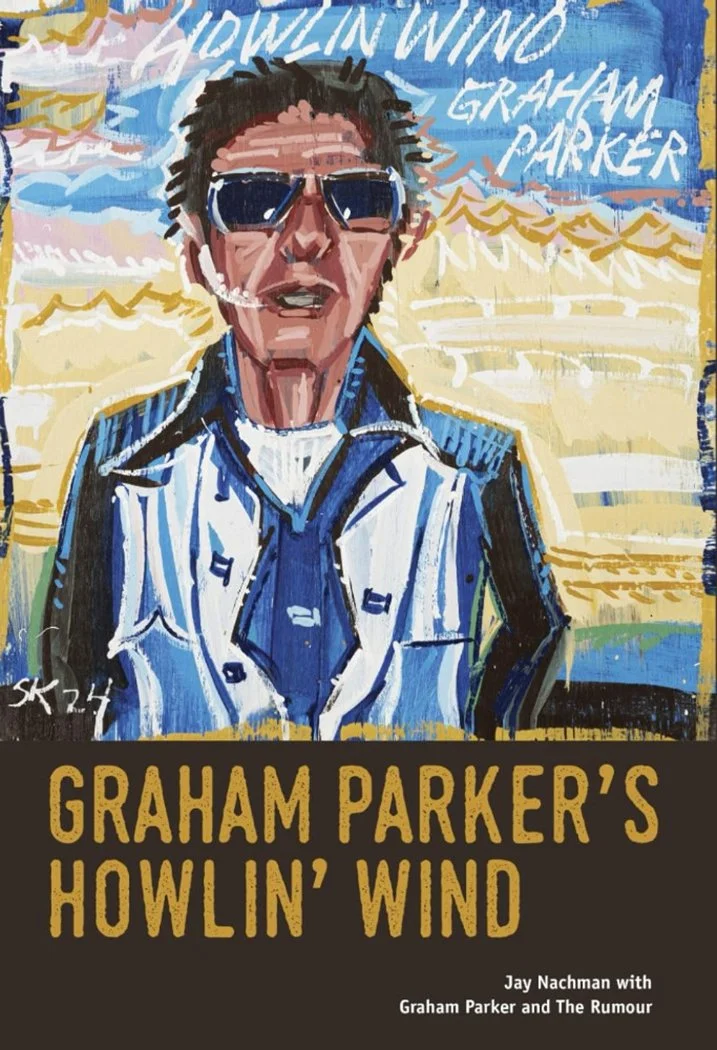
Graham Parker’s Howlin’ Wind by Jay Nachman with Graham Parker and The Rumour
With the 50th Anniversary of Graham Parker’s debut album HOWLIN’ WIND due in April of this year, long-time Parker fan Jay Nachman traces the rise to fame of the hugely influential U.K. artist. He is aided by input from Parker, members of his band The Rumour, and others, including Stiff Records co-founder and one-time Parker manager, Dave Robinson. Nachman covers in detail Parker's youth up to the release of that iconic debut album, which, at the time, was an industry game changer.
As prog rock became increasingly over-indulgent in the UK mid-70s, and before punk exploded, a select number of bands and artists coaxed punters out of their bedrooms, where they ceiling-gazed to Pink Floyd, Genesis and Yes, and back to a high-energy live scene. Leading that charge was Dr Feelgood. Their earthy, blues-driven rock propelled them from the London pub scene of the early 1970s to international fame and, eventually, a No.1 spot in the UK Album Charts in 1976. Just thirty miles from London in the Surrey village of Deepcut, Parker was also about to emerge as a leading light in what the music press would call ‘New Wave. Declan McManus, soon to be rechristened Elvis Costello, an ambitious, angry Liverpool-born young man with a forceful stage presence, would soon follow suit.
Heavily influenced by Van Morrison, Parker added aggression, energy, and his growling vocals to the more laid-back Belfast legend. Also, influenced by band members who had thrived in the London pub rock scene, a subtle reggae backbeat also found its way into Parker’s recordings. For Morrison’s song titles Tupelo Honey, Gypsy Queen and Wild Night, by unconscious revelation or otherwise, Parker’s debut album included White Honey, Gypsy Blood and the title track, Howlin’ Wind.
Nackman writes in some detail about Parker’s evolution. He covers Parker's childhood introduction to Little Richard, The Beatles, The Who, and The Rolling Stones, the formation of school bands, and his progressive appreciation of Otis Redding, Sonny Terry and Brownie McGhee, and blues and ska music.
Summer employment in Guernsey as a tomato picker and baker's assistant, alongside fellow students, introduced the naive Parker to hash, psychedelic bands like Pink Floyd, Jethro Tull, Captain Beefheart, and the occasional acid trip. He returned to the U.K., still passionate about songwriting and inspired by the work of Donovan, Joni Mitchell, and James Taylor. Restless again, Parker hitchhiked from Paris to Morocco, following artists and hippies, where he busked with locals, secured his first paid gig, and returned home with dreams of becoming a professional musician.
That aspiration was fulfilled in a relatively short time, with the assistance of Dubliner Dave Robinson. Working as a petrol pump attendant and house cleaner afforded Parker the time to concentrate on his songwriting. Most of it would end up on HOWLIN’ WIND, as he did not have the responsibility of a demanding job. Answering an ad by Stuart Johnson in Melody Maker magazine for a songwriter led to an introduction to Robinson. At that time, Robinson had a makeshift recording studio over The Hope and Anchor Pub in Islington. Robinson paired Parker with musicians who, with the demise of the pub rock scene, were unemployed and available. They included members of Brinsley Schwarz, whom Robinson had previously managed; his flatmate and former Ducks Deluxe guitarist Martin Belmont; a rhythm section of Andrew Bodnar and Steve Goulding; and keyboard player Bob Andrews. Collectively, they would become Parker’s backing band, The Rumour. The final piece of the jigsaw was Robinson, with his industry contacts, taking the reins as manager of Graham Parker and The Rumour. It was a ‘win-win’ scenario for both Parker and Robinson. Parker had the songs and now had the players to flesh them out.
HOWLIN’ WIND was recorded at Eden Studios with Nick Lowe at the controls. With Robinson's influence, the band signed with Vertigo. Robinson’s reward was his 20% management fee, which financed the launch of Stiff Records in partnership with Jake Riviera.
While Parker was turning heads in the U.K., his earthy R&B style was being closely watched by a huge admirer in New Jersey, Bruce Springsteen. He later added backing vocals to Endless Night on Parker’s 1980 record THE UP ESCALATOR.
A page-turner, well-researched and written with passion, the book includes a ‘track-by-track’ analysis, lyrics, and detailed notes on each song. Nachman confesses that writing the book made him fall in love with the album again. I absolutely concur. This hugely enjoyable, informative book had me dusting off my original vinyl of HOWLIN’ WIND. I was reminded not only of how outstanding it is, but also how timeless it sounds five decades later. Highly recommended. Best enjoyed with the album, preferably on vinyl, playing in the background.
Declan Culliton