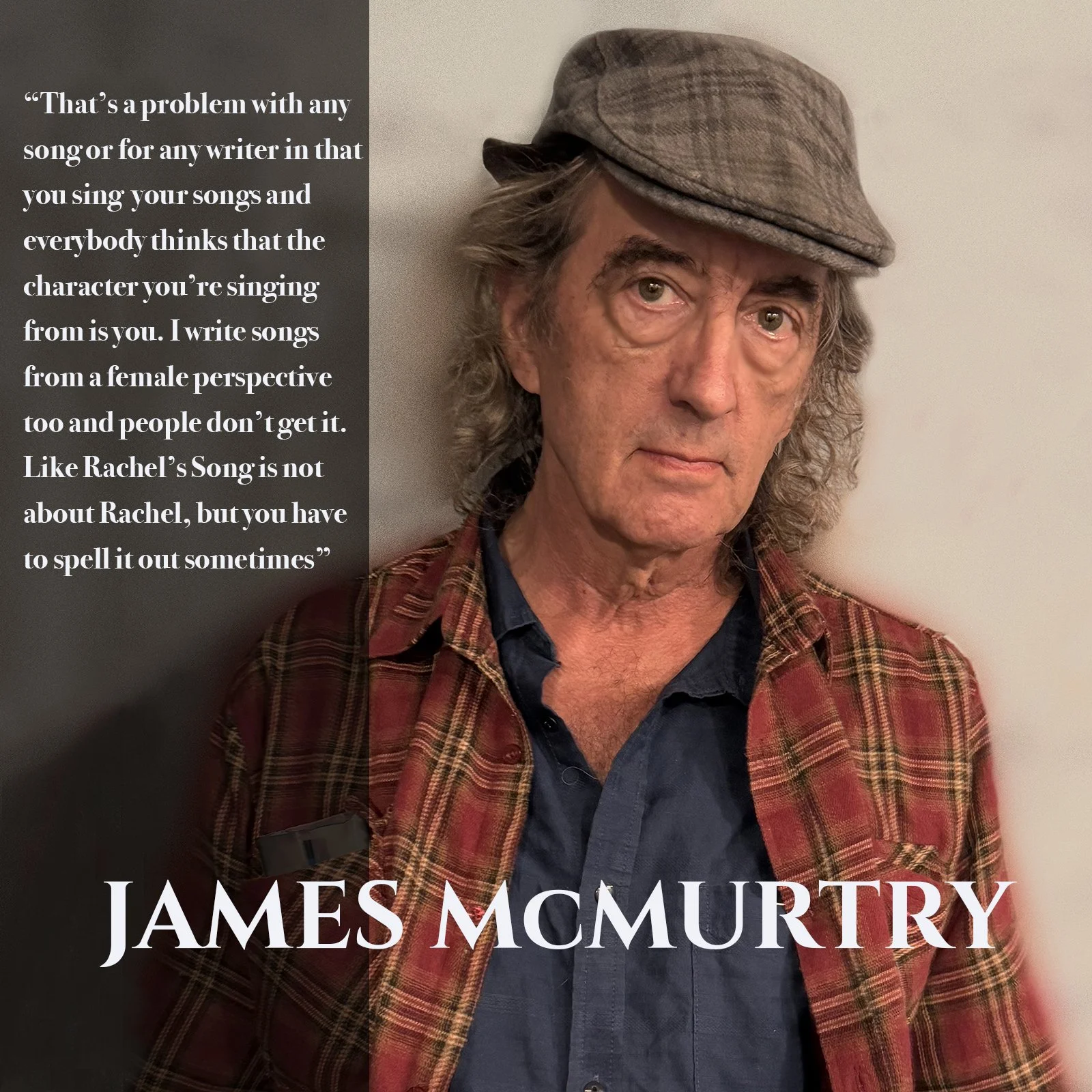
Lockhart is a small town in central Texas, about 30 miles south of Austin. It was once named as the "Barbecue Capital of Texas" and has been a location for many movies over the years. Every Tuesday, resident James McMurtry packs his guitars and takes the journey to Austin in his pick-up, to perform a residency at the famous Continental Club. This has been a decades-old tradition and something that this writer would absolutely love to witness (bucket list item).
James McMurtry is one of the great songwriters. He is a shy man and does not court fame in any of its guises. Jason Isbell has gone on record to say “He’s a good man, and one hell of a songwriter. He’s got that combination of poignancy, wit and beauty in conversational language.” Those who have witnessed James McMurtry in a live setting know that the grapevine hype is fully justified. His guitar prowess is also off the scale in both quality and technique. James kindly sat with Lonesome Highway before his recent Dublin gig and shared some of his thoughts.
Thanks very much for meeting with Lonesome Highway. Welcome back to Ireland. Your last visit was in 2017, almost ten years ago, and how has it been trying to drive on our roads again? (Texas is ten times larger than Ireland and takes twelve hours to drive, north to south).
It depends on the roads really and the traffic there. I do a little bit of driving on the motorways and it’s the first time I’ve ever driven on the left. I wouldn’t trust myself in the cities. BettySoo (Korean‑American singer‑songwriter) does most of the driving and I watch her going to the right place but my mind doesn’t follow to the right place with her. If I’m sitting in the right lane, I forget it’s the fast lane here! So, I just stick to the big roads where I just have to exit and merge into traffic.
You first came to Europe in 2009. Your guests on that tour included Ian McLagan and Jon Dee Graham, both of whom have now sadly passed on. They were part of the Live In Europe release that followed the tour back then.
They were both on that record. It was something of an accident, as it started as a video project in Amsterdam. The Paradiso (venue) wanted to shoot some live video. I had to give them $3,000 to multitrack the audio. The label wanted to put out the video and it looked good, shot for shot, but they were editing on the fly, which I didn’t realise when I took the project. I wasn’t going to get the raw footage to edit myself. They were just editing as they went and so they cut from a vocal line to the kick drum pedal. I couldn’t do anything with the video, but the audio sounded pretty good so I thought that I’d make a record out of it.
In terms of touring, how difficult is it now. In the past you had the full band but that is now more difficult?
This summer we got to bring the band to Scandinavia, and some German and Italian dates. We don’t make as much money here (Europe) as the overhead is higher. BettySoo and I have been working as a duo a good bit so we thought that it would be cool to come over and do an acoustic thing. Backline and rental gear can be an issue.
You live in Texas, a red state politically, and given your own personal politics, is there ever an issue with attitudes towards the different personas you adopt in your writing?
That’s a problem with any song or for any writer in that you sing your songs and everybody thinks that the character you’re singing from is you. I write songs from a female perspective too and people don’t get it. Like Rachel’s Song is not about Rachel, but you have to spell it out sometimes. A John Prine song like Angel From Montgomery puts it right out there “I am an old woman, named after my Mother…” I don’t always set my characters up like that so it’s not always apparent who they are exactly.
Over the 40-odd years that you have been reflecting upon the human condition have you noticed much change in that time?
People are getting meaner, all the time. Our country has gone crazy (USA). I carry a passport wherever I go in case I want to leave. BettySoo carries a passport and a birth certificate with her in case she wants to stay (she is American but from a South Korean family of immigrants). This is no shit. I.C.E. doesn’t care where you’re born, they just care what you look like. They act and ask questions later. If you’re white like me, you don’t have to worry about someone messing with your citizenship and your basic humanity. I tell that story to a black guy and he says, “Well, are you surprised”? Being a white male American, I never thought about it before.
Is it based in Fear. A fear of minority and ethnic groups?
It seems to be hard-wired but that doesn’t make it right. If we are going to survive as a species then we are going to have to evolve. That means that our minds are going to have to evolve faster than our simian brains are capable of evolving on a cellular level. We are going to have to think around that hard wired stuff. It doesn’t serve any purpose and it’s morally wrong.
I have to applaud you for your stance on minority groups in America on the song Red Dress. That went down extremely well with people here in Europe. You made a stance with BettySoo in support of Drag Queens who were being marginalised?
The first time we did it was in Tennessee because they had just passed an anti-drag law that was going to punish drag performers so we decided that I would wear a red dress that I could fit into and BettySoo would dress up like a guy, and on the encore, we did Red Dress like that. One guy in the audience got real mad and went out on the street and found a policeman to come in and arrest us. The cop just shrugged his shoulders and walked off. We did it a couple of times in Nashville too and our label (New West) was freaking out cause they were extremely nervous - for about a day.
Mary Gauthier, who was at one of the Nashville shows took some video, and BettySoo’s boyfriend reached out to a friend who got the video on national TV. The first time I’d been on national TV in some time, without having to pay. Then Rolling Stone got wind of it and I was able to write my own piece in the magazine. Suddenly our record label is fine with it.
Corporate greed and political policy still sadly go hand in hand. I was thinking back to your song We Can’t Make it Here and how much it has stood the test of time. It’s cited one of the best protest songs ever written?
I don’t sing it anymore, cause the Trump guys would co-opt it. They went on this anti-Globalisation kick. The song was kind of dated when I wrote it (2005), and since then there’s been a lot of problems with globalisation; but we make good products by making the parts in places where they make those parts well. And it was also stitching the world together economically and culturally and that’s what triggered the global freak out because suddenly nobody knew what football team to root for and suddenly nationalism came roaring back as they were afraid we were losing our national identity.
It’s the only thing I can think of, because under Obama the economy was doing better, everything was doing better. To my mind the change really took off under Clinton, and Bush didn’t slow it down because his buddies continued getting richer, just as Clinton’s did, and we wouldn’t need to work towards a universal living wage which would hard to make happen. Now they’ve just torn it all down.
Ireland right now has full employment and yet there is a housing crisis and a high cost of living that is driving our youth to emigrate. Coupled with a racial tension towards immigrants that are coming to our shores it’s like a mirror of what we see in America and other countries. Not to the same extremes, but society seems to be morphing into this hard right direction politically.
It’s pretty much everywhere. When resources get stretched then everybody starts getting tribal again. People in the States are still very isolated geographically. I was thinking just how much water there is between us and everybody else, on both sides. One of our earlier tours, maybe 2017, the Syrian crisis had happened, and the US had a hand in that, we were part of that conflict, we created that refugee crisis and we were griping about taking in 100,000 Syrians. Italy got about nine million and I happened to be there around that time. I went out for a walk one night and walked down a nice, pleasant sidewalk, then went back to the hotel. When I got up the next morning, I did the same walk, and the sidewalks were piled up with sleeping bags full of refugees. Nobody in the States has any concept of that. If I hadn’t been there, I wouldn’t either.
Stephen King has said that you are “the truest, fiercest songwriter of his generation.”
That’s very nice of him.
I would suggest that comment is valid over any generation, in that your music has a timeless quality. And yet, on a recent song Sailing Away I noticed lyrics to the effect that “And have I any business being in this business anymore? And I'm sailing away feeling faded, and I'm not okay, sailing alone steering by the stars, and I can't get home now.” Is this you starting to feel less relevant?
Well, I don’t know if that was talking about me. Everybody gets to an age where they don’t fit so much anymore. I can hardly operate that mobile there (on table), and I need to use BettySoo and her tech expertise. She’s 20 years younger!
During Covid is it fair to say that you found a new medium in streaming live concerts?
I got comfortable with it but I needed a lot of help to make it work. I couldn’t figure out all that streaming process by myself. A lot of people did seem to connect.
We were nervous that you may decide to stop touring as a result.
It was strange and about two weeks into the lockdown, I was getting this strange feeling and I was thinking “Oh, that’s my back not hurting from having to rattle down the road in a van and carry a hatch back and forth.” I didn’t think I missed it, but then the club scene started back up again after lockdown, and I had missed it.
Was it the lack of a live audience?
It’s the rhythm of the day, where you get up, check out, go eat, drive four or five hours, check in and go to sound check. It’s harder over here (Europe) as you guys are not really set up for road travel. Today I got my car clamped. You can’t park, there’s no hotel garage, and there’s no place to park anywhere near the hotel, you’re looking for street parking and the signs look ok, but then you find that your car has been clamped.
Do you notice a big difference when touring around Europe and you’re no longer in the States?
I do in Ireland and in England but it’s harder on the continent as they don’t speak English as their first language. They speak English a lot better than I do, but they’re still about three words behind and so they concentrate, trying to get that lyric, and I can’t tell what they’re thinking. The first time I played in East Germany nobody spoke English because they were taught Russian in school, but they loved any kind of rock and roll, so they went crazy with the band.
Back in 2006 you are winning Americana music Awards for best song and best album, all the way through to this year, 2026, and inclusion in the New York Times list of the greatest American songwriters. Does this acknowledgement over time bring a sense of satisfaction when you are driving alone to those smaller venues?
We’ve been playing those smaller venues for a long time and we are filling them up consistently now. There was a time when that didn’t happen and our agent would struggle to get us shows. We would have to tour Montana in the winter time because nobody else would do that. Now we can play Florida in the winter and Montana in the summer. So, we clawed our way up to that.
That New York Times award probably just proves that I have a greater percentage of fans who read that paper. I came in ahead of John Mellencamp who has way more fans than I have so what I take from that is not as high a percentage of his fans read the New York Times.
Perhaps the Austin Chronicle Hall Of Fame Award was one that gave you most pleasure?
I don’t really put much stock in awards but what they do is give your record a little more life and a little more longevity. My father (writer Larry McMurtry) got an Oscar and he needed it at that time (2005) because he was dealing with movie executives who were much younger than him and they hadn’t even seen a movie that was made before 1980. They had no idea what ‘The Last Picture Show’ was, so to keep working as a screen writer, he had to have that Oscar.
Is the cycle between records a long period of time to write new material?
It doesn’t matter anymore, as the only real commercial value in a record is so you guys will write about us and radio people might spin us and it advertises tour dates. Used to be we would tour to support record sales and try to live off the royalties. That never really worked for me in that I never sold sufficient quantities, and now you put out records to advertise your tours and you get a profit on those tours as the only real revenue stream. There’s no mechanical royalties (payments to songwriters and publishers whenever a musical composition is reproduced) for a download or a stream. So, there’s no back end on a record.
Have you ever thought about releasing your online Covid concerts as digital purchases to boost your revenue potential?
I only ever did it for tips. It was like online busking. It’s work that I don’t really want to engage in. I would rather spend that energy to just keep going on down the road.
What about sponsorships. Is this an area that you would be interested in?
It depends on what they want in return. I don’t like to do private shows or parties. They think that they own you for the night. I’d much rather do a club date where there is a much greater symbiotic relationship; the club is selling liquor and you are selling seats and cd’s. And you’re just in business together.
The last time you played Ireland in 2017, I think there was a drinks company sponsorship that you were involved with?
I think that the leader of the opening band (JD & the Straight Shot) was looking to get his beer products licenced in Ireland and the UK so that he could set up with breweries here. He was the founder of Lagunitas Beer.
Movie and TV placements? I would have thought that your music was perfect for that space?
I’ve got a publisher but not really working in this area. I don’t know how the movie thing works any more, and some theatres are gone forever. Used to be real money, but I’m not so sure any more.
A thought would be to replicate the residency at the Continental Club in Austin into European cities. Perhaps some nights in Dublin, followed by a few nights’ residency in another European city?
You would have to talk to the promoters to see if that was financially viable. I have salaries and expenses to pay and I gotta cover the other nights too. I used to come over and play 35 straight dates with no breaks but I can’t do that anymore. Now I need a night off every six days or so. We are playing this time until the start of November and then I return home. It’s just simple economics.
In terms of writing songs, do you have much unrecorded material or is it more snippets and lines that you stockpile?
When a tour draw falls off then it’s time to get back to writing and turning those stored snippets and phrases into songs, booking some studio time, and making a record.
With the cost of studio time these days, is it better to record at home and have the musicians send in their parts remotely?
I don’t like to do that. I will have some overdubs but I prefer a ‘live on the floor’ approach. The Horses And The Hounds was a combination of live on the floor but because of Covid there was also a lot of overdubs and mail-in stuff. The current record was done in Austin, The Black Dog And The Wandering Boy, and that was all live recording.
That title refers to a dream that your father had I believe?
Before he passed, my father had dementia and he sometimes would hallucinate. My stepmother asked whether he had ever spoken to me about the back dog and the wandering boy? I said, “No, but I’m taking that to use.”
What do all the different producers you have worked with over the years bring to the recording process that makes it feel different and fresh from your perspective?
I just observed their techniques and used what I could, later, when I had to produce myself. I was imitating Lloyd Maines and John Mellencamp, everything that I could remember from those guys, when they would get into a situation. When I ran out of the tricks that I could remember on my own and if I started to repeat myself stylistically, I went back to other producers. An example would be on the album Complicated Game, where C.C. Adcock and Mike Napolitano just had me come in and play guitar and sing to a click track. I would then go away and earn some money on tour, and they would call me up to ask if I wanted to put drums on a track. Benmont Tench came in and played B3 on some tracks and that seemed to pull everything together. However, at no time were there more than two musicians in the studio at the same time. That was just how they worked as producers.
There is a fine line between engineering and producing a record, through to the mastering of the songs. How do you balance these different key areas?
Well, if I don’t like it, then I’m not going to put it out. I’ve had remasters before that can destroy a record. I don’t have anybody telling me that I have to put something out anyway. There was one record that got overhyped pretty badly where they overdid the high end and cut out the mid-range. I told them that my music kind of lives in the middle and I took it to someone else to remaster.
The whole process of making music is so different now. Do you have access to any of your earlier albums or are they held by the labels?
The early albums were all traditional deals and the label owns the sound recordings. I have writers’ rights but as regards the original recordings I have no control over those. I do have the four Compadre records, which are now on Lightning Rod, and that was a lease deal, so I own those master’s and I lease them out. On the last two records with New West, it’s a traditional deal and they own the recordings.
Are New West easy to work with?
They are very patient. Each of the last two records were started by me after I was supposed to have turned them in. I can’t really complain too much, but I did feel like they weren’t behind my last release. I’m not so sure that they lobbied much for a Grammy nomination. New West records are owned by the Fontaine family and I like old George Fontaine – he is a great character. When I was playing back a rough mix of The Horses And The Hounds before it came out, I remember on the song Fort Walton Wake-Up Call when it got to the line ‘How're they gonna build a wall with no Mexicans anyway’ - George looks at me and says “That’s a good question.”
Interview by Paul McGee Photography by Kaethe Burt O’Dea