It’s always a pleasure to chat with Ags Connolly, and even more so when he's recorded new music. His latest album, YESTERDAY’S MAN, arguably his career best, has just been released, following his James Hand tribute album from 2024 and the Tex-Mex-flavoured album released a year before that. We got the lowdown on the new album shortly after Connolly’s album launch at The Water Rats in King’s Cross, London.
I’m intrigued by your album titles. Before we speak about the new record, was your 2023 album title SIEMPRE, translated into English as forever or always, a statement about your commitment to country music?
Possibly, but I suppose it had a lot of meanings, and I felt it was quite all-encompassing. Really, it had meanings to do with quite a few of the songs on the album. I just think it's a nice title in general.
That record was essentially a celebration of Texan music from start to finish.
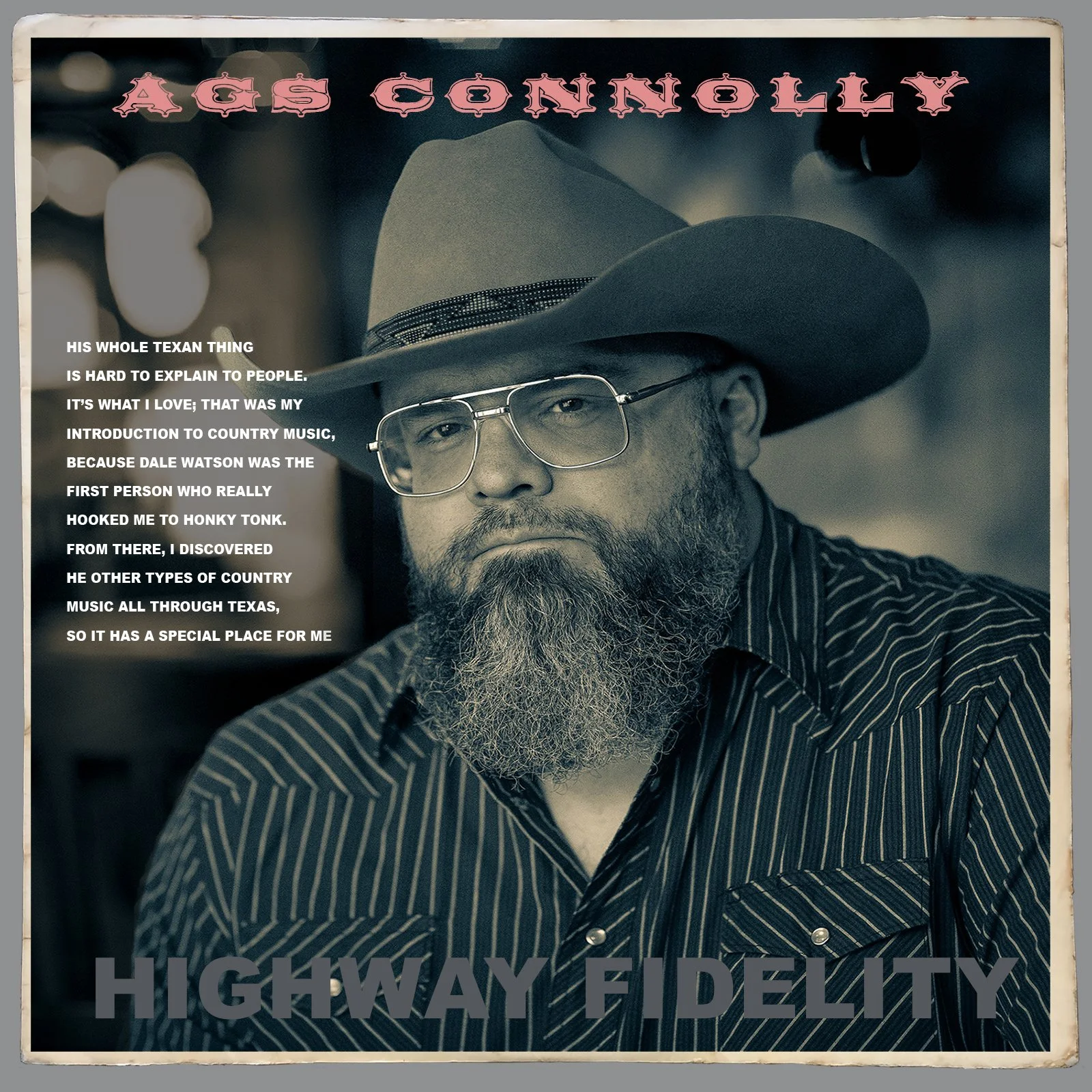
Yeah, that's right, this whole Texan thing is hard to explain to people. It's what I love; that was my introduction to country music, because Dale Watson was the first person who really hooked me to honky tonk. From there, I discovered the other types of country music all through Texas, so it has a special place for me. But I guess explaining that to people was tough, so I try to do it through the medium of music.
How did you discover Dale Watson?
It would have been seeing him live because I discovered him and a lot of country music through the pages of Country Music People magazine. I used to look through the reviews and gauge what I thought was up my street and what wasn't, as I still do. Back then, if I thought something sounded good, I’d go and buy the CD. I thought there was something very special about Dale Watson’s sound. That sound. I went to see him live a few times, and that's when I started going over to Austin.
Artists like Dale Watson must work hard to survive in Texas, so where does that leave guys like you in the European market, where, except Scandinavia, don’t always appreciate traditional country music?
That's a very good question. You have to accept that it's a small kind of niche thing that we're doing, which is mad when you think about it. Because if someone like Dale Watson had been around playing live in the 70s, he'd have been a major star. But now that the world has changed, it's seen as quite a niche thing, and people like me have to explain what we're doing because it doesn't sound like the country music people over here are used to hearing.
Many still dismiss country music as hick and unfashionable, yet those same people have likely never listened to it closely.
Like that I was definitely brought up to think country music was cheesy, but I started liking it more and more in bits and pieces and finally realised it was my thing. I think now you've got a lot more people who would admit to liking country music, but it's two opposing sides. You've got the pink cowboy hat crew who love all the poppy side of it, and then you have kind of the Yellowstone crowd who like the kind of rougher end of it that way. But neither of them are actually anything to do with stuff like Dale Watson, like we were just talking about. So, there's still an element of the real traditional stuff getting left out, but it is much more of an improvement than before, when it was seen as a kind of laughable thing that no one in their right mind would really like.
Are you noticing that there's a growing appreciation, however slowly?
Yeah, a little bit. I think people definitely understand it much more now. I think there was a period a few years ago when, if you were playing traditional country music, the more pop-country-oriented crowd outright really disliked that traditional sound and how old-fashioned it sounded. But now I think there's a little bit more of a link with that with that Yellowstone crowd. I call them that because Yellowstone has a more modern traditional sound. I just played a festival in Finland in the summer where every artist had an Appalachian-type sound, the singer-songwriter kind of Appalachian sound. There's a connection there with Guy Clark and Townes Van Zandt, and there's a connection between them and what we're talking about, Texas artists. There was no connection between Dale Watson and Taylor Swift, but there is now a connection between Luke Combs, the Yellowstone soundtrack, and the traditional artists that came before, so you could say it's slowly getting there.
Is the title of your new album, YESTERDAY’S MAN, a comment on your continued support for traditional country music, even though it isn't as commercially dynamic as it might be?
Possibly, but really, like SIEMPRE, it’s about how I feel about my music in general. My records are permanent things I’m leaving; I’m quite strong on legacy.
You recorded again at Woodworm Studio, which has hosted many famous U.K. artists, particularly in the folk genre. Not many country artists have recorded there.
Stuart Jones, who now owns the studio, bought it from a guy who had bought it from Dave Pegg of Fairport Convention, and it was the folk mecca. When Stuart took it on, they had a few more metal acts in there; Radiohead did their real earlier stuff there when they were called On A Friday. Stuart is very determined to make it more than just a folk or sometimes metal place; he wants to make it a much more of a multi-genre place. The equipment is top-notch, and it's a wonderful environment in a tiny, quiet village.
You had your regular players there: Rob Odergraff, Anna Robinson, Chris ‘C J’ Jones, but you also brought in two heavy hitters, Sarah Jory on pedal steel and multi-instrumentalist Cahalen Morrison.
As you probably know, on my previous albums I used a lot of American musicians who did their parts remotely because I really wanted the authentic players to match the sound I was looking for on those albums. For this one, I realised I needed to be doing something where everybody's in the studio, and I get to speak to everybody face to face. I hadn't done anything with Sarah before; she is, in my opinion, the best pedal steel player there's ever been in this country, and I was very pleased to hear that she was already a fan of mine, so she was really up for it. I've known Cahalan for a little while, and he lives up in Scotland now. It's obvious, but when you're making albums, using the best possible people really helps.
So, you had everybody in the studio for these recordings?
Yes, I had good reasons on my previous albums for using the remote guys. With the James Hand tribute record, I worked with people who'd all played with James, and then with SIEMPRE, a Tex-Mex album, I needed people who understood that kind of music. But at the same time, it's awkward if somebody does a part for you and you maybe haven't communicated exactly what you wanted in the right way, and they haven't done exactly what you wanted. When everyone's in the studio together, you can fix that in five minutes.
How long did the recordings take?
Well, I worked pretty quickly; we did the basic tracks with the rhythm section and with Rob, my guitar player, in the studio for a couple of days. With Sarah and my piano player Andy May, who played on my first two albums, we had a whole day to work with those guys. So, while the overall period is quite short, we made time for those players to get the most out of them. Cahalan was the same as Kieran Towers, the fiddle player; they both came in on the same day, although I think Kieran was maybe used to having more takes. He was a bit terrified at how fast he deemed it to be. I think it came out great anyway.
That’s a fast turnaround.
I've always believed I lose something with every take, and if you can't get something in three takes, then there's a problem. There's some disconnect. Maybe I would have liked it slightly longer on some things, but I'd much rather it be rough and ready than overdone.
Did you have a particular artist or album in mind when you wrote the songs?
I've been listening to a lot of Merle Haggard, that won't surprise anybody, but I really have been listening to him really intensely; he's one of the greatest songwriters; there are not many people who can use so few words and create that feeling. I was determined not to copy Merle, but to be even more direct with lyrics and stuff than I have been before, not stray from country at all, and give the album a slightly different feeling than I had before. That doesn't permeate every song, but Merle Haggard was certainly in my mind during the writing and production process.
Did you have someone in mind when you wrote When You Had The Chance, or is it tongue-in-cheek?
It's a real-life thing. Ninety-nine per cent of my songs are autobiographical, but I made this one more of a tongue-in-cheek barroom thing. It's based on reality, but I really wanted to do a kind of Austin country blues sound on the song, and I knew my guitar player, Rob Updigraff, and my rhythm section were capable of doing that. I could have done that song really slow, but I just thought this would be fun as an upbeat thing. I was quite happy with how it came out.
The song, That Might Have To Do, is more Hank Williams than Merle Haggard for me.
That's a great compliment. I was probably more thinking of, like, Wynn Stewart or maybe Roger Miller on that one.
Is the closing song Someone Wrote A Song About You aimed at someone?
Again, it's an autobiographical thing. I think when you write a song about someone, they can feel like it's an attack of some sort, or that you're getting overly personal with them or whatever, for the wrong reasons. But if you write a song about something you really have to care about, it or them, at least I do. It’s paying a compliment, really, rather than anything else.
What songs on the album are you most proud of?
I'm happy with all of them, but I'd say that the one that I particularly like, because I think it was the type of song I wanted to write for a long time, is Aren't You Lucky. I very much like that country folk kind of sound, like a Norman Blake type thing, but I guess I was thinking of Tim O'Brien or someone like that. I love those really simple songs, but they sound like something you haven't heard before; that's what I was going for.
You recently launched the album at The Water Rats in Kings Cross. How did that go?
It was really nice. And what was great about that is I got pretty much most of the band together that I could get including Sarah who was available. We had a rehearsal the night before, and it was perfect. I'm very grateful to everyone who turned up to those things. It's tough times out there, money-wise, but people still want to see live music.
You’re heading to Sweden soon to play there.
I'm just doing a one-off thing there. My friend Jeremy Pennell's playing in Gothenburg on Friday night; we toured together in 2017. It was a while ago, and we've kept in touch and always been really good friends. I saw he was coming to do this European tour. I said, "I'm just going to come to one of the gigs." I was going to come along on Friday, and then the venue got wind that I was coming, and they said, "Do you want to open the show?" I was like, "Okay, right." So, it's just one gig there. But I do go to Scandinavia quite a lot, especially Sweden.
You have made the point that you put your heart and soul into this album. You have certainly achieved that with YESTERDAY’S MAN.
I was definitely building towards this being my biggest album, and I pushed the boat out in a few different ways in terms of making it, and I feel like it's helped in some ways. You're still at the mercy of whether people take enough interest or whether the timing is right for certain outlets to take an interest or whatever. But I do think, and I already feel that it's starting to permeate out. The two singles have had a lot more interest than some of my singles have in the past. I'm never going to be a Luke Combs or whatever, but I think in the context of what I'm trying to do, an English person singing traditional country, I feel like there is more out there for me.
Interview by Declan Culliton Photograph by Alastair Hilton