
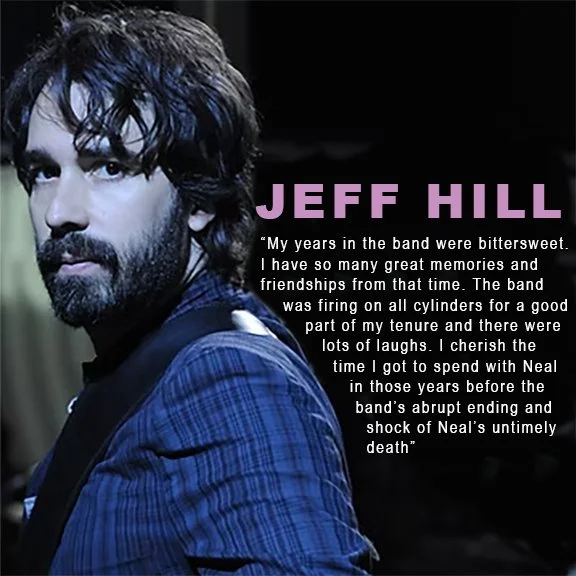
Lonesome Highway recently asked a long-time friend and fellow band member, Jeff Hill, to share his memories of working with the late, great, Neal Casal. Jeff is a bassist/producer/recording engineer and he was very kind to reminisce over the times he spent around Neal. Book Of Stories (Home Recordings 1998-2003) is an album of previously unreleased songs that has just been made available on the Royal Potato Family Record Label. The Neal Casal Music Foundation continues to inspire future musicians and bring mental health support to those in need. It also donates musical instruments and lessons to students in New Jersey and New York state schools where Neal was born and raised.
Your website defines you as bassist-producer-engineer. As a professional musician you have played across different music genres. Do you have a particular favorite?
Yes. I feel comfortable playing in many different styles and genres, but I strive to bring my style and sound to each genre. For me, great music is universal regardless of the style, so it is hard to pick a favorite. For me it would be music that is moving - whether it moves the hips or the soul, that is the music that I want to play.
Jazz has been a big influence I believe - has this resulted in collaborations that have inspired you?
Yes. I try to bring the jazz aesthetic to my playing and collaborations as much as possible. I strive to play with an improvisatorial spirit across genres. During the Pandemic reopening I was involved with some rewarding collaborative improv-concerts/recordings with Tony Mason, Scott Metzger, and myself - called Psychedelic Sangha. They were meditation concerts in front of a live audience in NYC.
When did you first meet Neal Casal?
I first met Neal Casal at a recording session in 1999 that Gary Waldman put together for a young artist named Shelby Starner. Jim Scott was producing, and the band was John Ginty, Kevin Hupp, Jack Petruzelli, Neal and myself.
You were a band member in Hazy Malaze and recorded with Neal back in 2003 on the debut album. What was it like being part of that band?
Being In Hazy Malaze was like being in a Garage band in high school with two of your best friends. We literally wrote and jammed the songs that became three records in the basement of Dan Fadel’s Mom’s house. In Denville NJ. Within a short distance of where all three of us grew up.
In all, you released three albums. How did your sound differ from other projects that Neal was involved with over that time, such as Ryan Adams?
The Malaze was a fun project that just kept going for no other reason than we loved playing together and the songs and grooves kept coming. The sound was based on the funky soul and rock n roll music that we grew up on and were listening to extensively on the 2002 tours with Shannon McNally. Neal, Dan, and I were the core rhythm section for that year.
In 2006 Neal released his solo album, No Wish To Reminisce. The producer was Michael Deming and a studio in Connecticut was used. You played on the album, and it was a very generous thirteen songs over fifty-plus minutes. What are your recollections of that recording process?
I remember that very clearly, basing much of the recording on the very beautiful and flushed out demos that Neal made for that record. I believe they were recorded on his Otari 8 track reel to reel. We spent a good amount of time getting basic tracks with Dan, Neal, and I. Neal and Michael spent a good amount of time layering lots of guitars and overdubs.
In 2009 the album, Roots and Wings, was released. A New Jesey studio setting, and you again play on the album, which included sixteen songs that clocked in at just under a solid hour of music. Neal self-produced on this one and was there much that changed in the recording process between these two projects?
I was not part of the initial recording process for this record. I did come in for a few days to add or replace bass that Neal was not happy with.
In 2011 Neal releases his tenth, and final, solo album, Sweeten the Distance, and it’s produced by Thom Monahan at the Hangar, in Sacramento. Eleven songs included, and did you also play a role in the recording process?
Yes. It was an amazing experience to work with Thom Monahan. We recorded at a studio in Sacramento called the Hangar and it was an old warehouse that was operated by John Baccigaluppi, one of the founders of Tape Op magazine (focused on creative recording techniques). It was an expansive space which held all the archives of tape Op magazine as well as an indoor skate ramp. Neal was really proud of that record and it’s among his best.
The same year, Neal joined the Chris Robinson Brotherhood as a founder member. You became involved in 2016 and remained until the band stopped in 2019, after Neal died. What are your memories of those years?
My years in the band were bittersweet. I have so many great memories and friendships from that time. The band was firing on all cylinders for a good part of my tenure and there were lots of laughs. I cherish the time I got to spend with Neal in those years before the band’s abrupt ending and shock of Neal’s untimely death.
How was the band dynamic during your time there – was there a democratic process, or did Chris Robinson have sole control on all aspects of recording, touring etc?
I wouldn’t call it democratic but musically Chris gave us free reign to be ourselves and I specifically appreciated that we would play different sets each night with new cover songs added daily. This kept the 3 hour shows fresh for the audience and band alike.
Neal always remained very busy and in demand. Other projects included recording with Hard Working Americans / Circles Around the Sun / GospelbeacH, as just some of his output. Were you in regular contact with him during all this hectic scheduling?
Yes, Neal was incredibly in demand. Neal was one of those friends where we were in always in some sort of contact but even when time had passed without speaking or seeing each other due to our busy careers, when it did happen, it would be as if no time passed at all.
You played on two of Neal’s posthumous singles that were also released, Everything Is Moving and Green Moon. How did that come about?
These were unfinished demos that Gary Waldman had in the archive. The vocals and guitar were produced by JP Hesser. He sent them to me during the pandemic and asked me finish production. On Everything Is Moving we added Dan Fadel’s drums, my bass, John Ginty on organ, John Graboff on guitar, and Jena Kraus on backing vocals. Jim Scott added tambourine and mixed. On Green Moon I added upright bass and sent it to George Sluppick to record drums to my bass to round out the psychedelic feel of the recording. I love the way it came out.
The No One Above You album was a further release in 2025, looking back to the years 1991-1998, and captures previously unreleased demos. You again feature on this posthumous release. What are your memories of this project?
No One Above You is a compilation of early Neal recordings. I was sent tracks to play bass on remotely in my home studio.
In putting together the current album Book Of Stories (Home Recordings 1998-2003) you played a pivotal role in transferring the original tapes that were discovered into digital format at your own recording studio in Brooklyn. Can you talk about the process involved?
I am no longer working in my studio in Brooklyn. Shortly before the pandemic I moved to a quiet town in North West Connecticut where I have a home studio. Gary Waldman brought around 20 1’2” reels from Jim Scott’s Studio in California. Neal had recorded music on these reels with an Otari MX505 8 track that Jim Scott gave him. Around 2008ish. im and Neal gifted the machine to me, and Gary wanted to put the reels up and see what was on them. Many of the reels were labeled, but others had no labeling. It was a real process of discovery as we put the reels up for playback and found songs that were familiar and unfamiliar to both of us. After they were all archived, Gary was able to identify the unreleased tracks and create a cohesive album with the material. A few of the tapes had gummed up over the years and I went through the process of baking them to try to bring them back to life. I would say at least two reels were unsalvageable. There is one particular track Dark and Dangerous Days that the reel didn’t slow down from the stickiness until the very last note of the song, leading to a very unsettling ending to the song. This was unintentional, but it really adds to the vibe of the finished song.
Do you have a regular involvement with the Neal Casal Foundation Trust, or is it more a case of being contacted by them to add your skills to certain projects?
Gary (Waldman) is a close friend, and he reaches out from time to time to be a part of projects.
When you look back over twenty-plus years of knowing Neal Casal, what do you remember most regarding his personality and his playing prowess?
Neal was a kind soul, a dear friend and incredible musician. He had an incredible sense of humor, impeccable taste, and was generous to most everyone he met. I loved him like a brother and miss him every day.
Interview by Paul McGee