
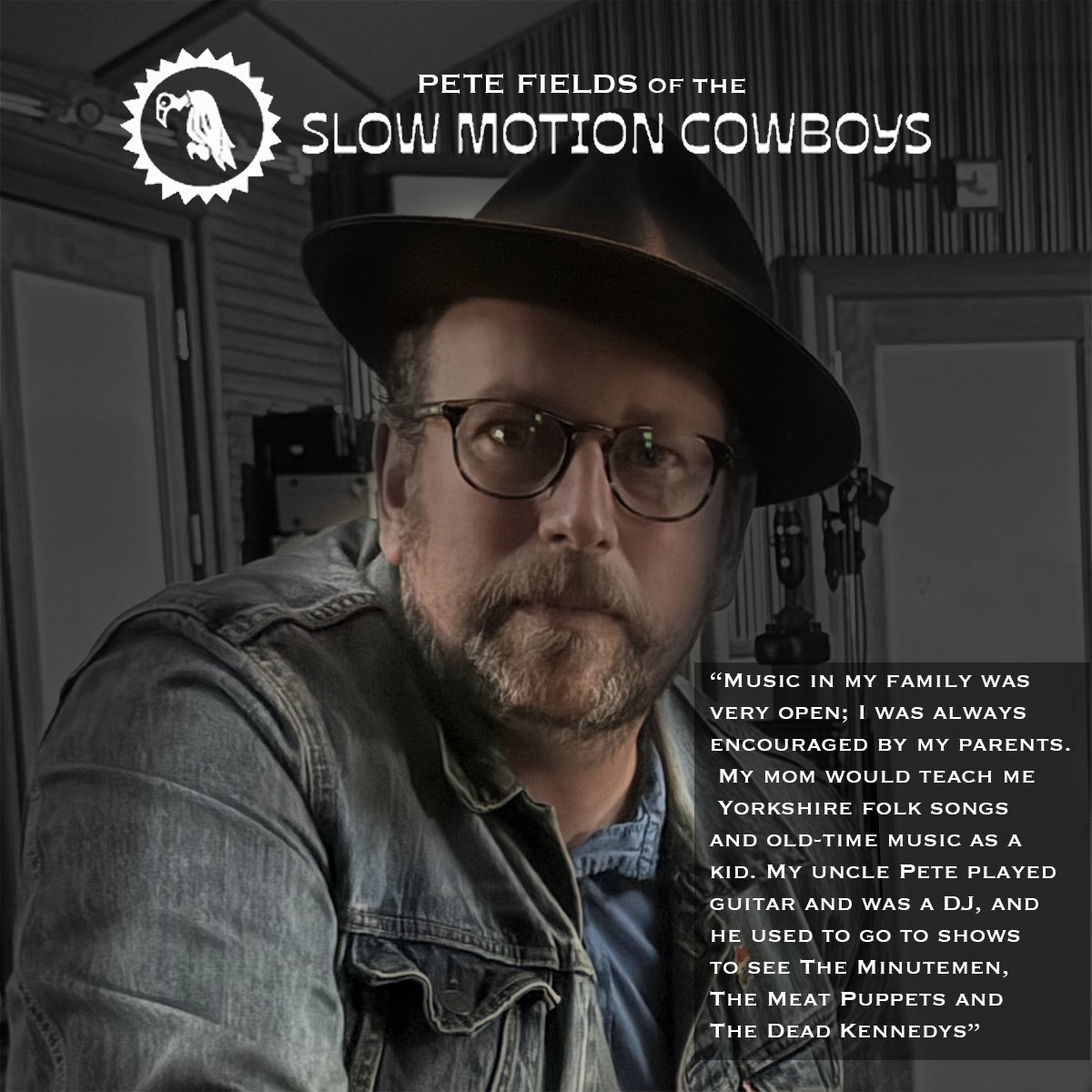
New Orleans may be the ‘jazz mecca’ of the United States, but an underground roots scene, sparked by bands like Hurrah For The Riff Raff and drawn by the city’s bohemian atmosphere, has steadily grown over the last decade. Pete Fields’ Slow Motion Cowboy typifies an artist lured to New Orleans to further his sound, which began in San Francisco and paused in New Mexico. Their latest album, WOLVES OF ST.ELMO, is a marvellous left-of-centre country record shaped by Fields’ time in the Bay Area, the desert, and his current home, The Crescent City. Pete spoke with us recently about his career journey and discovering the optimum environment in New Orleans to further grow his art.
What drew you to music, and in particular country music?
I was raised around a lot of blues and country music. I was born in San Francisco, but I also have family in Texas, and I would go to Austin when I was a kid and was exposed to Ramblin’ Jack Elliott and to Bob Dylan, as my uncle is a big Dylan fan. My dad lived in Alabama with my brothers before I was born, and both my parents were folkies, very political too and often referred to music. Music in my family was very open; I was always encouraged by my parents. My mom would teach me Yorkshire folk songs and old-time music as a kid. My uncle Pete played guitar and was a DJ, and he used to go to shows to see The Minutemen, The Meat Puppets and The Dead Kennedys. I also grew up in the Mission District, where there were a lot of Mariachi guys around that would come to your table, play you a song, and sell you a rose. When I moved to Washington State, I started playing old-time and bluegrass music there and learning about the tradition of that music from players up there.
Were you into San Francisco music at that time?
The Grateful Dead and a lot of that San Francisco clichéd music were uncool to me and took a long time for me to come around to it. I think the idea of folk music and its expression, and trying to find something that is yours, played a part for me.
When did Pete the listener and student become Pete the songwriter?
I didn’t know any songwriters growing up; to me, it was always about guitar players, Jimi Hendrix, Cream, and Neil Young. I always wanted to be in a band and shred guitar. I’m a big guy and was never a very subtle performer. I only started to find my angle when I began writing, and people who I admired were attracted to the songs. I had access to a lot of musicians and record collectors, and once I started contributing songs in my music circle, luckily, people started responding to that. That gave me an ‘in’ really from the first songs that I wrote. From there, it led to a high school band, and with the band Trainwreck Riders, we still play a lot of those songs in San Francisco.
What brought you to New Mexico before moving to New Orleans?
It sounds clichéd, but I needed to go to the desert. I went to Las Cruces, New Mexico, on my first tour, and that became our community outside the Bay Area, and that is where I met songwriters. If you meet a guy at the gas station in New Mexico, he will melt you with a song her wrote. There are dramatists, poets, musicians and a lot of old-time border music there, and anytime if I wasn’t doing well, I would just go out there. I needed a real change in my life and to put myself in a position to grow and push the band, instead of waiting for it to come to me, so I moved to Los Cruces, New Mexico, where there is a tradition of sitting around a fire and playing songs. I put myself in a position to be around people who were receptive, and that forced me to write, really dig in and push myself. It’s also a good jump-off spot for tours in Texas and the southeast. When I was living there, I got signed to Arkam Records in Muscle Shoals, which was encouraging, and we would play all the little towns through New Mexico in what I called ‘the enchilada circuit.’
Who were the Slow Motion Cowboys band members at that time?
My bass player, Shawn Wyman, has been there throughout, but Slow Motion Cowboys is like, Pete and The Slow Motion Cowboys, who can I find to elevate my songs? I’m a city kid, but I always wanted to learn about music and teach myself the traditions, a lot of which were lost. I’ve always tried to write songs that pickers can respond to.
You are settled in New Orleans now. Is there a big roots / country music scene there?
I wouldn’t say it is a very big scene, but what is special about it is that it attracts people with certain values and ethics. The core value is punk rock across the board, and bands that came before me, like The Deslondes and Hurray For The Riff Raff, whom I was obsessed with, established a scene in New Orleans. They both stayed after Hurricane Katrina and created a new music scene that was valued by the city, and I see those folks as paving the way for what I can do. There are folks two-stepping here now, there are punks and guys with cowboy hats. There is such a tradition of jazz in New Orleans that what we and others are doing still feels very new and an underground feel, but at the same time, the values here, there are great record stores and access to WWOZ Radio, which is an amazing radio station. New Orleans is a perfect place, and it’s not stagnant and still creating new music and birthing rhythms and scenes, and not just the trad jazz.
Like a melting pot, the new album, WOLVES OF ST.ELMO taps into the sounds of San Francisco, New Mexico and New Orleans. It’s very much a ‘full band’ project.
Before I moved to New Orleans I would drive there, buy records, go to see live music and drive back to New Mexico. By the time I arrived here my friend Shawn was already living here, I was well set up, I had a community, I had a band, and I had matured a little bit. I had toured with a buddy, Langhorne Slim, when we were both in our twenties, and my album BUZZARD SONGS was recorded with his rhythm section. When I was touring with Trainwreck Riders, playing heavy music, he would encourage me to play other styles that I really wanted to do but never really had the confidence to do. That was what got Arkam Records involved, but I really tried to strip down my sound with my album SUN BURNT FEATHER and got a lot of my chest with that record. So, when I came to New Orleans, I wanted to put more outside influences in my music instead of inside, where it’s only a mic in a room and me. I had access to Alex (Pianovich) on piano, my bass player Shawn and Will McMains on drums and it became a more external record, telling stories.
There are a lot of contributors on the album. Did it take long to complete the recording?
It took about three or four years to complete because we had the pandemic, and I also put out a digital acoustic record of New Mexico songs; I felt that I had cleaned out the closet before finishing this record. I didn’t rush it and took my time. Any time I could, I would go into a nice studio, five minutes from my house, explore sounds and add piano and mandolin, send it to Nashville for Paul Defiglia to put organ on it. I also started playing with Alex, Greazy Alice, and others to try to develop a bigger sound.
Tell me about the connection with Margo Cilker, an artist much admired by us at Lonesome Highway?
I’ve known Margo for a long time; she’s part of my musical family, and she’s covered a few of our songs. She started playing some of my songs at her shows and calling me out as the writer of the songs. With her covering my song Invisible Stars and Uncut magazine reviewing THE WOLF OF ST.ELMO and the groundwork that I had already put down, it has all been working out for me.
There is a lot of love, torn relationships, and survival in your writing. Is that autobiographical or fictional?
Biographical, definitely. My past albums were ‘I feel this way’ records, though I tried to do everything differently with this record, and I think there is more hope with this one, even though the internal melancholy is still there. That is how I process the world and always have. I was fifteen when I went to Texas, my dad had just passed away, and it was a hard time. But it also exposed me to a blueprint of how to express myself, and with Slow Motion Cowboy, I look at myself and don’t shy away from the fact that I don’t know how to write a happy song, but I think I do know how to write a hopeful song.
The song Catch & Release is particularly melancholic and sounds like it was an outtake from Neil Young’s TONIGHT’S THE NIGHT.
You nailed that. I appreciate you saying that. That is my favourite Neil Young record, and I’m ‘Neil Young obsessed.’
The title track, which closes the album, has a border feel and dreamlike quality. What is the backstory to it?
It’s a very specific song, and it’s supposed to be almost like a movie. I often feel most comfortable in the most chaotic and extreme place. I’m most happy in Bisbee, Arizona, which is a beautiful town of outlaws and bikers, and there is a really rowdy biker bar there called St. Elmo’s Bar. Every time I go there, I sit at that bar, and there is this little lady who weighs probably ninety pounds who brings two wolves to the bar, not full wolves but big mixed-breed dogs. The whisky is flowing, and these two dogs are staring at me like they’re ready to bite me any minute. There is the uncertainty with things that are wild, and I’m caught between being comfortable in my skin and being in an unknown and dangerous place. I use colour in that song a lot. My wife is a costume designer and talks about how red on stage represents lust or jealousy, and so I wanted to use red in the song. I often feel most comfortable in the most chaotic and extreme place. When I was writing that song, I was thinking if I just dreamed that scene with the wolves. I went back to play that bar on the record release tour, and I said from the stage that I had a lot of drinks in this bar one night, but were there wolves in this bar? The reply was ‘Yes, that’s Ally, she lives down the street, she drinks here with her wolves.
Dobro and slide guitar are very much part of your core sound.
It is. When Slow Motion Cowboys first started, I played with a guy called Cayenne Dan, who is a dobro player, and mentored me. He played tunings that I had never heard before, introduced me to old-time slide and Hawaiian players, and made me use my voice to relate to the slide. New Orleans rhythm alongside slide guitar is the formula of Slow Motion Cowboys.
Interview by Declan Culliton