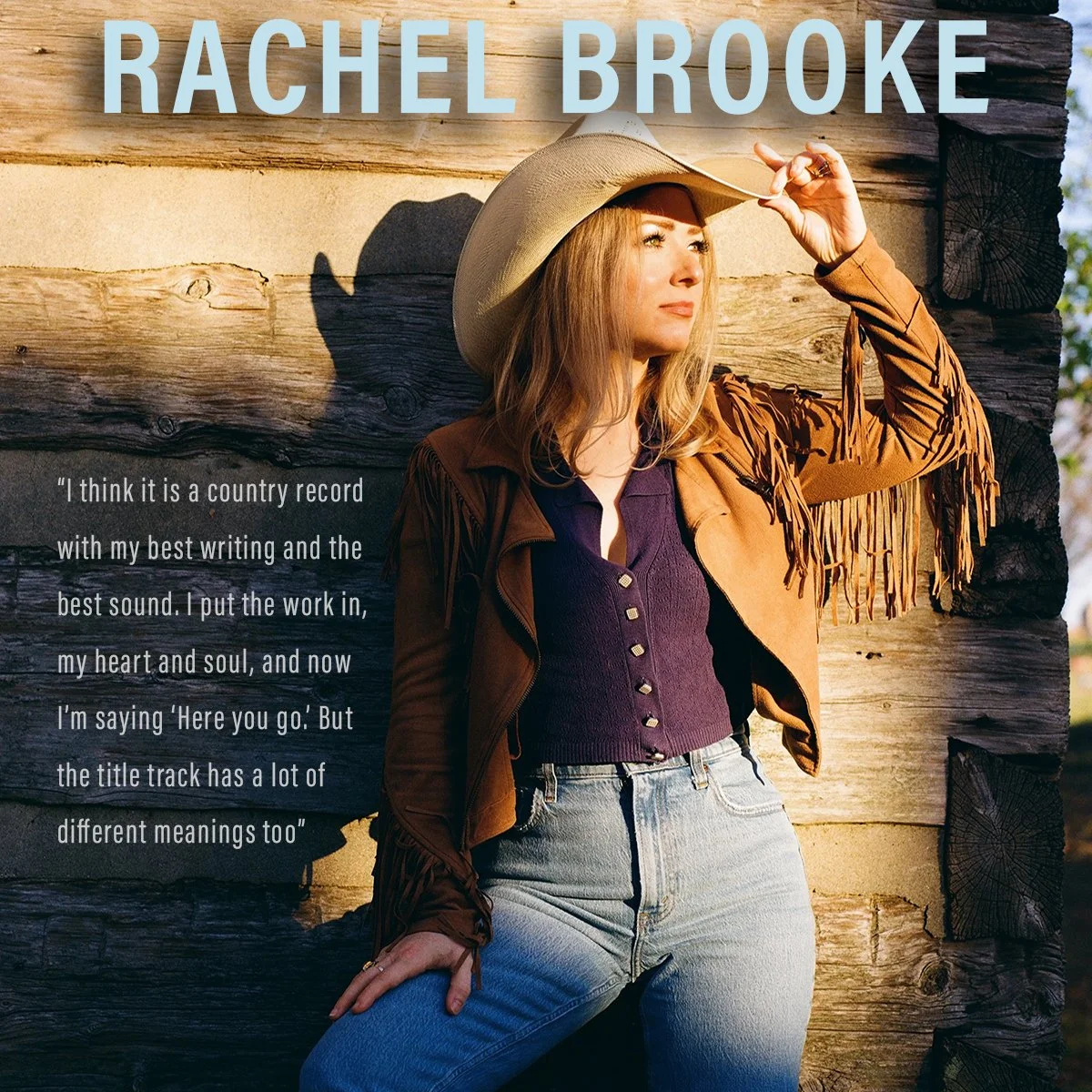
The cover shot on THIS ONE’S FOR YOU, Rachel Brooke’s latest album, reflects both her current mindset and the album’s musical direction. Wearing a Stetson and beaming, she hints at a happy, traditional country record, far removed from the sorrow often found in her earlier impressive work. The album is upbeat, laced with humour, and should grow Brooke’s loyal fanbase to a wider audience. Rachel was in top form when we spoke recently about the new album and the journey that led her down the classic country road with this project.
Before we talk about the new album, speak to me about SINGS SAD SONGS, which you released last year.
I was hitting it pretty hard out on the road with my band and was working on the songs from the new album, but I got to a point where I thought, ‘I can’t do this anymore,’ and I needed to take a step back. I still had a need to create, so I just went to my basement, recorded SAD SONGS and put that record out to clear my mind and my soul.
You closed that album with a degree of hope with the song Silver Lining, which references advice your mother had given you.
Thank you for asking about that, because I’m intentional and ended that record with that song for a reason. There is always another side and more coming along the way.
Is the title of your new album THIS ONE’S FOR YOU, Rachel Brooke, looking in the mirror or is the title aimed at others?
The album title has lots of meanings for me, and it’s hard just to pinpoint one. I think THIS ONE’S FOR YOU is a country record with my best writing and the best sound. I put the work in, my heart and soul, and now I’m saying ‘Here you go.’ But the title track has a lot of different meanings too. In the song, I’m saying lots of things like ‘here’s a song for you’, but also a lot of different things, from ‘here’s a drink for you’ to ‘fuck off.’ It encompasses a lot of different things in one song.
It’s your most traditional country album. Was that intentional from day one?
Yes, I did because I never do the same thing twice when I’m recording an album. I will try to do whatever feels right for me at the time. This time it was country, because I grew up playing country and bluegrass, even though I’ve made records that didn’t really exactly fit a hundred per cent in those categories. My country roots go really far back, so I decided to do a country record with this one and see how it turns out.
Did you record locally?
Yes. There were two different recording sessions on the record. Firstly, I recorded it near Detroit, which is about an hour and a half away for me. It was at a studio called Tempermill Studio, A pretty well-known studio in Detroit. I worked with an engineer named Jake Chives. He is easy to work with and did a great job on the record; he also did a lot of the editing, mixing and mastering. And I then flew to Missouri, and Rick Wagner and I worked together on his guitar parts at his studio and sent those files back to Jake Chives. It was a unique experience because I worked with my brother, who is also an amazing producer, on all my other records at his studio. I decided to try something different for this record.
You’ve included a lot of humour in the songs.
A lot of my earlier albums were sad, from my heart and about relationships and my feelings at the time. This one feels like my own personality, I like to make jokes and puns and that came out strong in my writing. I also think it’s me growing as a person, having worked through a lot of pain in my twenties. I think I now have a better perspective on the world, and I’m in a new headspace now.
Were there particular artists that you were listening to while writing the songs for the record?
Yes. Shel Silverstein. As a kid, I didn’t think that much about him as a musician, but his playful writing, he wrote great songs for a lot of people. He was a great influence, and Roger Miller, who has a similar style and also wrote some weird stuff. John Prine was also a big influence, and I really dived into his music in the last few years. It’s good, smart and intentional writing.
You open the record with a confessional song, I Chose Poorly, with an element of tongue-in-cheek.
I think that was the best song to start the album with because I tried to add humour to the album. I thought long and hard about what song to start with and felt that song set the tone for the rest of the record.
When Dube Gets The Crud is a standout song. Is it based on a real-life character?
Yes, Dube was my stepdad; he passed away last year. At a time when we were living in a small town in Northern Michigan, he lived about two miles away. We bought a house there, and there were lots of things that needed to be fixed. It was our first place, and we didn’t really know what we were doing. We’d call Dub up and ask him how to do things, and he always seemed to have the parts we needed and helped us fix lots of things around the house. One day, true story, we called him up looking for some help, and my mom just said, ‘No, Dube’s got the crud.’ That story developed into the song inspired by Shel Silverstein’s writing. It’s a real story and a pretty special song for me.
The Ballad of Bald Hill plays out like your life story, tinged with a degree of sadness.
I honestly feel very close to that song. It is the story of my life; every moment in that song is real. Bald Hill is the road I grew up on, and I have very fond memories of it. I often wish I could go back to those days. My mom still lives there. When I think of where I want to be when I die, it’s there. There is a church on Bald Hill where we went to Sunday School every week, and all I wanted to do, like most kids, was to go home. The song takes you through my life, where I was a teenager wanting to see the world and experience things away from a small town. I got married, divorced, while still trying to figure out exactly what I wanted from life. When I talk about ‘Cowboy Joe and the real outlaws’ in the song, that was a game that my siblings and I played. The end of the song is me just wanting to go home, somewhere that I wanted to leave as a kid, and now just want to go back to.
Is The Real Pretender aimed at a particular individual or the music industry in general?
It’s aimed at everybody and is meant to be funny. That song was inspired by spending lots of money trying to get your record heard and your music out there. There’s nothing wrong with that, but the song is making fun of the whole industry rather than just one person. A lot of it is from my own experience, and a lot of things that artists have to do that seem weird and dumb just to hope that people will hear your music and pay attention.
With so much music being released, how challenging is it to get your music heard?
I don’t mean this in a negative way, but there is just so much music out there, so I have no expectations about this album because I’ve found in the past that those expectations hurt. If this record is meant to find somebody and does, I’m happy. It doesn’t really seem to matter how much money and time you put into promoting your music these days, I realise that now. All I can do is keep doing my best and put out good music.
As an independent artist, can you separate the artist from the business person?
I have to be in a totally different mindset to work on the administrative side of my career. For the last year or so, I’ve been in writing and recording mode, and now I have to try to get people to hear my music, though that input is fairly minimal compared to my last few releases.
Listening to the new record and chatting with you, I get the impression of a person totally reenergised.
After hitting that block last year and pushing against a brick wall, I actually feel free now. It’s like I had an epiphany or ego gap where I released every attachment and decided that I’m going to do what makes me happy. I’ve let go, and now I feel good.
Interview by Declan Culliton