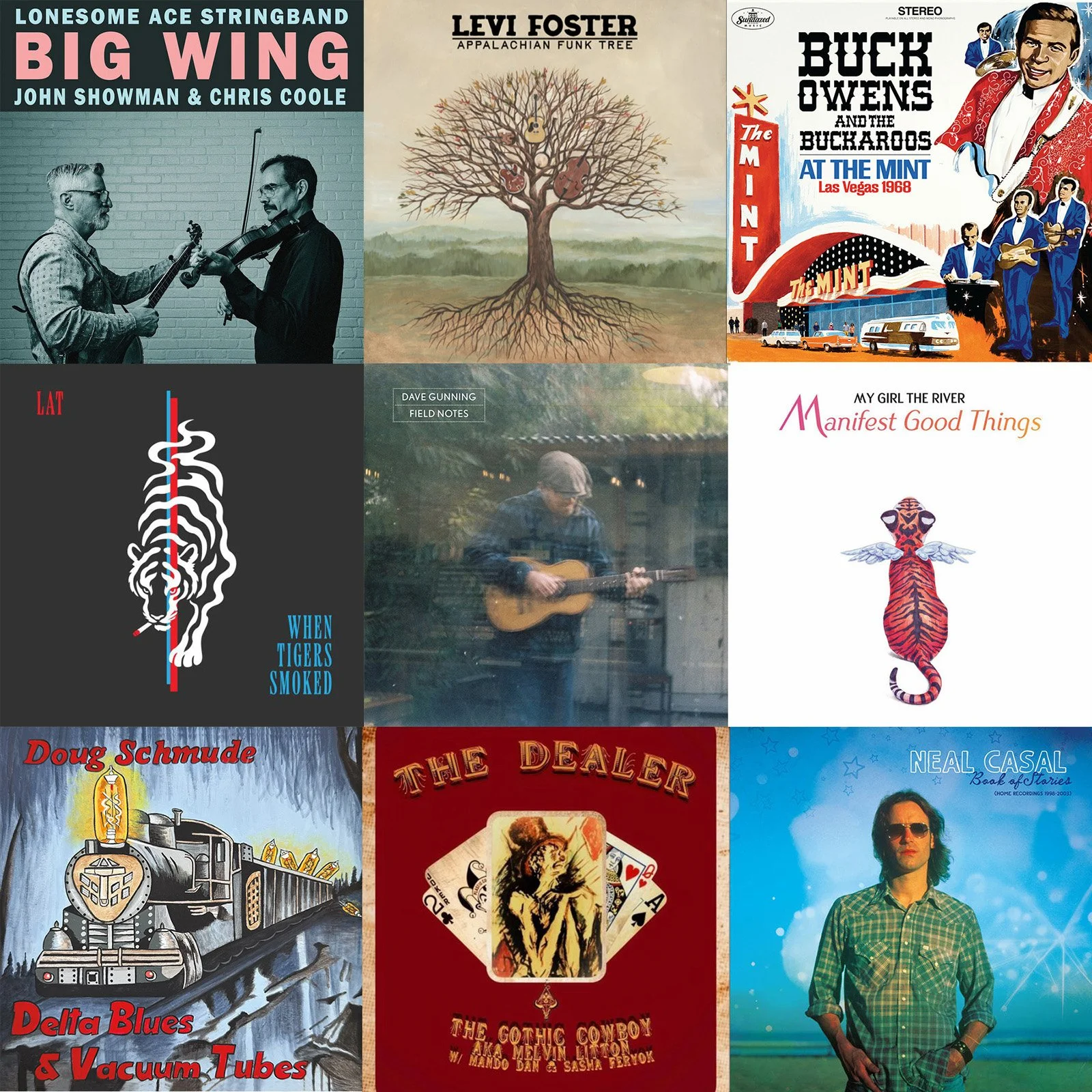
Lonesome Ace Stringband Big Wing Self Release
The seventh studio album from Canada’s Lonesome Ace Stringband finds them stripped down to a duo, with the departure (on good terms) of long term bassist Max Heineman. But fans of the progressive old time/bluegrass/folk fusion band need not fear - this album continues the high standards they have set themselves in previous recordings and even surpasses them.
One of the hardest touring bands in the North American continent and further afield, John Showman (fiddle, strings and vocals) and Chris Coole (banjo, guitar, percussion and vocals) continue to push the boundaries of roots music with their modern approach to recording and production, but all the while anchored in their shining musicianship and composition skills.
The opening instrumental, Crowe River, is a good example of their unpredictability - the zany intro features a distorted ukulele and jingle bells, before morphing into a driving fiddle-led old timey tune, and eventually fading out into the buzzing of an angry sounding bee. The first song is also the first of four covers, Stage Fright being a Robbie Robertson composition, here given a banjo-led treatment and showcasing the superb vocal harmonies of the duo. They collaborate with another Ontario band, the Andrew Collins Trio (a jazz/bluegrass fusion band) on the cowritten instrumental May Day, which features the celebrated mandolin playing of Andrew Collins. James McEleney is the bass player in that band and he also plays bass on a number of the tracks here.
Log Train is a country song written by Hank Williams, reputed to be the last song he sang on stage, and it’s easily the slowest paced song on the collection. Peep Of The Day picks up the pace again, a celebration of the dawn chorus which takes off in a flight of fancy and is almost enough to turn this reviewer into a ‘morning person’. Doug Paisley’s song Drinking With A Friend is given a suitably maudlin treatment, with droning fiddle and distorted bowed bass echoing the protagonist’s admission that he has wasted his life away. The title track was written by John Showman in response to seeing his children grow up and branch out in life, ‘My heart knows these days are done …. Even though I long to carry you again/ You’re up there with your big wings flying free’. Carpet Beetle is another frenzied fiddle instrumental with a funky bass line (played by Alan Mackie) and the closing Hurricane Season also features a thumping bass in a punk-like anthemic number.
Keeping it in house, John Showman recorded, mixed and mastered the tapes, while Chris Coole did a superb job of designing the sleeve. Highly recommended to all string band and roots music listeners.
Eilís Boland
Levi Foster Appalachian Funk Tree Banner
This album is an obvious amalgamation of influences where, under Shooter Jennings’ production, Levi Foster delivers a varied and enjoyable set of songs that tell stories and underline them with some soulful Memphis motivations, bluegrass backstories and country colourings. The title itself sets you up for this and at times all may appear in a particular song. The reliable set of seasoned sessioneers include, on different tracks, bassists Mike Rinne and Ted Russell Kamp, Brian Whelan on lead guitar, drummer Jamie Douglass, guitarists Evan Hull and Richie Worrell, keyboards from Reed Pittman, and Greg Leisz playing steel. Also adding their talents throughout are Aubrey Richmond on fiddle and Jake Groves on harmonica. This collective team provide some incisive and astute playing but allows Foster’s distinctive voice to sit front and centre. His is a personable, warm and lived-in voice that feels something of a throw back to some of the fine country singers of the 50s and 60s, with a touch of that swampy funk feel of Tony Joe White’s delivery too. Throughout the songs come with what some would consider a cornball sense of humour, but it is something that fits the overall mode of the music. Some lines from Fat Elvis can help to illuminate that “I met her down on Bourbon Street / my two left feet didn't bother her at all … She showed me how she got them plastic beads / Now I'm sweatin' like fat Elvis on a postcard down in Memphis Tennessee.” However those lyrics can run from that to some more serious concerns and observations.
The title song mixes banjo, fiddle, steel, keyboards and a funky rhythm section which sums up the album and its way of bring these elements together in a workable and cohesive way letting you know something good is going on here. Dobro opens Yazoo Clay and outlines a song that ask the Lord to guide him home as he fears he has the devil on his tail, it is a slow-paced understated plea, while a more uptempo tale of woe is Slam A Swingin’ Door, wherein the lady of concern gives him a hard time when he hides out in his local bar as he can’t walk out and slam the door. More of a historical perspective is James River Man about a hard thinkin’, hard drinkin’ man who lives in, on and by the river and who has to fight his ground. It has a hard edged rockin’ guitar solo that stands out by offering something a little different. By way of contrast One Eye Open has a stylistic vocal that shows Foster’s ability to adapt his delivery to a particular song as it requires. It has some understated pedal steel and piano that set it in a more classic country mode.
A lyrical cinematic feels pervades the story of Fast Horse, which leads you through the tale of a man who reckons that if you live the kind of life he does you are going to need a capable horse to keep a step or two ahead. He adds a spoken interlude on Blackberry Bramble that suits its storytelling of his relationship with his brother and a little witchcraft. His accent gives the song additional authenticity to its delivery. He takes on a different role for Bloodhound, using the analogy to trace his desires. There is another move towards an effective gospel theme on the ‘over yonder’ allegory of Rest Assured. The album ends with End Of Man, which is bolstered by some strong guitar and vocal accompaniment.
The previous thirteen tracks have all acquitted themselves to memory and have proven a good companion over many listens and single out Levi Foster, on only his second album release. He is someone who through his amalgamation of much of the music he grew up with and loved is merging these into a format that encompasses those strands into a inimitable personal blend. It is the kind of album that has the ability to create its own space and, hopefully, spread its roots wide and deep.
Stephen Rapid
Buck Owens and The Buckaroos At The Mint, Las Vegas, 1968 Sundazed
Over fifty years after the events, recordings of Buck Owens and the Buckaroos' previously unreleased 1968 shows at the famous Mint Hotel and Casino in Las Vegas have seen the light of day. The album features country broadcaster and disc jockey Ralph Emery introducing the band before they launch into their customary set opener, Buckaroo. The good-natured stage banter between songs, customary in live performances by Owens, is also to the fore, but the real winner is the quality of the material, which runs at thirty-plus songs by the artist that pioneered the Bakersfield Sound and influenced so many artists that followed, most notably Merle Haggard, Gram Parsons and Dwight Yoakam.
Owens' vocals and Fender Telecaster guitar skills are matched by his four-piece band, Don Rich (guitar, fiddle), Doyle Holly (bass), Tom Brumley (pedal steel), and Jerry Wiggins (drums). Instrumental inclusions like Orange Blossom Special, Buck’s Polka, and Steel Guitar Polka show how good these players were.
However, the songs carry the day, and with over three hundred songs recorded by Owens, including twenty-one No. 1 hits, it’s no surprise that he packs his sets with standards, including melodies that feature short passages from various songs. As a result, Cryin’ Time, Your Tender Loving Care, Act Naturally and Love's Gonna Live Here Again are all accommodated in a medley that clocks in under four minutes. Under Your Spell, Excuse Me (I Think I’ve Got A Heartache) and Foolin’ Around get a similar treatment later in the set, and Tiger By The Tail merges into Open Up Your Heart (and Let My Love Come In). No such shortcuts for Together Again and Second Fiddle, both of which are performed in full before the album closes with Sally Was A Good Ol’ Girl.
Originally scheduled for release on Capitol, the tapes sat gathering dust for nearly six decades before Sundazed Music rescued them. Buck Owens and The Buckaroos have nine other live albums, but this gem, totally unfiltered, offers a gateway into both one of country music's legendary artists and a snapshot of typical Las Vegas entertainment at the time.
Declan Culliton
Left Arm Tan When Tigers Smoked Self Release
UNDEFEATED, released in 2022, introduced Lonesome Highway to Fort Worth, Texas band Left Arm Tan. Their fifth album, it seemed at one point that it might be the band’s swansong when they took a break from their heavy touring schedule in 2023. Ironically, a cruel twist of fate became the stepping stone for this thirteen-track album. While recovering from a series of surgeries in 2025, Daniel Hines, the band’s keyboardist, guitarist and backing vocalist, wrote over fifty songs while rehabilitating and, together with lead vocalist and songwriter Brian Lee, tailored the ones that made the cut in WHEN TIGERS SMOKED.
The album title is taken from a Korean expression meaning ‘once upon a time’ and characterises the ‘story-type’ songwriting on the album. It addresses pain, failure, and missed opportunity, but also a degree of optimism, no doubt mirroring the challenging times Hines faced and overcame.
Together with Hines and Lee, the remaining band members are Mark Belding (horns, steel guitar, guitars, harmonies), Jeff Scroggins (bass, harmonies), Shawn Light (guitars, mandolin, keys, harmonies) and Tim Manders (drums). Collectively, they recorded the album live to tape over six days in Dallas.
Having lived through trying times when putting pen to paper, it’s not surprising that several songs meditate on life’s challenges, whether self-reflective or observational. With a delightful and full-on melody, Almost Perfect Sinner (“I'm an almost beautiful sinner, half healed scar in the mirror / Still dancing with the fear that I'll never make it right”) is a commentary that may be imagined but is more likely factual. Equally sweet-sounding is Heartbreak Again, although it carries a dark sentiment of dejection and despair. On a lighter note, the breezy Amsterdam is a love letter to a suitor, and interestingly, the song repeats later on the album as Amsterdam II, but with a more leisurely treatment, laced with pedal steel and slick acoustic guitar, resulting in a border feel. Less sentimental and more judgemental Drunk, High and Empty Inside (“You wear that old disguise like a thrift-store dress / Lipstick on the bottle, hair tangled in the mess / The bills are coming due, your hands are starting to shake / You're drunk dialling Jesus at some roadside café”) points its finger at a past cohort.
From tackling mortality head-on with the album’s opening song, What’s Left Of Me, to expressing contentment with the cards they have been dealt, Hines and Lee have written and recorded, with the input of fine players, a bunch of highly enjoyable country-roots songs well worth your attention.
Declan Culliton
Dave Gunning Field Notes Self Release
In June 2025, Dave Gunning travelled to Point Lonsdale, Australia, to record this album, and to step into a completely new environment to further explore his songwriter muse. Stripped-back and intimate, the setting of the Resting Bell studios appear as no more than small log cabins in the woods. Producers Mark Lang and Nick Huggins used the natural surroundings to capture Dave in all his quiet power on these ten songs of deep reflection during their time together in the recording process.
I count thirteen album releases from Dave Gunning, including a live set in 2004, a tribute album to John Allen Cameron (The Godfather of Celtic music) and two Christmas albums. His debut arrived back in 2003, and since then he has consistently been releasing music of real quality. Dave grew up, living in Pictou, a small harbour town in Nova Scotia, Canada. Drawn to the influence of his surroundings and the pull of the ocean, he often reflects the lives of fishermen and sailors in his songs, many of which are drawn from the Celtic and folk traditions of his upbringing. He has a great way with words, and of capturing the essence in a song. He is also a master at the storytelling tradition, again reflected in a number of songs across his impressive body of work.
An example would be the track Vincent Coleman (co-written with Bruce Guthro), which is included here, and is a story song that captures all the horror of the Halifax disaster of 1917, when a French cargo ship collided with a Norwegian vessel in the harbour, causing an ignition of high explosives that were being transported. It is estimated that approx. 2,000 people were killed and a further 9,000 seriously injured by the huge blast, which was considered the largest human-made explosion on record at the time.
Vincent Coleman was a train dispatcher for the Canadian Government Railways, and his bravery in warning of the danger to incoming trains to the port, saved many more lives from the death toll in the disaster. Coleman had remained at the telegraph office in the depot, to send vital messages to trains approaching the harbour, his bravery costing him his life in the service of others. His final telegram was reputed to read “Hold up the train / Ammunition ship afire in harbour making for Pier 6 and will explode / Guess this will be my last message / Good-bye, boys.” Such a poignant tale, captured in all its sad significance, in the words of this tribute song.
Elsewhere, Dave laments the state of our world in the opening song World Of Make Believe with the lyrics highlighting our plight “Find some hope underneath the greed / There’s darkness overtaking / The voice of reason fading / A criminal mistaken / For a hero in the waiting / Living in a world of make believe.”
There are songs to the enduring power of love and both Going Nowhere Tonight and Raven’s Glen speak of relationship joys and a dedication of love and loyalty to another, in Dave’s case, his wife Sara. She is also the inspiration on the closing song She Is the Swan and this track is a co-write with Rose Morrison, herself a Cape Breton fiddler, singer, and songwriter with nearly 25 years of professional experience. It is one of three co-writes with her, alongside another with JP Cormier, a Canadian multi-instrumentalist, singer-songwriter, and producer blending Cape Breton Celtic roots with bluegrass and folk. A guitar prodigy from age five, he is a highly respected session player.
Angel’s Share is a song in tribute to a departed friend, drinking a toast in his memory and referencing that portion of whiskey that evaporates during maturation, the process adapted here to honour the spirit of a loved one “Knowing somehow, someway we are all together / You are with us watching over as you drink / The angel’s share.”
Co-producer Mark Lang has a co-write credit with Ron Sexsmith on the song Sunrise Trail, where leaving Pictou on the northern shoreline of Novia Scotia and the closure of the old pulp mills impacted upon both economic growth and environmental concerns.
Pursued By Grace looks at being lucky in attitude, rather than focusing on hard times “When I find myself sitting alone in the dark / Never thinking that I’d ever make it this far / Sometimes a guardian angel takes the devil’s place,/ When you’re pursued by grace.” Two other songs look at the cost of relationships and the journey that unfolds; Blue Heart examines the sadness left by a failed romance, whereas The Cost acknowledges the sacrifice of any ongoing commitment “It has been years of give and take / Working up this soil / Watch as the spotlight dims the page / We still find our voice.” The price is willingly paid for those values that we hold dear, and the true reward lies in the satisfaction of a life well lived.
The guitars and banjo that can be heard on this album are not individually credited; however the simple recordings are warmly delivered in their surroundings, which include birdsong in the trees and a front-porch implied innocence to everything. A superbly delivered concept of everything that contains the true magic of music and quiet performance, including the captured sound of Dave’s feet on the floorboards as additional percussion. A quiet treasure.
Paul McGee
My Girl the River Manifest Good Things MGTR
Kris Wilkinson Hughes has recorded four albums under her performance persona of My Girl the River. Bedford in England is currently the home base for Kris, having grown up in Louisiana, and her musical journey began with the release of a 2015 debut titled THIS AIN’T NO FAIRYTALE which was recorded in her American home. Her follow-up album in 2019 was produced by Neilson Hubbard and Kris delivers a very appealing mix of folk/roots-based music, all wrapped in a sweetly toned vocal range.
This album was recorded in Saltwell studios, based in the village of Leighton Bromswold, Cambridgeshire, UK. Opening song Up the Mountain is a manifesto to keep facing challenges and pushing forward “Another mountain / Stands before me / I can see it beyond the clouds / When I get down, I will start again / And I will carry you with me now.” It’s a very positive, soulful, delivery and impressive in the quiet confidence.
Teenage Geek is a song that reflects upon youthful days and growing up “five people in a two bedroom / I would hang out in my parents' room / quietly strumming my latest tune, soaking up the privacy.” Humble beginnings before the butterfly emerged from the cucoon to fly away. The song Heavy reflects upon the personal burdens that we can impose upon ourselves. Looking for acceptance and seeking self-approval, feelings can weigh upon a developing mind “Just because I can carry it (carry it) / Doesn't mean it's not heavy.”
Kris plays acoustic and electric guitar and sings all lead vocals, with her husband Joe Hughes on bass guitar and backing vocals. Their daughter, Rue also features on background vocals. Studio owner and engineer Chris Pepper contributes on drums, marxophone and piano. There are also string arrangements from Kris, the much-respected George Marinelli contributes on electric guitar, Harry Whittey (keyboards and horns), Ryan Robinson and Steve Lee (electric guitars), and Alan Young (piano) also bring their talents to the project.
The easy groove of Living Your Life is very addictive while the gentle melody of A Little Favour recalls days of falling for the first time and trusting in another to take care of your heart, with daughter Rue Hughes appearing on piano and vocals. Breadcrumbs On the Water is a song that asks that we “Don’t waste the gift of time” and that we be kind to ourselves and treat our creativity and inspirations with due respect.
The Good, The Bad, The Good is a reflection on life and the daily challenges that we all face “Regardless of the good the bad the good / We all move through our day in the same direction / And you don't know what I'm going through / And I don't know a thing about you.”Communication is all that anyone needs in order not to feel quite so alone on their daily journey… as the chorus sings “Life is a gift that we don’t get to keep.”
Without You is a love song that celebrates the sense of safety and security in giving yourself to another completely “Oh the years have passed / And I know we've changed / But when we come together / To me we are still the same / When I need a shoulder / I can lean on you / What would I do without you.” Love indeed conquers all. And this enduring message carries into Everywhere You Go with an easy sway and the admission that “I don't always get it right / My inner child picks a fight / And I spend the night with my anger” – refreshing to acknowledge that every relationship experiences the peaks and troughs of normality.
The final song Where Does the Rain Come From? has superb lap steel, courtesy of JP Ruggieri, and lovely strings from Kris, on a song about feeling down, missing someone close, and reflecting upon the fragile mortality of living “I saw a stranger smile at me / It opened up a memory / I could hear your voice whisper in my ear / You have nothing to fear because I'm always here.”
It’s an appropriate way to end an album that has much to recommend it. Assured in every way, confident in both performance and production, My Girl the River is an experience that will stay with you and this album is recommended.
Paul McGee
Doug Schmude Delta Blues and Vacuum Tubes Lost Hubcap
Ten songs from this Baton Rouge, Louisiana-born musician on this project that is very much in tribute to his love of the blues. After seven americana-based albums, Doug finally focuses on the album he’s always wanted to make, a collection of electric and acoustic blues featuring seven original songs, three classic covers, and plenty of great attitude in the stylised playing.
Whether it’s resonator slide guitar, harmonica, mandolin, dobro, lap steel or banjo, this talented musician makes everything sing sweetly across his back catalogue. From a debut album in 2003 Doug has been creating music that always convinces and delivers in a very enjoyable fashion and on this album, his focus also includes bass (three tracks) and drums (one track), together with credits for washboard and suitcase… In a nutshell, this multi-instrumentalist works up an energy that really impresses from the outset.
With a running time of just under thirty-three minutes, this is such a great rollercoaster ride, from the swagger of The Sway, all the through to the ZZ-Top sounding Thunderbirds and Doug is joined by Doug Driesel (bass on five tracks), Brandon Allen (drums on three tracks), and Paul Chris (drums on four tracks). Cover versions of Mississippi John Hurt song Make Me A Pallet On Your Floor, Moon Goin’ Down by Charlie Patton, and I’m Bad, I’m Nationwide the ZZ Top classic from 1979, all give due respect to their creators in a tour de force of delivery and dynamic.
Titles here include The Devil Was My Uber Driver/Dry County Blues/Sweet Brown Liquor and Red Mustang, each one a polished gem. In addition to songwriting, recording and performing, Doug also shares his talents as a session guitarist, recording engineer and producer. Well worthy of your attention and investment.
Paul McGee
The Gothic Cowboy The Dealer Self Release
This new album is further titled “Aka Melvin Litton w/ Mando Dan and Sasha Feryok.” It is quite the journey that this gothic cowboy has undertaken over several decades as a troubadour musician and travelling minstrel. An early influence was growing up in the city of Lawrence, home to the University of Kansas, the largest public university in the state. After a short stay in the air force academy, Melvin Litton veered off this initial path to dream of a life as a full-time musician, dedicating himself to the craft, and his travels over the years has seen him prosper in both solo and band ventures.
Along the way he formed the Border Band, with regular players Roger Holden (guitars) and Dave Melody (drums, percussion), together with a revolving door of bass players, and they released a series of albums; before Melvin teamed up with his long-standing buddy “Mando” Dan Hermreck (mandolin, backing vocals), who played on the Gothic Cowboy solo album, Between the Wars (2016).
This outing is twenty-one tracks played over eighty minutes of music, and the duo of Litton and Hermreck are joined by Sasha Feryok and her superb skills on “Slavic” fiddle. There are a wide range of influences included, and repeated plays show the tracks to focus on the observations and the story songs of Melvin, drawn from both experience and imagination. He is a great writer and interprets life with a keen eye. As musicians, this trio are highly skilled and the interplay between them is a real joy throughout. This is never more evident than on the instrumental Country Fair and the great synergy achieved.
Life is seen as a gamble, whether trying your luck at a card table, or simply riding the peaks and troughs of the breaks that get dealt your way. We are all born into the inherent risks and take our chances along the journey undertaken. How you play the game is of course the important detail, whether to stick or twist, whether to walk away or to increase the odds.
Opening song James Street Bridge tells the tale of a rural cattle trader coming to the city of Kansas to sell his stock and the fate that greets him at the gambling houses there. The title track The Dealer is another story song that tells of a gambler taking on the old rule that “the house always wins.” There is always the chance that the tables can be turned and, whether through cheating or talent, the odds can change. In this case, the dealer comes off the loser and pays with his life.
Alias Amos Cregg tells the tale of a man who tries his hand at coal mining, railroad work, gold prospecting and farm owner in Oklahoma, all in his search for success and wealth. He ends up a victim of the dust bowl days and the Great Depression in 1930s America and the song lyric state that the “only gold he got was in his teeth.”
Bring the House Down is a tribute song to Billy Hunsinger who founded a band named the Drifting Hobos to play what he termed “hobo music.” He was a local celebrity and played live on radio stations in places Lawrence, Atchison and Leavenworth, Texas. On weekends, his band played nightclubs and dance halls. After returning to Lawrence some years before he died, Hunsinger formed the Lonesome Hobos, and he passed away at the age of seventy.
Dream Drifter is a tale about faithless women and a life spent aimlessly trying to get over the heartbreak of unrequited love, and we are also given the dark side of love on Sweet Nancy where a jealous suitor murders the man of her dreams and leaves Nancy no option but to sacrifice herself to the night wolves in both abandonment and despair.
We do get some sweet love stories of course; it’s not all doom and gloom. With Keep On Rollin’ there is a long-distance trucker looking to just get back home to his sweetheart, and on Your Green Eyes Smile we have a tale of staying for love and not leaving for a life that promised new adventures. Also, Slow Me Down looks at the positive impact a woman has when relationships need some yin and yang to balance the books.
If the troubles of the world are getting too much then you could always stay carefree and just enjoy playing the fiddle; we are all but pawns in the game of chance, so why fret over things we can’t control, and Fiddlin’ Song gives us this perspective. Being open to change and to allow fresh insight is what I gain from For A Nickle Or a Dime and the untimely death of a beloved dog on Hero cannot diminish the influence that was made on others during the years of life as a loyal pet.
Women are up to their wicked ways again however on Dead Bear In the Barranca and Boxcars and Boneyards (a co-write), the former a tale of old ghosts and a man who just runs out of luck; the latter a tale of being scorned by society as a war veteran and by a woman in love. The senseless reality of war is also tackled on the songs Witches Waltz and Son Of Mine where the sacrifice made is just too high a cost to have to pay.
The passage of time, and getting close to the end are always subjects that astute songwriters will address, and on both Last Ride and, a real highlight, Just Before He Dies the reflections of a life lived are poignant and insightful ‘His wife crying in the kitchen, the clock ticking on the wall, The old dog asleep in the shadows, the dying embers glow, Their son’s name chiselled in stone.’
A traditional song Range Of the Buffalo is included and tells of a young, hired hand hunting those mighty mammals, and the life of a wrangler is the subject of Cowtown, written by David Leach. All the other songs are written by the gothic cowboy, Melvin Litton. His ability to capture a moment is such a great gift and you can tell that you’re in the hands of a master craftsman across the entire span of this impressive album.
Paul McGee
Neal Casal Book Of Stories (Home Recordings 1998-2003) Royal Potato Family
Yet another uncovered diamond from the mists of time. When a beautiful spirit leaves this world there often remains a vapour tail, a sense of something lingering in the ether. Perhaps shape shifting into something almost recognisable; a breeze on your face, like a whisper in your ear, or perhaps a random sign in nature that sparks a memory or a smile?
Neal Casal was a gentle soul. He was a shy man, without ego, and some might say that he walked this earth lightly. He took the decision to end his life in 2019, leaving behind a legacy of inspiring work in his songs and in his contributions to other artists, and the bands that he played in along the way.
The Neal Casal Music Foundation was created out of the tragedy of Neal’s untimely death and is presided over by a select group of people who want to ensure that his legacy endures. Gary Waldman is one of those folks, and in his role as long-time friend and manager, he knew Neal better than most. If indeed, we can ever really ‘know’ another. Clearly Neal carried his own personal weight and those inner voices got to a point where the only way to silence them was taking that ultimate step that nobody wants to contemplate.
Are there clues in these songs as to why Neal decided to end his journey? Yes, if you decide to look for them in the lyrics. Others will simply want to revel in the beautiful vocal tone and sweet melodic chords that Neal created, giving his music a timeless quality and a resonance that echoes long after his passing. These twelve songs were recorded over the years 1998 – 2003, at two locations, on his Otari 8-track analogue tape recorder and the quality of the recordings is particularly good, standing the test of time. It’s an intimate listening experience with tantalising hints at what a full band would have brought to the arrangements.
Here, we have just Neal with his guitars and harmonica, experimenting with occasional drumming, trying a creative bass line here and there, or playing keyboards and piano on some of the songs to add layers and nuance to the melody. It all sounds so fresh and light.
What is irrefutable is the sense of loss felt when the realisation hits; this special talent had so much more to give. The songs house some recurring themes; there is talk of leaving and moving on, of not wasting time, changes, hiding away, and vulnerability.
Neal had such a light touch on his guitar, his chords leaving plenty of room in the melody and in his phrasing. Muscatine and In My Mind are bright songs with a rich sound, fine guitar and rhythm, as Neal wrestles with relationship challenges and inner aspirations. And yet there is that existential threat of outside forces and anxiety at the way of the world. Songs like Dark and Dangerous Days and Something You Should Know speak of external change and the things that get lost.
Others look at the price paid for cutting ties and moving on, with Down With A Friend, Words and Music, and Leave My Loving Cup Behind reflecting upon the impermanence of life and changing circumstance. There is a hint of the melancholy that gripped from time to time in songs Where Does the Time Go and It’s Got Me Down. The words “Trying to be all things to all people / Never gets me anywhere but lost” resonate in the latter song.
On another track How Many Times we find Neal asking, “How many times must I feel this way / How many times will I feel this pain.” Sensitive, sweet and sad; the message is perhaps best caught on the cover song Joe, Don’t Let You Music Kill You by Tom T Hall and the lyric “Don't hang your life up for a song.” Maybe the nomadic lifestyle of incessant touring and the lack of a real, loving home base to return to, is what ground down the resolve to feel something akin to normal in this world? It’s not for me to say.
I travelled with Neal on a short Irish tour back in 2001, and his company was both easy and enjoyable. A treasured memory, and one that was rekindled in playing these wonderful songs from around that time. This is a very special album and I highly recommend adding it to any collection of quality music.
Paul McGee