
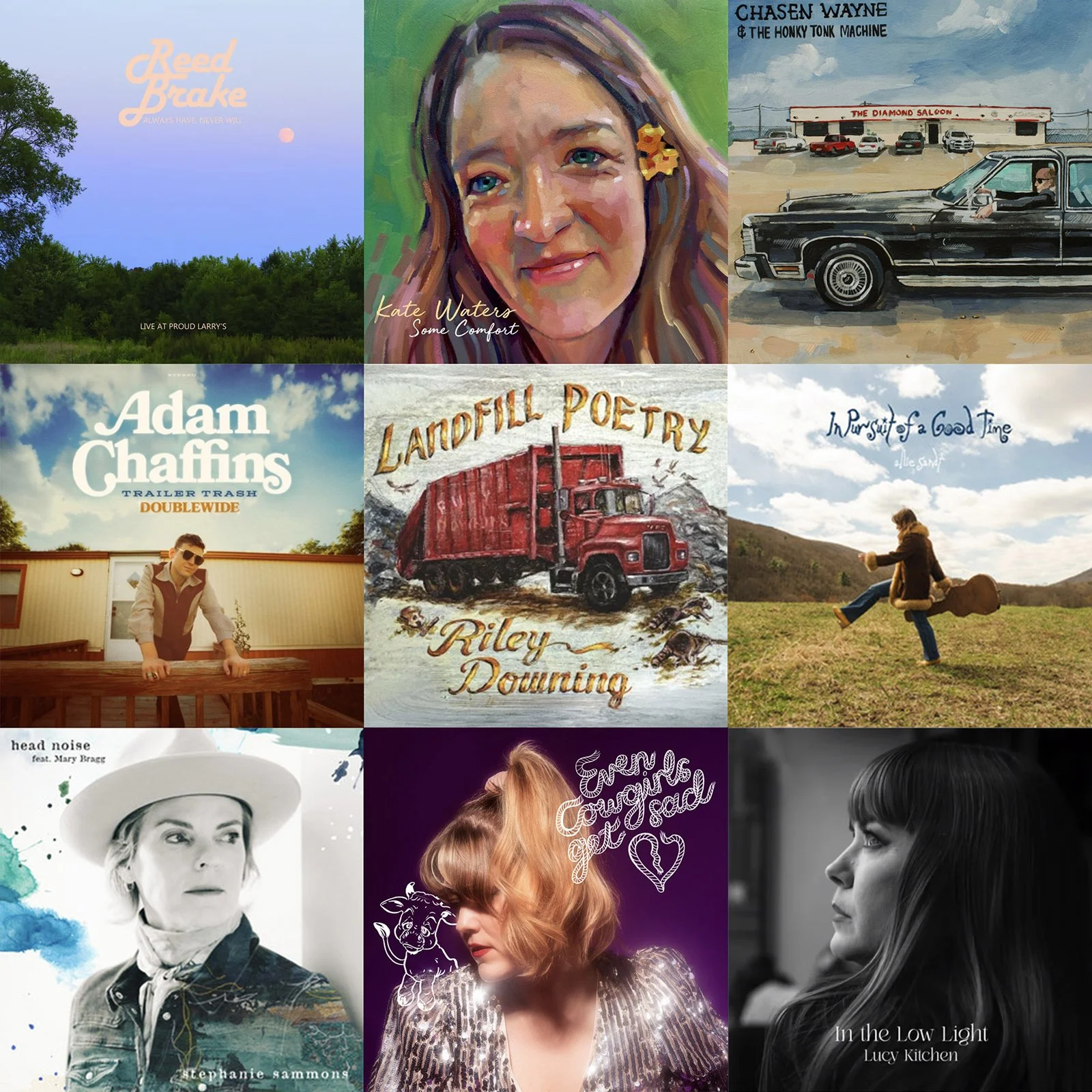
Reed Brake Always Have, Never Will Self Release
Tuscaloosa, Alabama is home to Reed Brake, a four-piece band that create a fine blend of roots music and folk traditions. The members are Jack Adams (guitar, vocals), Lucas Hales (bass), Justin Hart (mandolin, vocals), David Phillips (drums).
They certainly kick up a lot of dust when the songs take hold, and the raw energy of performance wins you over on this live album. The eleven songs were captured by Blake Gardner at Proud Larry's venue, Oxford, Mississippi, and the interplay between the four musicians is both inspired and spontaneously free from any constraint. Six of the songs appear on the debut studio release from 2023, titled Visions and Dreams, with a further two songs taken from the EP release Mixedwoods from 2024.
Emmaline sounds like it could have been taken from an old Band off-cuts release, all raw and loose in the delivery. Savage Gulf and Holdin’ On Nuggets are the two longest tracks included, with both given extensive workouts by the players. Over thirty minutes is devoted to these two centre pieces of the live set and like anything that seems special when you are in the middle of witnessing it all around you; the experience can tend to grate a little from the distance of your home stereo and appear somewhat self-indulgent. No doubting the talent of the musicians to weave their instruments and melody into this musical tour de force, but a little trimming would in hindsight have been a prudent move.
Hemlock Song kicks in at just over seven minutes and has an urgency as guitar and mandolin dance around the watertight rhythm section of Hales and Phillips. Equally, Hot Out Of Grease, bounces along for over eight minutes in a display of great dexterity on mandolin by Justin Hart. When Jack Adams joins on guitar, the effect is quite stunning in the delivery and free riffing.
Built to Last is a cover version of the song by Robert Hunter and Jerry Garcia. It appeared on the final Grateful Dead album in 1989 and was also the title of the record. Return To Earth is an unreleased song and is an appropriate title as things begin to wind down. A strong example of what this band does best; creating a fine dynamic in their interplay. The final song is Scent Of Damp Leaves with the pulsing bass of Lucas Hales and the rhythmic playing of David Phillips driving the tempo, while Adams and Hart weave their magic through the melody. Some lovely moments, but the overly long tracks do take away somewhat from the ultimate enjoyment.
Paul McGee
Kate Waters Some Comfort Self Release
This is a very impressive album from a musician who grew up surrounded by creativity in her formative years. Spending time between Oklahoma, Texas, and New Mexico, the influences from adolescent years blossomed into a passion to create her own music.
The album was recorded at Red Tree Recording Studio in Magnolia, Texas, in less than a week, with the musicians delivering an outstanding example of inspired ensemble performance across eleven songs.
Words is a song about trying to articulate, to communicate inner feelings in a way that gets to the honesty, and strips away all the superficiality “We talk past each other now / But then we listen in the space / And anyways, it’s written on your face.” Pedal steel and mandolin hold the melody on a strong opener.
Next Right Thing is a co-vocal with David Burchfield that looks for direction, to take the right decision and the best path in moving forward “I throw my fate at the feet of a love that won’t demand / that we do the next right thing.”
Honey, I’m Tired is a song that highlights the challenge that relationships can present. Whether to keep on trying to make something work or whether to just let it go and move apart. There is some great fiddle and mandolin on this one from Jeff Duncan and Russ Willis respectively.
Really Over shows the other side of relationships and the sense of loneliness that hangs in the air in the aftermath of goodbye “And all the cheap shots taken / Promises over and over, forsaken / Miss the mark, but drive the stake in / There’s no more need to debate.” Kate’s yearning delivery on vocal is so authentic and heartfelt, creating a special moment, with atmospheric banjo, guitar and pedal steel winding around the atmospheric arrangement.
Consumed hints at dreams and expectations not realised, of illusions shattered along the path. Endings are hard, with the experience gained hardly worth the reality “This love inside my heart / burned this body and tore apart / I love and I wound at the same time / We’ve reached capacity.”
The tile track Some Comfort has a sweet melody, with warm keyboards courtesy of Russ Willis, on a classic country blues that asks for the healing embrace of love to bring a respite “Where would I be without you coming in my life? / I wouldn’t know love’s freedom / but I wouldn’t know it’s knife..”
Had To Give is a song that touches upon forgiveness and looks at a failed relationship with the benefit of hindsight. Instead of anger, it’s something special to be able to use the pain as a life experience and to grow from the hurt “You left me at the altar / you broke my heart / But it clarified my mind / and gave me a brand-new start / And I’d forgive you if there was something to forgive / But you gave me all the love you had to give.”
Wasting Time is about moving forward and going in search of your dreams “I have mostly got no hard feelings / What was my floor was just your ceiling / So we made love and fought / and it gave its healing / Now I’m steadying out where I once was reeling.” The chorus refrain wrapped in the building melody with the band in perfect sympatico as Kate delivers another standout vocal performance.
It Gets Better is a song of optimism, with that timely message of ‘what doesn’t kill you, makes you stronger.’ Youthful wishes need to turn into something of substance “Leaves keep turning / Dreams go awry / Gotta keep on climbing above the tree line / ‘Cause I know – it gets better.”
Peace On Earth is a prayer and a hope for us to embrace each day in a loving awareness, to hold the mystery of nature close and wonder at all its magical gifts. If only the tyrants and despots of the world who seek to gain pointless ego-driven conquests could all be rounded up and forced to spend a week in each other’s company at a boot camp, where Kate and her fine band sing this song on repeat…
A bonus track It’s Love just confirms the prior message that all we really have that endures is our ability to love and to share our time here with others. Kate on acoustic guitar and Russ Willis on superb pedal steel mirror the sentiment with restrained and beautifully judged performances.
Kate Waters (piano, acoustic guitar, vocals), Russ Willis (banjo, keys, mandolin, pedal steel, accordion), Jeff Duncan (fiddle), Gus Alvarado (drums, percussion), Andrew Gordon (upright bass), Matt Kidd (guitars), with guest slots from David Burchfield – vocals (track 2), and Jay Snider – drums (track 10.)
All songs were written and produced by Kate Waters. A superb album, so much to enjoy, and one of my favourites in this year of so much strife in the world. This is a healing balm in every sense.
Paul McGee
Chasen Wayne & The Honky Tonk Machine The Diamond Saloon Self Release
Austin based Wayne delivers his latest release that is again a mix of straight country with a myriad of additional influences, such as cosmic country and cinematic overtones. It is an album that focuses on the titular location, at least it appears to but, as with many pre-releases, there are no lyrics to refer the overall storyline to. Never-the-less it is a journey worth taking, one that they are happy let you join them for the ride.
The albums opens with Part One (one of several such interludes) which features a piano playing in what could be easily assumed is an empty saloon, before Denis O’Donnell comes in as the narrator and sets the tone for the following tracks. There is a synopsis in the press release for the album that lets you know that this is thematically the story of two brothers Ricky and Rex, who live in the town of Van Horn in Texas. They are co-owners of The Diamond Saloon, with Rex trying to keep the place going while Ricky has no such interest. His interest lies elsewhere, in taking risks and naively believing that that will lead to something more rewarding.
That story is told through a number of the songs, including the title track, a solid pedal steel-led country song. This sets you up for what appears to be a honky tonk album, although it's not quite that as the tone can easily change. Wait A Minute is a more uptempo song that is equally pleasing. More reflective is the late night Rex’s Lament, the song that follows. Again the pedal steel guitar of James Sherman Maness III is at the forefront of the arrangement, with Alex Riegelman’s deft lead guitar and Jared Josiah Standish’s violin. En Laredo adds some bite, with the assembled band being the solid machine that they are named for. We take a breather for the next selection, En Nuevo León, until it picks up pace and allows the song to have its head. Here, as throughout, Wayne proves himself a more than effective vocalist and communicator.
We get a little more funky with Easy Money. From then on we have the driving beat of Morning Light, and the atmospheric instrumental Caliche. There is a touch of border music on Carlos which, with a number of other tracks, hits the mark pretty much from the get go. The solo piano of Jordan Hillman features on the third of the piano interludes, before Santa Muerte takes us back down south. The rhythm section of Conner Church and bassist Will Felty lay down the bedrock that these arrangements (by Wayne) are built on, to allow them to rock or take a more relaxed pace. More travel is outlined in Another Dusty Road. It is a song that offers the tale of deals done and deals gone wrong. The penultimate song is Rio Concho Waltz & Ricky’s Shift which begins to draw the story to a conclusion. The final offering is El Salon Diamantés which opens with bar noise and a robust beat. It rounds out an album by an artist I was unacquainted with, but am firmly on the side of. Chasen Wayne and his cohorts, The Honky Tonk Machine, have produced an album that will continue to reveal much with additional plays and, although it journeys outside the parameters of the definition of honky tonk that some may hold, it is however a prime example of where the music can go without losing sight of its roots and primary influences.
Stephen Rapid
Adam Chaffins Trailer Trash: Doublewide Spirit Nashville / Fluid Music Revolution
East Kentucky-born Adam Chaffins moved to Nashville shortly after graduating, but his home state remains the inspiration for his solo writing and recordings. His strong work ethic has meant that much of his time in Music City has been spent writing for acts like The Infamous Stringdusters and working as a hired gun for Billy Strings, Lee Ann Womack, and many others, alongside his solo career. A pointer towards his prowess as a writer was the offer of a publishing deal from legendary producer and songwriter Frank Rogers, Chaffins being only the third songwriter to receive such an offer from Rogers, the other two being Chris Stapleton and Josh Turner.
Chaffins’ solo work yielded SOME THINGS WON’T LAST in 2020, and his five -track EP TRAILER TRASH from last year. His sophomore full-length record TRAILER TRASH: DOUBLEWIDE includes the five songs from that EP, alongside nine new tracks. Following in the footsteps of his fellow Kentuckian Tyler Childers, Chaffins seamlessly blends the bluegrass sound so precious to his home state with modern country and roots across these fourteen tracks. Very much a ‘storytelling’ project, the songs are tales, both imagined and real-life, of characters, incidents and memories, and all from inside the borders of the writer’s home state.
Recorded at Sound Emporium Studios in Nashville, the production duties were shared by Frank Rogers, Derek Wells, Mike Fiorentino, and Chaffins, with a host of Nashville big hitters on board. Included were Derek Wells (electric and acoustic guitars), Bryan Sutton (acoustic guitars), Robbie Crowell (keys), Fred Eltringham and Matty Alger (drums and percussion), Russ Pahl (steel guitar), Matt Combs (strings) and Dominick Leslie (mandolin). Lead vocals and bass guitars were by Chaffins.
With coal mining in Kentucky dating back to 1790, and with his father being a former coal miner, that theme was always going to filter into Chaffins' writing. Pride of place goes to King of Coal Dust County, which tells of a ‘rags-to-riches’ individual, possibly based on a real-life person or, more likely, on a few people who built their empires from humble beginnings. Either way, it’s a winner with a melody that’s impossible to shake off. Kentucky Girl is certainly not fictional, with its wedding-bell intro. It’s dedicated to Chaffins’ wife, fellow artist and frequent co-writer Brit Taylor, whose excellent album LAND OF THE FORGOTTEN, released earlier this year, was produced by Chaffins. Taylor’s backing vocals can be heard on the majority of the album’s tracks.
Given the song’s title, you could be forgiven for expecting Trailer Trash to be a full-on and raunchy affair. On the contrary, it’s a soul-stirring, tender love song, with spoken words mid-song adding to its potency. Bar Dive Moses (“He’s got holes in his boots / And he don’t let the truth / Mess up the good stories he has”) is a clever ditty about a typical barfly, and the wordplay in You Get Drunk, I’ll Get High is equally smart. The latter was a co-write with his wife and maybe suggests the formula for a perfect marriage (“You get drunk and I’ll get high / I’ll roll the skunk and you pour the wine / You do it your way and I’ll do it mine / And we’ll meet in the middle somewhere”). Both opener Living Til My Dying Day and Sugarcoat It are swampy country rockers and hitting a similar vibe, and a few seconds short of the six-minute mark, Little Bit At A Time bookends the record in fine style.
TRAILER TRASH: DOUBLEWIDE is loaded with sharp, witty wordplay, but in the background are ‘true-to-life’ observations and characters, from an artist with the capacity and skill set to create music that is both ‘ear candy’ and deeply meaningful, mirroring real-life dramas, often unfulfilled expectations, and simple, treasured scenarios.
Declan Culliton
Riley Downing Landfill Poetry Oh Boy
The second solo album by small-town Missouri-born Riley Downing, his first on the Oh Boy record label, is a series of observations on often unremarkable individuals going through their routine daily lives alongside more personal commentaries or, in Downing’s own words, “things I picked from my own personal mental landfill”.
Before committing to a professional career as a singer and guitarist with the New Orleans-based band The Deslondes, Downing toiled as a garbage man in rural Missouri. We hear of his final days hoisting bags of rubbish into a dump truck (“Me and Michael Murphy on the back of the truck / Hopping on and off before the town woke up … I think I’ve had enough / Oh but really what it is / Is I’m a guitar picker”) in the opening and title track. Fortunately, the monotonous work was made bearable by the Tom T Hall CD which played continually in his truck between stops.
Delivered in a semi-spoken, gravelly vocal and being familiar with antisocial work that is generally underappreciated by many, Downing turns his attention to the folk who work shift hours in Night Shift. Closer to home, he speaks of his doting grandparents, Helen and Gene. Growing up next to him, their simple devotion to each other, hard work for little return, and love of country music made an immeasurable impression on him that remains close to his heart. Overcoming the fear of change and following your dreams is at the heart of Chance, fuelled by his own decision to pack in the garbage business in favour of a more fulfilling career.
It’s not all solemn and broody, and the playful Country Fool and Hay Hay, while depicting real-life characters and foolish overindulgences, are light-hearted and easy on the ear.
Recorded at The Bomb Shelter in Nashville and co-produced by Andrija Tokic, Grant D’Aubin and Downing’s colleague in The Deslondes, John James Tourville, charmingly ramshackle LANDFILL POETRY leans into a wide range of genres with swampy folk, country and R&B and a touch of New Orleans rhythm to the fore.
Declan Culliton
Allie Sandt In Pursuit of a Good Time Self-Release
The title of Allie Sandt’s debut solo album may suggest an artist with a positive outlook on life or possibly a statement of her intent as she prepares to move from New Jersey to Nashville in the coming weeks. The twenty-four-year-old singer-songwriter cut her teeth performing solo in basement venues in New York before joining indie rock band Seeing Double as their singer, bass player, and primary songwriter. This seven-track record introduces a singer, songwriter, and multi-instrumentalist who has worked at her trade from a young age, performing and touring before this recording, which took place in several locations, including friends’ basements and closets, as well as the occasional recording in formal studios when opportunities presented themselves.
Along with production and string arrangements, Sandt contributed vocals, bass, acoustic guitar, keyboard, nylon guitar, electric guitar, percussion, and vibraslap. A host of friends and local musicians performed the rest of the instrumentation. The album draws on Sandt’s time living in upstate New York, where she attended college.
Her influences span genres, from classic folk artists like Joni Mitchell and Paul Simon to a more recent generation of bands such as her fellow New Yorkers Big Thief. She also dips into the rockier side of alt-country on the track Intersection (“I'm strung out wondering what is the matter / Throw a bone or at least throw a dagger / I don't like to be ignored /But you're not talking anymore / And I'm spent”), which grapples with a relationship that is breaking down. Matters of the heart also feature on the tender Light Bill. Beautifully articulated by Sandt and supported by a choir of backing vocals and evocative piano, it’s a winner. Amanda Antiques is backed by a jazzy rhythm section with the marriage of guitars, piano, bass, bongos, vibraslap and mandolin creating a sonic treat. An excursion into modern folk, The Wheel has Sandt effortlessly hitting serious high notes and bookending a hugely impressive album from an artist whose professional solo career is only kicking off.
“Here we are once again / I am showing to an audience a suitcase of the places that I’ve been”, she sings in the title and opening track. With those suitcases packed for what may well end up being a lengthy stay in Nashville, this body of work screams ‘watch this space.’
Declan Culliton
Stephanie Sammons Head Noise Point Guard
It’s no surprise that Dallas, Texas-based artist Stephanie Sammons cites Mary Gauthier, Emily Saliers (Indigo Girls), Jonatha Brooke, Beth Nielsen Chapman and Gretchen Peters among her mentors. Another key trusted advisor is Mary Bragg, who produced HEAD NOISE, having also worked with Sammons on her debut record, TIME AND EVOLUTION.
After listening to HEAD NOISE several times, similarities with these talented women come to mind in the musical contours, vocal deliveries and, above all, Sammons’ eloquent songwriting. The latter led to her winning the Kerrville Folk Festival’s New Folk Competition earlier this year.
The album is a series of interconnecting songs, ten in total, often slightly unsettling, from the viewpoint of a middle-aged woman whose responsibilities include keeping her small business and same sex marriage afloat, while watching her parents advance in age, and her two stepchildren advance from childhood to adulthood.
The sweeping title track captures all the above emotions (“God help me make it to the morning / Without waking up again at 4 am/When I'm not sleeping, I'm overthinking / About problems I can't solve or end”). Insecurity, uncertainty and denial are at the heart of Tough Love, which characterises the eventual breakdown of a relationship.
Lone Coyote, written from the perspective of an adopted orphan (“I see the world through jaded eyes/ Could be from my father’s side/ Does he wonder where I roam / A drifter longing to belong”), is quite a stunning opening song and introduction for what follows. The song is also much more than a fictional tale, given that Sammons is the stepmother of two adopted children
Entering middle life somewhere between the ages of her grown-up children and ageing mother is reflected on in Midnight Twilight, and Marathon rejoices in the capacity to survive, like the long-distance runner, despite life’s knocks and challenges.
Sammon's vocals perfectly fit the impeccable song crafting on the album, and credit goes to Mary Bragg’s sympathetic production, piano skills and backing vocals. Other contributors included Jon Estes on bass and keys, Matt Rollings on piano, and Jordan Perlson on drums, Josh Kaler on pedal steel.
The album finishes on a resilient note with a cover of Shawn Colvin’s That Don’t Worry Me Now, bringing closure to a journey with signposts to real live issues, elegantly communicated both lyrically and musically and highly recommended.
Declan Culliton
The Northern Belle Even Cowgirls Get Sad Die With Your Boots On
The brainchild of singer-songwriter Stine Andreassen, Norway’s premier Americana (or more precisely Nordicana) artist, The Northern Belle’s latest album finds Andreassen collaborating with a different team of players than her last project, BATS IN THE ATTIC from 2024. If that last record genre hopped from southern rock to country and folk rock, her latest recordings are consistently more ‘pop’-slanted or what used to be called ‘soft rock.’
Andreassen co-produced the album with Preben Sælid Andersen (who also contributed piano, electric and acoustic guitar, glockenspiel) and recorded the eight songs at Globus Studios in Oslo. She also called on the services of players Bjørnar Ekse Brandseth (pedal steel, electric guitar), Øyvind Blomstrøm (acoustic guitar), Nikolai Grasaasen (pedal steel), Tor Egil Kreken (bass), Henrik Lødøen (drums, percussion), and Halvor Falck Johansen (acoustic guitar) to add their collective instrumentation to the songs.
With themes ranging from exasperation and regret (Burn MF, Dead To Me, No Friend of Mine) to isolation (Miss My Friends, There’s a Party Tonight), despite the sense of personal soul-searching, the melancholy in the songs is overcome by Andreassen’s crystal-clear vocals, which perfectly reflect the songs’ moods, and the supporting groove-laden melodies.
The album plays out like an inkling of what lay inside the writer’s head at the time she put pen to paper. In doing so, and as the album’s title implies, the core message behind Andreassen’s latest project is that it’s ok to be sad; better times are most likely around the corner.
Declan Culliton
Lucy Kitchen IN THE LOW LIGHT Bohemia Rose
What could have been a misery fest, the third album from English folk/americana artist Lucy Kitchen is instead an uplifting record of loss, pain and, ultimately, acceptance. Written during the run up to and aftermath of the death of her husband after a cancer diagnosis, Kitchen chronicles her myriad of feelings with refreshing honesty and insight. Calling on producer and sideman Tali Trow (Bonnie Raitt, John Murry, Bonnie Dotson) to co-produce, she says she actually found the recording of the album a joyful experience, and it helped her to ‘come back to herself’.
Opening song Winter King details the yearning in the aftermath of loss, its haunting soundscape created by the musicianship of Kitchen herself on acoustic guitar and flute, Tali Trow on guitars, keys and backing vocals, Jon Thorne on double bass, Pat Kenneally on drums, and Peter Mojzeš on strings. Kitchen’s vocals are striking - clear and sweet and true. More sad songs include The Ways We Were, describing the unflinching sorrow and the passage of time as life slips away, the gentle and melancholic Blue Light, and Chemo Song (Sleeping Song) which is unflinchingly stark and she’s ’not ready to let him go’.
We’re introduced to the stellar pedal steel playing of Michael Davies on the first of the more hopeful tracks, In My Corner, where Kitchen acknowledges that "I miss you in my corner / telling me I’m the one” but “I’m forging a new way/through the dust and the dirt”. Likewise, in Milk and Honey, she struggles with vivid dreams about her love but she is starting to come to terms with his loss. Bathed in strings from Peter Mojzeš, it continues the musically soothing palette which suffuses all the tracks. On Sunny Days, Kitchen nods towards the influence of 70s singer-songwriters with its jazzy overtones and her flute playing, while Red Skies finds her again vasillating between the pleasure of ‘going out dancing’ and being caught up short by memories of her loss when she stops at a red light.
The Boatman uses the familiar folk trope of a boat taking one across the river to another dimension, wherever that may be for you, and “I will see you on the other side”. The magnificent five minute track features drummer Pat Kenneally on Hammond organ, and fades out with bird song. Hope is also to the fore in the closing song, sung simply with her acoustic guitar, September’s Come, which collates all the album’s themes. Highly recommended.
Eilís Boland