
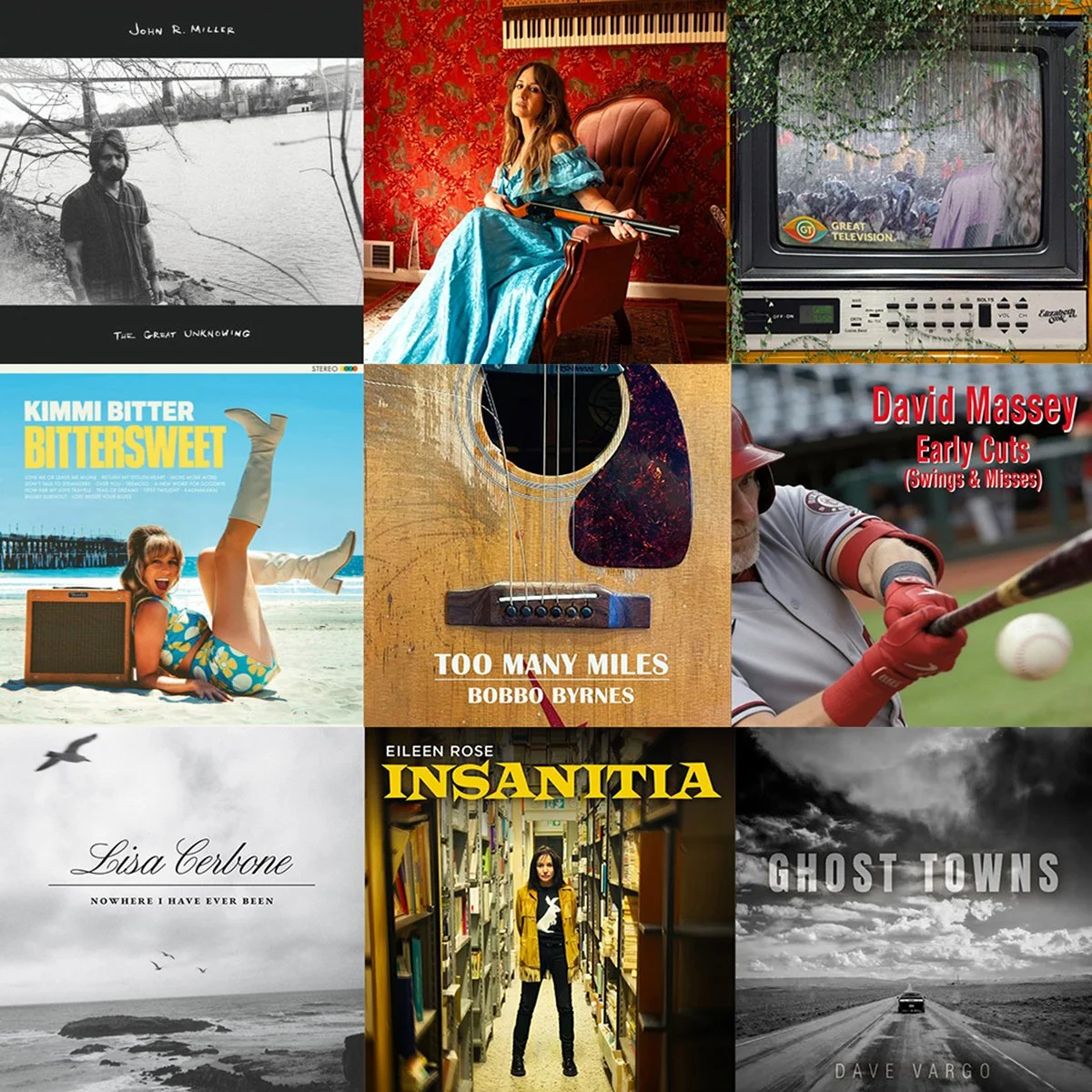
John R. Miller The Great Unknowing Rounder
Recorded at Leon Russell’s legendary Church Studio in Tulsa, OK, the West Virginia-raised singer-songwriter John R. Miller’s fifth album finds him in an experimental mood with a richer, fuller soundscape and musical arrangements than in much of his previous work. That’s not to say that he has totally abandoned his characteristic traditional singer-songwriter verve; a sixteen-song, sixty-five-minute-long album leaves lots of room to hop from country rock to swamp and blues to folk.
The recording process was a mix of live recordings in front of an audience, layered multi-tracking, and working with a collection of local Tulsa players previously unknown to Miller. Among them was Grammy-nominated John Fulbright, whose piano and keys feature strongly across the record.
Miller and his co-producer, Adam Meisterhans, nail that upbeat Tulsa sound on the gritty opener Don’t Bet On Me and later in the record with Steering Wheel Drums and the Dan Baird-written Golden Light, one of four covers that feature. Also covered are William Matheny’s If You Could Only See Me Now which sticks close to the original recording, and the closing track, an unspectacular version of Mark Knopfler’s Walk Of Life. At the other end of the scale, the final borrowed song is the Darrin Hacquard-composed A World Away. Reconstructed from a mid-tempo ballad into a full-force driving rocker, it’s a standout inclusion.
Other tracks with particularly sharp teeth are the no doubt confessional Day Drinking (“Day drinkin'/If it's one, it may as well be two/Day drinkin'/I just run outta reasons not to”) and possibly the aftermath of that binge, Two Days Clean. Daughter of Night, a classic traditional dark folk tale, is as good a song as Miller has penned. Black humour alongside naked anger emerges in Looking For A Place To Die, which addresses social divide and struggle (“I knew a guy who found his own little shack / Disappeared into the woods, he never came back / Lost the job he got with his five-year degree / To some motherfucking robot with a five-year warranty”). A two-fingered salute to authority also surfaces in Cornbread And Pinto Beans, where its semi-spoken vocals and a groovy backbeat tell of a strong-willed, anti-establishment, independent woman.
There’s a lot to get your head around in THE GREAT UNKNOWING, although the changes in direction, pace and genre don’t distract from what is a hugely listenable record. Miller’s sometimes smooth and other times rugged vocal deliveries, combined with contributions from an array of talented players, create something quite lovely here.
Declan Culliton
Margo Price Days Of Unrest Loma Vista
Featuring a three-part instrumental piece composed by Margo Price and her husband Jeremy Ivey titled The San Marcos Suite and performed by Price’s band The Price Tags, DAYS OF UNREST is a nine-track protest album released without prior notice to mark America’s 250th birthday. No stranger to supporting the underprivileged and downtrodden, Price was the first woman elected to the Board of Directors of Farm Aid and has consistently expressed compassion and support for Mexican and border communities. Proceeds from this album will go to the Florence Immigrant and Refugee Rights Project in support of detained immigrants.
The flight of desperate immigrants is addressed in the Woody Guthrie/Martin Hoffman protest song Deportee (Plane Wreck at Los Gatos). Written in recognition of a plane crash at Los Gatos in 1948 which claimed the life of Mexican farm labourers, Price is joined by Joan Baez and Billy Swan on the recording, which was previously recorded by Baez in 1971. Another cover, very much of these times though written in 1984 and directed toward Ronald Reagan, is Blaze Foley’s Oval Room (“In his oval room, in his rockin' chair / He's the president, but I don't care / He's a businessman, he got business ties / He got dollar signs in both his eyes”). It’s a rootsy version true to the original, with Price in fine forceful voice and a slick guitar break mid-song.
De Colores, a traditional Spanish protest folk song, is sung in Spanish by Price with backing vocals by the musical ensemble Memphis Mariachi. Bob Dylan’s Maggie’s Farm, which has featured in Price’s setlist over the years, gets a powerful makeover with twangy electric guitars and screaming harmonica.
Price’s raunchy and defiant self-write Can’t Stand Still is a return to the ‘no holds barred’ inclusions that peppered her excellent debut album MIDWEST FARMER’S DAUGHTER (“Well, women ain't supposed to ramble / Women ain't supposed to think / Why would I wanna stay home all night / Washin' dishes in the kitchen sink?”). In every respect, the song, and indeed the album in general, sums up the basic formula that Price and her band have perfected since that breakthrough record a decade ago.
Holding forth on subjects like injustice, power and control, themes not simply exclusive to America, DAYS OF UNREST finds Margo Price giving the listener a tour of exactly where her mind is in these troubled days.
Declan Culliton
Elizabeth Cook Great Television Thirty Tigers
“I wanted this album to take everyone on the ride of the American experience, both from a deeply personal perspective and from a place of reflecting on historical events and their ripple effects,” explains Elizabeth Cook, commenting on her eighth studio album, over two decades into her career.
Over those years, country artist and singer-songwriter Cook has unapologetically stuck to her guns and has sidestepped crossing over into pop/country territory. With a classic country voice and a songwriter known for not hiding too much, that career move would undoubtedly have been commercially successful. Fortunately, she has continued to write and record a potent mesh of roots and country-flavoured records.
GREAT TELEVISION often draws its influences from the rockier side of country without ever straying into mainstream rock. Recorded with Cook’s live band at Sunset Sound in Los Angeles, the production (excellent, it must be said) was by the ‘go-to’ man these days, Shooter Jennings.
The album takes its title from the spectacular opening track Sunset Promenade (“Turns out hurricanes are great television / Turns out all the things in my head are a prison / And I just want a friend I can stand and do my time with”). Appealing for escape and contentment, the song grapples with the present-day overconsumption of media and its resulting negative and often harmful consequences.
One of the often-forgotten historical events that Cook refers to in the statement above was the inspiration behind Thiokol Tripwire. The song recalls an explosion in a Georgia chemical plant that manufactured trip wires for the Vietnam War in 1971. It was the only place in Georgia where black women could be hired, and the blast took the lives of many black women working there.
Closer to home for Cook, Okeechobee Mud harkens back to the simplicity of growing up in the small Florida town, Wildwood, surrounded by close friends and family. Similarly reminiscent, Lightly, which closes the album in fine style, speaks of Cook’s love of family and a vulnerable sister (“I would stand before a fast movin’ train / Before I let your shame bring her any more pain / If you treat her anything but kind”).
Cook has always been upfront about the demons that she has faced up to and conquered over the years, and a spirited cover of The Stones' 19th Nervous Breakdown may be slightly tongue-in-cheek. On the contrary, the instantly catchy Girls of Atomic City celebrates independent women. The song's inspiration was Cook's research into the Manhattan Project, which focused on the manufacture of nuclear bombs during World War II and offered many women opportunities for employment outside the home, a rarity at the time.
For this writer, Elizabeth Cook has probably recorded a career best with this record. It may not be as honky tonk as her early career albums HEY Y’ALL, THIS SIDE OF THE MOON and BALLS and veers more in the direction of alt-country. However, it’s a marker of an artist who has matured like a vintage wine, and few, at present, are doing upbeat, rootsy music and eloquent songwriting any better.
Declan Culliton
Kimmi Bitter Bittersweet Self-Release
With one eye on the present and another on the past, Kimmi Bitter’s core sound lands somewhere between breezy West Coast roots and 1960s Countrypolitan. It’s a fusion that worked well on Bitter’s debut album in 2024, aptly titled OLD SCHOOL and that Countrypolitan leaning is even more prominent in her latest recording, BITTERSWEET. The opening track, Love Me Or Leave Me, and the closer, Lost Inside Your Blues, with sweeping orchestral strings performed by the Budapest Scoring String Ensemble, recall that lush 1960s Nashville Sound.
As with her debut album, Bitter called on Michael Gurley to co-write the majority of the songs and oversee the production. It’s a winning formula with the marriage of Bitter’s silky vocals, slick arrangements and the guitar playing of her long-time musical partner Willis Farnsworth working a treat. Those twangy guitar skills add another dimension to tracks like the swampy Tremolo and the slow-burning Talk To Strangers, heightening the allure of Bitter’s fluent vocal deliveries.
There’s also lots to shake your hips to with the rockabilly More, More, More and poppy That’s How Far My Love Travels. More suitable for ‘two steppers’ are A New Word For Goodbye and Over You, both of which meld melancholy with heartache. Sounding like it was borrowed from a Tarantino movie soundtrack, the instrumental Bigsby Burnout is an impressive nod to high-energy early-1960s California surf music.
Far from an overnight success, Kimmi Bitter and her band The Westside Twang, Willis Farnsworth (guitar) and Ben Neal (bass), have been touring relentlessly in recent years, promoting their retro country sound and increasing their fan base. A breezy evergreen affair, BITTERSWEET is a massive step forward for Bitter and is certain to increase her fan base by a large margin.
Declan Culliton
Bobbo Byrnes Too Many Miles Self Release
This album is a compilation of a different kind. The eighteen tracks chosen are taken from various releases over the career of Bobbo Byrnes, and they are included as all feature in the recent biography written by Bobbo, titled ‘Too Many Miles: On the Road with an Unofficial Rock & Roll Goodwill Ambassador.’ So, this music is more like a companion piece to what is an excellent memoir.
Five of the songs are from the time when Bobbo had different bands who were active on the roots rock circuit, with both Riddle and the Stars, and The Fallen Stars, gaining quite a big reputation across six separate album releases. The other thirteen songs are selected from the solo releases Bobbo Byrnes (2024); Sea Green Number 5 (2020); Two Sides of This Town (2018); Motel Americana (2017), with the title track featured twice, one as a hidden acoustic version of Too Many Miles taken from an album recorded in 2023, titled Two Days In October. Every song more than hits the mark and justifies inclusion on this unique pairing concept.
It seems somewhat churlish to choose selected tracks for special mention, especially given the prodigious talent on offer. Bobbo has written so many songs over his career, every one of his albums packed with classic tunes, that you really can’t go wrong with any of the back catalogue. However, that said, personal highlights would include Heart Like Mine, Never Learned To Fly, Every Sound That Crashes, Stronger Than Steel, Angelia and the superb title track, Too Many Miles, which showcases the superb guitar technique of Bobbo, together with the great lyrical reflection of love gone bad “I can’t be blamed for everything / Except my thousand-yard stare.”
This music is worthy of a place in any publication about the great American songwriter tradition, in both the range and variety of what is on offer. Bobbo is a very accomplished musician, and he contributes vocals, guitars and many other instruments on these songs. His wife Tracy sings on several of the tracks and plays bass, with other musicians from over the various releases also receiving credits. There is one new song included and on Winter of 71 we have Bobbo on solo acoustic guitar recollecting a childhood memory of a Christmas spent in the aftermath of his parents’ marriage split.
Chasing Rock and Roll is a key track, given that it captures the story of life on the road as a young band, trying to gain a foothold and touring the country in the “classic” 24-hour van tradition. Reference to Blue Rodeo in the lyric is an interesting marker in laying down the classic roots sound that Bobbo went on to refine. There is so much to enjoy in his song arrangements, with his use of melody, coupled with a dynamic guitar prowess, and a warm vocal tone that adds colour to everything.
Bobbo formed The Falling Stars after moving from Boston to Los Angeles and he went on to release four albums and an EP in that early line-up. He also recorded under another band name, Riddle and the Stars (when Ben Riddle joined up with the duo), releasing two albums of excellent American heartland music. As a side project he wrote songs that were inspired by the hit TV space-western series FIREFLIES back in 2002. He wrote a song for every episode, and the resulting three separate Eps were subsequently packaged into a compilation of sixteen songs under the moniker of Browncoats, the name of a spin-off movie from the original television show.
He has a great sensibility and lyrical insight that shows a sensitivity in both the playing and the writing. Bobbo can also rock out with the best of them, and given his talent for a cool melody line, topped off with inventive guitar playing, he really is the genuine article. Bobbo plays with a belief and a passion, and these are time-worn songs of the highway, living a vagabond lifestyle, and at every turn, willing to move with the throw of the dice.
Aspiring to become a prolific songwriter is the dream of many musicians. In trying to define a self-made man you could point to the individual who can stand against all odds and retain a self-belief in what he is achieving. It is following a long-cherished dream and making it a reality. On all fronts Bobbo Byrnes is this artist. He represents all that is good in the independent roots-rock scene and long may his light shine.
The biography is really a collection of his tour journals which Bobbo kept over the years and has now edited down with the full encouragement of his wife Tracy and a willingness to tell this story; one so typical of any musician who has followed a dream. His book details life on the road in full technicolour and focuses on the years 2013 through to 2025. Many of the anecdotes are hilarious and his memories stretch back to his first guitar, purchased in 1988, a collision with a bus in 2008, which gave him the impetus to start his touring adventures with a trip to Europe on the compensation cheque received, and some fledgling gigs in Germany. Bobbo always had a passion for ice hockey, but injury curtailed his promising career in this direction and gave an even greater focus into music. At this point Bobbo reckons that he has played over 5000 shows and visited in the region of fifteen countries with his music.
His wife Tracy, who plays bass and sings harmony vocals on all the album releases, deserves special mention. She has been an ever-present support to Bobbo, through good and bad times, and a touring ally in the early days of the band, prior to Bobbo going solo. Several different musicians have come and gone over the years as Bobbo worked through the different iterations of his sound. Now he plays mainly as a solo artist, sometimes as a duo with Tracy, and the rocking drive of previous projects is replaced by a more nuanced, thoughtful sound these days.
It’s a wonderful book and one that will give many hours of entertainment. Quite why Bobbo Byrnes is not more widely known for his artistry and in receipt of greater acclaim, is quite beyond me. However, this book and music combination is the perfect introduction to an artist of enduring quality and talent.
Paul McGee
David Massey Early Cuts (Swings and Misses) Self Release
If you are new to the work of David Massey, then you are in for a treat. His experience and writing craft as an American singer-songwriter is rooted in Washington DC. and he has released seven albums to date. His music focus that didn’t really click into place until a decision in 2017 to step away from a successful career in the legal profession, in order to devote his time to becoming a full-time musician.
It was back in 2004, when David’s debut album first appeared and Blissful State Of Blue was a thirteen-song reflection of his worldview at that time. The songs covered a wide spectrum, from worker exploitation to the cost of war, from relationship hardships to tales of jealousy and redemption. One song gained many admirers, and The Drunken Letter was an imagined scenario of a soldier in the front line of the battlefield receiving the news that he had become a new Dad. The story that unfolds from this premise, both moving and insightful, helped to put David’s reputation into a new space.
Continuing to be influenced by the observations taken from daily life, he released a second album in 2009, and with So Many Roads, David reflected on all the different turns that our paths can take.
Since those early years he has gradually built his experience and expertise as a performer and writer of great range. Across seven albums David Massey has shown a great consistency and talent in his artistic expression and on the most recent release Man In the Mirror (2025) he found himself wanting to look back at decisions made and the places where life had taken him.
This new release is a composite of those two early albums, with seven tracks taken from Blissful State Of Blue, and eight tracks from So Many Roads. In revisiting the songs, he can bring the perspective of greater experience and maturity. Slowing everything down and returning to more simple times is captured on Labor Day which questions the real price we pay for apparent progress. Relationship breakdown is the topic on Since You Took My Ring, when couples split, love doesn’t survive and questions of blame hang in the air. The American civil war, Gettysburg 1863, and General George Pickett (whose actions proved a turning point), are all wrapped up in Pretty Summer Day which reflects on how normal life continues, irrespective of whatever life changing events are happening elsewhere.
Marilee McGrath is a story song of jealousy and revenge with the bluegrass arrangement full of vibrant fiddle, banjo, mandolin, and upright bass joining together as eventual redemption is delivered. The Loneliness I’ve Known is a song about living a solitary existence and being haunted by dreams of having someone to love. Temptation and flirting with danger are the test of a man, and on Blissful State Of Blue the possibilities of a liaison with a beautiful blonde prove very appealing. Mandolin and banjo create a great melody to the rhythmic pulse of the arrangement.
Come What May looks at choices made and chances taken, with accordion, dobro, mandolin, and guitar delivering a fine bluegrass song arrangement. Heathens is classic country with pedal steel and fiddle easing the frustrations of the way in which humankind abuses the land and ignores the duty of care we collectively owe to mother nature. On You Can Come Back Home there is a classic tale of a child leaving home and the heartbreak suffered by the parent. On January Wind we have the question of homelessness and the attitude that society takes towards those in most need of our assistance. Where does responsibility lie and is it enough to simply say ‘not my problem.’ The gap between the ‘haves and the have-nots’ just keeps getting bigger.
We always chase what is just out of reach and man’s restless nature looks for fun with all the foolishness of an immature adolescent. On Things That He’ll Never Be this eternal question is posed, with no ultimate answer, apart from routine contentment never being enough. Accordion and piano feature to great effect in the melody. The superb interplay of acoustic guitar, fiddle, and piano highlight the issue of mental breakdown on the poignant Susie Came Home, a beautifully structured lament for the illness of a relative.
So Many Roads is a nostalgic goodbye to old band buddies, when the time arrives to take different paths, it can never be an easy decision “But I’m thirty-five years older and we’re not going to win this game / We tried so hard, there’s really no one to blame.” It’s one of the standout tracks on what is a strong retrospective. The final song Julie is another example of a parent advising a child on the ways of the world. Despite failing health, the father councils his daughter to sample all she can from living and experiences gained. The restlessness of youth and the perspective of life’s lessons.
Paul McGee
Lisa Cerbone Nowhere I Have Even Been Self Release
Album number six and over forty minutes of quiet reverie, across nine songs of understated charm. Much like its predecessor, We Still Have Sky (2024), it’s a gentle record, focused upon family, and the influences that love and memory leave as vapour trails in our lives. It is intimate, reflective, and captivating in the delivery.
The album opens with The Night At the Fair and we are transported back to younger days and a teenage crush on a boy that was not returned. Unrequited love leaving frustrated memories, so eloquently captured in the lyric “All I have are useless tickets / For amusements and silly games / That passed us by.”
The constraints of family is something that leaves an imprint, the experiences within the confines of the home shaping so much of our behaviour and belief systems. Such indelible marks define us and in songs Where Are You Going So late? and What Country Are We In? we are introduced to a longing for something more, something other. A restlessness that will not stop poking at any sense of contentment, urging an element of risk in looking for another cheap thrill, almost always transitory in nature, but so filled with energy and excitement in the moment. It’s cheating on a marriage, taking family for granted, hidden yearning for second chances at love and trying to bottle something that is really carried on the air and best captured in a passing breeze.
Mental illness is suggested in Cheating At Cards (Roland, Norwich State Hospital, 1936), and details of a traumatic event are kept obscure, but there is an atmosphere of frustration in trying to communicate beyond the point of a mental breakdown. Equally, the recluse in Tied To Sorrow wants nothing more than to escape the prison of depression and seeks strength to rise above the sense of isolation and loneliness that is so evident. That search for love is once more featured in Good Time Charlie and a song about a neighbourhood lothario who fills the impressionable dreams of a vulnerable orphan.
Lisa has said that a number of these songs are informed by her own family history and tales passed down by her father. The Missing Year is about losing a mother to illness and the cold realisation of a young girl that suppression of emotions is the best way to ensure stoic acceptance and survival. Another childhood memory is driving to local holiday resorts and trying to gain entry without paying. In Pretend Like You Belong we see family members sneaking into summer camps and concealing bathing costumes under their clothes. Simpler times, with money scarce, but adventure in the air.
A cover version of the ELO classic Can’t Get It Out Of My Head is also included, as much as to look at wishful obsession in dreaming of another possible life outside your norm, as to ponder upon other daily constraints and routines.
Throughout, the playing is so understated as to imbue a state of blissful gestalt. The hypnotic texture of twin guitars, fingerpicking styles, hushed vocals and soft melodies creates a meditative state. I find my thoughts drift into the ether, leaving behind a sense of quiet calm with the soothing melodies and tones.
Lisa Cerbone provides vocals and guitars, with Mark Kozelek on background vocals, guitars, bells, percussion, and Scott MacPherson contributing on drums. Album production is by Mark Kozelek and perhaps the key question to ponder is whether memory can be trusted as an accurate barometer of the past, and to what degree should it continue to shape identity? An album of both grace and gravitas.
Paul McGee
Dave Vargo Ghost Towns Self Release
This is album number four in a great run, building on a career momentum that started back in 2016 with the introduction of Dave’s debut release Burning Through. Across all four of these records there is the presence of Tim Pannella, a life-long friend and collaborator, as both co-producer and drummer. Together, this duo have a created a great blend of innate talent and studio experience that delivers a dynamic, stimulating live sound. The excellent guitar work of Dave Vargo is very prominent and a real driving force in all the song arrangements.
Lakehouse Recording Studios in Asbury Park, New Jersey was the location chosen, and the deadly duo of Vargo-Pannella were joined by Todd Lanka on bass, and Danielle Marrone on backing vocals. It’s a tight unit and it captures the vibrant sound of a finely tuned band. Kicking off with the powerful Anything At All it has all the hallmarks of Huey Lewis and the News at the peak of their success, and a song about regret and resignation with memories of the past “We were like dust blowing in the wind / So many wrong turns just before the fall / What it was and what it could have been / When it's gone will you miss anything at all.”
The guitar playing on A New Life, is again full of spark, and the song says to move on, leave the past behind, and keep looking forward. The album’s focus is very much that of no-frills roots rock, and some reflective songs of ageing, relationships and just trying to figure it all out as we grow. Captured perfectly on No Second Guessing with the words “Remember how you used to laugh / Don’t undermine those best intentions / So far yet close behind / There’s no need for second guessing this.” Retracing footsteps, old photographs that should remain hidden, the feeling that nostalgia isn’t what it used to be.
Let It Go reflects upon having to sometimes accept the need to get out of a routine and aim for new beginnings. On Where It Started there is the observation “Been reaching back through the shadows again / For the best parts that got thrown away.” The band really rocks out on this track and then, as a complete contrast, Hard slows everything down with a look at expectations versus the disappointment and reality of daily routine “This old city still stares you down / Maybe you shouldn’t stick around.” Youthful dreams fade into present times and Not So Young reflects upon the perspective earned from mistakes made “Always thought we had a plan / But maybe we’re not that smart, Went ahead anyway / We were doomed from the start.”
The optimism on Those Little Things is timely, with the message to show resolve and keep believing in something “Some days there's little things that prove you're not wrong / Those little things keep you holding on.” Similarly, on But I Do the lyric “Cut the cord on the promises that break / Can’t surrender to the choices that were made” points to letting go of the past. Another great rocking sound and the rhythm is so nicely paced with the subtle drumming of Pannella and the steady basslines of Lanka. With Tales To Tell there is a sense that looking forward is the best antidote to lamenting upon the past. Nothing lasts forever. Again, the inventive guitar of Dave Vargo is very prominent.
Promises aims straight at a jukebox jive and the band are nicely in the pocket as Dave finds some sweet spots to ride the melody on inventive guitar “All the promises made when we were young / Still haven’t come true for anyone.” It’s great stuff. Ghost Town looks back to beginnings, mistakes made, memories haunting like old demons. What strikes me about the album title is that all these ghost towns are no more than old memories, hanging in the past, stopping the protagonists from embracing the future. It can be cathartic to look back, but really all our energy for living should focus on the direction ahead of us. This album is a real highpoint in the growing career of this engaging artist who plays guitar with great invention and who knows how to write a stellar tune. An album with much to recommend it.
Paul McGee
Eileen Rose Insanitia New Shot
With deep family connections in both Ireland and Italy, Eileen Rose has always been mindful of her musical roots. Over several years, she has delivered real quality when it comes to her own vision and belief in the power of music to be a redemptive force. Across a series of great albums, we have witnessed her career blossom, and on this latest offering she focuses very much on her Italian connections and inspirations. Five of the songs are written in collaboration with Italian writers and translated into English. There is also a song that is delivered entirely in the Italian tongue.
Dusty Bones opens the album and it’s a driving rocker, propelled by the rhythm section of Massimiliano Malavasi on drums and Chris MacLachlan on bass. The rich organ sound of Riccardo Maccabruni is complimented by the incendiary guitar dynamics of Rich Gilbert. Eileen comes across with plenty of attitude in a strident vocal performance and there are hints of Springsteen in the arrangement.
Will the Wolf Survive? is a very acceptable cover of the famous Los Lobos song that appeared on their debut album of the same name, back in 1984. The studio players are augmented by Joel Guzman on atmospheric accordion. We then veer into a traditional country sound on From Away with some superb pedal steel and banjo courtesy of multi-instrumentalist Rich Gilbert, and some sweet harmonica played by Charlie McCoy.
Such variety continues throughout the rest of the album, and the twelve tracks are all very polished with the impressive production credits going to a combination of Eileen herself and joined by Rich Gilbert and Andrea Parodi. The slow burn on The Blonde Lady of the Cherry Trees is an Italian song written by Ivan Graziani and translated by Andrea Parodi and Eileen. The verses build to a celebratory chorus that would not be out of place on a Meatloaf album.
Another translated song by Andrea Parodi is the excellent Kind Of Hate You with Eileen sharing lead vocals with Bobo Rondelli on a country groove that is very much in the stable of the classic Nancy Sinatra and Lee Hazlewood duets. The song has some fine dobro playing by Paolo Ercoli with Carrie Rodriguez putting in a very welcome guest appearance on fiddle.
Everything slows down for a cover of the great John Prine song Storm Windows. Nice touches from Charlie McCoy once again on harmonica and French horn from Probyn Gregory. The band hang back on this one and play very much in the pocket behind the expressive vocal from Eileen. On Daydream Fail we are given a big arrangement with both horn and string arrangements augmenting the sound from the band, with piano and organ from Riccardo Maccabruni prominent, as Eileen impresses on vocals, echoing the spirit of Maria McKee in her phrasing and tone.
River Of Lonely is yet another Andrea Parodi song, translated into English by Eileen, and sounding quite superb in the Spanish rhythms of flamenco guitar, superb violin courtesy of Scarlet Rivera, Bossa Nova rhythm, with trumpet (Raffaele Kohler) and trombone (Luciano Macchia), chasing the Palmas clapping and inventive percussion. A real highlight, before Eileen changes lanes again and delivers a very cool slice of rock and roll groove on Lockdown; horns and piano duelling with the twin guitar attack of Rich Gilbert and Mark Sams, who guests. Another memorable track on this impressive album.
Turning for home we have more string arrangements courtesy of The Legendary Rich Gilbert on The Moment, with vibraphone played by Clara Zucchetti and the warm organ tones of Riccardo Maccabruni elevating the melody and song arrangement. Eileen then veers off into a light jazz flirtation with the superb guitar skills of Luca Pirozzi and Luca Giacomelli stealing the show. The steady upright bass of Raffaele Toninelli dovetails seamlessly with the drums (and whistle) of Emanuele Pellegrini on ‘Till the Wheels Come Off - move over Django Reinhardt.
The final song strikes me as something of a guilty pleasure for Eileen with the Italian language front and centre on Ma Che Freddo Fa, which means “But How Cold It Is.” The song rocks along at quite a pace, topped off by strident guitar by Rich Gilbert and the irrepressible talent of Ms. Rose… So, this has everything you could want in an album; plenty of variety in the songs, great musicians to colour the arrangements, a high-quality production, and the superbly honed vocals of Eileen Rose. I don’t know of any album in her back catalogue that is better than this one.
Paul McGee