The precursor to the mid-'70s explosive punk and new wave scene in the U.K., ‘Pub Rock,’ as the music press christened it, offered punters an alternative to the overblown prog scene or the flamboyant glam rock in the early 1970s. Securing a weekly residency at the Tally Ho in Kentish Town, American band Eggs Over Easy were the torchbearers of live roots music until their visas expired and they had to return home. Following in their footsteps were numerous U.K. bands, with Brinsley Schwarz the first to grasp the opportunity to deliver their roots-based music to pub masses equally eager to revel in live accessible music. Other U.K. bands that played the circuit were The Count Bishops, Ducks Deluxe, and Eddie and The Hot Rods. Cutting their teeth in London pubs before moving on to the larger venues were Dr Feelgood and Ian Dury, the latter tested the waters with his band Kilburn & The High Roads before morphing into the hugely successful Ian Dury & The Blockheads. The most prolific band at that time, recording-wise, was Brinsley Schwarz, who released six albums between 1970 and 1974 before disbanding in 1975. Schwarz and Bob Andrews both joined Graham Parker and The Rumour, recording and touring until 1981 when Parker pulled the plug on the band. They also both hooked up with Parker for a reunited Graham Parker and The Rumour in 2012. Schwarz also enjoyed a parallel career as a luthier before his writing, playing and recording mojo was reignited in more recent years, resulting in three solo albums, the latest SHOUTING AT THE MOON being released on the Fretsore Records label recently.
You cut your teeth as a band playing in the Pub Rock scene in the early 1970s.
Yes, up to that, there wasn’t really anyone playing in pubs. In fact, there wasn’t much music in pubs except for maybe a piano in the corner or some light jazz on the weekends. We stumbled into playing in pubs, and it came as a big surprise how much fun it was compared to what we had been used to before. There wasn’t very much going on at that time; you played in colleges and had to contribute to the PA if there was a main band on after you. It wasn’t particularly exciting, so finding a place where we could play what we wanted to play was great and, to a degree, saved the band from breaking up.
The American band, Eggs Over Easy, were the trailblazers for that scene when they secured a residency at The Tally Ho in Kentish Town.
Yes. Our manager, Dave Robinson, and our bass player, Nick Lowe, were out one evening and stumbled into The Tally Ho and saw them play. They came back to our house and said, ‘You really need to see this, it’s the answer.' We went down the next time, and they were playing the kind of music we played, which was known then as roots music, but maybe not as aggressively as we did.
How was the band formed initially?
Nick (Lowe) went to the same school as me. We got Bob (Andrews) from an advert in Melody Maker; there weren’t too many people playing organ like him at that time. Billy (Rankin) lived close to me in Southeast England; he was the only rock-and-roll drummer in the area. There wasn’t any magic about the band; it just came together.
You were booked to support Van Morrison at New York’s Fillmore East in 1970. Was that a case of ‘too much, too soon’ for the band?
It may have been. We had known one way or another that we still had a lot to learn, but after that trip and supporting Van Morrison, who was seriously good in all kinds of ways, that kicked in. We played four shows with him, which was a real lesson. When we got home, the desire to be better kept us together, so we rented a large ten-bedroom house, built a rehearsal room in it and played for ten to twelve hours every day, playing anything, we wanted. We loved it.
That resulted in six albums over four years, a phenomenal output.
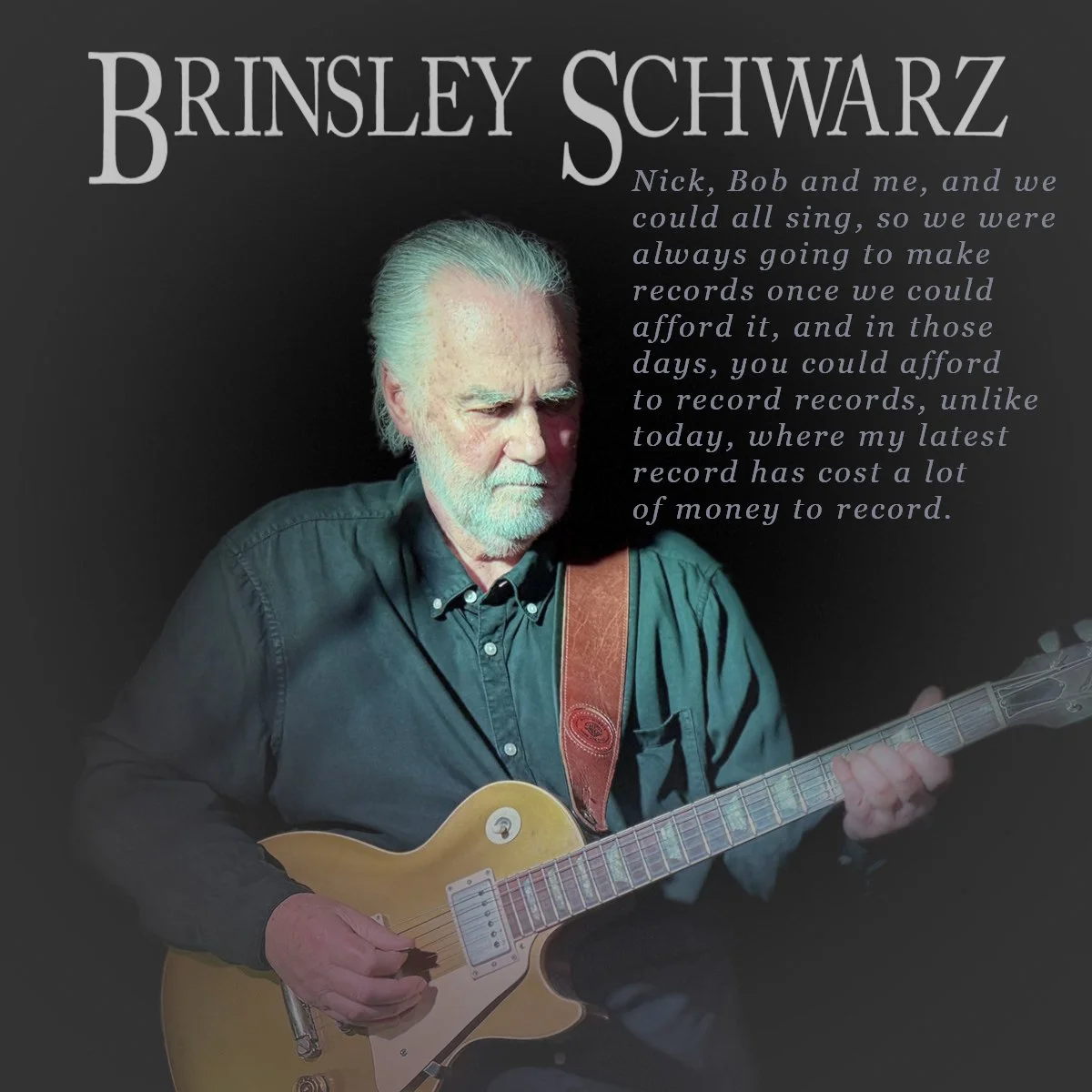
We didn’t have anything else to do, really, and were working hard. We had two or three people who could write songs, Nick, Bob and me, and we could all sing, so we were always going to make records once we could afford it, and in those days, you could afford to record records, unlike today, where my latest record has cost a lot of money to record.
Of those albums, which one particularly stands out for you?
NERVOUS ON THE ROAD would be my favourite album, and possibly PLEASE DON’T EVER CHANGE also.
The label ‘Pub Rock’ wasn’t a fair reflection of the quality of the bands playing that circuit at that time.
I don’t call what we were doing pub rock. The definition of pub rock is ‘music that bands play in pubs.’We stopped playing pubs in 1973. The press, without railing against them, called what we were playing ‘pub rock’ and we didn’t like that label, or any label in fact. The day that we read in The Melody Maker that ‘Pub Rock was here,’ we left that scene. We were starting to get into soul and R’n’B, which in those days was becoming a bit more musical and grown-up.
Bob Andrews and you went on to be members of Graham Parker and The Rumour.
Graham Parker and The Rumour was quite democratic as a band with simple rules; there was never a leader as such. We had simple rules, three great vocalists in the band, I wasn’t a particularly great singer at the time. But eventually the cost of keeping Graham Parker and The Rumour together had got out of hand. We had made two albums as Graham Parker and The Rumour, and one album when Graham packed it in. The four of us, me, Steve (Goulding), Andrew (Bodnar), and Martin (Belmont), carried on as a band and toured with Carlene Carter, made an album and did some touring ourselves before it fizzled out.
You then effectively retired from performing to pursue another career.
I had already done a bit of work at a guitar store in Richmond; they agreed to let me work there repairing guitars and be a member of staff, while allowing me to go on tour or record as well. It was a loose arrangement, but I spent about twenty-five years repairing guitars, which I loved doing. I loved guitars right from the beginning when I first heard Hank Marvin and The Shadows. As well as playing in a band, repairing guitars was the next best thing for me.
That also kept you in touch indirectly with the music industry.
It did, and we also had an American agent and manager when Graham Parker and The Rumour were touring in America, with whom I got on well. I was looking for work in America, and he contacted me to say he had bought an old loft in New York and wanted it converted into a suite of offices. I told him that I could do that, and he offered to put me up and supply me with two guys to do the heavy lifting and help. It took me eight and a half weeks to put it all together. Nothing to do with music or bands, but one of the greatest satisfactions in my life followed. Rodents tended to eat through the plastic lining on the wiring, exposing the copper wiring and leading to numerous fires in New York. We did all the electrical wiring to English standards; I had done that before working with my dad as a kid. The Chief Officer of the New York Fire Service came to inspect the work to certify it and asked who did the work. When I confessed to having carried out the work, he complimented, ‘You guys in England have high standards; this is as good as I’ve seen in my forty years of inspections.’
Did you look for work as a musician in New York at that time?
Well, I also had an interview and rehearsal with a band in New York that was amusing. I read an advert in one of the local music papers that read ‘Wanted guitar player, must be into Brinsley Schwarz.’ I called them up, and they asked for my name, to which I replied, Pete. I went to the interview the next day, and they recognised me, fell about laughing, but thought I shouldn’t be in their band.
What was the catalyst that kick-started your performing career once more?
Working at the guitar store, I was around guitar players all the time, all kinds, good and not so good, kids and learners. It rubs off on you, and that got me back into playing. My family and I had moved house down to the south coast of England, and I was working in the house, doing it up and decorating. I had just come home with a load of Ikea bedroom and kitchen cabinets. I managed to get them all into the house and was completely stressed out when the phone rang. It was Graham (Parker) phoning me to tell me that the band was reforming, making a film or a documentary, and that everyone else was on board except me. He knew that I didn’t like flying, but that they would all love to have me back in the band. So, despite my fear of flying, I heard myself immediately saying, ‘I’m in.’ The prospect of being in the band again and going to America to make a movie did it for me, and I got over ten years of fearing to fly.
Since then, you have recovered your mojo for writing, resulting in three albums: THE UNEXPECTED (2016), TANGLED (2021) and your recently released record, SHOUTING AT THE MOON.
Well, I have a workshop at the end of the garden where I repair things, and when TWO AGAINST NATURE, the Steely Dan album, came out, I was hooked. I’d always been a fan of theirs, but when I got that album, I couldn’t listen to anything else for months. I was zoned entirely into it. I was driving around one day when a lyric came to mind, and to my surprise, I started writing a song. Before I knew it, I had written ten songs and couldn’t stop writing. It all just happened without rhyme or reason, and as I had played so many guitar styles in the shop, things musically also seemed to open up for me again.
The Steely Dan influence comes across on the breezy song Nothing Is What It Seems from the new album and Falling Over Backwards has that Van Morrison soul and blues to it. You also include a Graham Parker cover on the album.
Yes, Watch The Moon Come Down, my favourite of Graham’s songs. I also covered another favourite of his songs, Love Gets You Twisted, on my last album, TANGLED.
You hooked up with producer and multi-instrumentalist James Hallawell to work with you on the albums.
James played with Graham Parker and me when we were recording Graham’s album MONA LISA’S SISTER. He then came to the Graham Parker and The Rumour reunion gig in Shepherd’s Bush. We had a chat backstage, and he invited me down to his studio. I had a song called Seal It With A Kiss that was a wedding gift for my niece-in-law, and I wanted to record it. They subsequently played it at the wedding. When I was recording at James’ studio, I played a few other songs, we recorded backing tracks for three or four others, and I had the material for an EP. It then ended up with enough songs for my first solo album, THE UNEXPECTED, and eventually, as we had enough songs, we made TANGLED. Because I was writing so much, I then started working on the new record, SHOUTING AT THE MOON. I still have enough songs for another album, if only people would buy physical records, artists would have enough money to make records.
Interview by Declan Culliton
SHOUTING AT THE MOON is available at https://www.fretsorerecords.com/brinsley-schwarz/