
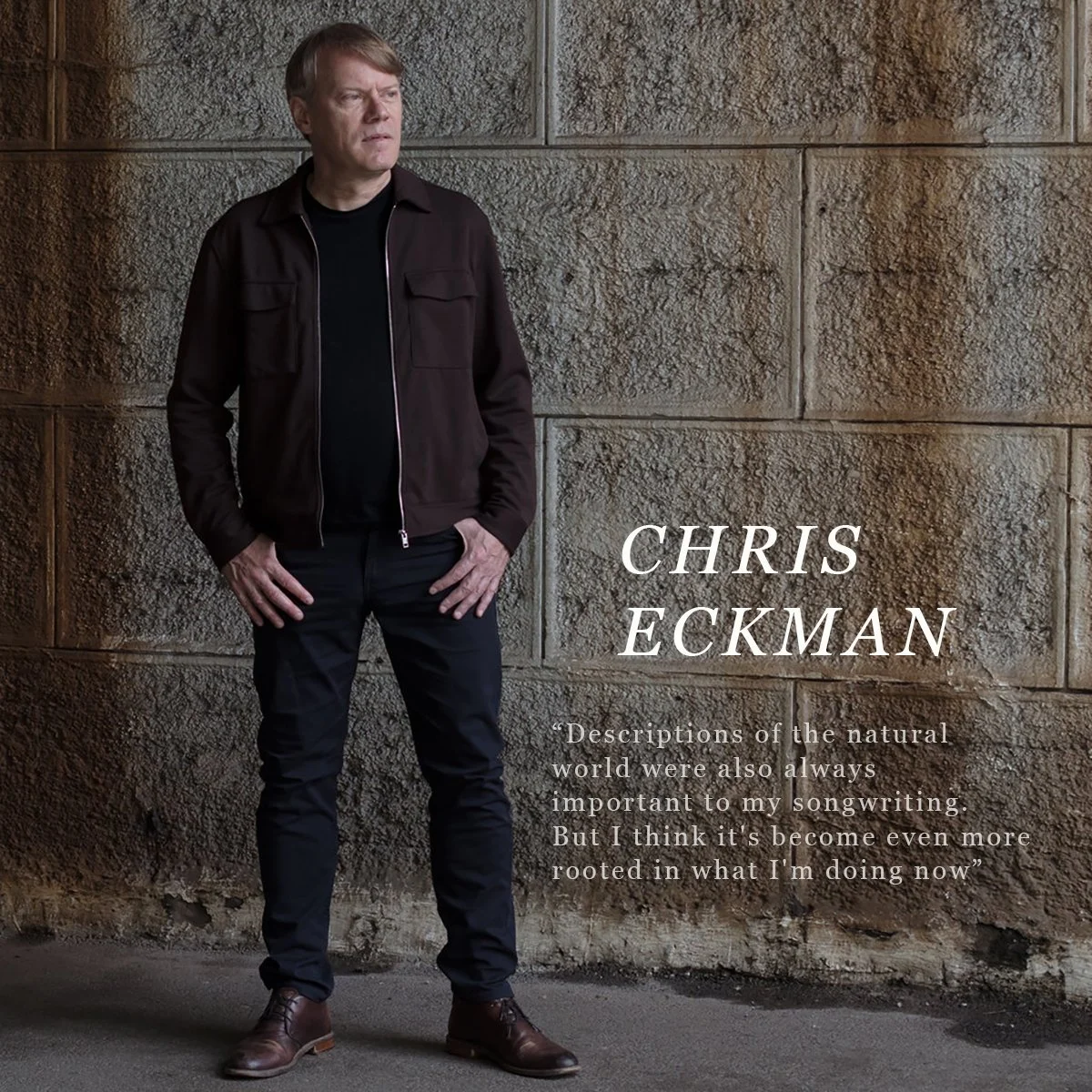
Founding member of Seattle band, The Walkabouts, songwriter, musician, producer and founding member of Glitterbeat record label, Chris Eckman’s latest solo album, THE LAND WE KNEW THE BEST, is arguably his most celebrated work to date in a career spanning four decades. As was the case with his 2021 record WHERE THE SPIRIT LIES, rather than self-produce, Eckman delegated the duties to Alistair McNeill, who crafted a sonic landscape that fully supported and enhanced Eckman’s haunting and often brutally confessional lyrics. With a heavy workload as label manager, producer, songwriter and recording artist, Eckman’s enthusiasm remains unabated. ‘I've always been extremely grateful and very happy to have spent a life around music, whether it's my own or someone else's,’ he tells Lonesome Highway.
Moving to Slovenia and establishing the Glitterbeat record label in 2012 was a brave move. What was your vision for the label?
We started it as a modest experiment. I had been travelling in West Africa and had gone back to Maili several times, meeting some artists there. At first, it was more of an educational experience for me; I felt a bit burned out by what I had been listening to and wanted a different perspective on music. It succeeded at that but eventually became something I was involved in at the production level. After I had produced a couple of records, I was licensing them to other labels and a friend of mine, who at that point owned a label called Glitterhouse, suggested we start a side label to handle these records. We started with three or four records, and now, thirteen years in, we've done one hundred and eighty records and are still moving forward.
Did the move effectively spell the end of the road for the Walkabouts, and was that regrettable?
I think we were at a turning point. I'm not sure it was the death knell for the Walkabouts, but it was a contributing factor, that's for sure. What became clear to me was that I would have less spare time to maintain the band, which was a bit out of reach. I think if the Walkabouts had been a multi-songwriter band, and there were other people who were contributing material, it’s highly conceivable that we could have continued. But that aspect of it just really rested on my shoulders. So, I was just very honest with everybody and just said, I think we're at a turning point here. Yeah, there was a lot of regret about that, but we had also been doing it for a long time. And I think maybe what was even more important is that the record we had released in 2011, TRAVELS IN THE DUSTLAND, and the touring that we did on the continent of Europe, had gotten lots of sold-out shows. And I felt like, well, this would be a good time to stop, too.
Did you feel that The Walkabouts were underappreciated in America, given how Europe embraced the band?
I guess there was an element of that. I tried to keep the bitterness out of it because we had so many arms opened to us, and we worked hard to get that. But on the other hand, the level of success we achieved in, let's say, Germany or Holland and Belgium, and places like that, was kind of beyond what we ever expected to do anywhere. So, what we had done was quite satisfying. And I did think about it sometimes, but for the most part, I just said, ‘You know, you go where people want to hear you.’ And there was always an element in America that we were well received by, and we had a pocket of a fan base. The problem with America is it's just so damn large; it's really hard to connect all those disparate dots.
You were also competing with an enormous grunge scene in America at that time.
That was it, too. We were fighting a very big tsunami, yeah.
Since the move to Slovenia, how has the environment that you live in there influenced your songwriting?
I don't know. It's something I don't give a lot of thought to, but it probably has had some effect. What has happened with my writing and just making music, because I run the label, it's ended up being something I just do. I wouldn’t say it is a part-time thing; it still applies to the centre of my identity, but I have less, let's say, available time to do it. So, I've accepted that I will be less prolific, which is fine. And what I think has also happened to me in the last five or six years is that I've really realised that I do live here. It's not just a place that I have a flat, I’ve developed a life here that sustains itself, something that's important to me, emotionally, spiritually, at all levels. So, I think that starts to change my writing to some degree. A lot of things came together with that. I really reacquainted myself with nature and hiking and walking, something I had previously done a lot in my life. But then there was a period when I wandered away from that, and in the last few years, it's focused me. Descriptions of the natural world were also always important to my songwriting. But I think it's become even more rooted in what I'm doing now.
That also comes across strongly in the artwork for your recent record, THE LAND WE KNEW BEST and in WHERE THE SPIRIT LIES from 2021. How important is the artwork as part of a complete package with those albums?
It's very important. The photos on the record covers and inside the records are all photos I took myself. That's another element of what I'm doing now, I can imagine these songs visually. I also look for photos that I took that help narrate that.
There are obvious comparisons for me with both albums, though THE LAND WE KNEW BEST has a fuller sound to it. Did COVID and the lockdown influence the writing and the somewhat stripped-down feel to WHERE THE SPIRIT LIES?
At this point, there are tens of thousands of COVID records, and, yes, WHERE THE SPIRIT LIES, it is one of these. It was a record not just recorded during that period but also written during a period, when I had, let's say, some personal upheavals and I was suddenly living on my own. I had wandered away from playing the guitar as frequently as I would have wanted to, and there was suddenly a large amount of time available. And I took advantage of that quite tentatively at first. In fact, I played the first three or four of those songs to a very good friend. After we got out of lockdown, they seemed a little bit different to me, but I was happy with them, even if I didn’t ever release them. And my friend said, ‘You're crazy, you've got to release them.’ I had this flush of nervousness, because I think the songs felt probably more personal than a lot of things that I've written, more deeply personal, because you're not necessarily always the narrator when you write. These songs became more of a narrative thing for me.
CTFD, the final track on WHERE THE SPIRIT RESTS, has me hitting the replay button every time. Tell me about that song?
I wanted to put that song last because it's less dark than some of the other songs on that record. In fact, that record really moves from darkness to light, without getting too grandiose with the metaphor. The darkest track is the first one, Early Snow. CTFD, it's about slowly coming to terms with new realities in one's life and new love and things like that. It’s about like trusting somebody again, the person that whispers in your ear and says, ‘calm the fuck down,’ and instead of rebelling, you actually listen to that. Because that can sometimes be the best advice.
Rather than self-produce that album and the new one, THE LAND WE KNEW BEST, you handed control over to Alastair McNeil. Was your intention to gain another sonic insight, and did you give him complete control?
Yes, to those questions. Basically, I knew Alistair, who also lives in Ljubljana. In similar circumstances to mine, he came here because he had a relationship that also dissolved for him, but he stayed here. He started in rock bands in the 90s, but he studied things like sonic arts and experimental music, and I knew him from the very small scene of that here in Ljubljana. I knew he had a really cool, but also very cosy, small studio. And, you know, on one hand, I was thinking I can relinquish control in a way and allow somebody to bring some different ideas to what I do. And it felt very, very liberating to me, also not to have to do the faders and mix it myself and struggle with all of that. There was enough going on in my life at that point in time. It really worked well the first time with WHERE THE SPIRIT RESTS, which was a really strange experience. His studio was less than a mile away from my flat, but after the original recordings, we went back into lockdown here in Slovenia. So, it was all mixed by him, just sending files back and forth, which is something I've done in the past, but usually with people who are a thousand miles away, not somebody who's only a mile away. It was a really good experience, and I also knew that the next record should have some differences to it, and I said to Alistair ‘Let's expand the palette. It doesn't have to be as austere; let's open the windows in the room a little bit. But other than that, I left a lot of it in his hands.
The album title THE LAND WE KNEW BEST is taken from a line in the opening track, Genevieve. Is that a reference to a location or a shared mindset?
I think it was both. I was talking about relationships; they don’t exist in a vacuum. Relationships also have context. One context is the land, the landscape, the physical place that people live. But the lyrics twist a little bit, because it's not really the land we knew best; it’s actually referring to the heart. There is the line that says, ‘The heart, the land we knew the best.’ So, it wasn't just this physical land that we knew best, but this landscape at the heart of the relationship itself.
You close the album with Last Train Home, which plays out like a continuation of that opening track both lyrically and sonically. Was that intended in the sequencing?
Yeah, I think I knew pretty well that that was going to be the final track. I didn't always know that Genevieve would open the album. Even when I suggested that to Alistair, he thought it was a little bit radical. But again, we started the previous record with Early Snow, an odd opening song, too. So, let's continue the tradition. The sonic connection was more accidental, but these kinds of things are never purely accidental. The different songs talk to each other in different ways. And the minute we first set up the sequence, we thought it was clear how these bookends worked, but it wasn't. We weren't so smart to see that from a long distance away, we had to get our hands dirty and start moving stuff around till it actually fell into place.
The songs work very well collectively. Was that a result of them being written over a short period of time, or did you have some of them on the top shelf waiting to be used?
I wrote them in a very short period of time, four or five months. But there was a final outpouring in a couple of weeks, when I collected fragments and put them together into something that resembles what they are now. That’s the way I started writing on the previous record, also because of just downtime and complete boredom during lockdown. I was picking up the guitar, strumming for long periods, and writing kind of unformed, incoherent things, and I would record them anyway, like auto-writing. Just sing some lines and talk some lines, and a lot of what ended up on WHERE THE SPIRIT RESTS came out of those fragments, and I continued that onto this new record. There are some songs where a whole verse would just come spontaneously, with maybe one or two words changed. It wasn't all written like that, but this was always the impetus. I always started with this, and I didn't start with a blank page in a book, writing things down.
The lines ‘And then that the rage is gone and the fear is calmed’ from the song Town Lights Fade. Is that a reference to coming out of lockdown, or is it more personal than that, a kind of rejuvenation or personal rebuilding?
It's the second. It was written after my divorce was finalised, and there were more positive things happening in my life after that. It's a reflection on that and not to get bogged down in bitterness or vindictiveness, but to rebuild a life. Even if you're not a young guy, you can still do it.
Is the song Haunted Nights a distant relation to Drinking In America from the last album?
Yes, but I think Drinking in America is probably less autobiographical. It's more of a poetic construction than a narrative construction. It's a lot of fragments floating around, which come together in the chorus. Haunted Nights is more of a classic narrative song. Also, I was listening to a lot of Kris Kristofferson over the last years. I think if you’re going to steal from somebody, he’s a pretty good one to steal from.
Even back to your Walkabout days, you have been heavily influenced by artists like Kris Kristofferson and Townes Van Zandt, yet your writing and presentation are quite different.
That's the key. You can be deeply influenced by somebody, but you don't want to turn it into mimicry. What strong influences do for people is that they help open doors. You hear something and are devastated by it because it's so damn beautiful. At the same time, you think I should never write another song after hearing that. But that dissipates once the ego takes over, as you got poked by it, and got a little bit of a shove in the right direction.
Your widespread influence was laid bare on the Walkabouts’ covers album, SATISFIED MIND, back in 1993, featuring songs written by The Carter Family, Gene Clark, John Cale, Charley Rich, Patti Smith, and more.
That was a terrifying record to make because we had never really played that slow, that quiet. It was like it was aspirational, that we could play like that, or to find out that we can. We had very little time to do it, but it was really trial by fire, and to have ghosts of all these songwriters that we love so much dancing around in it. I remember the guy who owned Glitterhouse Records at the time; he sent me a fax asking how it was going. I stared at the fax for about three days, thinking, ‘I don't even want to answer because I don't know if this is good or if it's just the worst thing we ever tried to do.’ For me, the most enjoyable part of that album was curating it. Carla (Torgerson) and I were sitting there and listening to songs for weeks. We started with probably a couple of hundred songs and whittled them down and down. And that was just pure joy.
Do you revisit the Walkabout music these days?
It's interesting because I recently went back to them. A friend mentioned a specific Walkabouts song, so I dug out that record and listened to it. I then found myself wandering around for a few days, revisiting the albums. It's not like a painful thing for me, because I feel proud of what we did, but I've also never been a very nostalgic person. I think that that's something that has always kept me with a little bit of a tentative relationship to what I've done in the past, like you don't want to look at it too closely, you don't want to give it too deep an embrace, because you want to move forward. You want to be looking for the next thing to do.
Your current writing style embraces sadness, despair, loss and detachment. Is that what motivates you and brings the best out of your writing?
I guess so. I think that when I was younger, I was thinking that ‘I want to write this kind of song, or that kind of song, and if I adopt this narrative technique, wouldn't that be interesting?’ At this point in my life, I’m just following my mood, or what I really feel connected to. What comes out is what matters; that's why this kind of auto-writing that I've integrated into my songwriting process is important. The thing is, it's not filtered. There are lines in these last two records that I would have never, ever put in a song before. Sometimes they're not even good lines; you think that you can write a better line than that, but I'm thinking, ‘That’s what came out.’ Sometimes that stripped back to honesty in writing is really what you want.
Record label manager, producer, songwriter, musician, and performer. Which gives you the greatest satisfaction, or is it the perfect balance for somebody with a career in the arts?
It's a good balance, although sometimes it becomes too much. But producing and running a record label really plays to this fan side of me. I've never been someone who didn't listen to other artists; that's a joy in itself for me. My old turntable just collapsed, and I got a new one last night and stayed up until almost 2 am just listening to records. It was such a joy to spend those many hours, five, six hours, listening to records. I don't get a chance to do that very often, but I've always been extremely grateful and very happy to have spent a life around music, whether it's my own or someone else's. I love advocating for other artists; the label gives me a chance to do so. Producing has given me a chance to do that. So, it plays to the different sides of my personality.
Recording-wise, do you have anything in the pipeline?
Yeah, I've got a record I'm going to do with Jana Beltram, the woman who sings on THE LAND WE KNEW THE BEST. We're going to do a dual record that we've been planning for a while. We'll record it in the spring. It'll be very simple, just a couple of duets. I wrote a couple of songs for it, and she has a couple, and we'll do a few covers. What I don't want to do is spend five years not making a record. I’ve really got into making records again, and so I'm going to keep it going.
Interview by Declan Culliton
Chris Eckman will perform at Kilkenny Roots Festival in May 2026 https://kilkennyroots.com