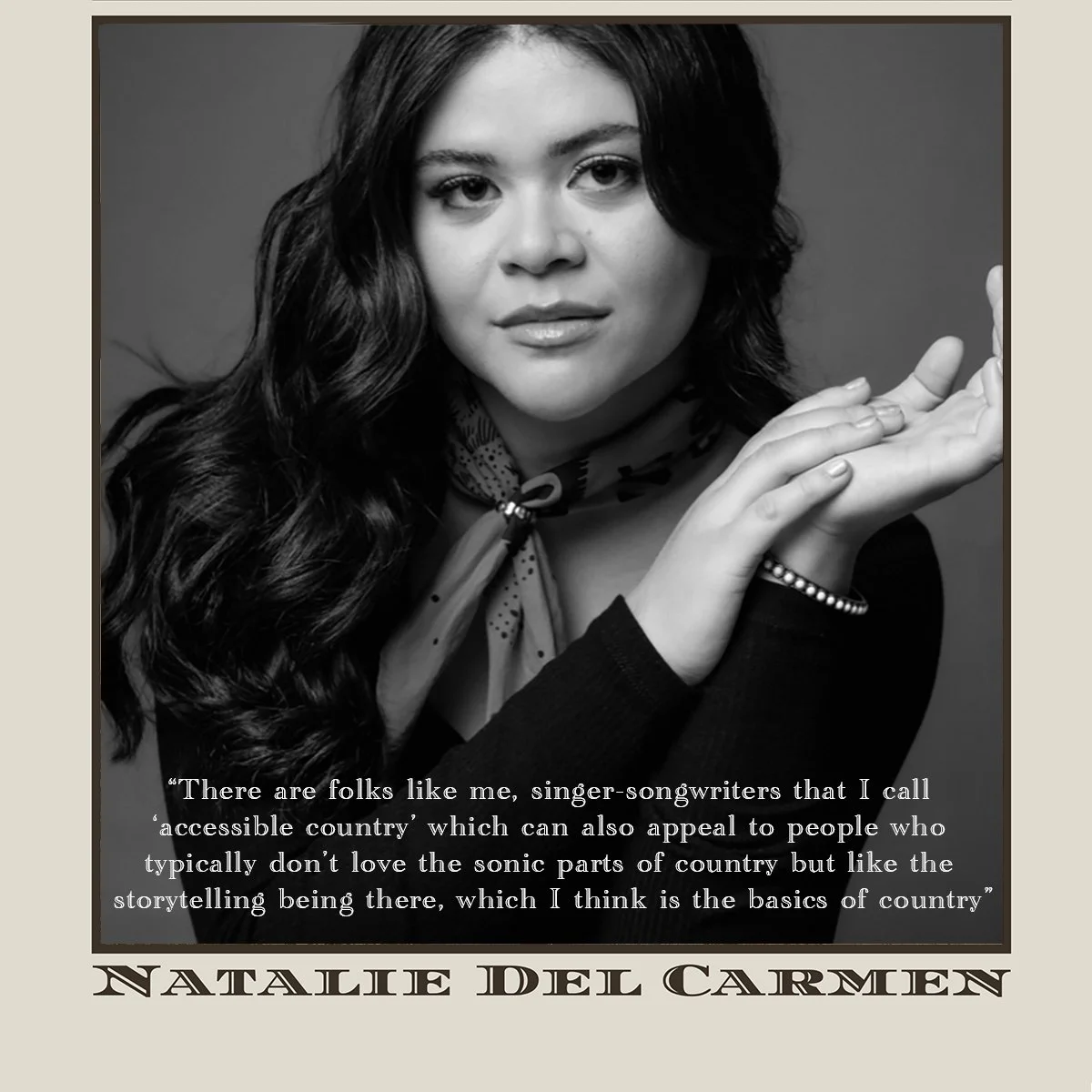
One of a growing number of young women making waves in the Americana genre, Natalie Del Carmen may be a city dweller, but her songwriting drills into real-life concepts and personal angst that exist in both urban and rural settings. Her latest album, PASTURES, is a collection of thought-provoking songs from the perspective of a young woman finding her way in an often-gruelling modern world. ‘I am Gen Z, and the album is written in a very Gen Z way, and it reflects what we are experiencing right now,’ she confessed to Lonesome Highway when we spoke to Natalie via Zoom earlier in the week.
A bachelor’s degree from Berklee College of Music, numerous singles, two albums and an EP released by the age of twenty-four. That is an impressive portfolio.
Starting out, I just knew I wanted to take music seriously. I realise that nowadays, with streaming and people having shorter attention spans, I thought it was important to keep putting out new music.
What was the Berklee College experience like for you?
I got lucky and found a really good group of friends there early on. I loved my days being music-centred, and at the time, it was important to me that I got a bachelor’s degree. I learned a lot there, and because of that, putting out music in my early twenties was easier because I felt educated as to where the industry was moving. You don’t have to go to music school to make it in this industry at all, but I do think that at Berklee, they give you the right tools. I specialised in songwriting there.
Did that chapter convince you that roots music was your preferred direction.
I did feel that the emphasis for women was pop music because it’s a very specific structure to teach and understand why a particular song is a hit. I learned those things but also realised that I loved country and Americana music, and the songs that I brought to class always leaned that way. People would tell me that I liked storytelling songs more than pop songs, which I took to heart and realised during college that it was what I wanted to do.
What defines country music for you?
It’s a very wide umbrella for me with many sub-parts of country music. There is the pop country that gets a lot of radio play, but I like country that leans towards traditional these days. Emily Scott Robinson and Zac Top are doing amazing things in country music. Then there are folks like me, singer-songwriters that I call ‘accessible country’ which can also appeal to people who typically don’t love the sonic parts of country but like the storytelling being there, which I think is the basics of country.
What current country artists impress you?
People I share my label with, like Braxton Keith, a super young guy who I think is great, and I love Gabe Lee. Emily Scott Robinson and Zac Top, who I mentioned before, and also Emily Ann Roberts. They are all my favourite artists right now.
PASTURES, the title of your new album, implies open spaces. Was that in your thought process when naming the record?
Yes, I wrote the final song on the record, Pressure In The Pastures, about how a pasture can be a very open and freeing thing, but in your early twenties, you realise that your life can go anywhere, and there is a lot of pressure to pick one path. Some people will tell you to do multiple things because it’s probably the only time in your life that you can do anything you want. For me, at my age, I viewed a pasture as more scary than freeing. I didn’t know where I was going, what I wanted to live up to and in society, people put a lot of pressure on you to accomplish things very quickly.
For me, the record is looking at the world through the eyes of your generation.
For sure. I am Gen Z, and the album is written in a very Gen Z way, and it reflects what we are experiencing right now. But I also hope that it can be universal enough for older people who may think, ‘My twenties were also a mess, and I also hated them.’
It’s less pop orientated and country than your debut album, BLOODLINE.
With BLOODLINE, I was between eighteen and nineteen when I wrote a lot of those songs and didn’t know what I wanted to do then. I envy artists who are very strategic about what they put out. I can’t say that about me. I love the BLOODLINE album, but it was a continuation of what I was exploring at that time. It was very pop but also getting into the Americana singer songwriter thing, and it’s funny looking back at that time when I wasn’t exactly sure what I was going to do going forward.
You released a number of singles over the past eighteen months prior to the album release. Did the feedback to the singles give you confidence and positivity?
Yes. I released Good Morning From Magnolia, which was one of the first singles, and the feedback I was getting was that ‘This sounds like you.’ That was really affirming because at the time, everything we were working on for the album sounded quite like that single.
There is lots of fiddle, mandolin and banjo on the album. I believe that you inherited a banjo from your grandfather.
I always wanted to play banjo, and one day, my grandfather, who had a banjo dating back to the early 1920s, felt that I should play it. It needs to be refurbished, but I refuse to do that because I want to keep it in the condition that it was created and not alter it in any way. I need to get a new banjo to keep playing it.
You tapped into Brunjo, a collective of friends you studied with at Berklee to produce the album and contribute the instrumentation alongside your own playing.
I certainly got what I needed from Berklee because I met those three people, which I think, in a way, was meant to be. They have worked on everything that I have put out so far. Their studio is in Kingston Springs, just outside of Nashville.
The song Plans Abot Plans suggests breaking free. Is that from personal experience?
Yes, I do have control problems and am very much Type A and like to live my life in a very tight way. That works when you are in school from five years old to twenty-one, when your life leads a very specific path. If you do something well, you get graded immediately, and you feel good about it. Then you leave college, and you realise that life does not work like that; you can achieve things, and nobody might care. That was shocking for me to have been in a system which had been very well constructed for me, but to then find out that life isn’t really like that. I wrote about that in Plans Upon Plans.
Your father can take credit for the story behind the song El Cortez.
Yes, we spent Christmas in Las Vegas and gambled together for the first time. We lived pretty close to Vegas but had never done the Vegas experience, and my dad gave me twenty dollars for the Wheel of Fortune, and I didn’t do half bad. I was in the car on the way home and thought about how people can feel rich in life without the involvement of money. I wrote the song about the rich experience with my dad that really had nothing to do with the money.
Should I get a sense of regret in the song What Should Have Been (By Now)?
There is regret, but also bittersweetness, and the true heart of that song is that you could have gone x,y or z path, but for some reason you did not, and you have to accept that. At college, I had these big plans that I was going to graduate early and move to Nashville to start a whole new life. I met my partner of four and a half years, and that went completely out the window. At the time, for me, that went completely against the grain not to put myself first, but thankfully, I moved back to Los Angeles, where there is stability for me and family support that I would not have had in Nashville. So, all the paths I could have taken ended up in the right one, which is what What Should Have Been (By Now) is about.
Is there a healthy scene in Los Angeles for you to perform?
There are quite a few collectives that have come together to do songwriter nights, and I have done Hotel Café a few times; they are moving out of Hollywood. I love that venue, they do Americana and country and a lot of singer-songwriters, especially young women my age.
You have also recently been performing in Nashville.
Yes, I was in Nashville a few weeks ago and did a show at The Bluebird Café and played at The Basement for the first time. I also performed at the 3rd & Lindsley with Sophie Gault, who is on the same label as me. I love her music; it’s very specific to her. I love artists like her who have a vision.
You have already achieved a lot at an early age. Have set goals for yourself going forward?
Of course, I have dreams of things I’d like to achieve if the industry allows me. I’m already writing for the next record and starting to record new things as well because this record, PASTURES, was finished this time last year and took a while to put out.
Interview by Declan Culliton