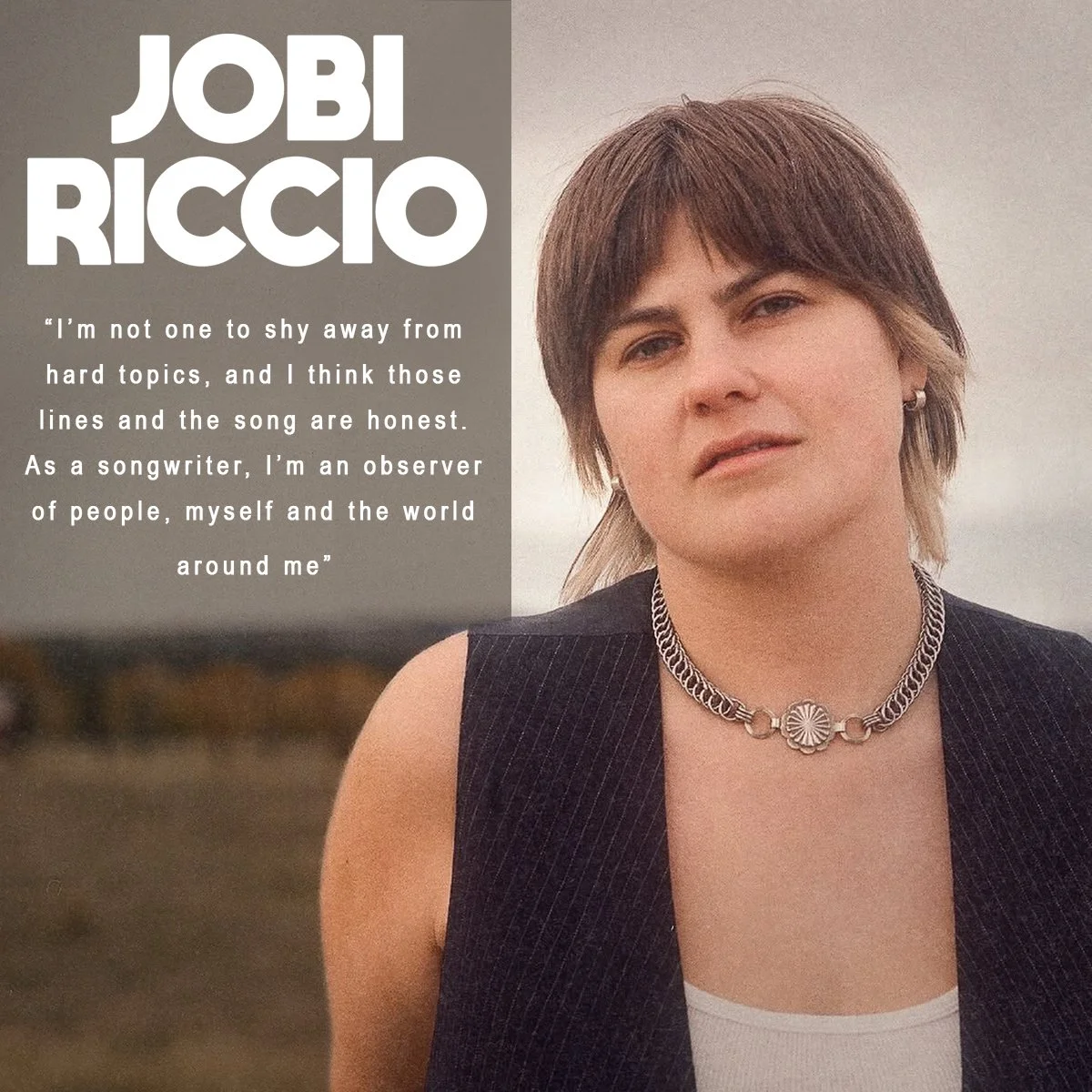
Colorado-born and currently living in Nashville, Jobi Riccio has just released her third album, FACE THE FEELING. The recipient of the Newport Folk John Prine Fellowship in 2023, Jobi has taken a massive step forward with the new album, which tackles the grinding reality of self-examination and broader worldly concerns with brutal honesty. It’s a powerfully emotive project from a young artist blessed with the ability to express both anguish and fulfilment in her songs.
It’s been three years since we spoke with you about your last album, WHIPLASH. If that record was a ‘coming of age’ project, how would you describe your new album, FACE THE FEELING?
FACE THE FEELING is an album where I am looking at a lot of things that I was avoiding in the past. In a way, it’s an album of reckoning but also an album of growth, speaking the truth and learning to talk to yourself lovingly and honestly. In that way, it’s a natural progression from WHIPLASH.
I described it as an exercise in ‘mirror gazing’ before I got a physical copy of the record and saw your image in the inner sleeve doing just that.
It’s a reflective album, facing up to things. I don’t know if that image is a bit obvious, but I thought it was cool. We did a lot of photo shoots with mirrors in small videos. I had this idea of the words ‘face the feeling’ coming up time and time again to someone in their daily life and thought that one of the most likely places that they would see that would be on the bathroom mirror when they wake up in the morning. I struggled with being someone who avoided things for a long time and got to a place where I could no longer do that, so there are a lot of songs and lyrics on this record where I am reckoning with that.
The extremely emotional opening song A Little At A Time stopped me in my tracks to the extent that I put it on repeat before listening to the rest of the album.
We did two local takes of that song, and I cried after the second one. My friend and co-producer Isaiah Beard, that I was recording with, just looked at me and said, ‘we’re done with the vocals on that one.’
The production on the album is more adventurous than your previous work. I particularly like the addition of strings to that track and a few others. Was that input suggested by your producer, Jesse Timm?
Yes, that was Jesse’s input; they wrote and arranged all those string parts, hired the players and conducted that whole session. I heard mock-ups of the strings beforehand and went back and forth on a few things, but by and large, it was all Jesse. We’ve been writing and working on my music together for years, and Jesse is one of the first people that I will send a song to. I was really excited about having strings. The Breeders’ LAST SPLASH record has some really cool string parts on a few of the songs. I grew up in the era of chamber pop music, and bands like Ra Ra Riot and Vampire Weekend were super popular when I was a teenager. I love string parts, but we didn’t really get a chance to do that on my last record, and Jesse and I both wanted to have strings on this record.
You co-produced with both Jesse and Isaiah Beard. Did that connection arise from you all attending the Berkeley College of Music?
Yes, that was the connection for Jesse and me. It was through Jesse that I met Isaiah. We were looking for someone else to bring in to record WHIPLASH, and a friend of mine from school had just done a record with Isaiah and sent me some rough mixes. The production and mixes on them were really cool. We have grown together as a collaborative unit.
Where did you record the new album?
We recorded at Club Roar studios in Nashville. Isaiah lives here in Nashville, and Jesse came from New York City for the recording. With the exception of the strings, all the other players were Nashville-based.
There is some seriously open-hearted songwriting on the album. A Little At A Time, which I previously mentioned, and High Beam being another.
I wrote High Beam when I was cat-sitting at my friend's house. It’s a vulnerable song that I wanted to add humour to deflect from the body of the song. I was going through a heartbreak as well as going through a larger life pattern, being attracted to the wrong type of person, which I think a lot of young people do. I had this idea for a lyric about someone being caught in a headlight, and I wondered how I wanted to say it. Sometimes I get an image or a metaphor that won’t leave me, and I wonder how I can crystallise it into something that will work. Once I got the lyrics “Your stare was like a high beam, I got drunk on that shine”, the rest just spilt out of me.
Love Of The Song includes the lyrics “I’m not drinking for the taste or singing for the love of the song.” Autobiographical?
Yes, why lie? I’m not one to shy away from hard topics, and I think those lines and the song are honest. As a songwriter, I’m an observer of people, myself and the world around me. I wrote that song during a really hard period of my life. In Nashville, everyone here is a musician, a writer, a producer, or otherwise involved in music, and being really plugged into your career can kill the joy of it if you don’t get some space away from it. I was really struggling with the work/life balance when I first moved here, coming from Denver, where I had a few musician friends, though my family were not musicians. Things in Nashville felt like too much and still do, and I have to work to cultivate my hobbies and my other interests and take a step back and not use alcohol or continually scrolling on my phone and any other easy thing you can reach for when I feel sad or anxious about my life or the state of the world. Who doesn’t feel that way at times?
You forcefully express your concern for the environment in Wildfire Season, one of the album’s standout tracks.
I remember being a small kid and having deep climate anxiety before I even knew what that term was or what climate change was. I was very connected to nature growing up in a beautiful area, and then, driving into the city, witnessing pollution and being affected by it. Once I learned about climate change in school, it became a big issue for me. My first job in high school was as an environmental canvasser, going door to door to ask people to get involved. If I weren’t doing music, I would be working in forestry and something climate related. The song Wildfire Season was a long time coming. I’ve dealt with wildfires my whole life and have seen them get worse and worse as I've got older. Everyone my age has lived with climate change and the loss of public land. It’s heartbreaking to be from a place with such access to beautiful nature, watch that diminish, be encroached upon, see oil and gas exploration come in, and have that culminate in wildfires. I was looking for the words to that song for years and wanted to include a nod to indigenous power movements because some of the loudest voices in the climate movement are indigenous. I get a lot of energy from playing that song in my sets; it’s a moment of catharsis in my shows. I also do a bit of fundraising around that, selling postcards featuring my hometown that read ‘wildfire season.’
The album cover, depicting a large billboard with the slogan FACE THE FEELING is striking.
That billboard is from a drive-in movie theatre in Buena Vista, Colorado. I wanted the album cover to be a big screen or a billboard that read ‘Face The Feeling’ because I kept coming back to someone seeing those words, because this record is me confronting different feelings and issues. I didn’t want my face on the album cover and wanted something that was a bold statement. I had the idea of having those words on something that big a year before we shot the album cover.
No doubt the album title is also aimed at a wider audience, not simply directed at you.
Yes. We live in a world today where if you don’t want to confront or be uncomfortable with anything, you don’t have to, but by doing that, you will not be happy. You don’t have to make yourself food; you can just order Uber Eats, and someone else will deliver it to you. You don’t have to ask someone in your community for a ride to the airport because you can order, once again, Uber. All these companies and corporations that streamline our lives by taking away the discomfort in our daily lives and profiting from our pain, much of which is tied to our phones. It’s having a big effect on our mental well-being. I can only speak for myself, but I notice in myself that I’m not processing the world around me as effectively as I did as a child because of all the phone screen time. The independent culture that we have in spades naturally in America is bad enough, and then you add technology to that, it’s overwhelming.
If I had not heard Jobi Riccio’s music before, how would you describe it to me?
I often struggle with that question because I think I’d have to come up with some cheeky-cool answer that I frankly don’t have. But in a broad sense, I usually say Americana, indie-rock, and also a singer-songwriter to let people know that I write my own songs. There is a hyper-categorisation in culture driven by social media, and I am not good with categories; I prefer to be fluid in every sense of my life.
Interview by Declan Culliton