Every year, Lonesome Highway comes across outstanding artists and albums, often under the radar and previously unknown to us, that make it into our favourites of that year. A case in point is AMERICAN ROUGH, the debut album from Chicago-based country artist, Andrew Sa. Andrew’s high-pitched falsetto vocal, sensual melodies and intimate songwriting, including a number of co-writes with H.C. McEntire, who produced the album, strike the perfect balance between vulnerability and frankness. Andrew recently spoke with us about the album and much more.
I understood that your first stage appearances were at a very young age, in your mum's karaoke business.
Yes. She owned, with her then-husband, who's since passed, a karaoke company called Karaoke Kids, and they would travel around, do private parties, play at restaurants or bars, and whatever. She would train us at home; we would get our rehearsals in at home, pick the songs, get them ready, and then she'd send my sister and me up to warm up the crowd, because if a 10-year-old can do it, then, anybody can.
Do you remember the first songs that you performed?
Oh, absolutely. They were Patsy Cline and Reba McEntire songs. My mom was obsessed with Reba McIntire; she modelled her appearance on her. My mom has a beautiful singing voice, and she would sing a lot of Reba songs. Patsy Cline was probably the first person whose songs I wanted to sing. My grandparents really loved her, and I'd been hearing her songs forever since I was a very small kid.
It has taken quite a while for you to record your debut album. What triggered that?
I certainly dreamt of it as early as maybe 17, when a friend introduced me to the music of Rufus Wainwright, and I heard his album POSES, his second record. That was the first time I thought and dreamt that it could be possible for me and the first time that I started thinking about having my own album. But to answer your question, all the stars aligned to finally make it happen now in my life. I'm quite a perfectionist, and I knew even though I've been writing songs since I was maybe 20, that they weren't up to par with what I wanted to put on plastic.
Had you been performing regularly prior to deciding to record an album?
I've always been a performer. I saw in your write-up on the album that you mentioned that I had done theatre. I did theatre till I was in my early to mid-20s, and then I started just hoofing it, pounding the pavement, singing cover songs and original songs in Chicago for almost 15 years before this record came out.
I also mentioned the vocal similarities with Roy Orbison in the review. Is that something that came naturally to you, or were you influenced by his vocals?
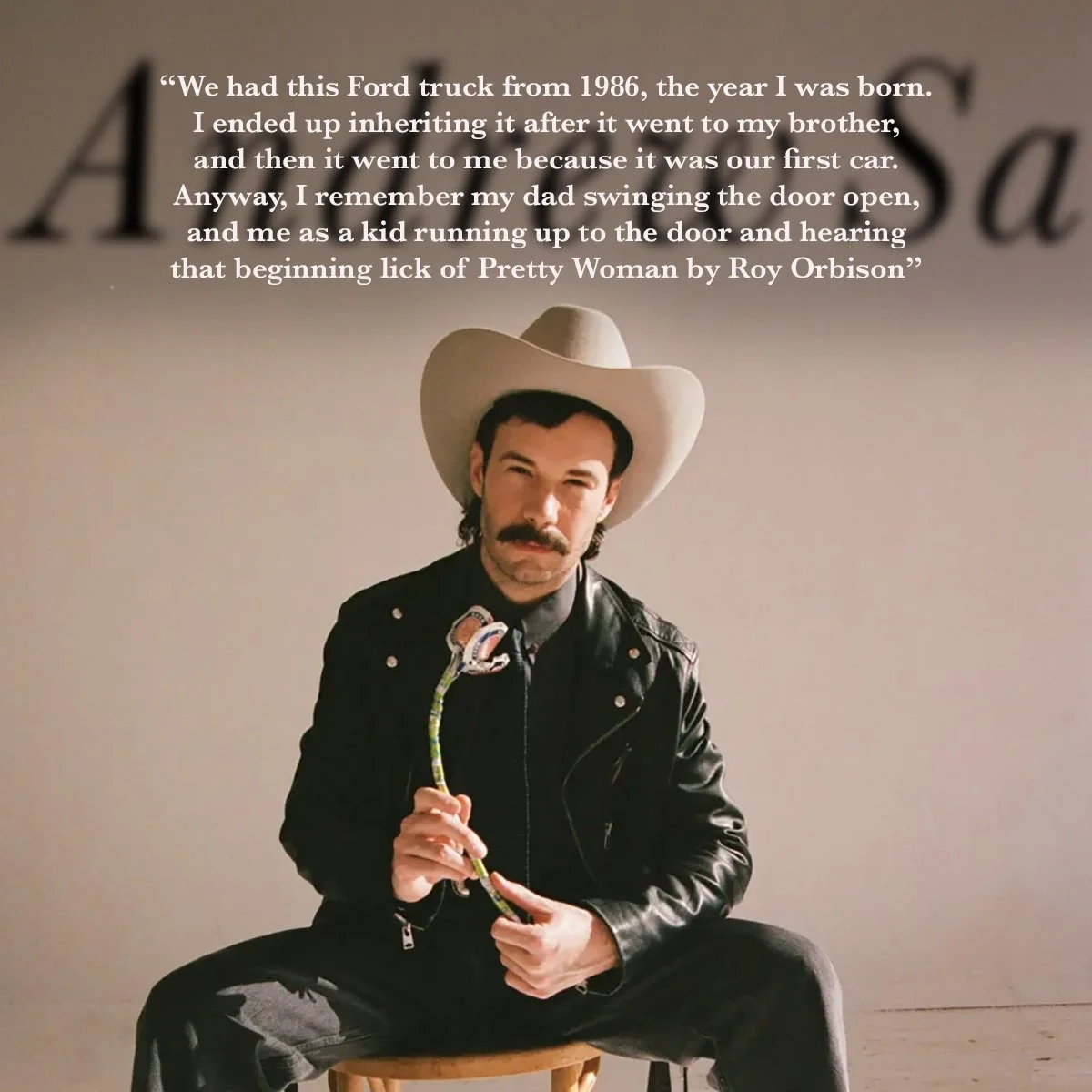
One of my earliest memories of music is with my dad. We had this Ford truck from 1986, the year I was born. I ended up inheriting it after it went to my brother, and then it went to me because it was our first car. Anyway, I remember my dad swinging the door open, and me as a kid running up to the door and hearing that beginning lick of Pretty Woman by Roy Orbison from a cassette that my dad had. We wore out that Roy Orbison greatest hits cassette in the truck. So, yes, Roy's voice has been in my brain and in my bones for a long time.
You hooked up with H.C.McEntire, a favourite of ours at Lonesome Highway, to produce AMERICAN ROUGH. How did that connection come about?
Oh man, H. C. Macintire. When I first heard her music, her poetry, and her incredible voice, it was so emotional. That was in 2020 during lockdown. We were both interviewed for this article in No Depression, which explored the intersection of cosmic country music, queerness, and astrology. Anyway, when I saw her name, and I told you my mother, who has been obsessed with Reba for so long, I thought, "Oh my goodness, is she a descendant of Reba?” And she's not. But I listened to her music, and when the lockdown was lifted, my manager and I went to see her perform, and he turned to me, and he said, "I think she should be the one we ask to produce the record.” I knew I wanted to write with someone who was going to be the producer of the record, and I just hadn't heard anyone with such a unique voice, but also her poetry; it just really floored me. She agreed to work on the songs and the production. This would have been 2021, and she would have just released her own album ENO AXIS.
Bloodshot Records then came on board.
I had heard of Bloodshot for years. I've been in Chicago since 2009, and my friend Kelly Hogan was maybe the first person to talk to me about the label because she used to be on Bloodshot. I had loved records from the label, and we were in talks with another record label out of Nashville that did not come to fruition. But someone from that label reached out to his friend at Bloodshot because he was such an advocate and supporter of the label, and Howard (Greynolds) from Bloodshot approached me. It happened in a funny way, but I'm grateful that it has because they've been such a champion of this record. They've really made me feel very supported.
Kelly Hogan is a super artist in her own right. How did you come to meet her?
Ok, you mentioned Liam Cazar in your write-up on the album, who wrote the song Under You. His sister Sima Cunningham, who's in a band called Finom, runs this annual camping music festival on a farm out in Albany, Wisconsin. Kelly Hogan lives right down the street from this farm, and she's been friends with the band for a long time. She came to the festival, and I was playing it, and she sat on her launcher with her beer and watched me sing. And afterwards, we met, and became friends, and I hire her as often as I possibly can. I have an annual Christmas show at my favourite venue in Chicago, The Hideout, and she is a special guest every year. We often sing a duet together.
I described your music as ‘soulful country’ rather than ‘country soul.’ Do you think that is an accurate reflection of what you're doing?
I do think so. I read that and thought it was probably clearer than saying "country soul". I'm certainly influenced by soul, and soulful singing. One of the biggest inspirations that H.C.Entire and I share, and we would play often during the tracking sessions, is Nina Simone. This is a funny little anecdote: H.C., being from North Carolina, apparently visited Nina Simone's childhood home and was looking for artefacts. She found this tin can that looked very old, and anyway, she kept it for so long, and she brought it with her to all of our tracking sessions. We imagined that the spirit, or some presence, of Nina Simone was with us while we were recording.
Is the album title, AMERICAN ROUGH, deliberately provocative?
Absolutely. I wrote the song American Rough as a sultry, sexy, slinky song, and not thinking about the provocative nature of it. But when I first wrote that song, and I presented it to HC, she said, "Oh my goodness, Andrew! I think that's the title right there.” We had hemmed and hawed over the record's title, but ultimately, we did want it to feel provocative. We wanted people to lean in and wonder what that meant.
I note you recorded in both Chicago and North Carolina. Was that over a long period of time?
It was over a long time, yeah. Heather and I started working together and planning in the summer of 2022 and held our first recording session in December of that year. The next session was in the summer of the following year, and then we did all of the overdubs in Chicago that fall. It was a long process; it took about four years.
Given that lengthy period, if you were to start recording a debut album today, would AMERICAN ROUGH be the album you would record?
Oh my, that's such an interesting question. I think that this album is certainly the fruit of a budding relationship between Heather and me because we were so new working together. I am so proud of this record, and I am so happy that it's my first. But you know, I've already been thinking about my second. If I had to go back and make my debut record again and make this record again, I would make it exactly the same way.
There's a lot of intimacy in your songwriting,
Thank you. I crave that in the music that I seek out, that sort of intimacy and poeticism, which is why Heather's music so drew me in.
The track Lavender Cowboy, written in memory of the late Patrick Haggerty, whose band Lavender Country released what is considered the first gay-themed country record in 1973, is a key song and statement on the record.
Yeah, I wanted to write something to remember him. I wanted to encourage everyone else to remember him. I selfishly wanted to write something that felt more celebratory than inherently sad; I wanted to write a celebratory elegy.
For me, the previously mentioned Under You is a particular standout and powerful track.
This was the first time I'd been gifted a song by someone. During the pandemic, Liam Kazar and I were online writing to each other. Liam had played with me for years, and he knew my voice and my affection for Roy Orbison and his vocal stylings. I'm very honoured that he, being a straight man, gave me such an intimate romantic song.
What tracks are you most proud of?
Oh, that's a hard one. I fell in love with the way we recorded the song Your Whisper, even though I wasn't sure about it at the time. Heather had told me to try to sing it a little more reserved, instead of full voice, and I was reluctant at first to do that. But the way that it ends up pulling you in is arresting to me, especially the saxophone solos. I'm such a huge fan of the saxophone, and I don't think that most people would associate that with country music, which was fun. The other song I love is You Turned Me On. It had started as just me trying to write a classic kind of Motown song, and it turned into this celebration of eroticism.
Do you bring your theatre training into your stage show?
No doubt, in every way. I think of that as such a useful foundation of tools when I'm on stage. Whether that's to be the showman in that moment, or the vulnerable storyteller when I need to be. Also, it's come in handy when things go wrong, to keep it alive, keep things moving.
Is fashion in country music important to you?
Oh, absolutely. I was just talking to someone recently about the power of a cowboy hat. There's nothing like it. It creates such a presence instantly, you know, and then you get like an inch cowboy boot, and you're standing tall. I appreciate the rhinestones and the sequins as well; they do a lot of the work for me under the lights, and I don't have to move very much to create magic for the audience. Yeah, I've been infatuated with country fashion since I was a kid.
Interview by Declan Culliton Photograph by Alexa Viscius