
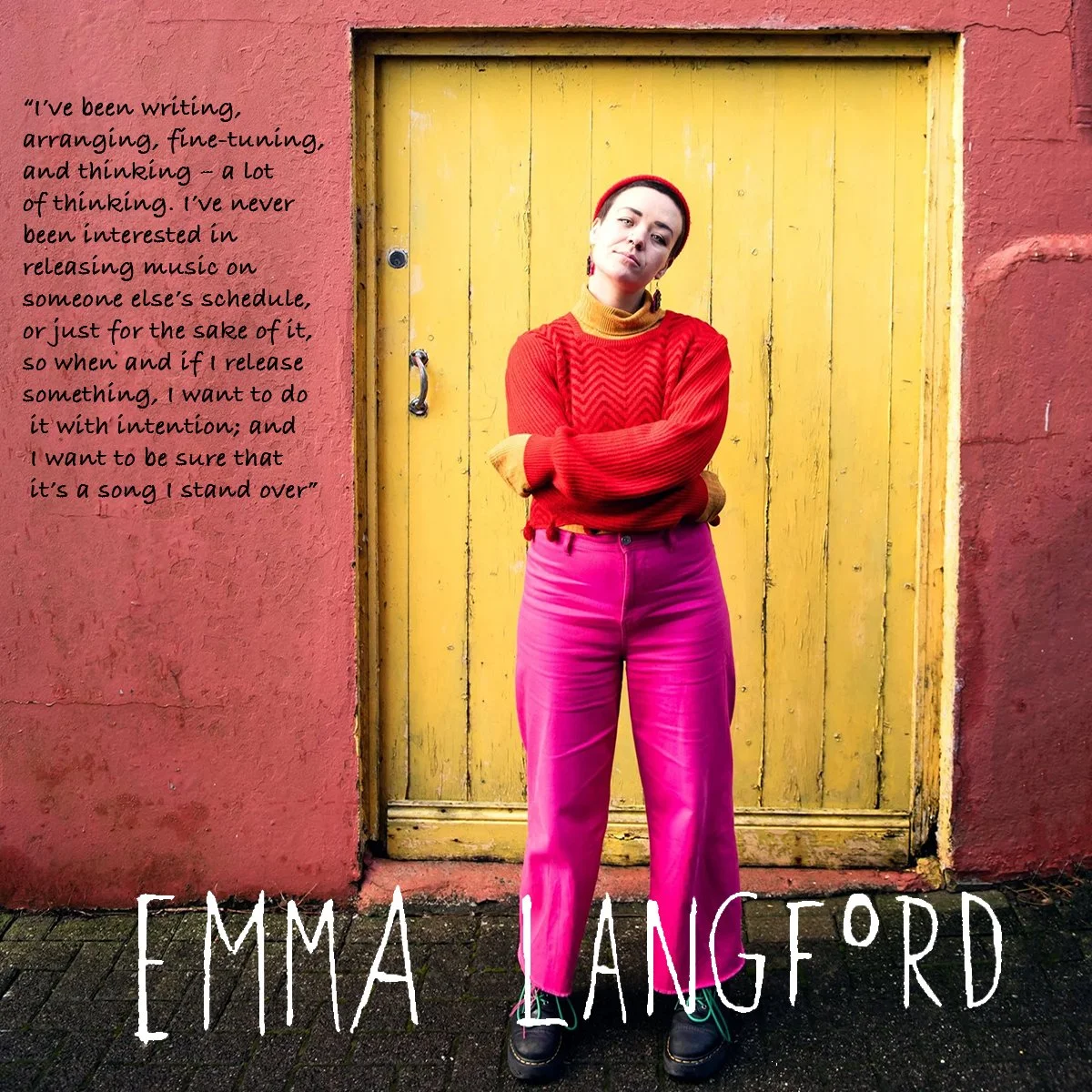
Emma Langford is based in Limerick city, in the mid-west of Ireland. Her creative talents are well known throughout the country and flow into different areas of artistic expression. It has been awhile since Emma picked up her guitar and took to the road on tour, but we are delighted to confirm that she is playing a series of shows over the coming months around Ireland. As she prepares for these upcoming concerts, Emma took some time away from her busy schedule to look back over her career to date and to discuss other issues that will be of interest to our readers and long-time admirers of her singer songwriter gifts.
Where do we find you right now?
You find me right now in my beloved back garden, in the sun, in Limerick City.
We wanted to highlight the upcoming gigs that you are performing. Can you let our readers know where they can catch you?
I’m about to head to Monroes in Galway and Whelan’s in Dublin this weekend, the 14th and 16th of August. Later this month on the 27th I’ll be making my debut at Debarras in Clonakilty, which I’m excited for. The 4th of September I’ll bring the trio to Lillies Live Lounge in Sligo, and then McGrory’s Hotel in Culdaff, County Donegal, right up the tip-top of the country. The 13th of September I play a solo set in Willow & Wild Cafe in Leixlip, and the 25th of September the trio head to Coughlan’s in Cork City – and that’s all before I start my collaborative tour with ornithologist Seán Ronayne and poet Ben MacCaoilte!
It’s been a while since we had new music from you. Your last release was a 2024 co-write titled Hunting The Hare, which was a statement against animal cruelty, if I am correct?
Yes, Hunting The Hare was about animal cruelty, about the damning effects of tradition on our humanity; but also about the spate of femicides our country suffered around the time of writing in 2021; and when I released the song it was partly motivated by the live-streamed attempted genocide of the Palestinian people, and of the Sudanese and Congolese people too.
Can we expect a new album anytime soon?
I’ve been writing, arranging, fine-tuning, and thinking – a lot of thinking. I’ve never been interested in releasing music on someone else’s schedule, or just for the sake of it, so when and if I release something, I want to do it with intention; and I want to be sure that it’s a song I stand over. My plan is to have a single out before the end of the year, come hell or high water, and then an album next year. That’s something I’m really excited to get to work on. It focuses a lot on women’s stories, women in history and in the news, and women in myth and folklore.
Your involvement in other art forms is well known, and you prefer to be seen more as a creative and a storyteller. You took drama and stage school classes as a teenager?
I attended a stage school and speech & drama classes from the age of 5 ‘til about the age of 12; and then I got awkward and self-conscious and a bit more introverted about my creative pursuits – I preferred to write and draw than to sing and dance in a group; so, I spent a lot more time alone as a teenager. I also nearly lost my voice to nodules, so that slowed my roll a lot, and art and writing didn’t require me to use my voice. I did join a number of choirs as a teen though and started vocal coaching and vocal therapy to recover my singing voice and build technique and skill. I mimed a lot in the choir because it hurt to sing aloud, but my one-on-one singing lessons felt a lot like flying sometimes.
You then graduated in 2013 from Limerick University. Was your course based around contemporary dance, voice, and performance skills?
It was, and it wasn’t exactly what I expected going into it – the course name has changed now, and it’s a very different curriculum by all accounts. I learned a lot more than I necessarily wanted to about Gregorian chant and contemporary Mexican song. But I guess learning is learning, and learning is growing, so I’m grateful for what I did get out of it.
How did this shape your initial experiences in playing music at open-mic evenings while finding your creative path?
Open mics were an escape from academia to a large extent. Also seeing as I was on campus, I got a job at the smaller, artsier college bar, the Scholars, pulling pints and cleaning tables, and somewhere along the line I started curating playlists and booking acts to play there – and then I booked a weekly slot in there myself, and sort of cut my teeth a bit that way, playing to a room full of people talking. That teaches you a lot about powering through and doing it for yourself – you’re certainly not getting much external validation in those settings, but you’re learning your stage craft and your musicianship is growing all the while.
In 2017 you released the much-praised album Quiet Giant. How do you look back upon that time now from today’s perspective?
It was a really, really special time in my career but of course I didn’t realise that at the time – if we spent all our time gazing about ourselves and noting the amazing, transient nature of life, we’d get nothing done. I was just looking up at the next rung on the ladder and figuring out how to get there. Looking back now I’m grateful for all the work my younger self put in, the grafting she did while she had the energy – because I certainly don’t have the same kind of fuel in the tank now, 9 years on. The process of recording that album was extremely special, I had toured the songs so much with my musicians, so when the whole band got to the studio in Portlaoise, we just worked out the kinks together with our producers; it all felt organic, it flowed.
You were recognised as Best Emerging Artist at the RTE Folk Awards. Did this lead to a greater demand for you to perform outside of Ireland?
It’s been a really useful little tagline for the last 8 years: “RTÉ Radio 1 Folk Award Winner!” and yeah, I think it’s definitely helped me bag a few opportunities I might not have otherwise gotten – everyone wants to get in at the ground level with someone they’re being told is the next hot thing. I don’t think I really knew how to capitalize on it at the time; I remember Declan O’Rourke won his first ever award that year too, and he cornered me in the bar in Vicar Street afterwards and told me to use that award to knock on every single door. I had absolutely no idea what he meant, I just smiled and nodded and took my shiny award home and put it in my parents’ living room.
Then, in 2019, you became the first ever recipient of the Dolores O’Riordan Bursary. That must have been a proud moment given your shared roots in the Limerick community?
This really meant a lot to me, to be recognised as a sort of… torch bearer for Dolores’ legacy. It was special, I think I really felt my city buoying me up and walking alongside me in that moment.
A second album follows in 2020, and the success of Sowing Acorns. Given that it was released just before the onset of Covid and the shutdown of life as we knew it; how was the impact upon your career momentum?
If I think about this too much, I fall into a rabbit hole of what-ifs, so I try not to dwell on it too much. Everyone was hit by it. Everyone’s lives and careers were put on hold or derailed completely. But in (very) brief: I was set to travel the world with that album, I had tours booked in Germany, Switzerland; I was going to the Caribbean with Blue Rose Code; it really was set to be a huge year for me, and then everything came crashing down. I think I had the moxie (courage) to take myself on a different path, and I really focused on community building in that time, and I like to think that’s stood to me in a sort of unquantifiable way, but I’d love to know what could’ve been if every door in the world hadn’t been closed, locked and bolted.
I know that you have been regularly active with worthy causes, among them Safe Ireland, a charity focused on protecting women and children from domestic violence. Are you still active in addressing social issues?
I am, it’s an important part of having any kind of platform I think, and I’m bewildered by anyone who suggests musicians should just stick to music and leave “politics” out of it. We are all products of the privilege we’ve been handed growing up, and we need to keep our eyes open to that. I’m extremely lucky to have the support I have to be a full-time musician, so I give back where I can, and I raise awareness where I can, using my platform – such as it is.
You also curate the Limerick Lady Festival, which tackles the issue of gender imbalance in the music industry. This also led to the Limerick Lady podcast. Is this still alive and well?
I established The Limerick Lady ten years ago, in June 2016, in response to gender imbalance on stages at home in Limerick as well as on festival lineups, and the dearth of women’s voices on radio either as DJs or as artists; the initial intention was to build on our first event which took place at the Limerick Milk Market, but unfortunately running a festival is a huge undertaking and at the time I was just about to launch my own music career, so I just didn’t have the time, the skillset or the bandwidth – but we did run a number of great standalone events over the years, and yes myself and Ann Blake co-hosted a podcast until July last year when we went on an indefinite hiatus.
AsIAm is another charity that is close to your heart. Can you tell us something about the work that is conducted there?
AsIAm is an autism advocacy and support organisation – I’ve worked closely with them in the past, playing music at events, raising awareness about the work they do. Their website played a big part in learning that I’m autistic, they have a section on how autism presents in women, and how it’s often overlooked because the diagnostic tools are fundamentally sexist and rooted in how autism appears in men. I completed my assessment and received my diagnosis during the pandemic. I feel that their work is more important than ever right now, as schools, families and carers are so brutally under-resourced for looking after autistic people with extremely high dependency. AsIAm go to bat for these groups when it comes to lobbying the government for better and more meaningful support and resourcing,
Your songs have covered the full range of human emotions from love songs such as Sandman and The Unbearable Lightness Of Being, to sharing feelings of self-doubt in others like Closed Book and Tug O’ War. Do you always write from personal experience or are some of the songs observational?
My whole job as a songwriter, to my mind, is to take the human experience – whatever that might entail, in all its vastness – and parse it in any way I can, so that other people can maybe parse those feelings and experience a little more easily upon listening to a song. So that means my songs cover everything, from love to heartbreak, travel, self-belief, doubt. I’ve yet to write my own “Toms Diner” if that’s what you mean by “observational” – an impassive voice, outside of the experience and looking in, but I feel it’s only a matter of time.
Your song The Belle and the Ruin could almost be a musical, such is the visual imagery and depth in the tale. Is this something that you have ever considered?
I was definitely exploring storytelling through song on this one, in a way I hadn’t necessarily explored it before. Most of my previous writing was confessional and introspective, and this was a chance to step outside of myself, outside of time, and just paint a picture, so yes, I can see how you might consider that a bit musical-theatre-y.
Bear This Child is also very striking. Can you let us have some insight into the creation of this song?
I had been reading a book called Inside The Music (Conversations with Contemporary Musicians about Spirituality, Creativity, and Consciousness) when I wrote this – there was a notion within the book called “first thought” that really resonated with me, it’s the idea of running with a thought without letting the critical voice, the inner editor, take over. I decided to explore that idea and just noodle on the guitar and see what it evoked in me lyrically – I wound up with Bear This Child, a gentle reflection on depression and suicidal thoughts, and how they can feel intrusive and parasitic within your body. I had a number of friends at the time who had gone through some extremely dark patches, and I myself had experienced some very low ebbs, so creating and singing the song served as a sort of catharsis in processing all of that.
The Winding Way Down To Kells Bay is perhaps seen as the most ‘Irish’ of all your songs. Imbued with that special magic dust of Irish connection. The Irish concept of “Meitheal” comes to mind, and the lyric “And we’ll stop for the chat / and the auld cupán tae / on the winding way down to Kells Bay.” Does this song rank as your greatest success when you look back at your writing output?
I suppose Kells Bay, followed closely by Birdsong, is my biggest / best known song, if that’s how we’re qualifying “success”? I don’t know that I’d consider it the most Irish of all my songs in the sense that Irishness to me is an extremely complex thing, but it probably sounds the most Irish to a lot of people. I’m extremely proud of both songs for how people have connected with them, and the experience of writing and releasing them both was beautiful – Kells Bay was a eulogy of sorts; a tribute to my late grand-uncle Eamon Langford, a celebration of his community in South Kerry, and an invitation to the listener to come with me to that beautiful safe haven. Birdsong was a moment of finding my feet and my inner strength and quietening the relentless noise of external judgement, and again an invitation to the listener to do the same. I’ve had endless feedback on how both songs have done what they were intended for, so that’s how I’d quantify their success.
Every success with your upcoming concerts, and is there anything else that you would like to leave the readers with on our Lonesome Highway?
I’ve been tired for a while, but I feel like I’m back and I’m ready to connect with people again, I’m excited to meet new communities and play weird little gigs in places I’ve never been before. Releasing two albums and touring incessantly and doing all the management and admin and gig booking, on top of bringing other musicians along with me, and traveling abroad to the States and around Europe – it takes it out of you. But I wouldn’t change a thing about how I’ve approached my creative career in the last ten years, I’ve very much blazed my own trail and the people who get it, get it. And I’m endlessly glad of and grateful to those people.
Interview by Paul McGee