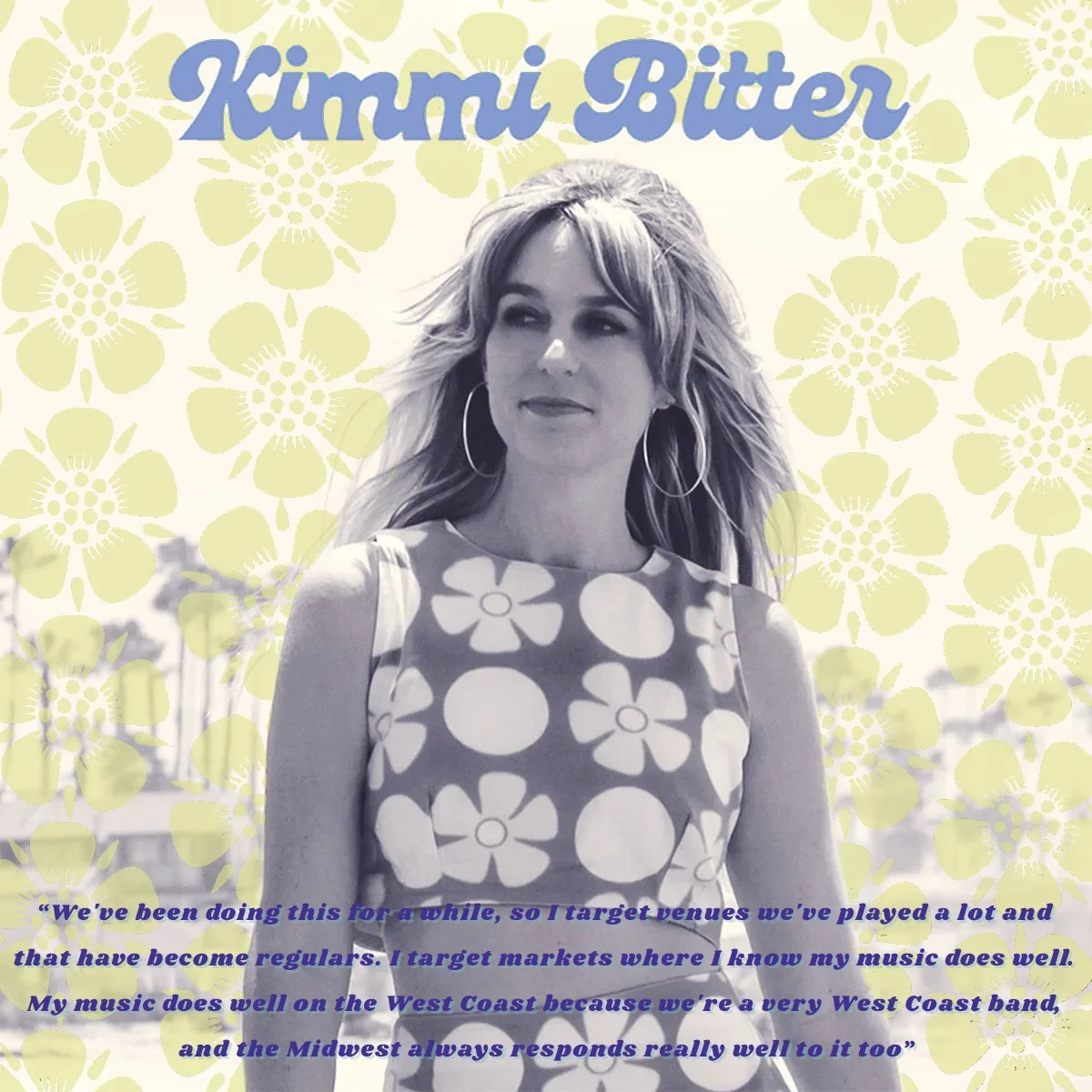
West Coast artist Kimmi Bitter has been channelling her love of retro-country music into her stage act for some time, and in the past few years, into her studio recordings. Her recently released album BITTERSWEET follows in the footsteps of her debut record OLD SCHOOL from 2024. Her latest record is somewhat more experimental, digging even more deeply into classic Countrypolitan with the addition of strings, while also paying homage to the border sound close to her hometown, San Diego, and including two instrumental tracks that recall the surf rock sound that originated in Southern California in the late 1950s and early 1960s. Through extremely hard work, sacrifice and astute self-management, Kimmi and her band The Westside Twang, featuring her longtime bandmates Willis Farnworth on guitars and Ben Neal on bass, have steadily grown their fan base in recent years. We chatted with Kimmi, joined by Willis mid-interview, to get the story behind the new album and an update on their progress since we last spoke two years ago.
How is touring working for you these days? Are you finding that audience numbers are being affected by the rising cost of living?
Kimmi - We're growing with ticket sales, because they were so small initially, but I can only imagine how they'd be if we weren't. Money is tight for everybody; the biggest thing for us is gas and food being expensive. Expenses are making it harder than it used to be, but we travel humbly, spend a lot of time sleeping in the vans, and try to keep our expenses as low as possible. And we travel just as a three-piece, and that's my full band, even though it doesn't have drums. So, I can pay my bandmates, and the merch has been really great right now because I have a fresh new album. So, right now we're okay.
The new album’s title, BITTERSWEET, is clever: it plays on your name and references both the happy and sad sides of the music industry.
Kimmi - I didn't know what I was going to name the album until recently, just before I was about to release it. I was going through all these different titles, and none of them felt right. I just had all these different titles, like "Welcome to Paradise" and "Tweet and Twang, and they just didn't feel right. Then I read something, and it said ‘bittersweet’ in a paragraph I was reading. The album feels kind of cheery and summery, but there are a lot of heartbreak songs, and some minor-key songs that are moody. So, with that and the play on my name, I went for that title.
It is more experimental than your debut record, OLD SCHOOL.
Kimmi - We're all native Californians, and we all just bond over that West Coast kind of music, and we tried to incorporate that a lot more in this one.
Adding strings to Love Me Or Leave Me and Lost Inside Your Blues gives them a classic Countrypolitan vibe.
Kimmi - We always dreamt of having strings, but they're very expensive, so we wrote it off and just tried to make it as Countrypolitan as we could, production-wise. We are a really small team, and I'm self-funding, but our engineer knew someone with a connection to a Budapest Orchestra, and it was pretty affordable to use them; they’re a full-blown 24-piece orchestra. It ended up expensive, but not nearly as expensive as it would be if we did it in the States. I paid for thirty minutes of their time, and it was on Budapest time, so we had to clock in on their daytime, which was like four a.m. for us. We zoomed with them and already had written the music, and they nailed it. I feel really lucky that it was within our means, and we were able to do it. We could only afford two songs, and we knew Love Me or Leave Me would be one. And then Lost Inside Your Blues, which is not country at all. It's just like a moody, cinematic-style song.
Closer to home, My Stolen Heart has a lovely border sound.
Kimmi - We're close to Mexico, being in San Diego, and I love that style of music, and a lot of the people in Countrypolitan did that stuff. You know, Patsy Cline with South of the Border, and then Elvis did some stuff too. My producer, Michael Gurley, pretty much wrote that song. When he showed it to me, it was such a slow ballad. I loved the song, but how many slow ballads can I afford on an album? He then gave it a ‘Spanish’ feel, and now it's one of my favourite songs on the album and one of my favourites to play live. It has danceability, which comes from that kind of mariachi music, and it’s just really fun.
Another departure I wasn't expecting is the harmonica on the song Over You, which works really well.
Kimmi - Yeah, for me the harmonica makes that song. It comes out of left field, as you would expect a pedal steel to be there, or a guitar solo or something like that. Because it's a Countrypolitan-sounding song, I wanted to use a muted trumpet, and we tried that, but the key in the song wasn't very friendly to the muted trumpet style. My producer said that we should do harmonica by Scott Gordon. He recorded it in Virginia, and it's so perfect- left field, but so fitting.
You have also included two instrumentals, Trail Of Dreams and Bigsby Burnout, which complement your retro style perfectly. The latter sounds like it’s from a Quentin Tarantino movie soundtrack.
Kimmi - Totally, I love instrumental music so much. When anyone asks me, "What do you want to play between sets to warm up the crowd?” it’s always Duane Eddy or The Venturers or like Les Paul and Mary Ford. I feel it's really easy on the ears. I love guitar and letting Willis (Farnsworth), who is such a big part of our sound, play his songs. I enjoy taking a break from singing too and just enjoying that kind of song and strumming the rhythm.
Willis - For Bigsby Burnout, I loved Eddie Cochran when I was younger, and there's this really awesome live shot of Led Zeppelin covering an Eddie Cochran song, and I remember watching Jimmy Page do this thing with the whammy bar and wondering, “How is he doing that?” So, I had this whammy riff for a long time, just being able to use the open strings and going up and down. I showed Kimmy, and she liked it, but I didn't know how to finish it. I showed it to Mike (Gurley), and he helped me write the B section.
The instrumentals perfectly complement your retro-sound.
Willis - Those instrumental tracks came together because our sound's been developing for the last like five years, and if I'm going to play country music, I'd rather play like a super twangy desert-style guitar. I found this company called Surfy Bear, and they specialised in this Fender-style tube reverb tank from the 50s and 60s. We bought it, and it changed everything; we could do stuff live that I'd wanted to do for a long time.
Kimmi - Trail Of Dreams originally had lyrics, and they were cute; it was all about travelling from Route 66 to the West Coast, but the song fell apart every time we tried to finish it. What I loved most about this song is Willis's guitar, and we had totally gotten rid of the song for the album. But I loved the song so much that we stripped back all the production. I had this little demo, and it just always sounded best. It sounded better on my little iPhone demo than it did with all the bells and whistles in the studio. So, we went back and, with just guitar, bass, and drums, salvaged the song at the last minute as an instrumental.
You mentioned Michael Gurley, who produced the album and is credited as a co-writer. With your touring schedule, do you set aside time to write with him?
Kimmi - Yeah, we go through seasons. Last year we did not tour heavily, a total of three months through the whole year. I really bunkered down and created with Mike, writing a bunch of songs, which started at the end of 2024. The hardest part is that he's in LA and I'm in San Diego, and like, mile-wise, it's not that far, but traffic-wise, it's like a three-hour drive. So, getting together was always like an event. But he does a lot at his house without me. I do a lot at mine without him, and when we get together, we show more complete ideas, and we've done a lot of work behind the scenes.
Was the recording and production spread over a long period of time?
Kimmi - It was over forty-seven days, spread out over a little over a year because of schedules and touring when we did, and people getting sick and rescheduling. It’s cool to work with someone like Mike who has an extremely extensive knowledge of every genre, pretty much, and for him to be a master virtuoso on guitar. He's mostly known for being in a band called Dada, a '90s alternative band with a cult-like, diehard following.
There is always a huge emphasis on the artwork on your albums and singles. Is that your work, or do you get external help?
Kimmi - That is all my own doing, and I was a little too obsessive-compulsive over this album cover. I probably made twenty before I got to that one; they were all beachy and fun and cool, but that one won. Willis took the photo; he's not a professional photographer, and it was severely underexposed, so it took a lot of editing to brighten it.
Willis - I borrowed this extremely nice camera from Kimmy's brother TJ, and the learning curve was insane because it's so advanced. Everyone thinks it's always a sunny day in California. Being coastal, it's almost always overcast in the morning, but we just lucked out: the sun was in the right place at the right time, and there were no clouds.
Kimmi - And, of course, I just photoshopped all the people out of the background.
Being self-managed, how do you schedule your tours and the venues that you book?
Kimmi - We've been doing this for a while, so I target venues we've played a lot and that have become regulars. I target markets where I know my music does well. My music does well on the West Coast because we're a very West Coast band, and the Midwest always responds really well to it too. So, I target those markets and then get a little expansive. Those are safe, and where the reception is going to be good, and I try to build and increase the fan base that way.
You are performing again next month at the legendary Honky Tonk Tuesday at Eastside Bowl at AmericanaFest in Nashville and the following day at Dee’s Cocktail Lounge.
Kimmi - Yeah, just those two shows for this year. Eastside Bowl with the Honky Tonk Tuesday is my favourite thing in Nashville, and this might be like the fourth year we've done it during the Americana Fest. We're friends with some of the guys with The Cowpokes who host the shows, and they say, “Why don't we just make this kind of like a tradition? If you guys are going to be out here, we'll have you guys play it.”
What would you deem as success for you and the band going forward?
Kimmi - Well, I really don't want to be independent anymore. There's a venue in our town called the Belly Up; if we could sell out venues like that in every major town, medium-sized, 300 to 500 capacity venues, that would be really cool. I know my music isn't tailored for top 40, and I don't foresee myself ever doing that unless the young generation falls in love with this nostalgic retro thing. My big bucket list things would be to play the Grand Ole Opry and to get a song in a Quentin Tarantino film. I feel like I could die after that. If that happened, I’d have done my life's duty.
Interview by Declan Culliton